Most B2B sales reps send 50-100 outreach messages a week and hear back from fewer than 5% of prospects. The problem isn’t effort — it’s that every prospect’s inbox looks the same. According to Salesforce’s State of Sales report, buyers now receive an average of 120+ outreach attempts per week, and only the most relevant, personalized messages break through. Lead engagement — the set of activities you use to make prospects pay attention and respond — is the skill that separates reps who fill their pipeline from those who don’t.
Key Takeaways
- Lead engagement covers every activity used to initiate and maintain two-way contact with a prospect — from first outreach through deal close.
- AI-personalized video increases B2B lead engagement by 2-3x compared to text-only email because it recreates the human connection at scale.
- An effective engagement strategy uses 5+ touchpoints across at least 2-3 channels — no single channel reaches everyone.
- The four core lead engagement metrics to track are reply rate, video view rate, meeting book rate, and time-to-first-response.
- Matching your engagement approach to the buyer’s funnel stage dramatically improves conversion — top-of-funnel needs attention capture, mid-funnel needs trust building.
What Is Lead Engagement — and Why It’s Getting Harder
Lead engagement is every activity used to initiate and maintain two-way interaction with a potential buyer — from the first cold email or LinkedIn message through every follow-up until the prospect either books a meeting, buys, or explicitly opts out. It’s not a single action. It’s the full pattern of outreach, value delivery, and response management that moves a prospect from unaware to actively interested.
The hard part: engagement is getting harder every year. HubSpot’s sales research shows average cold email reply rates have fallen below 8% for generic outreach. Gartner’s B2B buyer research finds that buyers now complete 60-70% of their decision-making process before they talk to a sales rep — meaning they’re getting harder to reach early and they come in with stronger opinions. Meanwhile, AI-generated outreach has flooded inboxes, making any message that feels templated invisible. For more on building your stack, see our guide to lead nurturing software.
What separates high-engagement reps from the rest isn’t volume — it’s relevance. They send fewer messages, but each one is more targeted, more personal, and arrives at the right time in the buyer’s decision process.
The Lead Engagement Gap
The engagement gap is the disconnect between what buyers expect and what most reps deliver. Buyers want outreach that acknowledges their specific situation, their company, their role, and their challenges. Most reps send the same email to 500 people and wonder why no one replies. The gap closes when personalization scales — which is exactly what AI video personalization makes possible.
Key Lead Engagement Metrics
Before diving into strategy, understand the four numbers that tell you whether your engagement is working:
- Reply rate: Percentage of outreach messages that receive a response (target: 15-25% for personalized outreach)
- Open rate: For email — but don’t mistake opens for engagement. A reply is the real signal.
- Meeting book rate: Percentage of engaged leads who schedule a call (target: 20-40% of replies)
- Engagement velocity: How quickly a lead moves from first touch to first response
The B2B Lead Engagement Framework: 5 Stages That Convert
An effective B2B lead engagement framework maps your outreach activities to five clear stages: attention, interest, consideration, decision, and expansion. Each stage requires a different communication goal and channel mix. Reps who use the same message at every stage lose prospects because they’re solving the wrong problem at the wrong time.. Choosing the right lead management software tool is a foundational step before running nurturing or engagement sequences.
Here’s how each stage works in practice:
| Stage | Buyer State | Best Channels | Your Goal | Success Signal |
|---|---|---|---|---|
| 1. Attention | Unaware or passively aware | Cold email, LinkedIn, AI-personalized video | Stop the scroll — earn a 15-second read | Email open + reply, LinkedIn connection accept |
| 2. Interest | Aware, curious but not prioritizing | Video follow-up, value-add email, LinkedIn content | Deliver a specific insight that earns a response | Reply, content click, meeting request |
| 3. Consideration | Actively evaluating options | Demo video, case study, follow-up call | Build trust and address objections before they’re raised | Demo booked, proposal requested |
| 4. Decision | Comparing vendors, seeking approval | Personalized video walkthrough, ROI summary email | De-risk the purchase decision for the buyer | Contract sent, verbal commit |
| 5. Expansion | Customer, potential upsell | Check-in video, QBR, success stories | Deepen the relationship and surface expansion opportunities | Renewal, referral, upsell |
Most reps only focus on stages 1-2 and treat all leads the same way regardless of where they are in their journey. The framework matters because it tells you what to say — not just how often to say it.
Pro tip
Use your CRM’s lead score or engagement history to determine which stage a lead is in before you reach out. A lead who watched your demo video last week needs a different message than one who’s never heard of you.
Lead Engagement Strategies That Drive Real Responses
The highest-performing B2B lead engagement strategies share one trait: they make the prospect feel like the outreach was made specifically for them. Generic outreach fails not because the copy is bad, but because it reads like it could have been sent to anyone. These five strategies close that gap.
1. AI-Personalized Video Outreach
Personalized video is the single highest-converting lead engagement channel in B2B sales today. According to McKinsey’s B2B Digital Sales research, buyers increasingly prefer digital self-service and visual content over traditional rep-led calls — but they still respond to genuine human connection. Video delivers both.
The challenge used to be scale. Recording a unique video for every prospect takes hours. That’s where AI video personalization changes the equation. With Sendspark, you record a single video once, and AI voice cloning generates thousands of individually personalized versions — each one using the prospect’s name, showing their company website as the background, and speaking in your actual voice. Video prospecting with this approach delivers 2-3x more replies compared to text-only email.
The key to making video work: keep it under 90 seconds, mention something specific about the prospect in the first 10 seconds, and end with a clear, single call to action.
2. Multi-Channel Sequencing
No single channel reaches everyone. Some buyers live in their LinkedIn DMs. Others only respond to phone calls. Many don’t check email on Fridays. A multi-channel outreach strategy doesn’t mean spamming every platform — it means building a deliberate sequence that uses 3-4 channels over 10-14 days.
A high-converting sequence might look like: Day 1 (personalized video email) → Day 3 (LinkedIn connection request with note) → Day 5 (value-add email with a relevant case study) → Day 7 (phone call) → Day 10 (LinkedIn message) → Day 14 (break-up email). Each touch adds context rather than repeating the same ask.
3. Value-First Cold Email
The fastest way to kill lead engagement is to lead with your product. Buyers don’t care about your features — they care about their problems. Value-first cold email flips the structure: open with an insight specific to the prospect’s industry, role, or company, and only introduce your solution in the context of how it solves the exact problem you just named.
Use a pattern interrupt in your subject line — something that doesn’t look like a sales email. Then build your email around a specific observation: “I noticed [Company] recently launched [Product] — which means [specific challenge] is probably on your radar.” Then connect that challenge to how you solve it. For templates that work, see these 15 sales email templates.
4. LinkedIn Engagement Before Outreach
Cold outreach always converts better when it’s not truly “cold.” Spend 3-5 minutes engaging with a prospect’s LinkedIn content — a genuine comment on a post, a reaction to a company update — before sending a connection request or message. This creates a digital footprint. When your outreach arrives, they’ve already seen your name, and you’re no longer a stranger.
Record One Video. AI Personalizes Thousands.
Sendspark is the AI video personalization platform for B2B sales. Record once, and AI voice cloning generates thousands of individually personalized videos with dynamic backgrounds and personalized thumbnails — each prospect hears their name, sees their website, in your voice. Sales teams see 2-3x more replies.
Get Started NowHow to Measure Lead Engagement
Measure lead engagement with four core metrics: email reply rate (benchmark: 15-25% for personalized outreach), video view-through rate (benchmark: 60%+ for prospects who start watching), meeting book rate (target: 20-40% of positive replies convert to meetings), and lead response time — how quickly your team follows up when a prospect engages. These four numbers tell the full engagement story.
Most teams only track open rates. Open rates are a vanity metric — they measure attention, not engagement. A lead who opens your email and immediately archives it has not engaged with you. A reply — even a negative one — is engagement. Focus on replies and meetings booked as your primary indicators of engagement health.
| Metric | What It Measures | B2B Benchmark | How to Improve It |
|---|---|---|---|
| Email Reply Rate | Percentage of outreach that gets a response | 8% generic / 15-25% personalized | Add personalized video, sharpen the subject line, lead with value |
| Video View-Through Rate | How much of your video prospects watch | 60%+ for engaged prospects | Keep videos under 90 seconds, front-load the personalization hook |
| Meeting Book Rate | Percentage of positive replies that become meetings | 20-40% of positive replies | Use a single clear CTA, send Calendly link, follow up within 4 hours |
| Lead Response Time | Speed of your follow-up to inbound lead signals | Under 5 minutes for inbound | Automate lead routing, use video as a fast personalized follow-up |
| Engagement Velocity | Days from first touch to first meaningful response | 8-14 days for outbound | Add more touchpoints in days 3-7, vary the channel mix |
Lead Engagement Scoring
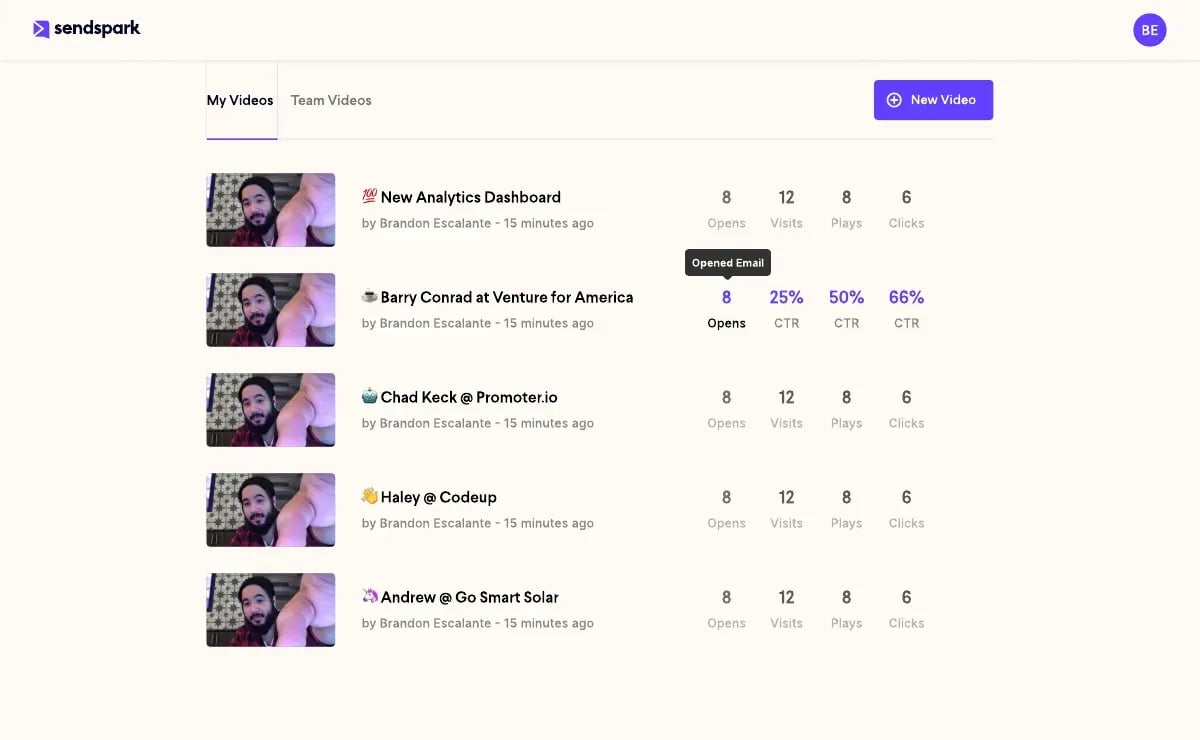
A lead engagement score assigns a numeric value to every interaction a lead has with your outreach. Email opens = 1 point. Reply = 10 points. Video watch = 5 points. Meeting booked = 25 points. This scoring feeds into your CRM and surfaces the hottest prospects automatically. Your HubSpot integration can capture video engagement data — watch time, replay events, CTA clicks — and feed it directly into your lead scoring model.
Common mistake
Treating email opens as engagement is one of the most common measurement errors in B2B sales. Apple’s Mail Privacy Protection made open tracking unreliable in 2021 — many “opens” are bot reads, not human opens. Use replies and clicks as your real engagement signals.
Lead Engagement Tools: Building Your Tech Stack
The most effective B2B lead engagement tech stack combines four tool categories: an AI video personalization platform for high-converting outreach, a CRM for tracking all engagement data, an email sequencer for automating multi-touch cadences, and a LinkedIn tool for social engagement. Each handles a different channel, and together they create a unified view of every lead interaction.
Here’s how a modern lead engagement stack fits together:
| Tool Category | What It Does | Why It Matters for Engagement | Examples |
|---|---|---|---|
| AI Video Personalization | Generates personalized video messages at scale using AI voice cloning and dynamic backgrounds | Drives 2-3x higher reply rates than text email; recreates human connection at scale | Sendspark |
| CRM | Tracks every lead interaction and feeds engagement data into pipeline management | Single source of truth for engagement history; triggers automated follow-ups | HubSpot, Salesforce |
| Email Sequencer | Automates multi-touch email and phone cadences with branching logic | Ensures no lead falls through the cracks; tracks open/reply data | Outreach, Apollo, SalesLoft |
| LinkedIn Automation | Automates connection requests and initial LinkedIn messages at scale | Adds social channel to multi-touch sequence; warms leads before email | LinkedIn Sales Navigator, Expandi |
| Intent Data | Signals which leads are actively researching your category right now | Prioritizes outreach to leads with buying intent — highest engagement rates | ZoomInfo, Clay, Bombora |
How Sendspark Fits Into Your Engagement Stack
Sendspark connects to your existing stack via HubSpot, Outreach, Apollo, and 50+ other platforms. When a lead opens your AI-personalized video, that event fires back into your CRM as an activity. You can build workflows that automatically move leads to the next stage, alert the rep when a prospect rewatches a video, or trigger a follow-up sequence after a CTA click. Video engagement data becomes pipeline data — not a separate silo.
For outbound prospecting specifically, the workflow looks like this: use outbound prospecting tools to build your target list, enrich with intent data from Clay or ZoomInfo, upload the list to Sendspark, record one master video, and let AI generate individually personalized versions for every prospect. Then trigger the send via your email sequencer. The whole setup takes under an hour for a 500-person campaign that feels 1:1.
For a deeper dive into the video side of engagement, see our complete guide to video prospecting.
Lead Engagement Summary: Choosing the Right Strategy by Stage
| Funnel Stage | Best Engagement Strategy | Primary Tool | Expected Engagement Rate |
|---|---|---|---|
| Cold / Top of Funnel | AI-personalized video + value-first email | Sendspark + Email sequencer | 15-25% reply rate |
| Warm / Mid-Funnel | Demo video + case study + follow-up call | Sendspark + CRM workflows | 30-50% reply rate |
| Intent Signal / Active Buyer | Immediate personalized video + phone | Sendspark + intent data alert | 50%+ response rate |
| Stalled Deal / Re-engagement | Break-up email + personalized video recap | Sendspark + email sequencer | 10-20% reactivation rate |
Frequently Asked Questions
What is lead engagement in B2B sales?
Lead engagement is the set of activities used to initiate, maintain, and deepen two-way interaction with potential buyers. It includes every touchpoint from cold outreach through deal close — emails, calls, video messages, LinkedIn interactions, and follow-ups. High lead engagement means prospects are responding, opening content, and moving forward in the sales process.
What is a good lead engagement rate?
A good email reply rate for personalized B2B outreach is 15-25%. Generic mass outreach typically falls below 8%. For video outreach specifically, engaged prospects who start watching typically complete 60%+ of the video. Meeting book rates of 20-40% from positive replies are considered healthy for most B2B teams.
How do you improve B2B lead engagement?
The most effective ways to improve lead engagement are: personalize every outreach to the specific prospect’s situation, use AI-personalized video to stand out in crowded inboxes, build multi-channel sequences rather than relying on a single email, and follow up within hours — not days — when a prospect shows interest signals.
How many touchpoints does it take to engage a B2B lead?
Most B2B leads require 8-12 touchpoints before responding to a cold outreach sequence. Research from RAIN Group shows that 80% of sales require at least 5 follow-up attempts after the first contact, yet most reps stop after 2. A 10-14 day sequence with 6-8 touches across multiple channels dramatically improves engagement rates.
What is AI video personalization and how does it improve lead engagement?
AI video personalization is the process of recording one video and using AI voice cloning and dynamic backgrounds to generate thousands of unique versions — each addressing a specific prospect by name, showing their company’s website, in the rep’s actual voice. Sendspark’s AI video personalization platform increases reply rates by 2-3x compared to text email by recreating genuine human connection at scale.
What’s the difference between lead engagement and lead generation?
Lead generation is the process of finding and capturing potential buyers — building your prospect list. Lead engagement is what you do after that — every action you take to get those leads to actually respond and move toward a purchase. You need both: generation fills the funnel, engagement moves leads through it.
How do you track lead engagement metrics in your CRM?
Track lead engagement in your CRM by logging every touchpoint as an activity, using email integration to capture open and reply data automatically, and connecting your video platform to record view events. Tools like Sendspark integrate directly with HubSpot and Salesforce to feed video engagement data — watch time, CTA clicks, replays — into your lead records and trigger automated workflows based on engagement signals.
Sources & References
- Salesforce State of Sales — “Buyers now receive 120+ outreach attempts per week; rep productivity under sustained pressure” (2024)
- HubSpot Sales Statistics — “Average cold email reply rates have fallen below 8% for generic outreach” (2024)
- Gartner B2B Buyer Journey Research — “Buyers complete 60-70% of their decision-making process before engaging a sales rep” (2024)
- McKinsey B2B Digital Sales Report — “B2B buyers increasingly prefer digital self-service and visual content over traditional rep-led engagement” (2023)
Record One Video. AI Personalizes Thousands.
Sendspark is the AI video personalization platform for B2B sales. Record once, and AI voice cloning generates thousands of individually personalized videos with dynamic backgrounds and personalized thumbnails — each prospect hears their name, sees their website, in your voice. Sales teams see 2-3x more replies.
Get Started Now