AI SDR agents now send millions of cold emails per day — and the result is predictable: average cold email reply rates dropped below 3% in early 2026, according to Cognism’s 2026 cold email benchmark data. If you’re an SDR relying on text-only outreach, you’re competing against autonomous agents flooding the same inboxes you’re targeting. The good news: human reps who pair smart sequencing with AI-personalized video are seeing reply rates of 8% to 12% — well above the new baseline. This guide breaks down exactly how to get there. For templates that get opens, see our guide to proven follow-up email subject lines.
Key Takeaways
- AI SDR agents have lowered the average cold email reply rate to under 3% in 2026 — text-only outreach no longer stands out on its own.
- AI-personalized video in cold email consistently lifts reply rates 2-3x by adding a human signal that autonomous agents cannot replicate.
- An 8-12 touchpoint multichannel cadence (email + LinkedIn + video + call) is now the standard for booking meetings with modern B2B buyers.
- The best SDR teams use AI for data enrichment, copy drafts, and follow-up sequences, while humans own discovery, objection handling, and relationship-building.
- Reply rate — not open rate — is the only metric that predicts pipeline. Track it weekly and coach against it.
What Is SDR Email Outreach (And Why It Still Wins in 2026)?
SDR email outreach is the practice of sending targeted, personalized cold emails to prospective buyers to generate awareness, start conversations, and book discovery meetings. It sits at the top of the revenue funnel and is the primary channel most sales development teams use to fill pipeline. Despite years of predictions about its decline, email remains the highest-ROI channel for first-touch B2B prospecting.
According to HubSpot’s State of Sales report, email still outperforms LinkedIn messages and cold calls as an initial outreach channel when measured by meeting-booked rate. Buyers check email with intent — they’re there to read and act. That’s a different mindset than scrolling a social feed.
What changed in 2026 is the baseline. AI SDR agents like those from 11x.ai, Artisan, and Regie.ai now draft and send personalized cold email sequences autonomously — at a scale no human team can match. That volume has trained buyers to be more skeptical and faster to delete. Inboxes are flooded with “personalized” text that all sounds the same because it came from the same underlying models.
That’s exactly why SDRs who add a genuinely human signal — like an AI-personalized video where the prospect hears their name in your voice and sees their own website in the background — hold a real advantage. You’re still the human building the relationship. AI just helps you do it at scale.
9 Practical Tips to Improve SDR Email Outreach
The gap between a 2% reply rate and a 10% reply rate usually comes down to a handful of execution habits. These nine tips cover the fundamentals that actually move the needle — from how you structure a single email to how you coach your team every week.
Tip 1: Define One Buyer Outcome Per Email
Every email you write should answer one question from the reader’s perspective: “What’s in this for me?” Pick a single outcome your prospect cares about — reducing churn, cutting onboarding time, closing more deals in Q3 — and build the entire email around it. One outcome, one call to action, one ask. The moment you try to say two things, you say nothing.
Tip 2: Write Subject Lines That Earn the Open
The best cold email subject lines are 4-7 words and make no grand promises. Curiosity and specificity outperform hype every time. “Quick question about [Company]’s onboarding” will outperform “Increase your revenue by 40% today.” Keep the promise low; keep the relevance high. See subject lines that open for tested examples your team can use right now.
Tip 3: Open With a Signal-Based First Line
Skip the “I hope this email finds you well.” Open with a real signal: a hiring post, a funding announcement, a recent product launch, a LinkedIn comment your prospect made. This first line proves you actually looked at them. It’s the fastest way to separate your message from everything an AI SDR agent generates at scale, because signal-based prospecting requires fresh, real-time context that most autonomous tools still lag on.
Tip 4: Pair Text With an AI-Personalized Video
Adding a personalized video thumbnail to your cold email consistently lifts reply rates. Sendspark’s AI-personalized video intros for outbound let you record once and generate thousands of videos where each prospect hears their own name in your voice, sees their company’s website as the background, and gets a personalized thumbnail. That’s a human signal at machine scale. Sales teams using this approach report 2-3x more replies compared to text-only sequences.
Pro tip
Drop your personalized video on Touch 1 and again on Touch 5 of your cadence. Touch 1 creates the first impression; Touch 5 re-engages prospects who opened but didn’t reply. Video at both moments dramatically outperforms text-only follow-ups at the same touchpoints.
Tip 5: Run 8-12 Touchpoints Across Multiple Channels
One email is not a cadence. Salesforce’s State of Sales research consistently shows it takes 8 or more meaningful touches before a buyer engages. Mix email, LinkedIn connection requests, LinkedIn voice notes, personalized video, and calls. Each channel reinforces the others. See our 4-step prospecting cadence framework for a practical sequencing model.
Tip 6: Protect Your Deliverability
None of the above matters if your email lands in spam. Set up SPF, DKIM, and DMARC on every sending domain. Use separate domains for outbound campaigns to protect your primary domain reputation. Warm up new domains gradually over 4-6 weeks. Keep spam complaint rates below 0.1% — Gmail’s threshold tightened again in 2026. Our guide to keeping video emails out of spam covers the technical setup in detail.
Tip 7: A/B Test One Variable Per Send
Test subject lines against each other. Test a video thumbnail against no video. Test a two-sentence email against a five-sentence one. The rule is simple: change one thing at a time. If you change three things and your reply rate goes up, you have no idea which variable drove the lift. Discipline in testing compounds into meaningful insight over a quarter.
Tip 8: Use Reply Rate as Your North-Star Metric
Open rate tells you about your subject line and deliverability. Reply rate tells you whether your message resonated enough to earn a response. That’s the metric that predicts meetings booked and pipeline generated. Track reply rate at the sequence level and at the individual rep level. Coach to it weekly. For the full picture of what to track, see our guide to personalizing outbound at scale.
Tip 9: Coach With Weekly Email and Call Reviews
The fastest way to improve an SDR team is to review real outreach together. Pick two or three emails per week and read them aloud as a team. Does the opening line reference a real signal? Is the ask clear? Would you reply? This kind of peer review surfaces weak patterns faster than any tool. Pair it with recorded call reviews and you have a flywheel for continuous improvement.
Record One Video. AI Personalizes Thousands.
Sendspark is the AI video personalization platform for B2B sales. Record once, and AI voice cloning generates thousands of individually personalized videos with dynamic backgrounds and personalized thumbnails — each prospect hears their name, sees their website, in your voice. Sales teams see 2-3x more replies.
Get Started NowThe AI SDR Stack: Augmenting Human Reps in 2026
An AI SDR agent is software that autonomously monitors intent signals, drafts personalized outreach copy, sends sequences, and triggers follow-ups without a human clicking send. Tools like 11x.ai, Artisan, AISDR, and Regie.ai have matured rapidly. By mid-2026, most sales-forward companies have at least evaluated one. Understanding what these agents actually do — and where they fall short — is essential for any human SDR who wants to stay indispensable.
In the agentic workflow, AI handles the high-volume, repeatable tasks well. It runs account-based AI sequences by pulling enrichment data from tools like Clay and Cognism, cross-referencing technographic and firmographic signals, segmenting lists automatically, and generating first drafts of emails tailored to each segment. When integrated with Apollo, it can identify net-new contacts who match your ICP the moment they show relevant intent signals — job changes, technology installs, content downloads. Paired with Outreach or a similar sequencing platform, the agent can run full email sequences inside Outreach without manual enrollment. That stack — Clay for enrichment, Apollo for prospecting signals, Outreach for sequencing — is becoming the standard foundation for outbound SDR teams in 2026.
But AI SDR agents have a genuine weakness: they produce text, and right now, every inbox is full of AI-generated text. Reply-rate decay from pure-text AI outreach is measurable. Buyers have developed pattern recognition for AI persona research outputs — the emails that open with “I noticed your company recently expanded into [X]” feel templated because they often are. The signal-to-noise ratio in pure AI outreach is collapsing. This is where the human-in-the-loop SDR creates asymmetric advantage. When you combine AI-generated copy drafts with a genuinely human element — your real voice, your face, a video that shows the prospect’s actual website — the message breaks through the noise in a way no autonomous agent can replicate today.
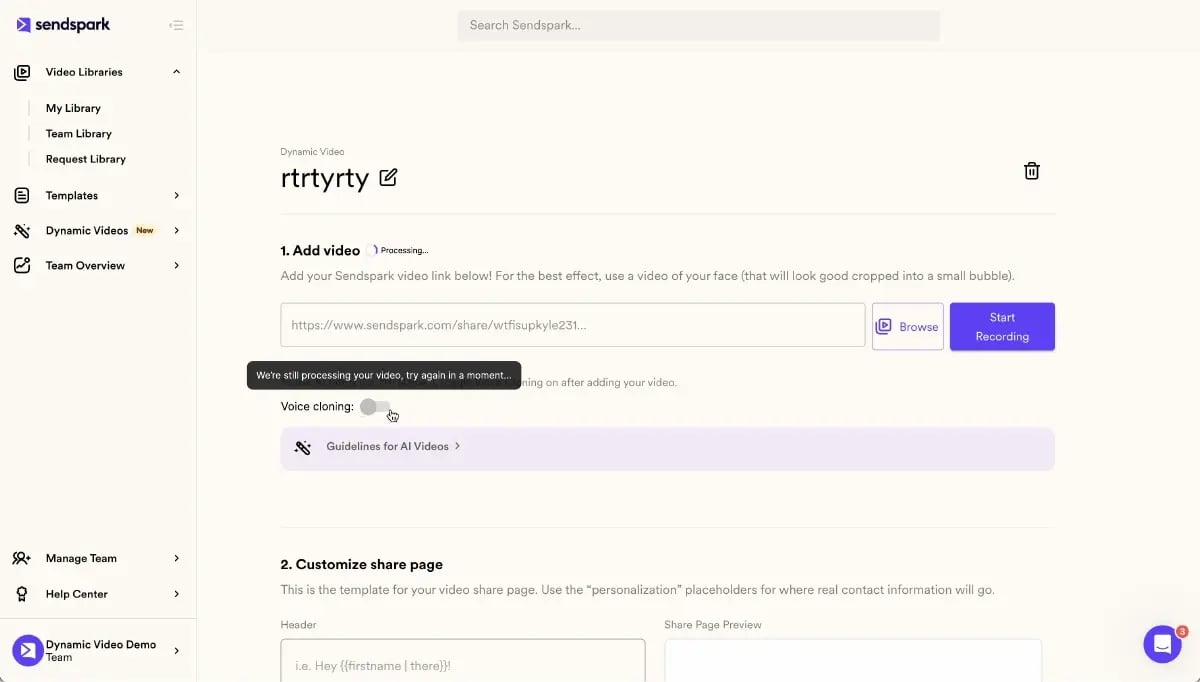
That’s the case for AI voice cloning and dynamic backgrounds at the video layer. Sendspark’s AI voice cloning and dynamic backgrounds platform lets one SDR record a single base video, then generates hundreds of individualized versions — each with the prospect’s name spoken in the rep’s cloned voice, their company website visible in the background, and a personalized thumbnail showing their name or logo. To an AI fatigue-saturated inbox, this feels unmistakably human. That perception drives replies. You can explore how this connects to your broader outbound motion in our pillar guide to AI video personalization for outbound sales.
Common mistake
Treating AI as autopilot rather than augmentation is the fastest way to tank deliverability and erode reply rates. Mass-personalized sends from an autonomous agent that hasn’t been properly warmed up, segmented, or reviewed by a human will trigger spam filters and train buyers to ignore your domain — often permanently. AI handles the draft; you own the judgment.
The right division of labor looks like this: AI handles intent monitoring, list building, copy drafts, and follow-up scheduling. Humans handle the discovery call, objection handling, deal psychology, and the creative judgment calls — like deciding which signal to lead with, when to break sequence with a direct call, and when a prospect has gone cold versus when they need one more genuinely personal touch. The SDRs who thrive in 2026 are not the ones who resist AI tools. They’re the ones who use AI to clear the repetitive work and spend their human hours on the tasks AI still can’t do well.
Multichannel Cadences: Pairing Email with Video, LinkedIn, and Calls
Modern B2B buyers rarely respond to a single cold email. According to Salesforce’s State of Sales, buyers now interact across an average of 10 channels before making a purchase decision. That means a single-channel outreach strategy leaves most of your pipeline on the table. A structured 8-12 touchpoint cadence that mixes email, video, LinkedIn, and calls is now the standard — not a nice-to-have.
Below is a 14-day sample cadence that combines all four channels. Drop the personalized video on Day 1 (first impression) and Day 7 (re-engagement). Use LinkedIn as social proof between email touches. Use a call only after you’ve established some presence — cold calling a prospect who has never heard of you is harder than calling someone who has already seen your video.
| Day | Channel | Action | Personalization Layer |
|---|---|---|---|
| Day 1 | Email + Video | Send cold email with AI-personalized Sendspark video thumbnail embedded | Prospect’s name in AI voice, company website as dynamic background |
| Day 2 | View prospect’s profile (creates a soft awareness ping) | No message — passive signal only | |
| Day 3 | Send connection request with a short, non-pitchy note | Reference a recent post or shared professional interest | |
| Day 5 | Short follow-up email — one new insight or stat relevant to their role | Tie to a signal (hiring data, news mention, or recent content they shared) | |
| Day 7 | Email + Video | Re-engagement email with a second AI-personalized video | Different video angle — show a specific use case relevant to their industry |
| Day 8 | Send a LinkedIn voice note if connected (30-45 seconds max) | Reference the email video — “I sent you a quick video on Monday, wanted to follow up here” | |
| Day 10 | Call | Cold call — prospect has now seen your name 3-4 times | Open with a reference to the video or the insight from Day 5 email |
| Day 12 | Value-add email — share a relevant case study, stat, or short resource | Tie to their specific business context (company size, role, vertical) | |
| Day 14 | Break-up email — low-pressure, keeps the door open | “No worries if the timing’s off — happy to reconnect when [relevant trigger] comes up.” |
The LinkedIn voice note on Day 8 is often the highest-converting touch in the sequence. It’s rare enough to stand out, personal enough to feel genuine, and short enough not to waste anyone’s time. After a prospect has already seen your video email, a voice note from the same person feels like a natural continuation — not a cold interruption. For more on structuring this kind of sequence, see our complete cold email system for SDRs and AEs and our guide to personalizing outbound at scale.
Common SDR Email Mistakes That Tank Reply Rates
Most SDR outreach underperforms not because the rep lacks skill, but because a handful of repeatable mistakes compound across every send. Recognizing these patterns is the fastest way to improve. Here are the six mistakes that most reliably kill reply rates. For SDRs looking to scale their outreach, AI video follow-up sequences are a proven next step.
Sending One Giant Blast to a Generic ICP
Blasting 500 contacts who all match “VP of Sales at a SaaS company” is not targeting — it’s spray and pray. The more narrowly you define the segment (industry + company stage + a shared challenge), the more relevant your opening line can be, and the higher your reply rate will climb. Tight segments beat large lists every time.
Burying the Ask in Paragraph Three
Cold email readers decide in about three seconds whether to keep reading. If your call to action is hiding at the bottom of a four-paragraph email, most people will never see it. Put the ask early, make it frictionless (a yes/no question or a specific time slot), and keep the whole email under 120 words when possible.
Leading With “I” Instead of the Prospect’s Outcome
Emails that open with “I’m reaching out because we help companies like yours…” are about you. The prospect doesn’t care about you yet. Open with something about them — a signal, a challenge their role faces, or a result a peer in their position achieved. Make the first sentence prove you understand their world.
Following Up Too Aggressively or Not at All
Two days between every touch is too aggressive and will get you flagged as spam. One email and no follow-up leaves 80% of your pipeline on the table. The cadence above — spread over 14 days, across multiple channels — is designed to stay persistent without being obnoxious. Space matters as much as frequency.
Ignoring Deliverability Fundamentals
Technical deliverability issues are invisible until your reply rates collapse. By then, your domain may already be on a blocklist. Check your SPF, DKIM, and DMARC records monthly. Monitor complaint rates after every send. Use a tool like Google Postmaster or MXToolbox to watch domain health. One deliverability problem can undo months of good outreach.
Treating AI as Autopilot Rather Than Augmentation
This is the dominant failure mode of 2026. SDRs who hand their entire outreach to an AI SDR agent and stop reviewing what goes out lose control of their brand, their deliverability, and their relationships. AI drafts, you approve. AI sends at scale, you review the signals. The human-in-the-loop SDR is not optional — it’s the differentiator. For more on building AI tools into your workflow effectively, see our roundup of the best AI sales tools for SDR teams.
SDR Outreach Quick Reference
| Stage | Goal | Recommended Channel | Sendspark Asset |
|---|---|---|---|
| First Touch | Create awareness, earn a reply | Cold email + personalized video | AI-personalized video intro with dynamic background |
| Social Proof Layer | Build familiarity before follow-up | LinkedIn profile view + connection request | N/A — human touch only |
| Mid-Sequence Re-Engagement | Re-activate prospects who opened but didn’t reply | Email + video + LinkedIn voice note | AI voice clone + dynamic background video, new angle |
| Call Touch | Book the meeting with a warm prospect | Outbound cold call | Reference the video by name to establish recognition |
| Break-Up / Nurture Exit | Keep the door open without burning the contact | Final email | Optional: short text-only Sendspark video for final personal touch |
Frequently Asked Questions
What is SDR outreach?
SDR outreach is the set of prospecting activities a sales development representative uses to contact potential buyers and generate qualified pipeline. It includes cold email, cold calling, LinkedIn messaging, and video outreach — usually run as a structured multichannel sequence. The SDR’s job is to start conversations and book discovery meetings, which they then hand off to account executives to close.
What’s the best email outreach cadence for SDRs in 2026?
The most effective cadences in 2026 run 8-12 touchpoints over 14-21 days across email, LinkedIn, video, and calls. Starting with a personalized video on Day 1, following up with LinkedIn presence on Days 2-3, and mixing email and call touches through Day 14 consistently outperforms email-only approaches. Spacing touches 2-3 days apart avoids the spam threshold while staying present in the buyer’s awareness.
How are AI SDR agents changing email outreach?
AI SDR agents like those from 11x.ai, Artisan, Regie.ai, and AISDR now autonomously draft, send, and follow up on cold email sequences using intent signals and enrichment data. They’ve raised the volume baseline dramatically — which means buyers are more skeptical of text-only personalization. The human advantage in 2026 is adding a genuinely personal layer (like AI-personalized video) that autonomous agents can’t yet replicate convincingly at scale.
What’s a good cold email reply rate for SDRs?
According to Cognism’s 2026 cold email benchmarks, the average cold email reply rate sits below 3% for text-only outreach. SDRs using signal-based personalization with AI-personalized video regularly see 7-12% reply rates. Anything above 5% puts you in the top quartile of outbound performers. Track positive reply rate separately from total reply rate — “not interested” replies inflate the number without moving pipeline. For a proven template for each scenario, see how to respond to a not interested email.
Should SDRs use video in cold email?
Yes — and the data is consistent on this. Personalized video thumbnails in cold emails increase click-through rates significantly compared to text-only messages. The key is genuine personalization. A generic recorded video adds little. A video where the prospect hears their name in your voice, sees their company’s website, and gets a personalized thumbnail performs measurably better. Sendspark’s sales prospecting solution is designed specifically for this workflow.
How do you write a cold email subject line that gets opened?
The best cold email subject lines are 4-7 words, specific to the recipient, and carry low or no explicit promise. Questions (“Quick question about [Company]?”), references to shared context (“Your team’s expansion into EMEA”), and pattern-interrupt openers (“Not another SaaS pitch”) all outperform hype-driven subject lines. According to HubSpot’s State of Sales report, personalized subject lines generate 26% higher open rates than generic alternatives. See our list of subject lines tested for video email open rates for proven examples.
What’s the right multichannel mix for modern SDR outreach?
For most B2B SDR teams in 2026, the right mix is email as the primary channel, LinkedIn as the social proof and connection layer, personalized video for first touch and mid-sequence re-engagement, and calls after a prospect has seen your name at least twice. The exact ratio depends on your ICP — enterprise buyers often respond better to LinkedIn and video; SMB buyers are more likely to reply directly to a well-crafted cold email. Test your mix quarterly and follow the data. Our Apollo integration makes it straightforward to tie intent-signal data directly into your multichannel sequences.
Sources & References
- HubSpot State of Sales 2026 — Reply rate benchmarks and channel preference data for B2B buyers.
- Salesforce State of Sales 2026 — SDR productivity statistics, AI adoption rates, and multichannel buyer journey research.
- Gartner B2B Buying Journey Research — Modern B2B buyer behavior and intent signal analysis.
- Cognism Cold Email Statistics 2026 — Subject line performance, open rate, and reply rate benchmarks for outbound SDR teams.
- Harvard Business Review — How Frequent Emails from Sales Reps Affect Customer Trust — Research on cadence frequency and its effect on buyer trust and engagement.
Record One Video. AI Personalizes Thousands.
Sendspark is the AI video personalization platform for B2B sales. Record once, and AI voice cloning generates thousands of individually personalized videos with dynamic backgrounds and personalized thumbnails — each prospect hears their name, sees their website, in your voice. Sales teams see 2-3x more replies.
Get Started NowTopics: blog