Most B2B sales reps send cold emails into the void. They get a 1-3% reply rate and call it a day. Social media prospecting changes the math entirely — because you can warm up a prospect before you ever send a message, turning a cold outreach into a warm one.
This guide covers everything you need to build a repeatable social media prospecting system: which platforms to use, how to structure your daily routine, and how to use AI-personalized video to stand out when you finally do reach out.
Key Takeaways
- Social media prospecting uses LinkedIn, Twitter/X, and other platforms to identify, research, and warm up B2B prospects before direct outreach.
- LinkedIn is the highest-ROI platform for B2B — sales reps with a Social Selling Index above 70 are 51% more likely to reach quota, per LinkedIn research.
- An effective routine covers four phases: research, engage (comment/react), connect (personalized request), and convert (DM or video message).
- AI-personalized video messages on LinkedIn get 2-3x more replies than plain-text InMail — record one video and let AI clone your voice to personalize it for each prospect.
- Social media prospecting works best when integrated with your CRM: log every interaction, track engagement signals, and trigger video outreach from your sales sequence.
What Is Social Media Prospecting?
Social media prospecting is the practice of using social platforms — primarily LinkedIn, but also Twitter/X and others — to identify, research, and engage potential B2B buyers before initiating a formal sales conversation. Unlike cold email, social media prospecting lets you warm up prospects over days or weeks by engaging with their content, understanding their priorities, and building name recognition before you ever send a direct message.
The goal is simple: when your connection request or DM arrives, the prospect already recognizes your name. That familiarity dramatically increases open and reply rates. According to LinkedIn’s Social Selling Index research, social sellers generate 45% more opportunities than peers who don’t use social selling, and they’re 51% more likely to reach quota.
Social media prospecting is not the same as social media marketing. Marketing broadcasts to an audience. Prospecting is targeted, one-to-one engagement with specific individuals who match your ideal customer profile (ICP). Every action — a comment on a post, a reaction, a personalized connection request — is deliberate and directed at a named prospect in your pipeline.
How Social Media Prospecting Differs from Cold Email
Cold email starts with zero relationship. You’re interrupting someone’s inbox with a pitch they didn’t ask for. Social media prospecting builds a micro-relationship first. You’ve commented on their content twice, reacted to their promotion announcement, and sent a connection request that references something specific they posted. By the time you send a message, it’s not cold — it’s warm.
The two approaches complement each other. Most high-performing SDRs use social to warm up prospects, then trigger email or phone outreach once a connection is made. The combination typically outperforms either channel alone. You can explore the full outbound prospecting playbook for a multi-channel breakdown.
Who Should Use Social Media Prospecting?
Social media prospecting works best for B2B SaaS, professional services, and consulting — any business where the buyer is an individual decision-maker (VP, Director, or C-suite) who is professionally active on LinkedIn. If your ICP is a warehouse manager who isn’t on social, cold calling and email may be more effective. For anyone selling into tech, finance, HR, or marketing — social media prospecting should be a core part of your outreach.
Best Platforms for B2B Social Media Prospecting
LinkedIn is the clear #1 platform for B2B social media prospecting, and it’s not particularly close. It’s where business decision-makers are professionally active, it has native sales tools like Sales Navigator, and it’s the only major platform where a cold connection request from a sales rep is socially acceptable. For most B2B teams, LinkedIn will generate 80-90% of their social media prospecting pipeline.
LinkedIn is the foundation of any B2B social media prospecting program. With 1 billion members and advanced search filters, you can find virtually any decision-maker by title, company size, industry, geography, and seniority. Sales Navigator adds even more precision: save lead lists, get alerts when prospects change jobs or post content, and identify warm intro paths through your network.
Key LinkedIn features for prospectors:
- Advanced Search — Filter by job title, company headcount, geography, and seniority
- Sales Navigator — Save lead lists, get job-change alerts, see who’s viewed your profile
- Content engagement — Comment on prospects’ posts to build familiarity before connecting
- InMail — Message people you’re not connected to (limited monthly credits)
- Voice and video messages — Send direct video messages to connections for higher engagement
- LinkedIn integrations — Connect directly to Sendspark’s LinkedIn integration to send AI-personalized video in DMs
Twitter/X
Twitter/X is a secondary channel for social media prospecting, but a useful one for specific use cases. If your prospects are vocal on Twitter — posting about industry trends, sharing opinions, engaging in conversations — it gives you natural engagement opportunities. The key signal: when someone tweets a business problem your product solves, you have a perfect, contextual moment to reach out.
Twitter prospecting works best for marketing, media, and tech buyers who are publicly active on the platform. It’s less effective for traditional industries or enterprise buyers who rarely tweet.
Instagram and TikTok
Instagram and TikTok are almost never primary B2B prospecting channels. There are niche exceptions — creative agencies, influencer marketing platforms, or consumer brands — but for the majority of B2B sales teams, these platforms offer minimal ROI. Stick to LinkedIn and Twitter/X unless your research shows your ICP is unusually active elsewhere.
Pro tip
Before investing time in any platform, search for 10 of your best customers and see where they’re most active. That platform is where your next best-fit prospects are too. For B2B SaaS, it’s almost always LinkedIn.
How to Build a Social Media Prospecting Strategy
A social media prospecting strategy has four phases: Research, Engage, Connect, and Convert. Each phase has a specific goal and set of actions. Most reps fail at social prospecting because they skip straight to Connect — sending connection requests to cold strangers with no prior engagement. Working through all four phases systematically is what makes social prospecting work.
Phase 1: Research — Build Your Target List
Start with your ICP. Define who you’re targeting by job title, company size, industry, and relevant signals (recent funding, hiring for sales roles, using a specific tech stack). In LinkedIn Sales Navigator, save these as saved searches that auto-populate with new matches each week.
For each target account, identify 2-3 contacts to engage — ideally the economic buyer plus an influencer (like a sales manager who’ll champion your tool to the VP). Add them to a tracking spreadsheet or your CRM and use the B2B prospecting tools that fit your workflow.
Phase 2: Engage — Build Familiarity Before Connecting
Spend 1-2 weeks engaging with each prospect’s content before connecting. Leave thoughtful comments (not “Great post!”), react to their updates, share their articles with your network. The goal is to appear in their notifications 2-3 times so your name is familiar when your connection request arrives.
Quality matters more than quantity here. One genuinely insightful comment adds more value than ten generic reactions. Read their posts carefully and respond to the actual substance.
Phase 3: Connect — Send a Personalized Request
When you send a connection request, always include a personalized note — never use LinkedIn’s default message. Reference something specific: a post they wrote, a topic they discussed, or a mutual connection. Keep it under 300 characters. Don’t pitch in the connection request; the goal is just to get accepted.
Connection acceptance rates for personalized requests are typically 35-50% vs. 15-20% for default requests. The extra 10 seconds of personalization pays for itself immediately.
Phase 4: Convert — Reach Out with Value
Once connected, wait 1-3 days before sending a message. In your first message, lead with value — not your pitch. Reference their recent content, share a relevant resource, or ask a question about a challenge they’ve posted about. Only introduce your offering after you’ve established the conversation.
This is where AI-personalized video messages make the biggest impact. Instead of another text DM, you send a 30-60 second video that opens with their name and company. Conversion rates on video messages are consistently 2-3x higher than text on LinkedIn.
Record One Video. AI Personalizes Thousands.
Sendspark is the AI video personalization platform for B2B sales. Record once, and AI voice cloning generates thousands of individually personalized videos with dynamic backgrounds and personalized thumbnails — each prospect hears their name, sees their website, in your voice. Sales teams see 2-3x more replies.
Get Started NowSocial Media Prospecting Tactics That Get Replies
The most effective social media prospecting tactics exploit timing and context. Generic connection requests and copy-paste InMails get ignored. But a message that arrives immediately after a relevant trigger event — a job change, a funding announcement, a pain-point post — gets opened because it’s clearly not a blast. Here are the highest-ROI tactics for each phase of the prospecting process.
Trigger Event Prospecting
Trigger events are the most powerful signal in social media prospecting. When a prospect posts about a specific problem, announces a promotion, or shares a company milestone, you have a natural, contextual reason to reach out. Common triggers to watch for:
- Job change — New leaders often evaluate and replace incumbent vendors in their first 90 days
- Fundraising announcement — Companies that just raised are typically hiring and spending
- Pain-point posts — When a prospect complains about a problem your product solves, reach out immediately
- Hiring for relevant roles — If they’re hiring SDRs, they’re scaling outbound and need sales tools
- Content engagement — When they comment on a topic in your space, it signals interest and gives you a connection point
LinkedIn Sales Navigator’s alert system makes trigger event tracking automatic. Set alerts for your saved leads and accounts, and you’ll get a daily digest of relevant events to act on.
The Comment-First Approach
Before sending any direct message, comment on 2-3 of a prospect’s posts. This gets your name in front of them organically and makes the subsequent connection request feel earned rather than random. The comment needs to be substantive — add a data point, share a counterexample, or ask a follow-up question that shows you read the post carefully.
According to Salesforce’s State of Sales research, reps who engage with prospects on social media before cold outreach see significantly higher response rates than those who go straight to direct messaging. The warm-up matters.
InMail vs. Connection Request + DM
InMail (LinkedIn’s paid direct message to non-connections) has a reputation for low response rates because most InMails are generic pitches. Connection request + DM consistently outperforms InMail when you’ve done the engagement groundwork first. The sequence: engage with content → personalized connection request → value-first DM once connected.
Save your InMail credits for high-priority prospects you can’t reach otherwise, and make those InMails extremely personalized and specific to the prospect’s situation.
Multi-Touch Social Sequences
Social media prospecting is not a one-touch activity. A realistic sequence for a high-value prospect might look like:
- Week 1 — Comment on 2 posts, follow/connect on Twitter if active
- Week 2 — Send personalized LinkedIn connection request
- Day after acceptance — First DM with a value-first opener (resource, question, insight)
- 3 days later — Follow-up DM with a personalized AI video message
- Week 3 — Email outreach that references the LinkedIn connection
This kind of coordinated, multi-touch approach across channels is what AI for sales prospecting enables at scale — without requiring a rep to manually track every touchpoint for hundreds of prospects.
Common mistake
Don’t send a pitch in your first message after connecting. Prospects who’ve just accepted your connection request haven’t signaled buying intent — they’ve only signaled curiosity. Lead with value, not your product.
How to Use AI Video in Social Media Prospecting
AI-personalized video is the single highest-impact tactic in social media prospecting today. A 30-60 second personalized video in a LinkedIn DM converts 2-3x better than text because it’s genuinely unusual — most prospects receive hundreds of text messages but very few personal videos. When that video opens with their name, references their company, and shows their website in the background, it immediately signals that this isn’t a blast — and prospects respond.
Why Video Outperforms Text on LinkedIn
Text DMs on LinkedIn are easy to ignore. Video DMs are harder to dismiss — they create a sense of social obligation to watch, especially when they open with the prospect’s first name. HubSpot’s marketing research consistently shows that video generates significantly higher engagement rates than text across channels, and LinkedIn DMs are no exception. Sendspark customers using AI video outreach on LinkedIn report a 2:1 meeting-to-reply ratio versus plain text outreach.
The Challenge: Personalized Video at Scale
The problem with video prospecting is obvious: if you’re targeting 200 prospects a week, you can’t record 200 individual videos. Recording a custom video for each prospect takes 3-5 minutes each — that’s 10-16 hours per week, before you’ve done any other prospecting activity.
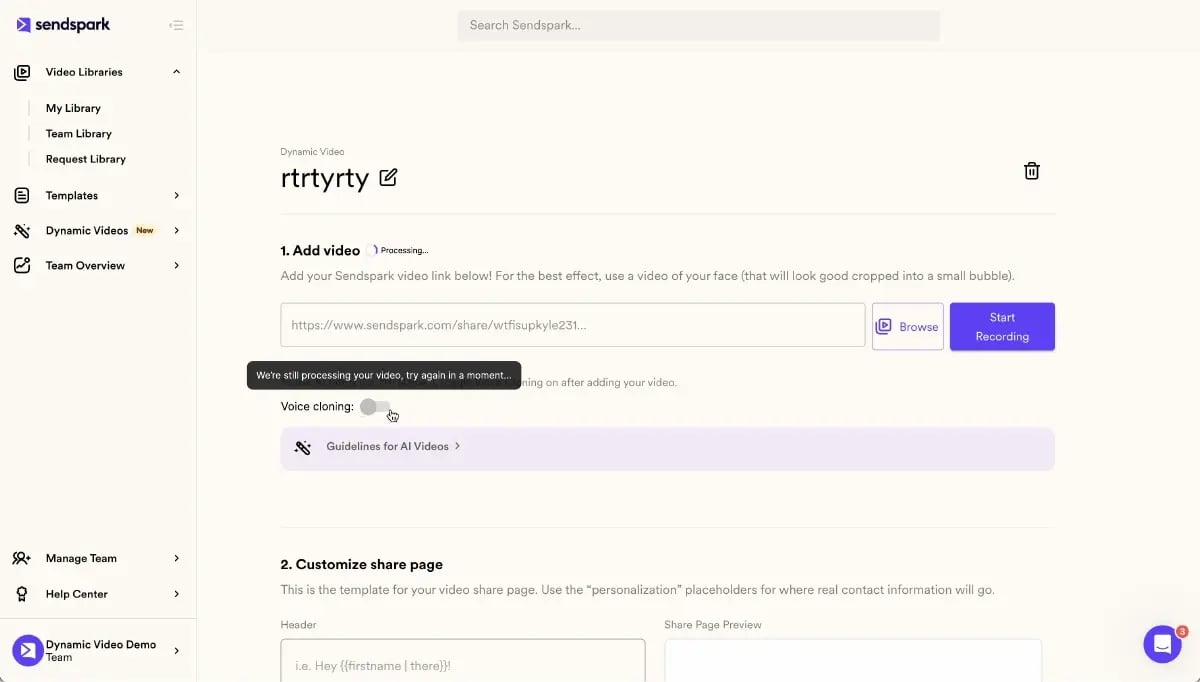
That’s exactly the problem that Sendspark’s AI video personalization solves. You record one video — a single, polished 30-60 second pitch. Sendspark’s AI voice cloning then generates a unique version for each prospect on your list, with their name, company, and relevant details spoken in your own voice. Each prospect receives what feels like a fully personal video, but you recorded it once.
The Sendspark Workflow for LinkedIn Prospecting
- Record your base video — One high-quality 30-60 second video covering your key message
- Import your prospect list — Upload a CSV with names, companies, and any personalization fields
- AI personalizes at scale — Sendspark’s AI generates individual videos with each prospect’s name spoken in your cloned voice, their company website in the dynamic background, and personalized thumbnails showing their name
- Send via LinkedIn — Use Sendspark’s LinkedIn integration to send personalized video messages directly in LinkedIn DMs or share as video posts
- Track engagement — See exactly who watched, for how long, and who clicked the CTA — then follow up with the hottest prospects first
This workflow is what turns social media prospecting from a 1:1 activity into a scalable system. You can run the same AI-personalized video across 500 LinkedIn prospects in the time it used to take to record 10 individual videos.
Setting Up AI Video for LinkedIn DMs
The setup takes about 15 minutes. Clone your voice using Sendspark’s voice training tool (read a short script, and the AI clones your vocal pattern), create your base video, and define the personalization fields. From there, you can generate batches of personalized videos in minutes.
For social media prospecting specifically, the most effective personalization fields are: first name (spoken at the opening), company name (shown as the dynamic background), and a trigger event reference (mentioned in the video script as a variable, like “I saw [Company] just raised a Series B…”).
The results speak clearly: teams using AI video personalization in LinkedIn outreach consistently report 2-3x higher reply rates compared to text-only sequences. That’s the difference between 3% and 6-9% reply rates on LinkedIn — a channel where 3% is already above average.
Platform Comparison: Which Social Network Wins for B2B?
Here’s a side-by-side breakdown of the major platforms to help you prioritize where to focus your social media prospecting time:
| Platform | Best For | Decision-Maker Density | Outreach Method | Avg. Reply Rate | B2B ROI |
|---|---|---|---|---|---|
| All B2B sectors | Very High | Connection request + DM, InMail, video message | 5-15% (personalized) | ★★★★★ | |
| Twitter/X | Tech, media, marketing | Medium | Comment, quote tweet, DM | 2-8% | ★★★☆☆ |
| Creative, consumer, agency | Low | Comment, DM | 1-4% | ★★☆☆☆ | |
| TikTok | Very niche B2B | Very Low | Comment, DM | <2% | ★☆☆☆☆ |
| Facebook Groups | SMB, local business | Low-Medium | Group engagement, DM | 3-8% | ★★☆☆☆ |
For most B2B SaaS and professional services teams, LinkedIn should absorb 80%+ of your social prospecting time. Twitter/X is worth 15-20% if your ICP is active there. Everything else is secondary unless you have specific evidence your buyers use those platforms professionally.
The best social media prospecting results come from combining LinkedIn outreach with LinkedIn video prospecting and integrating those touchpoints into your broader sales cadence. See the full breakdown of outbound prospecting strategies for how social fits into a multi-channel sequence.
Frequently Asked Questions
What is social media prospecting?
Social media prospecting is the process of using platforms like LinkedIn and Twitter/X to find, research, and warm up potential B2B buyers before initiating a formal sales conversation. Unlike cold email, it builds familiarity through content engagement and personalized connection requests before any direct outreach.
Which social media platform is best for B2B prospecting?
LinkedIn is the best platform for B2B social media prospecting by a wide margin. It has the highest concentration of business decision-makers, native sales tools like Sales Navigator, and a professional culture where sales outreach is accepted. For most B2B teams, LinkedIn generates 80-90% of social prospecting pipeline.
How long does social media prospecting take per day?
An effective social media prospecting routine takes 30-60 minutes per day. Split it roughly as: 15-20 minutes engaging with prospect content (comments, reactions), 10-15 minutes sending connection requests and follow-ups, and 10-15 minutes reviewing alerts and updating your CRM with new touchpoints.
How do I use video for social media prospecting on LinkedIn?
Send personalized video messages via LinkedIn DMs after connecting with a prospect. Record a 30-60 second video and use an AI video personalization platform like Sendspark to generate individual versions with each prospect’s name, company, and dynamic background — so every prospect receives what feels like a personal video without you recording hundreds individually.
What is a good social media prospecting reply rate?
A personalized LinkedIn DM sequence typically achieves 5-15% reply rates, compared to 1-3% for generic InMail blasts. Teams using AI-personalized video in LinkedIn outreach report 2-3x higher reply rates than text-only approaches, putting effective video prospecting reply rates in the 10-20% range for warm prospects.
How do I scale social media prospecting without losing personalization?
Use AI video personalization tools like Sendspark to record one video and generate hundreds of personalized versions — each with the prospect’s name spoken in your AI-cloned voice and their company website shown as the dynamic background. This approach lets you run personalized video outreach at scale without recording individual videos for each prospect.
How does social media prospecting integrate with my CRM?
Log every social touchpoint (comment, connection, DM) in your CRM as an activity. Use LinkedIn’s native HubSpot or Salesforce integrations, or connect through tools like Sendspark’s HubSpot integration to automatically sync video engagement data — who watched, for how long, and who clicked your CTA — back into your deal records.
Sources & References
- LinkedIn Sales Solutions — Social Selling Index — “Sales reps with an SSI above 70 are 51% more likely to reach quota; social sellers generate 45% more opportunities than peers who don’t use social media.” (2024)
- Salesforce State of Sales Report — “Reps who engage with prospects on social media before cold outreach see significantly higher response rates than those who go straight to direct messaging.” (2024)
- HubSpot State of Marketing Report — “Video generates higher engagement rates than text across channels; LinkedIn DMs with video see substantially higher open and reply rates than text equivalents.” (2024)
- Forrester Research — Social Selling Analysis — “Social selling works best as part of a multi-touch outbound strategy, not as a standalone channel.” (2023)
Record One Video. AI Personalizes Thousands.
Sendspark is the AI video personalization platform for B2B sales. Record once, and AI voice cloning generates thousands of individually personalized videos with dynamic backgrounds and personalized thumbnails — each prospect hears their name, sees their website, in your voice. Sales teams see 2-3x more replies.
Get Started Now