Your cold email pitch is the 2-3 sentences that determine whether a prospect keeps reading or hits delete. It is not the subject line. It is not the CTA. It is the core value proposition — the moment where you explain why you reached out, why it matters to them, and why they should care. Get it right and reply rates climb. Get it wrong and every other part of your email is irrelevant.
This guide breaks down exactly what makes a cold email pitch work: the anatomy, seven scenario-specific examples, and why AI-personalized video pitches are rapidly outperforming text in B2B outreach.
Key Takeaways
- A cold email pitch is the 2-3 sentence value proposition at the heart of your outreach — distinct from the full template, the script, and the icebreaker.
- Every high-converting pitch has four components: a relevance hook, a pain-point statement, a value claim, and a low-friction micro-CTA.
- Personalized pitches get 2-3x more replies than generic ones — but personalization at scale requires AI, not more time recording individual videos.
- AI-personalized video pitches outperform text by showing each prospect their own name, company, and website — Sendspark’s AI voice cloning makes this scalable.
- The single most common pitch mistake: leading with “I” — it signals generic outreach before the prospect reads a single word of your value claim.
What Is a Cold Email Pitch?
A cold email pitch is the 2-3 sentence value proposition at the core of a cold outreach email — the section that explains who you are, what problem you solve, and why the prospect should care. It sits between your opening line and your call to action, and it is the single element that determines whether your email earns a reply or gets deleted. Think of it as the hook inside the hook: while your subject line gets the open, the pitch gets the response.
Many sales reps conflate the pitch with other elements of a cold email. They are distinct:
- Cold email template — the full email structure, from subject line to sign-off, with placeholders for personalization. Templates are containers; the pitch is the core of what goes inside.
- Cold email script — a word-for-word guide for phone or email sequences, designed to ensure consistent messaging across a team. A cold email script is more prescriptive than a pitch framework.
- Cold email icebreaker — the opening line designed to grab attention, typically a specific observation about the prospect. The icebreaker opens the door; the pitch walks through it.
The pitch is the core message: a concise articulation of your value, written for this prospect’s specific situation. According to RAIN Group’s research on B2B sales prospecting, 71% of buyers are willing to meet with a salesperson who reaches out at the start of their buying journey — but only if the outreach demonstrates clear understanding of their business. That’s what a strong pitch achieves.
Every effective cold email pitch has three jobs:
- Grab attention — not through flashy language, but through immediate relevance that makes the prospect feel seen.
- Establish relevance — answer “why me, why now” before the prospect asks it. Connect your offering to their specific context.
- Create curiosity — the goal isn’t to sell in the pitch; it’s to earn the next interaction. Leave them wanting to understand more.
The Anatomy of a High-Converting Cold Email Pitch
Every high-converting pitch has four components: a relevance hook, a pain-point statement, a value claim, and a low-friction micro-CTA. Missing any one of these weakens the entire email — prospects feel the gap even if they can’t name it.
Component 1: The Relevance Hook (1 sentence)
The hook is why you’re reaching out to this specific person at this specific moment. It must be something you observed about them — a job change, a company announcement, a LinkedIn post, a funding round — not a generic opener. The hook sets the entire tone: if it feels researched, the rest of the email gets read. If it feels mass-market, nothing else matters.
- Weak: “Hope you’re having a great week.” (Generic, irrelevant)
- Strong: “Saw you just promoted two SDRs to AE — congrats, and that usually means the top-of-funnel pressure just got more intense.”
Component 2: The Pain Point (1-2 sentences)
Name a specific frustration your prospect almost certainly faces — not a vague industry challenge, but a concrete friction point. The best pain points are things your prospect already knows they experience but hasn’t found a clean solution for. According to HubSpot’s research on sales email effectiveness, emails that name a specific pain point generate significantly higher reply rates than those focused on product features.
Component 3: The Value Claim (1 sentence)
State what you do and — critically — the quantified outcome it produces. Outcomes, not features. Prospects don’t buy platforms; they buy results. “We help SDR teams at Series B SaaS companies increase reply rates by 2-3x using AI-personalized video outreach” is a value claim. “We have an innovative video platform” is a feature dump.
Component 4: The Micro-CTA (1 sentence)
End with a low-friction ask — not a 45-minute discovery call, not a “let’s connect”. A “yes or no” question, or an offer to share a relevant case study. The micro-CTA should be so easy to say yes to that replying feels like less effort than ignoring it.
Here’s how weak pitches compare to strong ones across all four components:
| Component | Weak Pitch | Strong Pitch |
|---|---|---|
| Relevance Hook | “Hope you’re doing well.” | “Saw you’re scaling your SDR team from 5 to 12 reps this quarter.” |
| Pain Point | “Many companies face challenges.” | “At that scale, message consistency usually breaks down and reply rates drop 30-40%.” |
| Value Claim | “We have a great platform.” | “We help B2B SaaS sales teams deliver AI-personalized video pitches at scale — 2-3x more replies without adding headcount.” |
| Micro-CTA | “Can we schedule a call?” | “Worth seeing how similar-sized teams are doing this?” |
Pro tip
Read your pitch out loud. If it sounds like it could have been sent to 10,000 other people without changing a word, it will convert like it was. Every sentence should make the prospect think “how did they know that about us?”
7 Cold Email Pitch Examples That Actually Work
These seven pitch types cover the main B2B outreach scenarios. Each one leads with relevance, names a pain, and ends with a soft next step. Use the framework — not the words — and adapt every example to your product, your ICP, and your prospect’s specific context.
1. The Problem-Led Pitch (PAS Framework)
PAS (Problem-Agitate-Solve) works when you know your target audience faces a well-defined problem. State it, amplify its cost, then offer the solution.
“Saw you’re scaling your SDR team at [Company]. Most teams at your growth stage hit the same wall: reply rates drop as volume goes up, because reps start sending the same email to everyone. We help B2B sales teams break that pattern — our AI video personalization platform lets reps record one pitch and automatically generate individually personalized versions for every prospect, boosting reply rates by 2-3x. Worth 5 minutes to see how?”
2. The Trigger Event Pitch
Company news — funding, new hires, product launches, expansions — signals growth and opens a window for relevant outreach. Timing is the whole game here.
“Congrats on [Company]’s Series B — growth at that pace usually means the sales motion needs to work harder, not just bigger. We specialize in helping Series B SaaS companies build scalable personalized outreach workflows that maintain quality as headcount grows. Other portfolio companies in your investor’s network have cut cost-per-meeting by 30% using our approach. Open to a quick overview?”
3. The Social Proof Pitch
Lead with a customer outcome from someone just like your prospect. The brain applies social proof to its own situation automatically — hearing “someone like you achieved X” makes X feel achievable.
“I work with other VPs of Sales at fintech companies — most recently [Similar Company], where we helped their outbound team go from a 3% reply rate to 9% in one quarter. The lever was switching from generic email sequences to AI-personalized video pitches that addressed each prospect by name with their company site in the background. Is improving your outbound reply rate a priority this half?”
4. The Insight-Led Pitch
Share a counterintuitive finding about their industry. This works because it positions you as a peer, not a vendor — you’re sharing intelligence, not asking for time.
“Most enterprise AEs think longer emails convert better because they explain more. Gong Labs data shows the opposite — the highest-converting cold emails are under 200 words. We help sales teams run shorter, hyper-personalized outreach sequences that outperform their longer cadences. Would it be worth seeing the playbook?”
Record One Video. AI Personalizes Thousands.
Sendspark is the AI video personalization platform for B2B sales. Record once, and AI voice cloning generates thousands of individually personalized videos with dynamic backgrounds and personalized thumbnails — each prospect hears their name, sees their website, in your voice. Sales teams see 2-3x more replies.
Get Started Now5. The Short & Blunt Pitch
For saturated inboxes, sometimes three sentences beats three paragraphs. Senior buyers in particular respect brevity — it signals you understand their time constraints and can get to the point.
“Scaling your outbound team and seeing reply rates fall? That’s the pattern we fix. We help B2B SaaS sales teams get 2-3x more replies from cold outreach using AI-personalized video — same effort, dramatically better results. Worth 5 minutes?”
6. The Shared Connection Pitch
A mutual connection transforms a cold email into a warm one. Always get permission from the connection first. Even a casual mention — “we were on a panel together last month” — dramatically increases response rates compared to pure cold outreach.
“[Mutual Name] suggested I reach out — they mentioned you’re building out your outbound motion. We’ve helped several companies in [Mutual Name]’s network move from 2-3% cold email reply rates to 8-10% by adding AI-personalized video pitches to their sequences. Happy to share a quick example if useful.”
7. The AI-Personalized Video Pitch
This is the pitch that consistently outperforms text across B2B sales verticals. Instead of a text email, you send a 60-90 second video where the prospect sees their name, their company, and their own website as the background — all automatically generated by AI, not recorded individually.
The written pitch for this format is what you send in the email body around the video thumbnail:
“[FirstName] — recorded a quick 60-second video specifically for [Company]. I noticed you’re expanding your outbound motion and wanted to show you exactly how other [Industry] sales teams are getting 2-3x more replies from cold outreach right now. No deck, no fluff — just one tactic that’s working. Video above.”
The video itself shows the prospect’s name, their company’s website as the dynamic background, and speaks in your cloned voice. It takes 30 minutes to set up and then runs automatically for every prospect in your list. This is what Sendspark’s AI intro feature enables — record one video, personalize at scale with AI voice cloning. For the spoken version of this same structure — the one you would use on a call, not just in an email — see our B2B sales elevator pitch examples.
Why AI-Personalized Video Pitches Outperform Text
AI-personalized video pitches get 2-3x higher reply rates than text cold emails because they combine two things text cannot: visual proof-of-effort and genuine personalization signals. When a prospect clicks play and immediately hears their name and sees their company’s website in the background, the message is unmistakable — this wasn’t a blast, this was made for them.
The core problem with text pitches at scale is the personalization-quality trade-off. You can write highly personalized pitches for 10 prospects per day, or you can send 200 generic ones. Both options have serious limits. Salesforce’s State of Sales research consistently shows that buyers expect relevant, personalized outreach — and immediately recognize generic sequences. Most text pitches, even well-crafted ones, feel mass-market because they are.
“Buyers are sophisticated enough to recognize when they’re receiving the same email as everyone else, even when their name is in the subject line. What stops the scroll is when outreach demonstrates that a real human looked at their specific situation — that’s the bar we now have to clear.”
— RAIN Group, Top Performance in Sales Prospecting study
AI-personalized video solves the scale problem entirely. With Sendspark’s AI video personalization platform, a sales rep records one pitch video. Sendspark’s AI voice cloning then generates a unique version for every prospect — each one says their name, includes a personalized greeting, and displays their company website as the dynamic background. The rep’s voice, face, and message are consistent. The personalization is 1:1 for every recipient.
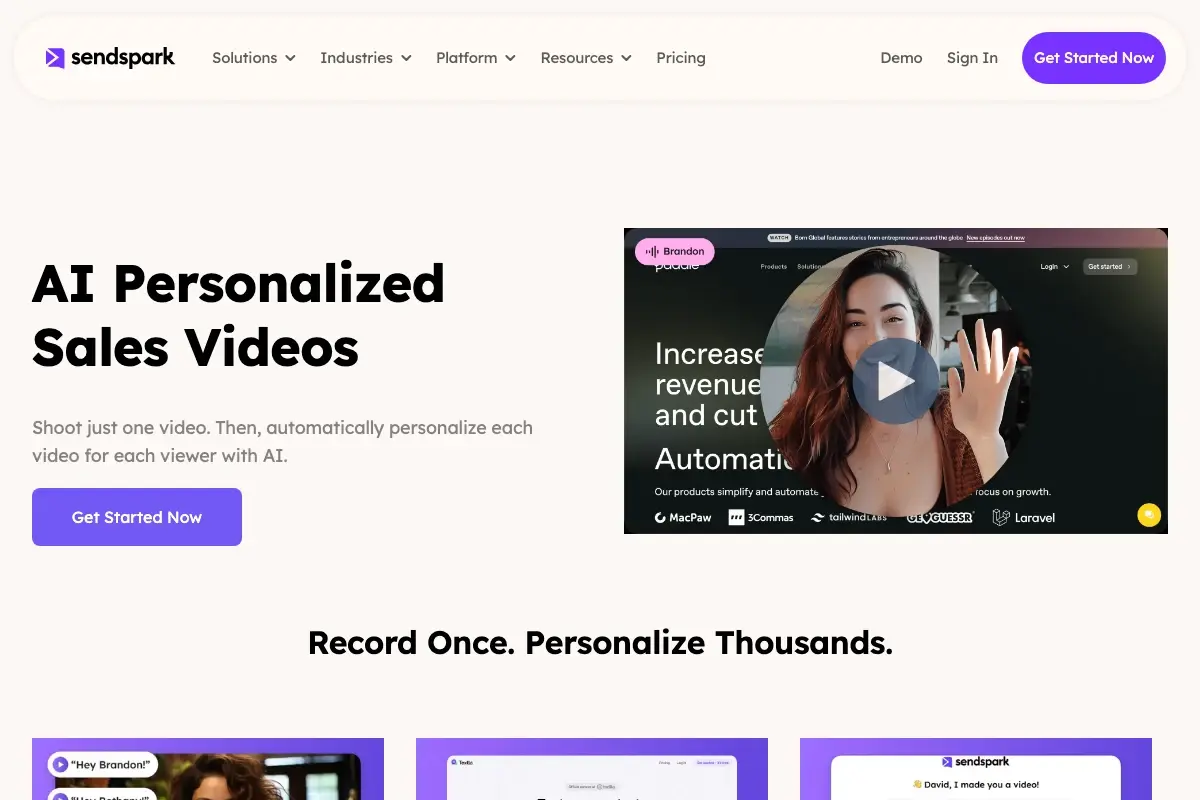
Here’s how text pitches compare to AI-personalized video pitches on the metrics that matter:
| Factor | Text Cold Pitch | AI-Personalized Video Pitch |
|---|---|---|
| Personalization level | Name + company field merges | Name, company, voice, dynamic background — 1:1 for every prospect |
| Time per prospect | 2-5 min for true personalization | ~30 seconds setup; auto-generated at scale |
| Reply rate vs generic | Moderate lift with personalization | 2-3x higher reply rates |
| Click-through rate | Baseline | 50% higher CTR on video thumbnails |
| Scalability | Caps out at ~50-100 truly personalized emails/day | Scales to thousands with no additional rep time |
| Setup effort | None — write and send | One 60-90 second recording, then automated |
The sales prospecting teams seeing the most success with video pitches are not using it for every email — they’re using it for their highest-value prospects, their warm follow-ups, and their re-engagement sequences. If you’re already using HubSpot or Outreach, Sendspark connects directly to inject personalized video pitches into your existing sequences.
Advanced strategy
Combine the Trigger Event Pitch (Section 3) with AI video personalization for maximum impact. When a prospect’s company announces a funding round or new hire, send them a personalized video that references that specific event — dynamic background showing their updated website, your cloned voice saying their name. This combination converts at 4-5x the rate of generic outreach.
5 Cold Email Pitch Mistakes to Avoid
The most common pitch mistakes all share the same root cause: prioritizing what you want to say over what the prospect needs to hear. Here are the five that cost the most replies — and how to fix each one.
Mistake 1: Leading With “I”
Emails that open with “I’d like to introduce myself” or “I’m reaching out because” signal generic outreach before the prospect reads a single word of your value claim. Per HubSpot Sales Blog research, emails starting with “I” get significantly lower open and reply rates than those opening with a prospect-focused observation. Start with “you” or with an observation about them — never with yourself.
Mistake 2: Feature-Dumping Instead of Outcome-Leading
A pitch that lists product features (“We have AI-powered insights, a real-time dashboard, and 200+ integrations”) gives the prospect nothing to hang their decision on. Features explain how something works; outcomes explain why it matters. Every feature in your pitch should translate directly to a business result the prospect can picture for their own team.
Mistake 3: The Vague Pain Point
“I know you’re busy” is not a pain point — it’s a platitude that signals you know nothing about their actual challenges. “I noticed your sales team’s LinkedIn job posts all mention ‘improving pipeline quality’” is a pain point. The more specific the pain, the more the prospect feels seen — and the more likely they are to respond. See our guide on cold email personalization for techniques to research prospect-specific pain points at scale.
Mistake 4: The Overlong Pitch
Every sentence in a cold email pitch has to earn its place. If you need four sentences to make your value claim, your offer probably needs tightening — not your email. The goal is to say the most important thing in the fewest words. An overlong pitch often signals a rep who isn’t confident in their core value proposition. Cut ruthlessly: if a sentence doesn’t advance the case for why the prospect should reply, remove it.
Mistake 5: Skipping the Relevance Hook
Without a “why you, why now” opening, the pitch defaults to feeling mass-market — because it is. A pitch that could have been sent to anyone feels like it was. Even a brief relevance signal (“saw you recently expanded your sales team”, “noticed your company just launched in the UK”) shifts the entire email from cold to considered. For more on structuring sales emails that get replies, including where the relevance hook fits in the overall email architecture, that guide covers the full framework.
Here’s a summary of the five mistakes and their fixes:
| Mistake | Why It Fails | The Fix |
|---|---|---|
| Leading with “I” | Signals generic outreach before the pitch starts | Open with an observation about the prospect |
| Feature dumping | Prospects buy outcomes, not capabilities | Every feature becomes an outcome (“X → so you can Y”) |
| Vague pain point | Generic pains don’t make prospects feel seen | Name the specific friction you know they experience |
| Overlong pitch | Buries the value claim; signals unclear thinking | Cut every sentence that doesn’t earn a reply |
| No relevance hook | Email feels mass-market from the first word | Add one specific observation about the prospect’s situation |
Published July 2026
Sources & References
- RAIN Group — “71% of buyers are willing to meet with sellers who reach out, if the outreach is relevant to their business situation.” Top Performance in Sales Prospecting Study.
- HubSpot Sales Blog — Research on cold email reply rates and the impact of personalization on email performance metrics.
- Gong Labs — Analysis of cold email conversion patterns, including length, opening lines, and personalization signals across millions of B2B sales emails.
- Salesforce State of Sales — “Buyers expect personalized outreach — and immediately recognize generic sequences.” Annual B2B buyer behavior research report.
- Jeb Blount / Sales Gravy — Sales prospecting methodology and the science of building relevance in cold outreach. Author of Fanatical Prospecting.
Frequently Asked Questions
What is a cold email pitch?
A cold email pitch is the 2-3 sentence value proposition at the heart of a cold outreach email. It is the section that explains who you are, what problem you solve, and why the prospect should care — distinct from the subject line (which drives the open), the icebreaker (which grabs attention), and the CTA (which asks for the next step). The pitch is the core of the email that determines whether the prospect replies.
How long should a cold email pitch be?
An effective cold email pitch is 2-4 sentences — long enough to establish relevance, name a pain, and state your value, but short enough to respect the prospect’s time. The entire cold email (including opener, pitch, and CTA) should be under 150-200 words for B2B outreach. Longer emails bury the value claim and reduce reply rates.
What is the difference between a cold email pitch and a cold email template?
A cold email template is the full email structure — subject line, opening, pitch, body, CTA, and sign-off — often with placeholder fields for personalization. The pitch is just the core value proposition section inside that template. You can use one pitch framework across many templates; the template determines the email’s overall architecture, the pitch determines whether it converts.
What is the best cold email pitch for B2B sales?
There is no single “best” cold email pitch — the most effective pitch depends on your ICP, your product’s value proposition, and the prospect’s specific situation. The Problem-Led Pitch (PAS framework) works well for outbound to known pain points. The Trigger Event Pitch works best when you have timely company news to reference. For highest reply rates at scale, AI-personalized video pitches — where each prospect sees their name and company in a personalized video — consistently outperform all text formats by 2-3x.
How do you write a cold email pitch that gets a response?
Write a cold email pitch that gets a response by following the four-component anatomy: a specific relevance hook (why this prospect, why now), a named pain point (not a vague challenge), a quantified value claim (outcome, not feature), and a low-friction micro-CTA (a yes/no question, not a 45-minute call request). Every sentence should serve one of these four jobs. If it doesn’t, cut it.
Should you use video in your cold email pitch?
Yes — when done at scale with AI personalization. A generic video sent to 500 prospects performs similarly to a generic text email. But an AI-personalized video where each prospect hears their name and sees their company website gets 2-3x more replies and 50% higher click-through rates. Sendspark’s AI voice cloning lets you record one video and auto-generate personalized versions for every prospect in your list, making video pitches practical at any outreach volume.
What makes a cold email pitch fail?
The most common cold email pitch failures are: leading with “I” instead of a prospect-focused observation, listing features instead of quantified outcomes, using vague pain points that could apply to anyone, writing too many sentences that dilute the core message, and skipping the relevance hook that establishes why you reached out to this specific person. Any one of these mistakes drops reply rates significantly; all five together produce a pitch that reads as a mass blast.
Record One Video. AI Personalizes Thousands.
Sendspark is the AI video personalization platform for B2B sales. Record once, and AI voice cloning generates thousands of individually personalized videos with dynamic backgrounds and personalized thumbnails — each prospect hears their name, sees their website, in your voice. Sales teams see 2-3x more replies.
Get Started Now