A viewer who watches 80% of your demo video is a hotter lead than one who fills out a generic contact form and never opens your follow-up email. That’s the shift video lead generation has gone through since this guide first published: video isn’t just a lead magnet format anymore, it’s a source of first-party intent data you can score, route, and act on. Done right, video still out-converts static content at every stage of the funnel – and now it can tell you exactly who’s ready to buy.
Updated September 2026
This guide covers the tactics that actually move the needle: building a video-powered pipeline, capturing leads at the moment of peak engagement, distributing video across email and landing pages, and – the part most “video marketing” advice still skips – turning watch behavior itself into a lead-scoring signal with AI video personalization.
Key Takeaways
- 85% of video marketers say video has directly helped them generate leads, and video landing pages convert at nearly double the rate of pages without video.
- Gated content, in-video calls-to-action, and forms embedded directly in the player capture leads at the exact moment engagement peaks – not after the viewer has already clicked away.
- AI video personalization lets you record one video and generate thousands of individually personalized versions, each carrying its own watch-through rate and engagement data back to your CRM.
- Video engagement data (completion rate, replays, click patterns) is a first-party intent signal you can feed straight into lead scoring – no third-party cookies required.
- 96% of B2B buyers say they prefer video content when researching a purchase, so a page without video is losing consideration before a rep ever gets involved.
Build a Video-Powered Lead Generation Pipeline
A video-powered pipeline uses a different video at each funnel stage – awareness, consideration, and decision – instead of one generic explainer repeated everywhere. Video outperforms static content because it earns attention instead of asking for it: 85% of video marketers say video has directly helped them generate leads, and websites with video convert measurably better than ones without. Vertical-specific teams see this directly – real estate lead generation is one example where a short personalized video routinely outperforms a plain-text follow-up.
Start by mapping video to the stages your prospects actually move through:
- Awareness: short, top-of-funnel videos that explain a problem your audience recognizes – these earn views and shares, not necessarily form fills.
- Consideration: product-specific videos (demos, use-case walkthroughs, customer stories) gated behind a lead form, since the viewer has shown enough interest to trade an email address.
- Decision: a short, personal video from a rep – not a polished brand asset – that references the prospect by name and their specific situation. This is where a focused B2B video marketing strategy pays off, because a generic video at this stage reads as an afterthought.
The mistake most teams make is treating every video like a decision-stage video: expensive, produced, and gated behind a long form. That kills top-of-funnel reach. A working pipeline needs cheap, fast, personal video at scale just as much as it needs one polished flagship piece – see how this fits into a full video marketing funnel, or explore how marketing teams use Sendspark to run this at scale.
Pro tip
Record one core video and use AI to swap the intro for each segment – same core pitch, different opening hook for cold prospects vs. warm leads. You get pipeline coverage without recording ten separate videos.
Capture Leads at the Point of Highest Engagement
The best time to ask for contact information is while a viewer is still actively engaged with your video, not after they’ve clicked away to their inbox. Gated content, in-video calls-to-action, and forms embedded directly in the video player all capture intent at that peak-attention moment instead of hoping a viewer remembers to come back later.
Gate the right content, not everything
Gating works when the content is worth the trade: a detailed product walkthrough, a customer case study, or a template pack. Gating a 90-second overview behind a form usually backfires – prospects bounce rather than trade an email for something that thin. Reserve the form for content substantial enough to justify it.
A useful test before you gate anything: would you be comfortable if a prospect screenshotted the form and complained about it on social media? If the content behind it doesn’t clearly earn a full contact record, either shorten the form (name and work email only) or move the gate later in the video, after the viewer has already gotten real value. Teams that gate too aggressively tend to see plenty of form starts and very few completions – a signal the trade isn’t perceived as fair, not that the audience lacks interest.
Use in-video calls-to-action
A video CTA placed at the right timestamp – not just at the end – captures viewers before they lose interest. Keep the ask short and specific (“Book 15 minutes” beats “Learn more”), and place it prominently enough that a distracted viewer can’t miss it.
Embed lead forms directly in the player
Modern video players can surface a short form inside the viewing experience itself, so a prospect never has to leave the video to convert. This matters most for longer-form content: forms placed inside videos over 60 minutes see click-through rates in the 67-75% range, because the viewer has already proven deep interest by staying that long.
Common mistake
Don’t front-load every video with a form before the viewer has seen a second of content. Let them experience enough value to want to convert – a form gating the first three seconds converts worse than one placed after a strong opening hook.
Put Video to Work Across Email, Landing Pages, and Automation
Video performs best when it shows up in the channels prospects already check daily: email, landing pages, and the marketing automation sequences that nurture them afterward. Each channel needs a slightly different approach to actually move a lead forward instead of just adding a view count.
Video in email marketing
Including video in your email marketing gives you a way to add a personal touch that plain text and static images can’t match – a thumbnail preview alone tends to lift click-through rates noticeably compared to a text-only link. Use video to introduce yourself, thank a customer, share a testimonial, or walk through a proposal one-on-one.
Sendspark makes it fast to record and send AI-personalized videos straight from your inbox – get started for free to see how it fits your outreach.
Video on landing pages
Landing pages with embedded video convert meaningfully higher than pages without one, because video answers the “is this for me?” question faster than a wall of text can. Keep the video short, put it above the fold, and make sure the page’s core message doesn’t depend on the visitor pressing play – treat video as reinforcement, not the only pitch.
Autoplay muted with captions on tends to outperform requiring a click to start, since most visitors won’t opt in to sound on a page they just landed on. Pair the video with a headline and subhead that stand on their own, so the page still converts for the visitor who scans the text and never presses play. If you’re testing video against a static hero image, give it at least a few weeks of traffic before calling a winner – video’s lift shows up more in scroll depth and time on page than in a single afternoon of conversion data.
Video in marketing automation
Sendspark connects with HubSpot, Outreach, and dozens of other automation platforms, so personalized video can trigger automatically at any stage of the customer journey – a new lead added to a list, a deal moving stages, a support ticket closing. That means video reinforces every automated touchpoint instead of only living in one campaign.
Turn Video Engagement Into Lead-Scoring Data with AI Personalization
An AI video personalization platform lets you record one video and use AI voice cloning and dynamic backgrounds to generate thousands of individually personalized versions – and every one of those views reports back watch-through rate, replays, and click behavior you can feed straight into lead scoring. That combination didn’t exist when video lead generation meant “produce one explainer and hope it converts.”
Since third-party cookies became unreliable for targeting, marketers have leaned harder on first-party engagement data – behavior on channels you actually own. Video is one of the richest sources of that data, because unlike a page visit, a video view carries a built-in intent signal: how far someone watched, whether they replayed a section, and what they clicked next.
What AI personalization adds to lead scoring
- Personalized thumbnails that show the prospect’s name or company logo lift open and click rates before the video even plays – your first engagement data point.
- Dynamic backgrounds let one recorded video appear customized to each prospect’s website or industry, without re-recording a single take.
- Watch-through rate per recipient tells you who’s actually interested versus who opened out of curiosity – a far more reliable signal than an email open, and one you can track in detail with video analytics.
- Combined videos (a personalized intro stitched to a reusable demo) let you track exactly where each viewer drops off, so follow-up messaging can pick up where their attention did.
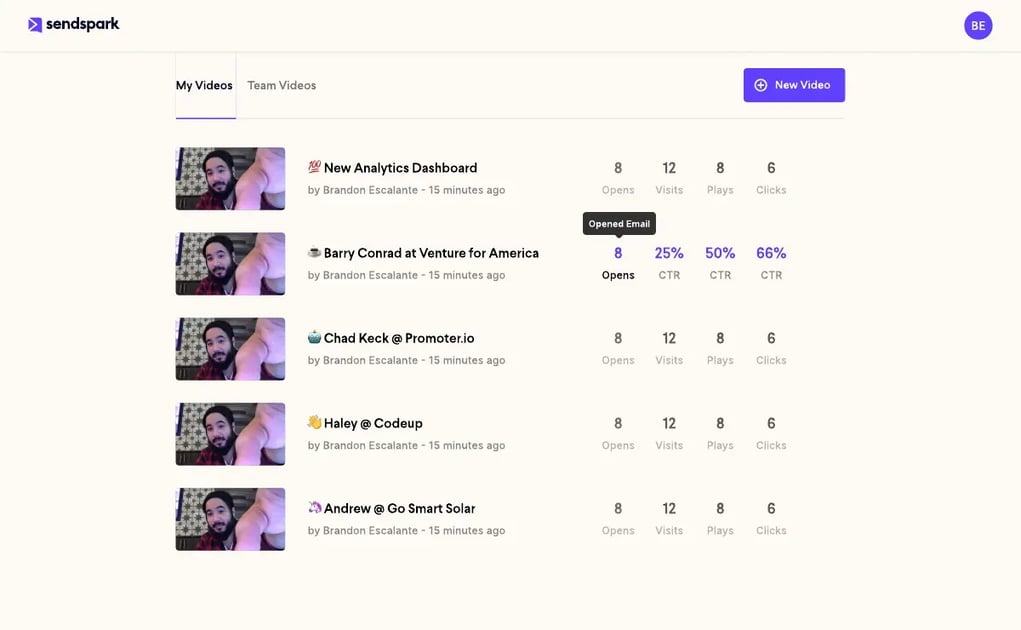
Sendspark customers use this pattern to turn anonymous website traffic into scored leads: a visitor lands on a pricing page, an automatic trigger generates a personalized video referencing their company, and their watch behavior becomes the first real signal a rep sees before ever picking up the phone. For the full framework on turning watch data into a score your CRM can act on, see our best practices for video-based lead scoring.
In practice, that means setting a simple rule set before you scale: a lead who crosses 75% watch-through gets routed to a rep the same day, one who watches 25% goes into a nurture sequence, and one who never opens the video at all gets a different subject line on the next attempt rather than the same video again. The scoring logic doesn’t need to be complicated to be useful – it just needs to turn a pile of anonymous views into a short list a rep can act on immediately.
That’s the core idea behind record one video, personalize at scale: the recording effort stays fixed while the personalization – and the resulting engagement data – scales to every lead in your pipeline. For the broader strategic playbook on personalization at scale beyond lead capture, see our comprehensive guide to personalized video marketing.
Video Lead Generation Tactics Compared
Not every tactic fits every stage of the funnel. Use the comparison below to match the right approach to where a lead actually is, rather than defaulting to the same gated-video playbook for every campaign.
| Tactic | Best funnel stage | Setup effort | What it captures |
|---|---|---|---|
| Gated video content | Consideration | Medium | Email + firmographic data upfront |
| In-video CTA / embedded form | Consideration to decision | Low | Contact info at peak engagement |
| Personalized video email | Decision | Low (with AI) | Opens, replies, watch-through rate |
| Video landing page | Awareness to consideration | Medium | Page conversion rate, time on page |
| AI-personalized video for website visitors | All stages | Low (automated) | Per-visitor engagement data for lead scoring |
Record One Video. AI Personalizes Thousands.
Sendspark is the AI video personalization platform for B2B sales. Record once, and AI voice cloning generates thousands of individually personalized videos with dynamic backgrounds and personalized thumbnails — each prospect hears their name, sees their website, in your voice. Sales teams see 2-3x more replies.
Get Started NowFrequently Asked Questions
What is video lead generation?
Video lead generation is the practice of using video content – gated demos, in-video forms, personalized outreach videos – to capture contact information from prospects. It works because video holds attention longer than text, and modern platforms can track exactly how engaged a viewer was, turning that behavior into a usable lead signal.
How does video marketing generate more leads than text or static content?
Video communicates faster and more completely than text, so prospects reach a purchase-relevant understanding sooner. Video also produces measurable engagement data – watch time, replays, clicks – that static content simply can’t, which gives sales and marketing teams a much clearer read on genuine interest.
What is a video-powered sales pipeline?
A video-powered sales pipeline maps a different type of video to each funnel stage: short awareness videos, gated consideration-stage demos, and personal decision-stage videos from a rep. It replaces the one-size-fits-all explainer video with content matched to where a prospect actually is in their buying journey.
How do you add a lead capture form to a video?
Most modern video hosting and personalization platforms let you embed a short form directly inside the player, either as an overlay at a set timestamp or as a gate before playback starts. Place it after enough content to earn trust rather than before the viewer has seen any value.
Can AI-personalized video improve landing page conversion rates?
Yes. Landing pages with embedded video already convert better than pages without one, and AI personalization compounds that by making the video itself specific to the visitor – referencing their company or industry in a personalized thumbnail or dynamic background – which increases the odds they watch far enough to convert.
What’s the best way to nurture leads with video content?
Use short, personal follow-up videos triggered automatically at key moments in your marketing automation – a form fill, a pricing page visit, a stalled deal. A brief personalized video referencing the lead’s specific situation outperforms a generic nurture email because it demonstrates effort the recipient can immediately recognize.
How do you measure ROI on a video lead generation campaign?
Track leads generated, cost per lead, and downstream pipeline influenced by video-sourced leads, but don’t stop at view counts. Watch-through rate and click behavior are leading indicators of lead quality, so a smaller pool of highly-engaged video leads can outperform a larger pool of low-engagement leads on actual pipeline value.
Sources & References
- Wyzowl, State of Video Marketing 2026 — “85% of video marketers say video has directly helped them generate leads” (2026)
- Content Marketing Institute & MarketingProfs, B2B Content Marketing Trends Research — “96% of B2B buyers prefer video content when researching a purchase” (fielded 2025)
- HubSpot Blog, State of Video Marketing — video-driven lead generation and engagement data (2026)
- Wistia, Video and Marketing Automation — using video across the automated customer journey (2026)
Record One Video. AI Personalizes Thousands.
Sendspark is the AI video personalization platform for B2B sales. Record once, and AI voice cloning generates thousands of individually personalized videos with dynamic backgrounds and personalized thumbnails — each prospect hears their name, sees their website, in your voice. Sales teams see 2-3x more replies.
Get Started NowTopics: Tips & Tricks