Most sales reps send the same prospecting message to 500 contacts and wonder why no one responds. The problem isn’t effort — it’s relevance. The teams booking the most meetings today prospect fewer people more deliberately, combining verified signals with outreach that feels individually researched rather than mass-produced.
This guide covers exactly how to prospect for clients in B2B: building a precise ideal client profile, picking the channels your prospects actually use, writing messages that get replies, and scaling personalized outreach with AI — without spending hours a day on manual research.
Key Takeaways
- Define your ICP before sending any outreach — targeting the wrong companies wastes budget and rep time regardless of how good your messaging is.
- Multi-channel prospecting (email + LinkedIn + video) generates significantly more meetings than single-channel outreach, according to RAIN Group research.
- Personalization is the #1 reply driver, but manual 1:1 personalization doesn’t scale beyond a handful of contacts per day.
- AI video personalization lets you record one video and auto-generate thousands of individualized versions — each prospect hears their name, sees their company website, in your cloned voice.
- Track reply rate and meetings booked per channel to invest time where your ICP actually responds.
What Is Client Prospecting (and Why Most Reps Get It Wrong)
Client prospecting is the process of identifying potential buyers, qualifying them against your ideal customer profile, and initiating contact through personalized outreach to start a sales conversation. Done right, it builds a predictable pipeline of new opportunities. Done the way most teams do it — blasting generic emails to unqualified lists — it burns rep hours and trains your domain for the spam folder.
The core mistake is treating prospecting as a numbers game. The logic seems sound: more messages equals more chances. But Salesforce’s State of Sales research consistently finds that top-performing reps prioritize quality over quantity — targeting fewer, better-fit accounts and tailoring every touchpoint to the specific buyer’s context rather than the segment average.
Modern client prospecting looks fundamentally different from the spray-and-pray approach. It combines:
- Precision targeting — using intent data, hiring signals, and funding events to find companies actively showing buying behavior
- Multi-channel sequencing — reaching prospects on email, LinkedIn, phone, and video in a coordinated cadence
- Contextual personalization — referencing specific signals that prove you’ve done research beyond reading their homepage
- Speed-to-signal — contacting a company within 24-48 hours of a trigger event, not days later when the moment has passed
The reps who consistently book meetings aren’t sending more messages. They’re sending smarter ones to better-qualified lists.
Why Generic Outreach Fails
Your prospect gets 30-50 cold outreach messages every week. Most of them open with “I hope this message finds you well,” proceed to describe their product, and end with a request for 30 minutes of calendar time. Your prospect deletes them without reading past the first sentence.
Generic outreach fails for one reason: it doesn’t answer the question your prospect asks silently when they see your message in their inbox — “Why should I care about this, right now?” A message that can’t answer that question in the first two sentences doesn’t deserve a reply. Building a prospecting system that answers that question consistently is what separates a 1% reply rate from a 10% one.
What Modern Client Prospecting Looks Like
Modern prospecting is intelligence-led. Before a rep sends a single message, they know the prospect’s tech stack, the company’s growth trajectory, whether they’re hiring for roles that signal a relevant problem, and whether anyone at the company has engaged with content related to what the rep sells. That intelligence shapes every word of the outreach.
It’s also coordinated. A single cold email rarely books a meeting. The teams with the highest meeting rates run structured sequences — an email, then a LinkedIn connection request with a note, then a follow-up email referencing a piece of relevant content, then a video message, then a final call attempt. Each touchpoint adds value rather than simply asking again.
Step 1: Build Your Ideal Client Profile Before You Prospect
Your Ideal Client Profile (ICP) defines the specific company characteristics that predict whether a prospect will buy, expand their contract, and refer others. It combines firmographic data (company size, industry, revenue range), technographic signals (the tools they already use), and behavioral indicators (recent hiring, funding events, geographic expansion). Prospecting without a defined ICP means spending rep time on companies that will never buy, regardless of how compelling your outreach is.
The best place to build your ICP isn’t a spreadsheet — it’s your existing customer base. Pull your top 20-30 customers by annual contract value and lifetime value, then mine them for patterns:
- Industry verticals — which sectors appear most frequently, and which have the shortest sales cycles?
- Company size — headcount range, revenue bracket, and number of relevant team members (e.g., SDRs for a sales tool)
- Tech stack — what tools do they use that your product integrates with or complements?
- Growth stage — are they post-Series A hyper-growth, or established mid-market with stable teams?
- Trigger events — what was happening in the business when they first became a customer?
Trigger events deserve special attention. A SaaS company that just raised a Series B is hiring sales reps and actively investing in tools to make them productive. A company that just posted 15 SDR job listings is building outbound — that’s a buying signal, not just a demographic fact. For a deeper framework on scoring prospects against these criteria, our B2B lead qualification framework walks through exactly how to weigh each signal.
Pro tip
Set up LinkedIn Sales Navigator account alerts for your target companies. When a company in your ICP posts new sales roles or announces a funding round, you’ll be notified immediately — reach out within 48 hours to maximize your timing advantage before competitors do.
Firmographic vs. Technographic ICP Signals
Firmographic signals — company size, industry, location, annual revenue — define whether a company is theoretically a fit. Technographic signals tell you whether they’re practically a fit: do they already use the tools your product integrates with? Are they on the same platform as your best customers?
For Sendspark, for example, a high-fit account would use HubSpot or Outreach (integration compatibility), have 10-50 active SDRs (enough volume to justify AI video personalization at scale), and sell a product with a considered B2B buying cycle (where video outreach has the highest impact on conversion rates). That’s a much tighter target than “any B2B company with 50-500 employees.” Tighter targeting means fewer messages, higher reply rates, and faster closed deals.
How to Prioritize Accounts Within Your ICP
Even within a well-defined ICP, not all accounts are equally worth pursuing right now. Prioritize accounts showing active buying signals over accounts that merely match your firmographic criteria. An ICP-fit company with no relevant hiring, no recent funding, and no engagement with your category is lower priority than a slightly less perfect fit that just posted 10 SDR job listings and launched an outbound-heavy sales motion.
Build a simple scoring model: tier 1 accounts score high on both fit and timing; tier 2 accounts are strong on fit but neutral on timing; tier 3 accounts are borderline fit. Your reps should spend 70% of prospecting time on tier 1, 25% on tier 2, and barely touch tier 3.
Step 2: Use the Highest-ROI Prospecting Channels
Not all prospecting channels deliver equal results for every ICP. Cold email scales efficiently and supports personalization. LinkedIn gives direct access to decision-makers with visible professional context. Video outreach consistently outperforms text in reply rates when personalization is present. Phone calls work best for warm follow-up on accounts showing intent. The most effective prospecting programs combine 2-3 channels in a coordinated sequence rather than relying on any single one.
Here’s how the main channels compare for B2B client prospecting:
| Channel | Best Use Case | Avg Reply Rate | Personalization Ceiling |
|---|---|---|---|
| Cold Email | Large-list outreach at scale | 1–5% | High (template variables + AI custom lines) |
| LinkedIn DM | Decision-maker access, warm intros | 10–25% | High (profile context visible) |
| AI Video Outreach | Standing out, complex products | Up to 3x text reply rates | Very high (AI voice + dynamic backgrounds) |
| Cold Call | Immediate qualification, warm accounts | 1–2% connect-to-meeting | Medium (live conversation only) |
| Referrals | Fastest close, highest trust | 70%+ conversion rate | Built-in (warm introduction) |
Cold Email Prospecting
Cold email is the backbone of most B2B prospecting programs because it scales efficiently. A well-structured sequence with verified email addresses, a compelling subject line, and a single clear CTA can reach hundreds of prospects in a day. The challenge is differentiation — your prospect receives dozens of cold emails weekly, and most are structurally identical.
Effective cold email prospecting follows three rules: open with a specific, researched signal about the recipient rather than a generic compliment; make one concrete ask rather than a vague meeting request; and follow up at least 4-6 times before moving on. Our guide on cold email best practices covers the exact sequence structure and timing that generates the highest reply rates across different industries.
LinkedIn Prospecting
LinkedIn gives you something cold email doesn’t: visible context. Before sending a DM, you can see who your prospect works with, what content they’ve recently engaged with, whether they’ve been promoted, and whether you share any mutual connections. According to LinkedIn’s Sales Solutions research, social selling leaders create 45% more opportunities than peers with lower Social Selling Index scores.
For LinkedIn prospecting to convert, your profile needs to be optimized first — prospects check it before responding to any outreach. A compelling headline, results-oriented summary, and recent thought leadership posts all increase response likelihood. For tactical approaches to combining LinkedIn with LinkedIn video prospecting, including when video DMs outperform text messages on the platform, our dedicated guide covers the full playbook.
Video Prospecting for Client Acquisition
Video outreach converts at 2-3x the rate of text-only email when personalized to the individual prospect. The barrier historically was time: recording an individual video for every prospect in a 500-person list was impractical at scale. AI changes that completely.
With AI-powered video personalization, you record one video and the platform auto-generates thousands of individualized versions. Each prospect hears their name in your voice (via AI voice cloning), sees their company website as the video background (dynamic backgrounds), and receives a personalized video thumbnail showing their brand. That level of personalization previously required filming individual videos. Now it takes minutes for your entire list.
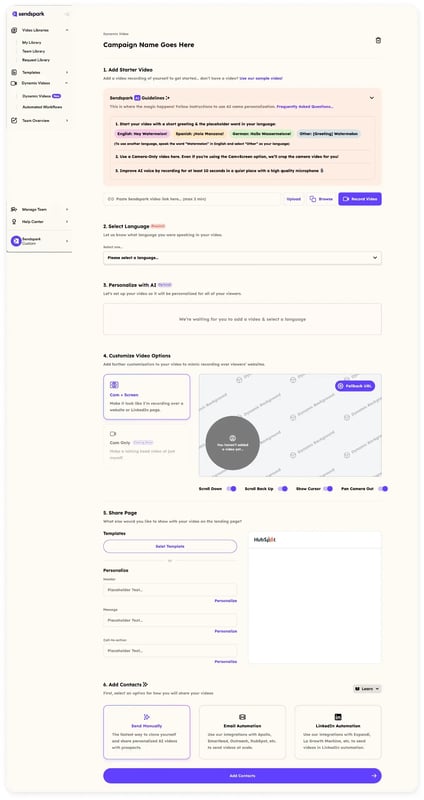
Research comparing cold email vs. video email reply rates consistently shows that prospects respond to personalized video thumbnails at significantly higher rates than text-only messages — the visual signal that the outreach was made specifically for them stops the scroll in a crowded inbox.
Record One Video. AI Personalizes Thousands.
Sendspark is the AI video personalization platform for B2B sales. Record once, and AI voice cloning generates thousands of individually personalized videos with dynamic backgrounds and personalized thumbnails — each prospect hears their name, sees their website, in your voice. Sales teams see 2-3x more replies.
Get Started NowStep 3: Write Outreach That Actually Gets Replies
The most common reason prospecting outreach fails isn’t the channel or the timing — it’s the message. Effective outreach shares three qualities: it references a specific, researched detail about the recipient; it makes a believable claim about the value of talking; and it asks for one small, low-commitment next step. Messages missing any of these three elements rarely generate replies, regardless of how polished they look.
The framework that works across all channels:
- The opening hook — reference a specific signal (recent funding, a new SDR hire wave, content they shared, a challenge their industry is facing right now)
- The relevance bridge — connect that signal directly to a problem you help solve, using one sentence
- The proof point — quantify your impact in one sentence: a percentage improvement, time saved, or the name of a similar company you’ve helped
- The micro-ask — “Worth a 15-minute look?” rather than “Can we book a 45-minute discovery call?” Lower commitment means higher acceptance rate
Common mistake
Leading with your product description kills replies. “We help companies like yours with X” — before establishing relevance — sounds like every other cold message. Reference the prospect’s specific situation first. Then explain why you’re reaching out.
Subject Line Strategy
Your subject line determines whether the email gets opened at all. The highest-performing subject lines for B2B cold outreach are direct, specific, and under seven words. “Quick question about [Company]’s SDR onboarding” outperforms “How [Company] can 3x their outbound pipeline” consistently — the former sounds like a human, the latter sounds like an ad.
Three subject line formulas that consistently generate opens:
- Signal-based: “[Company Name] just raised Series B — congrats” or “Saw your SDR hiring push”
- Problem-implied: “Your video prospecting reply rates” or “[Company]’s inbound-to-outbound ratio”
- Referral-implied: “[Mutual connection] thought I should reach out”
Building a Multi-Touch Sequence
A single cold message rarely books a meeting. The teams with the highest meeting rates run structured multi-touch sequences where each touchpoint adds value rather than just asking again. A typical effective sequence looks like this:
- Day 1: Personalized cold email with a specific signal and a single ask
- Day 3: LinkedIn connection request with a short, value-focused note
- Day 5: Email follow-up with a relevant piece of content or data point
- Day 8: AI-personalized video message via email or LinkedIn DM
- Day 12: Phone call attempt
- Day 15: Final email with clear CTA or graceful breakup line
The video touchpoint on day 8 is often the highest-converting step in the sequence. By that point, the prospect has seen your name multiple times. A personalized video — showing their company website as the background, greeting them by name — stands out sharply against the text emails that preceded it.
Step 4: Scale Your Prospecting with AI and Measure What Works
Scaling client prospecting with AI means moving from “personalize when you have time” to “personalize by default, for every contact.” The most effective prospecting teams don’t treat personalization as a premium service reserved for top-tier accounts — they use AI tools to make every outreach message contextually relevant, regardless of list size. Sendspark’s AI-powered prospecting solution does this for video: record one video, and AI voice cloning generates personalized greetings for every contact in seconds.
Scaling effectively requires three systems working in parallel:
- Data enrichment — tools like Clay or ZoomInfo that auto-populate prospect data, surface trigger signals, and auto-generate personalized first lines based on enriched context
- Sequence automation — Outreach, Apollo, or SalesLoft to send coordinated multi-touch sequences across email and LinkedIn without manual scheduling
- CRM sync — bi-directional data flow so engagement signals (video views, email opens, link clicks) update prospect records automatically and trigger the next step in the sequence
For video specifically, Sendspark integrates directly with HubSpot, Salesforce, Outreach, and SalesLoft — so every time a prospect watches your video, that engagement data flows into your CRM and can trigger the next outreach step automatically. You don’t need to check who watched — the workflow handles it.
Key Metrics to Track
The most actionable prospecting metrics are leading indicators — numbers you can act on before the quarter is over. Track them by channel so you know exactly where to invest more rep time and where to optimize the message.
According to RAIN Group’s Top Performance in Sales Prospecting research, the primary differentiator between top-performing and average prospectors isn’t the number of touches — it’s consistent follow-up combined with genuine value at each contact point. Top performers average 8 touchpoints before moving on. Most reps stop at 2.
| Metric | What It Tells You | Healthy Benchmark |
|---|---|---|
| Open Rate | Subject line effectiveness + list quality | 30–50% for cold email |
| Reply Rate | Message relevance + targeting precision | 3–8% cold email; 10–20% LinkedIn DM |
| Meeting Rate | Overall sequence effectiveness | 1–3% of all contacts reached |
| Video Watch Rate | Thumbnail and subject line appeal | 40–70% of video links clicked |
| Pipeline per Rep | Overall prospecting ROI | 3–5x individual quota target |
Connect your prospecting metrics to your full prospecting tools stack so every data point flows into your CRM automatically. If you need to build a spreadsheet to see your reply rate, you’ll never optimize it in time. Visibility drives behavior — reps who see their metrics daily outperform reps who see them monthly.
The final principle: if a channel isn’t producing results after 200 contacts and 4 full sequence cycles, it’s not the volume that’s wrong — it’s the message, the list, or the fit. Add more of the same before concluding the channel doesn’t work for your ICP.
Frequently Asked Questions
What does it mean to prospect for clients?
Prospecting for clients means identifying potential buyers who match your ideal customer profile, then reaching out with personalized messages to start a sales conversation. It includes researching target accounts, finding the right decision-makers, selecting the right channels, and crafting messages tailored to each prospect’s specific context and timing.
How many touchpoints does it take to book a meeting when prospecting?
Most B2B prospects require 8-12 touchpoints before agreeing to a first meeting, according to RAIN Group’s prospecting research. The majority of sales reps stop after 2-3 follow-ups — meaning reps who persist respectfully with value at each touchpoint dramatically outperform peers who give up early.
What is the most effective channel for prospecting new clients?
No single channel is universally best — it depends on your ICP. LinkedIn delivers the highest reply rates (10-25%) for senior decision-makers, while cold email scales more efficiently for large lists. AI-personalized video prospecting consistently outperforms text-only email by 2-3x when each video is tailored to the prospect. The most effective approach combines 2-3 channels in a coordinated sequence.
How do I build a list of clients to prospect?
Start by defining your ICP: firmographic signals (industry, company size, revenue), technographic signals (tools they use), and trigger events (recent funding, hiring waves). Use tools like LinkedIn Sales Navigator, ZoomInfo, or Apollo to build a targeted list matching those criteria, prioritizing companies actively showing buying signals over ones that merely fit your demographic profile.
How do I personalize client prospecting outreach at scale?
AI video personalization is the most effective way to personalize at scale. Record one video, and an AI platform like Sendspark generates individual versions for every prospect — each person hears their name in your voice, sees their company website as the background, and receives a personalized thumbnail. This delivers 1:1 quality without 1:1 recording time. For text outreach, tools like Clay auto-generate personalized first lines using enriched prospect data.
What is an ICP and why does it matter for client prospecting?
An Ideal Client Profile (ICP) defines the specific characteristics of companies most likely to buy, retain, and expand your product. It combines firmographic data (size, industry), technographic signals (tech stack), and behavioral indicators (funding, hiring patterns). Prospecting without an ICP means spending rep hours on companies that won’t buy, no matter how well-crafted the outreach is.
How do you know if your client prospecting is working?
Track reply rate, meeting rate, and pipeline created per channel on a weekly basis. A healthy cold email reply rate is 3-8%; LinkedIn DMs typically reach 10-20% with warm personalization. Trending your data weekly — not monthly — lets you catch and fix underperforming sequences before they drain rep time for a full quarter.
Sources & References
- Salesforce State of Sales — “Top-performing sales reps consistently prioritize quality of outreach over quantity of contacts” (Annual report)
- RAIN Group: Top Performance in Sales Prospecting — “Top performers send an average of 8 touchpoints before moving on from a prospect; average performers stop at 2-3” (Research study)
- LinkedIn Sales Solutions — “Social selling leaders create 45% more opportunities than peers with lower Social Selling Index scores” (LinkedIn research)
- HubSpot Sales Blog: Sales Prospecting — Prospecting frameworks, sequence structure, and cold outreach best practices
Record One Video. AI Personalizes Thousands.
Sendspark is the AI video personalization platform for B2B sales. Record once, and AI voice cloning generates thousands of individually personalized videos with dynamic backgrounds and personalized thumbnails — each prospect hears their name, sees their website, in your voice. Sales teams see 2-3x more replies.
Get Started Now