
Sales teams across B2B are quietly moving away from Vidyard — not because video CloudApp alternatives is losing ground, but because the bar for video personalization has risen sharply in 2026. Buyers expect to be addressed by name, see their own brand, and feel the message was made for them specifically. Vidyard’s AI Avatar feature produces one video per script, takes 20 or more minutes to generate, and creates the kind of synthetic-looking content that prospects increasingly recognize and ignore. Sendspark is an AI video personalization platform built to solve exactly this problem: record one video, and AI voice cloning generates thousands of individually personalized videos — each with dynamic backgrounds, personalized thumbnails, and your real voice speaking each prospect’s name. This article breaks down why sales teams are switching, how the platforms compare on every dimension that matters, and what the total cost difference looks like in 2026. Vidyard alternatives for B2B sales
Key Takeaways
- B2B sales teams switching from Vidyard cite AI avatar speed (20+ min per video) and cost as top reasons
- Sendspark’s AI voice cloning personalizes thousands of videos from one recording in seconds — vs Vidyard’s one-at-a-time AI Avatar process
- Sendspark’s agentic workflows in 2026 automatically research prospects, detect intent signals, and trigger personalized videos — a capability Vidyard does not offer
- Pricing starts at $49/month for Sendspark vs $89–$300+/month for Vidyard’s AI features
- Teams using Sendspark report 200–300% more email replies and 40–50% more meetings booked
Why Sales Teams Are Leaving Vidyard in 2026
The single biggest reason sales teams are leaving Vidyard in 2026 is the speed and scalability gap. Vidyard’s AI Avatars require a separate script for every prospect, take 20 or more minutes to generate per video, and produce one output at a time. Sendspark lets you record one video once, then generates thousands of personalized versions in seconds using AI voice cloning — each speaking that prospect’s name in your real voice. For SDRs managing hundreds of outreach sequences simultaneously, the math is straightforward.
Vidyard started as a video hosting and analytics platform, and it remains genuinely strong in that role — particularly for account executives who need to share deal summaries, product walkthroughs, or champion enablement content. But the AI personalization capabilities bolted onto that foundation were designed for a different era of outbound. Generating a single AI avatar video requires you to write a unique script, feed it into the avatar generator, wait for rendering, and then manually insert it into your sequence for that one prospect. Multiply that by a 300-person prospecting list and you have a process that doesn’t scale.
The cost structure reinforces the frustration. Vidyard’s AI features aren’t available on its $19/month Pro plan — they require the Starter tier at $89/month or higher, and enterprise-grade AI access pushes into $300+/month territory. Sales teams paying those prices expect a tool that can keep up with their outreach volume. Many are finding it can’t.
⚠️ Warning: AI Avatar Fatigue Is Real
Buyers in 2026 are increasingly skeptical of deepfake-style AI avatar videos in cold outreach. Research from Salesforce’s State of Sales 2025 shows that trust and authenticity rank as the top two factors determining whether a sales video drives a response. Synthetic avatars — where a digital face mouths a generated script — score poorly on both dimensions. AI voice cloning that uses your actual face and real recorded video performs significantly better because it preserves the human authenticity buyers are looking for.
There is also a broader buyer behavior shift happening. As AI avatars have proliferated across cold email and LinkedIn outreach, prospects have developed a sharp instinct for spotting them. The uncanny valley effect — where a video looks almost human but not quite — triggers skepticism rather than engagement. This is AI avatar fatigue, and it’s accelerating the move toward tools that use real video of the actual salesperson combined with AI personalization. Sendspark’s approach — your real face, your real voice cloned to say each name, each prospect’s website appearing behind you — reads as authentic because it fundamentally is. You can learn more about why this approach works in our video for sales guide.
How Sendspark’s AI Video Personalization Works
Sendspark’s core workflow is straightforward to describe and genuinely difficult to replicate: record one video, and the platform uses AI voice cloning plus dynamic visual personalization to generate a unique version for every prospect on your list — in seconds, at any scale. The AI learns your voice from your recording, then generates a natural-sounding version of each prospect’s name spoken in your voice. No scripts. No rendering queues. No repetitive recording sessions.
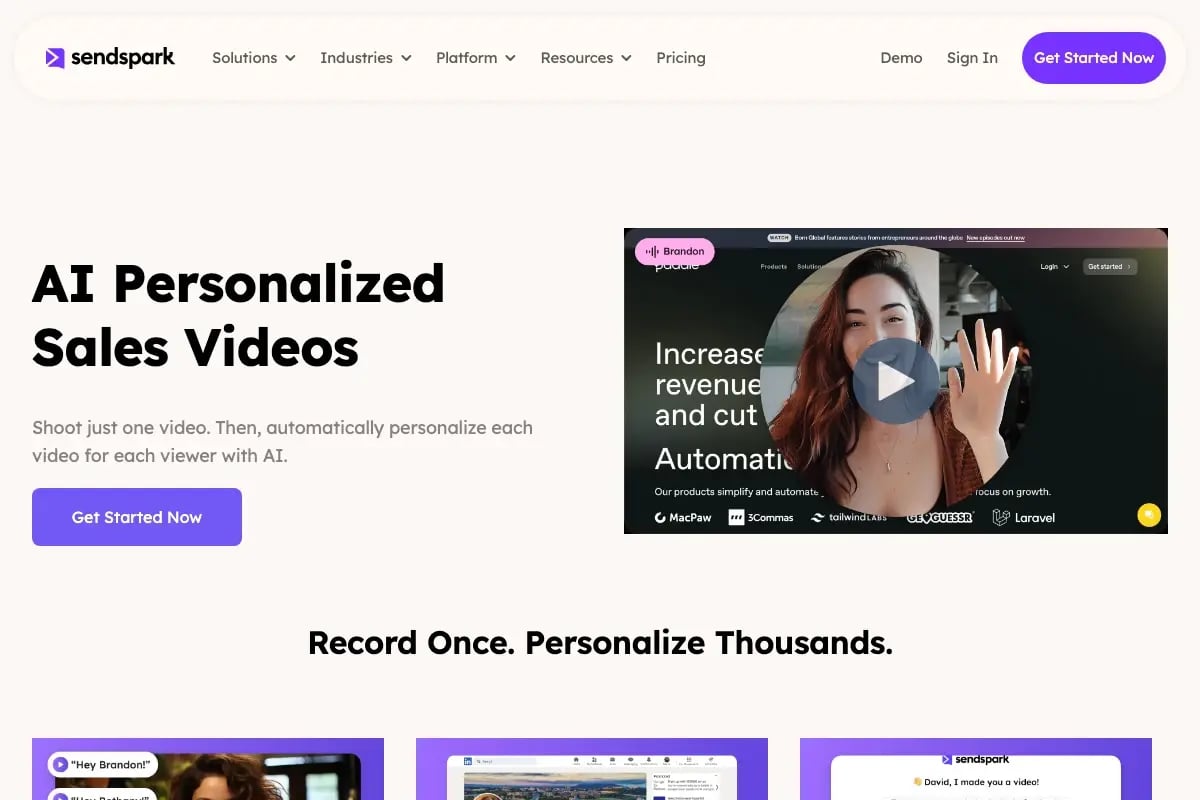
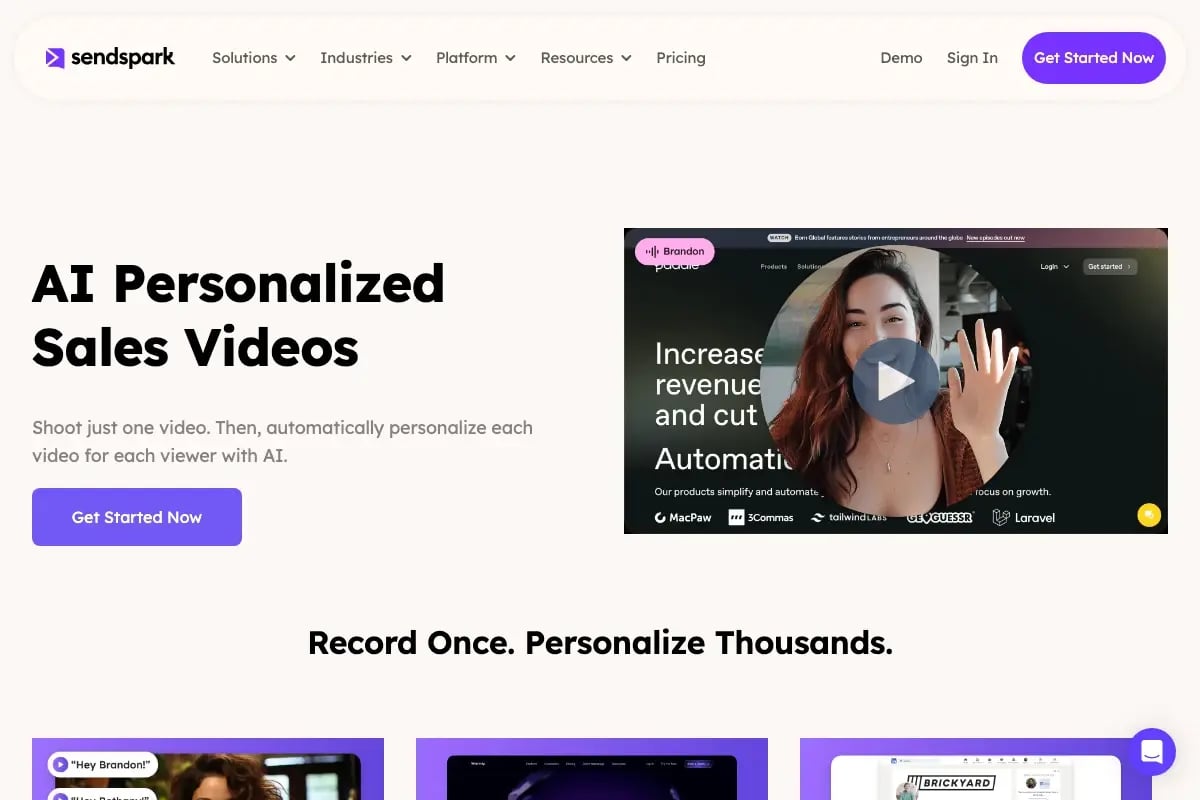
The AI Personalized Video feature handles the voice layer, but the visual personalization layer is equally important. Dynamic backgrounds automatically pull in each prospect’s own website or LinkedIn profile as the background of your video — so when a VP of Sales at Acme Corp opens their email, they see your face, hear their name, and see their own homepage behind you. This is not a graphic overlay or a static screenshot. The background is live, current, and specific to that prospect. Combined with personalized thumbnails that display the prospect’s name and company logo in the email preview, the click-through rate difference is measurable before anyone even hits play.
Sendspark’s Combined Videos feature adds another layer that’s particularly useful for account-based prospecting. You can merge a short, personalized AI intro with a reusable product demo or explainer video. The intro addresses the specific prospect — their name, their company, a relevant pain point — and then transitions seamlessly into the same high-quality demo you use for all prospects. This means your best-performing demo content works harder without requiring you to re-record it for every outreach. For more on how this compares across video prospecting platforms, see our roundup of the best video prospecting tools.
The integrations ecosystem makes all of this practical inside existing sales workflows. Sendspark connects directly with HubSpot and Salesforce, so personalized videos can be triggered from CRM contact records, embedded in email sequences, and tracked with engagement data that flows back into your pipeline. Across more than 50 platforms, the goal is the same: personalized video should fit into how your team already sells, not require you to build a new process around it.
Record One Video. AI Personalizes Thousands.
Sendspark is the AI video personalization platform for B2B sales. Record once, and AI voice cloning generates thousands of individually personalized videos with dynamic backgrounds and personalized thumbnails — each prospect hears their name, sees their website, in your voice. Sales teams see 2-3x more replies.
Get Started NowAgentic Video Workflows: The 2026 Competitive Edge
The most significant capability gap between Sendspark and Vidyard in 2026 is not a feature — it’s an architectural difference in how video fits into the modern sales motion. Sendspark’s Growth plan introduces agentic video workflows: automated pipelines that research prospects, detect intent signals, and trigger personalized video generation without a salesperson manually initiating each step. Vidyard has no equivalent capability. Every Vidyard video — AI avatar or otherwise — requires a human to set it up individually.
To understand why this matters, consider the signal-based outreach model that leading SDR teams have adopted. Instead of prospecting on a fixed cadence regardless of buyer behavior, signal-based outreach triggers contact when a prospect demonstrates intent — visiting a pricing page, downloading a whitepaper, being active on LinkedIn in a relevant topic area, or showing up in intent data from tools like G2 or Bombora. The problem with this model historically was that even when you had the right signal at the right time, creating a personalized video for that prospect still required manual work. Agentic video workflows close that gap entirely: when a prospect intent signal fires, Sendspark can automatically generate and deliver a personalized video without human intervention.
⚡ Pro Tip: Clay + Sendspark Agentic Workflow
Clay is a lead enrichment and workflow automation platform used by many high-performing SDR teams. By connecting Clay to Sendspark, you can build a fully automated video personalization pipeline: Clay enriches prospect data (company size, tech stack, recent funding, job changes), passes that data to Sendspark as personalization variables, and Sendspark generates a personalized video for each contact — all without a salesperson touching a single record. This is what an automated video personalization pipeline looks like in practice: high-volume, signal-triggered, genuinely personalized at the individual level.
The Clay and Sendspark integration is the clearest example of what agentic video workflows produce. Clay handles prospect research and enrichment — pulling in firmographic data, technographic signals, LinkedIn activity, and funding events — and feeds structured variables into Sendspark. Sendspark takes those variables and generates personalized videos at scale, incorporating the prospect’s name via AI voice cloning and pulling their website as a dynamic background. The result is a multi-touch video sequence where every touchpoint feels handcrafted, even though the pipeline runs automatically from the moment a lead enters the system.
This is a meaningful shift in how sales teams think about intent-based video triggers. Rather than video being a high-effort tactic reserved for top-tier accounts, agentic workflows make personalized video viable across the entire prospecting motion. An SDR can set up the workflow once, define the intent signals that should trigger outreach, connect their enrichment source, and let the pipeline run — with Sendspark generating fresh personalized videos as new prospects qualify. For teams doing high-volume outbound across multiple verticals, this removes the bottleneck that has historically made truly personalized video impractical at scale. You can explore how this applies to your team at Sendspark’s sales prospecting solutions page, and read the full methodology in our comprehensive guide to AI video personalization for outbound sales.
Sendspark vs Vidyard: Feature-by-Feature Comparison
Direct feature comparisons between AI video personalization platforms require precision because the platforms are genuinely strong in different contexts. Sendspark is purpose-built for high-volume, personalized cold outreach — SDRs and BDRs sending video at scale. Vidyard remains a capable platform for video hosting, analytics, and individual AE-level communication. The table below reflects both strengths honestly.
| Feature | Sendspark | Vidyard |
|---|---|---|
| AI Personalization Method | AI voice cloning + dynamic backgrounds + personalized thumbnails | AI avatars generated from scripts |
| Generation Speed | Seconds per batch (thousands at once) | ~20 min per minute of video (one at a time) |
| Scalability | 1 recording → thousands of unique prospect videos | Each script generates 1 video |
| Agentic Workflows | Yes — Growth plan and above | No — manual setup required per prospect |
| Starting Price (AI Features) | $49/month (Solo) | $89/month (Starter) / $300+/month (Business) |
| CRM Integrations | 50+ platforms including HubSpot and Salesforce | Major CRM platforms only |
| Clay Integration | Yes — full agentic pipeline support | No native support |
| Best For | SDRs and BDRs doing high-volume personalized cold outreach | AEs needing video hosting, deal summaries, and analytics |
For a broader view of how these platforms sit within the full landscape of video sales tools, see our detailed Loom vs Vidyard comparison and our personalized video guide, which covers how personalization affects pipeline metrics across different use cases.
Total Cost of Ownership and ROI for Sales Teams
When you evaluate AI video personalization platforms on total cost, the price-per-seat comparison understates the real difference. Sendspark’s Solo plan at $49/month includes AI voice cloning and dynamic backgrounds — the core personalization features — while Vidyard requires its $89/month Starter plan before AI capabilities become available, and full business-grade AI access runs $300+/month. At the team level, Sendspark’s Growth plan is $99/month, its Team plan is $299/month, and its Business plan is $699/month. The ROI case depends not just on price but on what each dollar produces.
HubSpot research consistently shows that video in sales outperforms text-only email on open rates, response rates, and meeting bookings — but the degree of personalization is the variable that determines the magnitude of improvement. Generic video performs modestly better than generic text. Deeply personalized video — where the prospect hears their name, sees their brand, and receives a message tailored to their context — performs dramatically better. This is the gap Sendspark is built to exploit at scale.
The verified performance metrics from Sendspark customers bear this out. Sales teams using Sendspark’s AI video personalization platform report 200–300% increases in email reply rates compared to text-only cold outreach. Click-through rates on personalized video thumbnails run approximately 50% higher than static image previews. Teams converting prospects to first meetings report 40–50% more meetings booked after integrating personalized video into their sequences. These are not projections — they reflect outcomes from teams actively using the platform across B2B SaaS, professional services, and technology verticals.
Two customer cases illustrate what this looks like in practice. Warmly, a pipeline intelligence company, used Sendspark’s AI video personalization platform to re-engage closed-lost leads — prospects who had previously been through a full sales cycle and gone dark. By deploying personalized videos that referenced each prospect by name, acknowledged their specific previous conversations, and addressed updated product capabilities relevant to their use case, Warmly generated $100K in new ARR within a single month from a list that most teams would have written off. Brikl, a B2B e-commerce platform, integrated personalized video into its outbound demo request process and recorded a 43% increase in demo bookings — a result directly attributable to the higher engagement rates from video that felt individually crafted rather than broadcast. For full details on team-level pricing and plan features, Sendspark’s pricing page outlines current tiers and what each includes.
Frequently Asked Questions
What is the best Vidyard alternative for B2B sales teams?
For B2B sales teams focused on high-volume personalized outreach, Sendspark is the strongest Vidyard alternative in 2026. It is purpose-built as an AI video personalization platform for SDRs and BDRs, with AI voice cloning, dynamic backgrounds, and agentic workflow capabilities that Vidyard does not offer. Teams that primarily need video hosting and deal-room functionality may find Vidyard still fits their specific use case, but for prospecting at scale, Sendspark is the more appropriate platform.
How does Sendspark compare to Vidyard for AI video personalization?
Sendspark uses AI voice cloning combined with dynamic backgrounds and personalized thumbnails to generate thousands of unique videos from a single recording — each prospect hears their own name in the salesperson’s real voice and sees their own website as the video background. Vidyard’s AI Avatars generate a synthetic avatar from a written script, produce one video per script, and take roughly 20 minutes per minute of video to render. The approaches are fundamentally different in both method and scale.
Can Sendspark replace Vidyard for enterprise sales teams?
It depends on use case. For enterprise SDR and BDR teams doing outbound prospecting at volume, Sendspark fully replaces Vidyard and outperforms it on the dimensions that matter most: personalization depth, generation speed, scalability, and CRM integration breadth. For enterprise AEs who rely heavily on Vidyard’s video hosting, detailed viewer analytics, and internal enablement content distribution, there may be a transitional period or a case for running both platforms for different functions. Most enterprise customers find Sendspark handles the outbound motion end-to-end.
How much does Sendspark cost compared to Vidyard?
Sendspark’s AI-capable plans start at $49/month (Solo), with Growth at $99/month, Team at $299/month, and Business at $699/month. Vidyard’s AI features begin at $89/month (Starter) and scale to $300+/month for Business-tier AI access. Vidyard does offer a $19/month Pro plan, but it does not include AI personalization features. At comparable capability levels, Sendspark runs materially less expensive while offering greater personalization capability and agentic workflow features Vidyard does not provide.
What integrations does Sendspark have that Vidyard lacks?
Sendspark integrates with 50+ platforms, including HubSpot, Salesforce, Clay, Salesloft, Outreach, Apollo, and dozens of additional sales engagement and CRM tools. The Clay integration enables fully automated video personalization pipelines — a capability Vidyard has no equivalent for. Vidyard supports the major CRM platforms but does not offer the same breadth of sales engagement tool integrations or any native agentic workflow support.
Does Sendspark have agentic video workflows like Clay integration?
Yes. Sendspark’s Growth plan and above support agentic video workflows, including a native Clay integration. This enables fully automated pipelines where Clay enriches and qualifies prospects, passes personalization variables to Sendspark, and Sendspark generates personalized videos — all without manual intervention per prospect. Intent-based video triggers can be configured so that when a prospect fires a qualifying signal, the video is generated and delivered automatically as part of a multi-touch video sequence.
How long does it take to switch from Vidyard to Sendspark?
Most sales teams are generating their first personalized videos within the same day they sign up for Sendspark. The core workflow — recording your base video and uploading your prospect list — takes under an hour for first-time users. CRM integrations with HubSpot or Salesforce connect in minutes. Configuring agentic workflows with Clay or other enrichment tools typically takes a few hours of initial setup. There is no lengthy onboarding period or professional services requirement for the core personalized video use case.
Record One Video. AI Personalizes Thousands.
Sendspark is the AI video personalization platform for B2B sales. Record once, and AI voice cloning generates thousands of individually personalized videos with dynamic backgrounds and personalized thumbnails — each prospect hears their name, sees their website, in your voice. Sales teams see 2-3x more replies.
Get Started NowSources & References
- HubSpot Research — “The State of Video in Sales,” documenting video’s impact on response rates and meeting bookings in B2B outreach. HubSpot Research
- Salesforce — “State of Sales 2025,” covering AI adoption in sales teams and buyer trust signals in digital outreach. Salesforce State of Sales 2025
- Warmly.ai — Case study documenting $100K ARR generated from closed-lost re-engagement using Sendspark’s AI video personalization platform. Warmly.ai
- Brikl — Case study documenting 43% increase in demo bookings following integration of personalized video into outbound sequences. Brikl.com
- Sendspark — Comprehensive guide to AI video personalization for outbound sales
- Sendspark Blog — Personalized video guide
- Sendspark Blog — Video for sales: strategies and benchmarks
- Sendspark Blog — Best video prospecting tools in 2026
- Sendspark Blog — Loom vs Vidyard: video tools feature comparison
Topics: blog