Vidyard built its reputation as a video hosting platform for enterprise teams. But in 2026, the core question for most sales teams isn't "where do I host my videos?" — it's "how do I send thousands of personally relevant videos without burning out my reps?" That question has a very different answer. Sendspark has evolved into a full AI video personalization platform built specifically for B2B outreach, and the gap between these two tools has never been wider.
Key Takeaways
- Sendspark is built for personalized video outreach at scale — record one video, and AI voice cloning generates thousands of individually tailored versions. Vidyard is built for video hosting and internal communications.
- Sendspark's AI voice cloning, dynamic backgrounds, and personalized thumbnails are features Vidyard does not offer at comparable depth for outbound sales.
- Sales teams using Sendspark report 2-3x more email replies and up to 50% more meetings booked, compared with generic video outreach.
- Sendspark starts at $49/month (Solo) versus Vidyard's higher enterprise-tier pricing — making it the more accessible option for individual SDRs and growing teams.
- If your team needs deep video analytics, internal video libraries, or enterprise-grade video hosting, Vidyard remains a strong choice. If you need personalization at scale for outbound, Sendspark wins.
Sendspark vs Vidyard at a Glance: The 2026 Comparison
The short answer: if you want a video sales platform that generates individually personalized videos at scale using AI, Sendspark is the stronger choice in 2026. If your priority is enterprise video hosting with deep analytics for internal and marketing use cases, Vidyard still delivers. But for outbound sales teams — SDRs, BDRs, AEs — Sendspark's AI-first architecture changes the math on what's possible.
Here's a direct side-by-side across the criteria that matter most for sales teams:
| Criteria | Sendspark | Vidyard |
|---|---|---|
| Primary use case | AI personalized video outreach for B2B sales | Video hosting, internal comms, marketing |
| AI voice cloning | Yes — core feature, available on Growth+ | No (AI avatars available, different approach) |
| Dynamic backgrounds | Yes — prospect's website, LinkedIn, custom | Limited |
| Personalized thumbnails | Yes — auto-generated per prospect | Basic custom thumbnails |
| Agentic workflows | Yes — Growth plan and above | No |
| Record once, personalize thousands | Core capability | Not available |
| CRM integrations | HubSpot, Salesforce, Outreach, Salesloft | HubSpot, Salesforce, Salesloft, Outreach |
| Analytics | View tracking, engagement, CTA clicks | Deep video analytics, heatmaps, viewer ID |
| Ease of use | Quick setup, rep-friendly interface | More configuration required for enterprise features |
| Starting price (2026) | $49/mo (Solo), $99/mo (Growth, 3 seats) | Free tier available; Pro and enterprise tiers higher |
| Best for | SDRs, BDRs, AEs doing outbound at scale | Enterprise video libraries, marketing, enablement |
| Setup time | Under 10 minutes to first personalized video | Varies; enterprise onboarding can take days |
| Ideal team size | Solo reps to growing sales teams (1-100+) | Mid-market to enterprise (50-5,000+) |
On pricing alone, the 2026 reality is clear. Sendspark's full pricing page shows plans starting at $49/month for solo reps, $99/month for the Growth plan (3 seats, 20,000 videos/month, API access, and agentic workflows), $299/month for Team, and $699/month for Business. That's a dramatically lower entry point than Vidyard's comparable feature tiers — particularly relevant for SDR teams that need scale without an enterprise contract.
Why Sales Teams Are Switching from Vidyard to Sendspark in 2026
The core reason sales teams are moving away from Vidyard comes down to a fundamental product philosophy mismatch. Vidyard was built to solve a hosting and analytics problem. Sendspark was built to solve a personalization and rep capacity problem. In 2026, the latter is where most outbound teams feel the most pain.
According to Salesforce's State of Sales report, sales reps spend less than 30% of their time actually selling — the rest goes to administrative tasks and content creation. Manually recording a personalized video for every prospect is simply not sustainable at the volume modern SDR teams need to hit. A rep sending 50 to 100 outbound touchpoints per day cannot record 50 to 100 unique videos. This is where the record once, personalize thousands model that Sendspark offers fundamentally changes what's possible.
Vidyard's AI strategy in 2026 has focused on AI avatars — synthetic video representations of a rep that can be generated at scale. The problem is that prospects are getting better at spotting AI-generated content. Gartner research on the B2B buying journey confirms that buyer trust in sellers has been declining, and anything that feels artificial compounds that trust deficit. This is what insiders call the AI authenticity tax — when prospects perceive a video as AI-generated rather than genuinely human, engagement drops.
Sendspark takes a different approach entirely. Instead of replacing the rep with an avatar, it clones the rep's actual voice and overlays genuine personalization signals — the prospect's company website as a live background, their name spoken naturally, personalized thumbnails that stop the scroll. The video still sounds and feels like the rep. It just scales to thousands of prospects in minutes. That distinction matters enormously for reply rates.
Teams using Sendspark for SDR prospecting consistently report 2 to 3 times more email replies and 40 to 50% more meetings booked compared to generic video outreach. That's not a small efficiency gain — it's the difference between a campaign that misses quota and one that exceeds it.
"Personalization at scale is the holy grail of modern sales outreach. The teams that figure out how to be genuinely relevant to each buyer — without burning out their reps — are the ones consistently beating their numbers."
— Insight consistent with Gong's sales engagement research, which shows personalized outreach significantly outperforms templated approaches across industries.
Record One Video. AI Personalizes Thousands.
Sendspark is the AI video personalization platform for B2B sales. Record once, and AI voice cloning generates thousands of individually personalized videos with dynamic backgrounds and personalized thumbnails — each prospect hears their name, sees their website, in your voice. Sales teams see 2-3x more replies.
Get Started NowAI Voice Cloning and Dynamic Backgrounds: The 2026 Differentiator
The most significant development in personalized video outreach in 2026 is the shift from "personalized-looking videos" to genuinely prospect-aware video — content that is contextually unique to each recipient at both the audio and visual level. Sendspark's combination of AI voice cloning and dynamic backgrounds is the clearest expression of this shift, and it's the feature category where the gap between Sendspark and Vidyard is widest.
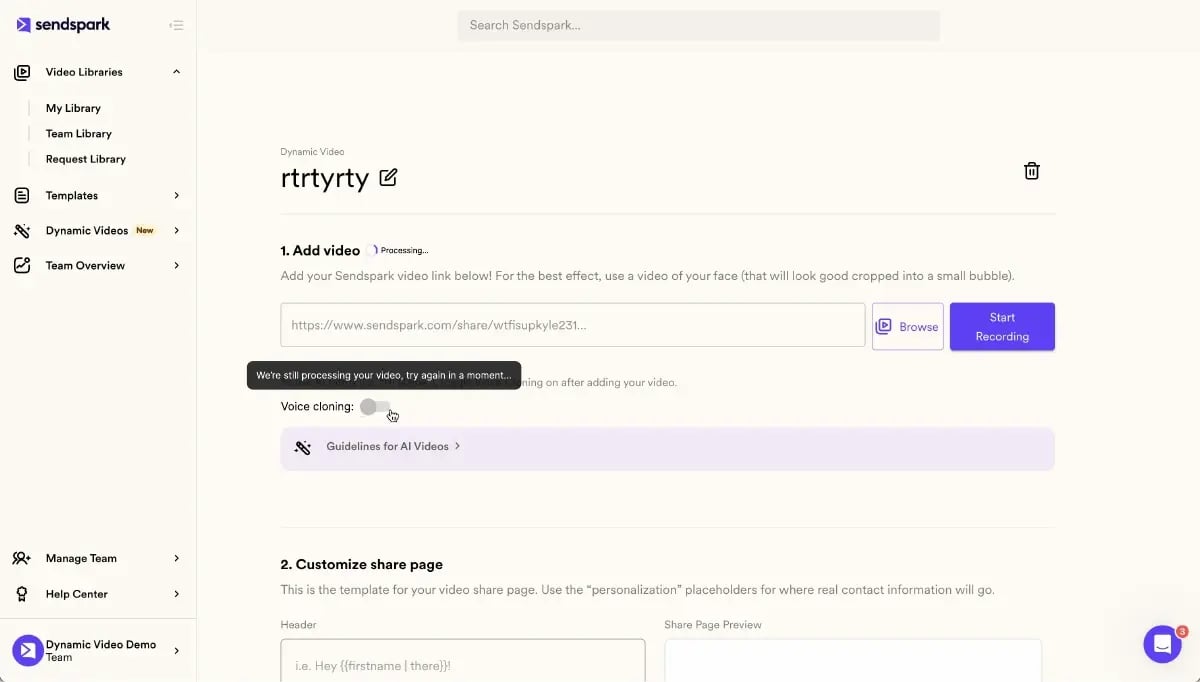
Here's how it works in practice. A rep records a single base video — their natural introduction, their pitch, their call to action — using Sendspark's AI video personalization platform. Sendspark then uses sender voice replication technology to clone that rep's voice from the recording. When the system generates individual videos for each prospect, it synthesizes the rep's cloned voice to naturally speak each prospect's name, company name, and any other personalized token. The result is a video that sounds genuinely human and specifically addressed — not a robotic text-to-speech overlay, but the actual rep's voice saying each prospect's name. This is human-in-the-loop personalization at its most effective: the rep's authentic voice and energy carry the video, while AI handles the scale.
The dynamic backgrounds feature adds a second layer of personalization that operates at the visual level. Rather than recording in front of a static branded backdrop, Sendspark can pull in live screenshots of a prospect's website, their LinkedIn profile, their company's product page, or any custom URL. The rep appears in front of content the prospect immediately recognizes as their own. This "I did my homework" signal — delivered automatically, at scale — is one of the most powerful engagement triggers in modern outreach. HubSpot's State of Marketing research consistently shows that personalized content drives materially higher engagement than generic alternatives, and dynamic backgrounds operationalize that principle at the individual video level.
Personalized thumbnails complete the picture. Before a prospect even plays the video, they see a thumbnail that includes their name, their company logo, or a screenshot of their website. In an email inbox filled with generic content, a thumbnail that references the prospect directly commands attention. Sendspark generates these automatically for every recipient in a campaign — no manual design work required. Pair that with the AI voice cloning capabilities and you have a system where every touchpoint in a sequence feels like it was created specifically for that one person.
The agentic workflows available on Sendspark's Growth plan take this further still. Rather than requiring a rep to manually trigger each personalization batch, agentic workflows can connect to your CRM or sequencing tool, pull prospect data automatically, generate personalized video batches, and insert them into outbound sequences — all without manual steps per prospect. This is the rep capacity model fundamentally rethought: instead of a rep's output being capped by hours in a day, an agentic workflow extends that rep's personalized touch to every prospect in their pipeline simultaneously. Vidyard's product roadmap has not produced a comparable capability for outbound sales personalization at this level of granularity.
Pro tip
When setting up your first AI voice cloning campaign in Sendspark, record your base video in a quiet environment with consistent mic levels. The voice clone quality improves significantly with clean source audio — a 90-second crisp recording outperforms a 5-minute noisy one every time. Check out Sendspark's video prospecting guide for recording best practices that maximize clone fidelity.
Feature-by-Feature: Where Each Tool Wins
A fair comparison means acknowledging where both tools are genuinely strong. Sendspark dominates on AI personalization depth and outbound sales workflows. Vidyard leads on enterprise video hosting infrastructure and detailed viewer analytics. Knowing exactly where each tool wins helps you make the right call for your team's specific needs.
Recording experience: Both tools offer browser-based recording with webcam, screen, or both. Sendspark's recording interface is designed around quick, rep-friendly workflows — minimal friction, fast upload, immediate sharing link. Vidyard's recording interface is similarly accessible, with the advantage of deeper integration into enterprise video libraries if your org uses Vidyard broadly.
Personalization depth: This is Sendspark's clearest win. Sendspark's video personalization features include AI voice cloning, dynamic backgrounds, personalized thumbnails, and prospect-aware CTAs. Vidyard offers basic personalization elements — name insertion in landing pages, some custom branding — but does not match Sendspark's depth on genuine per-prospect video differentiation.
CRM integrations: Both tools cover the major platforms. Sendspark's HubSpot integration lets reps send personalized videos directly from contact records and track engagement back in the CRM. The Outreach integration embeds Sendspark directly into sequences so reps never leave their primary tool. Vidyard also integrates with HubSpot, Salesforce, Salesloft, and Outreach — the coverage is comparable, though Sendspark's integrations are more focused on triggering and tracking personalized sends at scale.
Analytics: Vidyard holds a genuine advantage here, particularly for teams that need granular viewer-level data. Vidyard's analytics include detailed heatmaps, viewer identification, re-watch data, and engagement scoring that integrates into marketing automation. Sendspark provides meaningful engagement tracking — who watched, how long, CTA clicks, reply triggers — sufficient for most sales workflows, but it's not trying to be a full marketing analytics platform.
Brand customization: Sendspark allows full white-label video landing pages, custom domains, branded CTAs, and team-level branding controls. Vidyard offers comparable customization at enterprise tiers. For smaller teams on Sendspark's Growth or Team plans, the branding controls are accessible without an enterprise contract.
Pricing transparency: Sendspark publishes clear, self-serve pricing. Vidyard's higher-tier pricing requires contacting sales, which adds friction for teams that want to evaluate quickly. For a startup SDR team or a mid-market sales manager evaluating tools in a single afternoon, Sendspark's pricing model removes a real barrier.
Worth knowing
If your organization already uses Vidyard for internal video communications, marketing video hosting, or employee onboarding content, switching entirely may not make sense. Many teams run both tools: Vidyard for internal and marketing use cases, Sendspark for outbound sales personalization. The tools aren't mutually exclusive, and the use cases are genuinely different enough that dual-tool setups are common.
Use Case Fit: Which Tool Matches Your Team
The right tool depends entirely on what problem you're solving. Sendspark and Vidyard are not direct substitutes — they've evolved to serve different primary jobs. Here's how to think through fit by role and motion.
SDR and BDR outbound prospecting: Sendspark is the clear choice. The best video email software for an SDR is the one that generates the highest reply rate per hour of rep time invested. Sendspark's record-once-personalize-thousands model means an SDR can run a 500-prospect campaign with individually personalized videos in the same time it used to take to record 10 manual videos. The ROI math favors Sendspark significantly. For more on this motion, see the personalized vs. generic video ROI comparison.
AE deal progression: Both tools work here, but in different ways. For a video touchpoint mid-deal — a recap of a discovery call, a champion enablement video, a custom ROI overview — Sendspark's quick recording and personalized sharing page works well. Vidyard's deeper analytics can be useful for understanding whether a champion shared your video internally and who watched it, which has real value in complex enterprise deals.
Customer success: Vidyard has traditionally been stronger here, particularly for teams creating onboarding content, how-to libraries, or at-scale customer updates. Sendspark can handle personalized renewal outreach and expansion touchpoints effectively, but it's not primarily designed as a customer knowledge base.
Marketing: Vidyard has a meaningful advantage for marketing teams that need video hosting, gated content, marketing automation integration, and detailed content performance analytics. Sendspark's strengths are in direct outreach rather than content marketing. If you're a B2B marketer running AI personalized video campaigns to prospect lists, Sendspark fits. If you're publishing a video content library, Vidyard is better suited.
The pattern is consistent: Sendspark wins when the job is sending thousands of individually personalized video touchpoints in an outbound or direct sales motion. Vidyard wins when the job is hosting, organizing, and measuring video content at an enterprise level. Most growing B2B sales teams in 2026 have more of the former problem than the latter.
Frequently Asked Questions
Is Sendspark better than Vidyard for sales teams?
For outbound sales teams focused on personalized prospecting and pipeline generation, Sendspark is the stronger choice in 2026. Its AI voice cloning, dynamic backgrounds, and agentic workflows are purpose-built for the scale and personalization demands of modern SDR and AE workflows. Vidyard remains better suited for enterprise video hosting, internal communications, and marketing content libraries.
What is the best Vidyard alternative for SDRs?
Sendspark is the leading Vidyard alternative for SDRs specifically because of its record-once-personalize-thousands capability. An SDR can record a single base video and use AI voice cloning to generate hundreds of individually personalized versions, each with the prospect's name spoken in the rep's voice, a dynamic background showing the prospect's website, and a personalized thumbnail. No other tool combines these three elements as seamlessly for outbound prospecting workflows.
How is Sendspark different from Vidyard?
Sendspark is an AI video personalization platform built for B2B sales outreach. Vidyard is a video hosting and analytics platform built for enterprise-scale video management. The core difference is that Sendspark generates individually personalized videos at scale using AI voice cloning and dynamic backgrounds, while Vidyard focuses on hosting, organizing, and measuring video content. They solve different problems and increasingly serve different buyer personas.
Does Sendspark have AI voice cloning like Vidyard?
Sendspark has AI voice cloning as a core feature of its platform, available on the Growth plan and above. Vidyard's AI approach centers on AI avatars — synthetic video representations — which is a fundamentally different technology. Sendspark's voice cloning replicates the actual rep's voice for personalization, preserving authenticity while scaling output. Vidyard's avatars replace the rep's appearance entirely, which many prospects perceive as less genuine.
Is Sendspark cheaper than Vidyard?
Sendspark's published pricing starts at $49/month for Solo and $99/month for the Growth plan, which includes 3 seats, 20,000 videos per month, API access, and agentic workflows. Vidyard offers a free tier for basic use, but comparable feature tiers for sales teams are priced higher and often require contacting sales. For individual SDRs and growing sales teams, Sendspark offers materially more accessible pricing with transparent, self-serve plans.
Can Sendspark replace Vidyard for HubSpot users?
For HubSpot users focused on sales outreach, Sendspark's HubSpot integration covers the key workflows: sending personalized videos from contact records, tracking engagement, and syncing activity back into HubSpot. If your HubSpot use case includes deep marketing video analytics, gated video content, or large internal video libraries, you may want to keep Vidyard for those specific functions. For outbound prospecting and deal progression inside HubSpot, Sendspark is a complete replacement.
Which is better for personalized video at scale, Sendspark or Vidyard?
Sendspark is designed specifically for personalized video at scale and wins this comparison clearly. The combination of AI voice cloning, dynamic backgrounds, personalized thumbnails, and agentic workflows means a single rep can send thousands of genuinely personalized video touchpoints without recording each one individually. Vidyard does not offer a comparable capability for outbound sales personalization at this level. If scale personalization is the goal, Sendspark is the right platform.
Record One Video. AI Personalizes Thousands.
Sendspark is the AI video personalization platform for B2B sales. Record once, and AI voice cloning generates thousands of individually personalized videos with dynamic backgrounds and personalized thumbnails — each prospect hears their name, sees their website, in your voice. Sales teams see 2-3x more replies.
Get Started NowSources & References
- HubSpot State of Marketing — "Personalized content drives measurably higher engagement than generic alternatives across email and video channels" (2025)
- Gartner B2B Buying Journey Research — "Buyer trust in sellers continues to decline; authenticity and relevance are primary drivers of engagement" (2025)
- Salesforce State of Sales — "Sales reps spend less than 30% of their time actually selling; administrative and content tasks consume the majority of working hours" (2025)
- Gong Sales Statistics — "Personalized outreach significantly outperforms templated sequences across reply rates and meeting conversion" (2025)