Updated September 2026
Recruitment video outreach works because it replaces a wall of text with a human face and voice, and candidates respond to it. Job postings with video get 34% more applications than text-only listings, according to Vouch’s 2026 video recruitment marketing guide, and 72% of candidates say they’re more likely to apply after watching an engaging recruitment video.
Learn more about agency client communications with video.
What’s changed since agencies first started experimenting with recruitment video is the scale problem. Sending one polished video to one candidate is easy. Sending a personalized version of that video to two hundred passive candidates a week, each addressed by name with their own company mentioned, used to require a production team. It doesn’t anymore.
This guide covers why video outreach is now standard practice for recruitment agencies, how AI personalization is changing what “personalized outreach” means at scale, nine practical ways to use video across the recruitment funnel, and how to actually produce videos that convert – not just look good.
Key Takeaways
- Job postings with video receive 34% more applications than text-only postings, and 72% of candidates say video makes them more likely to apply (Vouch, 2026).
- Generic, templated recruiter outreach is losing effectiveness fast – recruitment marketing email engagement fell from 1.2% to 0.8% year-over-year (Pin, 2026) – which is pushing agencies toward personalized, multichannel outreach.
- Asynchronous video screening has gone from a niche tactic to standard practice, with 60% of Fortune 500 companies now using it, up from 23% in 2021.
- AI voice cloning lets an agency record one outreach video and personalize it at scale for hundreds of passive candidates – addressing each by name and company without re-recording.
- Organizations that adopt skills-first, video-supported hiring practices report meaningfully better business outcomes, including a 35% rate of exceeding financial objectives versus 27% for non-adopters (SHRM, 2025).
Why Video Matters for Recruitment Agencies Right Now
Video works in recruitment because it answers questions a job posting can’t: what does this team actually sound like, what’s the day-to-day really like, and is this a real person reaching out or a mail-merge. Vouch’s 2026 video recruitment marketing guide found job postings with video get 34% more applications, and candidates trust current employees speaking on camera three times more than they trust company messaging alone.
That trust gap matters more as candidates get pickier. Vouch also found employee-shared video content gets roughly 2x the click-through rate of brand-shared content on platforms like LinkedIn – a sign that authenticity, not production polish, is what moves candidates to act.
Recruitment agencies are essentially running an outbound sales motion in reverse: instead of pitching a product to a buyer, they’re pitching a role to a candidate, and often pitching the agency itself to a client at the same time. Sendspark’s recruitment industry page covers this dual-audience challenge in more detail, and the same playbook B2B teams use for outbound sales prospecting – personalized video instead of generic outreach – transfers directly to candidate sourcing.
The other shift is on the employer side. Recruitment agencies are increasingly judged on candidate experience the same way sales teams are judged on buyer experience, and 44 days is still the average global time to fill a role. Agencies that use video earlier in the process – job role explainers, candidate FAQs, quick client updates – tend to move candidates through the pipeline faster because fewer questions get stuck in an email thread.
Pro tip
Before scripting a single video, ask your recruiters which three questions candidates ask most in every first call. Turn those into short video answers – they’ll get reused for months.
Why AI Voice Cloning Is Replacing Generic Recruiter Templates for Passive Candidates
AI voice cloning lets a recruiter record one outreach video and have it re-rendered for each passive candidate with their name, target company, and role spoken naturally – without re-recording. This matters because generic templated outreach is losing effectiveness fast: recruitment marketing email engagement fell from 1.2% to 0.8% year-over-year, according to Pin’s 2026 State of Talent Acquisition report.
Passive candidates – the ones not actively job hunting, who make up the majority of strong hires – are the hardest group to reach with a template. They ignore mail-merge subject lines the same way B2B buyers ignore generic cold emails. Pin’s report identifies email, LinkedIn, and SMS together as the emerging baseline for competitive talent-acquisition teams, the same multichannel pattern that outbound sales teams adopted years ago.
This is the same problem Sendspark was built to solve for B2B sales outreach, and the mechanics carry over directly to recruiting. An agency records one video introducing a role or client, and Sendspark’s video personalization and AI intros features – AI voice cloning combined with dynamic backgrounds and personalized thumbnails – generate individually personalized versions for dozens of passive candidates in minutes. Each one hears their own name and sees a thumbnail with their target company, in the recruiter’s own cloned voice. In B2B sales outreach, this kind of personalization at scale drives 200-300% increases in email response rates and 40-50% more meetings booked; recruitment teams applying the same approach to candidate outreach are seeing similar lifts in reply rates compared to static templates. It’s the same mechanic pharma sales teams use to reach HCPs without a bigger commercial budget.
The distribution channel matters as much as the personalization. Most passive candidate outreach still happens over LinkedIn and email, which is why pairing a LinkedIn outreach workflow with personalized video tends to outperform either channel alone – it mirrors the “email plus LinkedIn plus SMS” multichannel pattern Pin’s 2026 report flags as the emerging baseline for competitive talent-acquisition teams. Agencies already running personalized video through LinkedIn report the same kind of reply-rate lift sales teams see when they add video to a cold LinkedIn sequence.
The other piece candidates now expect is asynchronous video screening – recording answers to a fixed set of questions on their own schedule instead of a live call. It has moved from a niche tactic to a mainstream one: 60% of Fortune 500 companies now use asynchronous video screening for initial interviews, up from just 23% in 2021, and 67% of candidates say they prefer it to an unscheduled phone call because they can prepare and answer on their own time.
Advanced strategy
Pair AI-personalized outreach video with an asynchronous screening step for the same role. Candidates who watch a personalized video are more likely to complete a follow-up async screen, which cuts the number of live first-round calls your recruiters have to run.
9 Ways to Use Video Across the Recruitment Funnel
Recruitment agencies get the most value from video when they map it to a specific stage of the funnel instead of producing one generic “about us” clip. Here are nine ways to use it, from first outreach through offer stage.
- Personalized passive candidate outreach: Record one video pitching a role, then use AI voice cloning to personalize a version for each passive candidate with their name and current employer. This is the single highest-leverage use of video in recruiting right now.
- Job role explainers: Short videos detailing responsibilities, required skills, and growth path. These reduce mismatched applications because candidates self-select out before applying, not after the first interview.
- Employee testimonials: Videos of current employees at the client company discussing day-to-day work build more trust than any job description, since candidates trust peers over employer messaging by a wide margin.
- Recruitment process overviews: A short walkthrough of what to expect – stages, timelines, who they’ll talk to – reduces candidate anxiety and cuts down on “what happens next” emails to your recruiters.
- Asynchronous video screening: Replace the unscheduled first-round phone screen with recorded answers to a fixed set of questions, which candidates increasingly prefer and which lets recruiters review faster.
- Client and success story videos: Short videos highlighting a successful placement demonstrate your agency’s track record to prospective clients, not just candidates.
- Video job ads: A 30-60 second video version of a job posting, distributed on LinkedIn and job boards, tends to get more shares and applications than a text-only listing.
- Client update videos: Quick personalized video updates to hiring managers on pipeline progress keep clients engaged without another status-update email.
- Offer-stage videos: A short personal video congratulating a candidate and walking through next steps at offer stage measurably improves the candidate’s final-decision experience during the highest-stakes moment in the process.
Want more detail on the client-facing side of this list? See our guide to agency client communications with video for scripts and cadence recommendations agencies can adapt directly. If you’re comparing tools for the outreach itself, our buyer’s guide to video email platforms breaks down what to look for beyond basic recording. And if you want to see how personalization at scale plays out in a specific niche vertical, our piece on video marketing and AI prospecting for real estate covers the same core mechanics recruitment agencies can borrow for candidate outreach.
Record One Video. AI Personalizes Thousands.
Sendspark is the AI video personalization platform for B2B sales. Record once, and AI voice cloning generates thousands of individually personalized videos with dynamic backgrounds and personalized thumbnails — each prospect hears their name, sees their website, in your voice. Sales teams see 2-3x more replies.
Get Started NowHow to Create Recruitment Videos That Convert
Recruitment videos convert when they’re planned around a specific candidate question, personalized at scale instead of sent as one generic clip, and tracked so you know which ones actually move candidates forward. Here’s how to build that process.
- Plan around one question per video: Don’t try to cover the role, the company, and the process in one clip. A video that answers “what’s the day-to-day like” performs better than one that tries to do everything.
- Personalize at scale, not just at the top: Use AI voice cloning to generate individualized versions of your outreach video for every passive candidate on a list, addressing them by name and referencing their current company, instead of hand-picking a few candidates for personal treatment.
- Use dynamic backgrounds and thumbnails: A thumbnail showing the candidate’s own company name gets more opens in an inbox than a generic headshot thumbnail, the same way personalized landing pages outperform generic ones.
- Invest in clean audio over a fancy camera: Candidates tolerate average video quality; they don’t tolerate audio they have to strain to hear. A decent microphone matters more than a 4K webcam.
- Connect video performance to your ATS or recruitment CRM: Tools like Bullhorn, Loxo, and JobDiva can show you which candidates watched a video and for how long, so recruiters follow up with engaged candidates first instead of working the list cold.
- Track watch-through rate, not just sends: Sendspark’s video analytics show exactly where candidates drop off, so a high send volume with a low watch-through rate tells you the subject line or thumbnail needs work, not the script.
- Keep a consistent cadence: Agencies that post video updates on a predictable schedule build recognition with both candidates and client hiring managers over time.
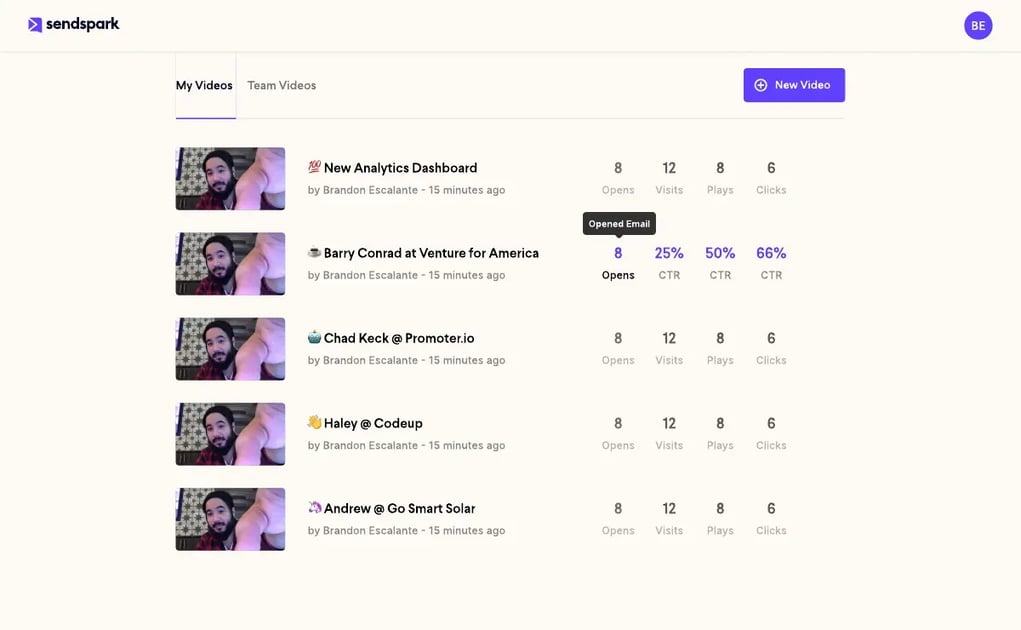
None of this requires a video production background. Most agencies start with a short walkthrough demo to see how the personalization and analytics pieces fit together before rolling video out across their full candidate pipeline.
Common mistake
Sending the same generic outreach video to your entire passive candidate list is barely better than a templated email – candidates can tell. The personalization has to be visible in the first five seconds, not buried in the script.
| Approach | Application Rate Impact | Candidate Trust | Recruiter Time per 100 Candidates |
|---|---|---|---|
| Text-only job posting | Baseline | Low – no human signal | Low (no video production) |
| Single generic outreach video | +34% vs. text-only | Moderate | Low (one recording, sent to all) |
| AI-personalized video at scale | Higher than generic video (name/company personalization drives opens) | High – feels individually addressed | Low (one recording, personalized automatically) |
| Fully custom video per candidate | Highest per-candidate, impossible to scale | Highest | Very high (re-recorded per candidate) |
Frequently Asked Questions
What is recruitment video outreach and why does it outperform email templates?
Recruitment video outreach means reaching candidates with a personal, on-camera video instead of a text template. It outperforms plain email because candidates can see and hear a real person, which builds more trust than a generic message – job postings with video get 34% more applications, per Vouch’s 2026 research.
How much does video increase job application rates?
Job postings with video receive 34% more applications than text-only postings, and 72% of candidates say they’re more likely to apply after watching an engaging recruitment video, according to Vouch’s 2026 video recruitment marketing guide.
What is the best video length for recruitment marketing?
Shorter is generally better: 30-90 second clips work best for job explainers and video job ads, since they’re easy to watch on mobile and easy to share on LinkedIn. Longer testimonial or process-overview videos can run a few minutes if they stay focused on one topic.
Can AI personalize recruitment videos at scale?
Yes. AI voice cloning tools like Sendspark let a recruiter record one outreach video once and generate individually personalized versions for each candidate – addressing them by name and referencing their current company – without re-recording for every person on the list.
Should recruitment agencies use asynchronous video screening?
Most agencies should offer it as an option. Asynchronous video screening has become standard practice, with 60% of Fortune 500 companies now using it for initial interviews (up from 23% in 2021), and 67% of candidates say they prefer it to an unscheduled phone call.
Which recruitment CRMs and ATS platforms integrate with video outreach tools?
Common recruitment CRMs and applicant tracking systems like Bullhorn, Loxo, and JobDiva can track video engagement alongside other candidate activity, letting recruiters see who watched a video and prioritize follow-up with engaged candidates first.
How do you measure ROI on recruitment video content?
Track application rate lift versus text-only postings, watch-through rate per video, and how quickly video-engaged candidates move through your pipeline compared to non-engaged candidates. Time-to-fill and cost-per-hire are the downstream metrics that show whether video is paying off.
Sources & References
- Vouch — “Job postings with video receive 34% more applications” and “72% of candidates are more likely to apply after watching an engaging recruitment video” (2026)
- Pin — “Recruitment marketing email engagement declined from 1.2% to 0.8% year-over-year” and multichannel (email, LinkedIn, SMS) outreach is becoming the baseline for competitive talent-acquisition teams (2026)
- LinkedIn Talent Blog / Global Talent Trends (via RecRam) — “60% of Fortune 500 companies now use asynchronous video screening for initial interviews, up from 23% in 2021” and “67% of candidates prefer async video screening over surprise phone calls” (2026)
- SHRM — Organizations using skills-first strategies “often or almost always” report better outcomes, including 35% exceeding financial objectives versus 27% for non-adopters (2025)
Record One Video. AI Personalizes Thousands.
Sendspark is the AI video personalization platform for B2B sales. Record once, and AI voice cloning generates thousands of individually personalized videos with dynamic backgrounds and personalized thumbnails — each prospect hears their name, sees their website, in your voice. Sales teams see 2-3x more replies.
Get Started NowTopics: Tips & Tricks