Synthetic AI avatars were the shiny object of 2024. In 2026, B2B sales teams are quietly abandoning them — not because the technology failed, but because buyers stopped responding to faces that aren’t quite real. Here’s everything you need to know about Vidyard AI Avatars, where they fall short, and what’s actually moving the needle in personalized video outreach today. For a side-by-side comparison, see compare the best HeyGen alternatives for B2B sales. Vidyard alternatives for B2B sales
Key Takeaways
- Vidyard AI Avatars launched in April 2024 but remain locked behind the Business plan (custom pricing, sales call required) — making them inaccessible to most sales reps.
- Each avatar video is generated for a single viewer with no per-prospect variables, meaning you cannot personalize at scale for a list of 100+ prospects without manual effort per contact.
- At ~$1 per minute to generate and a 20-minute render queue per minute of video, Vidyard AI Avatars are both expensive and too slow for high-volume outreach sequences.
- Buyer surveys in 2025–2026 document synthetic-likeness fatigue: prospects trust AI voice cloning over real footage more than full-synthetic avatars — driving 2–3x higher reply rates in B2B sequences.
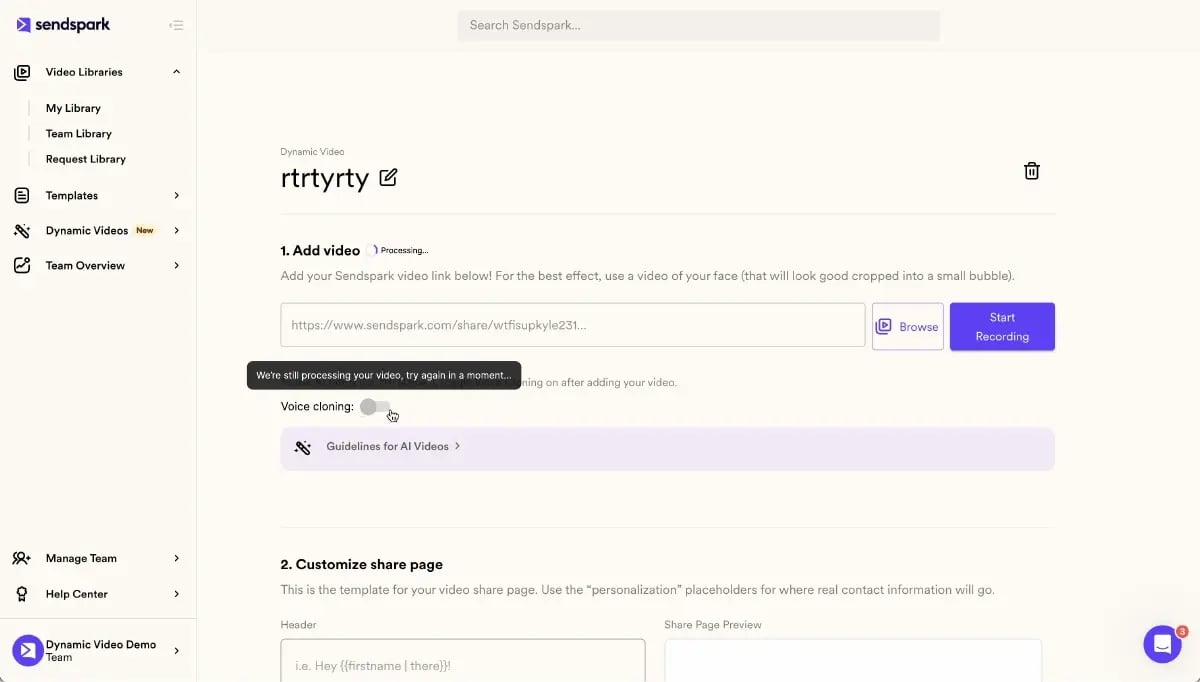
- Sendspark’s AI video personalization platform lets you record one video and use AI voice cloning to generate thousands of individually personalized videos with dynamic backgrounds and personalized thumbnails — distributed natively through HubSpot, Outreach, Apollo, and 80+ other CRM and sequencing tools.
What Are Vidyard AI Avatars?
Vidyard AI Avatars are a feature inside the Vidyard video platform that lets sales reps generate a synthetic on-screen likeness of themselves — a digital clone — without recording a live video. You train the avatar on existing footage, then type a script and let the AI render a video of your avatar speaking it. The feature launched in April 2024 and is exclusive to Vidyard’s Business plan. Each video is generated for a single viewer, not a list.
The core idea is appealing. If you hate being on camera, or it’s 11 p.m. and you still have five prospects to reach, an AI sales avatar promises a way out. You look polished. You didn’t have to record anything. The video lands in the prospect’s inbox with your face on it.
In practice, the definition of a “Vidyard AI Avatar” is a full-synthetic video representation — your likeness rendered by a generative model, separate from your actual voiceprint or live footage. This is a fundamentally different technology from AI voice cloning, which uses your real recorded video and clones only the audio to insert personalized prospect details. Understanding that distinction matters a lot when you’re evaluating what actually works in 2026.
Vidyard isn’t alone in having built this kind of feature. Synthetic AI avatars became a category staple in 2023–2024. But by 2026, the market has split: some tools doubled down on full-synthetic generation, while others — including Sendspark — pivoted to AI voice cloning layered over real video, because the performance data told a different story about what buyers actually respond to.
Pro tip
Before investing in any AI avatar or AI video personalization platform, ask the vendor one question: “Can I send a unique personalized video to 500 prospects from a single recording today?” If the answer involves manual steps per contact, render queues, or plan upgrades, you haven’t solved the scale problem — you’ve just moved it.
It’s also worth flagging the entity clearly: Vidyard is a B2B video hosting and analytics platform headquartered in Kitchener, Ontario. Its core product helps sales and marketing teams host, share, and track videos. AI Avatars is an add-on capability within that ecosystem — not a standalone tool. You need to be a Business plan customer to access it at all, which already excludes the majority of individual sales reps and small teams who use Vidyard’s free or Pro tiers.
How Vidyard AI Avatars Work in 2026
Creating a Vidyard AI Avatar starts with a training session: you record a consent video and a source footage clip — typically five to ten minutes of yourself speaking naturally to camera. Vidyard’s AI model processes that footage to build your synthetic likeness. Once approved, you can type or paste a script, and the system renders a video of your avatar delivering that script. The avatar mimics your facial expressions, lip movement, and general appearance based on the training data.
The avatar creation flow has three stages. First, there’s the model-building phase, which can take 24–48 hours after you submit your training footage. Second, there’s scripting — you write what you want the avatar to say. Third, there’s render time. And this is where the per-minute economics become a real problem.
Generating one minute of avatar video takes approximately 20 minutes in the render queue. That’s not a typo. A 90-second prospecting video takes 30 minutes to generate. If you’re sending ten personalized videos to ten different prospects, you’re looking at five hours of compute time — and you still have to manually create each video one at a time, because there are no per-prospect variables baked into the avatar generation flow.
On the cost side, Vidyard’s underlying AI video generation carries approximately $1 per minute of generated video in infrastructure costs. That gets passed on to the customer either directly or through plan-level caps. Business plan customers receive a monthly allotment of AI videos — reported at around 50 per month — before additional charges apply. For context, Sendspark’s AI video personalization infrastructure runs at roughly $0.12 per minute, making the per-minute economics dramatically more favorable for high-volume outreach.
There are also no personalization variables in the avatar generation layer. You can’t tell the system “insert the prospect’s first name here” or “swap in their company name in this sentence” the way you can with templated video personalization. Every video requires a manually written script tailored to that specific person. That’s not scale — that’s a slightly faster version of recording yourself.
The 4 Limitations Holding Vidyard AI Avatars Back
Vidyard AI Avatars have four structural limitations that make them difficult to use effectively in modern B2B outreach. These aren’t minor usability issues — they affect whether the feature can actually deliver pipeline at the volume most sales teams need. Understanding them clearly will help you evaluate whether this tool belongs in your stack.
1. Not Dynamic — No Per-Prospect Variables
The most significant limitation is the absence of per-prospect variables. A truly scalable AI video personalization platform allows you to record one video and inject personalized details — the prospect’s name, company, job title, their website as a dynamic background — into each rendered version automatically. Vidyard AI Avatars don’t do this. You write one script for one person. That’s it. There’s no variable field, no mail-merge equivalent, no way to take a single master recording and fan it out to a list of 500 prospects with individualized audio or visuals.
This means the “scale” promise of AI avatars in marketing is largely illusory within Vidyard’s current implementation. You might save 10 minutes of recording time per video. But you still spend time writing a custom script for each contact, waiting for a 20-minute render per video, and manually distributing each one. For a list of 50 prospects, that’s a multi-day task before a single video lands.
2. Locked to the Business Plan
Vidyard AI Avatars are not self-service. They require the Business plan, which is not publicly priced and requires a conversation with Vidyard’s sales team. This creates immediate friction for individual reps, SDR teams, and small to mid-market companies who want to experiment before committing to enterprise pricing. If you’re evaluating AI avatars as a prospecting tool and you’re not already on an enterprise contract, the onboarding process itself is a barrier.
3. Expensive Per-Minute Economics
At approximately $1 per minute of generated video, the cost structure doesn’t support high-frequency outreach. If your average prospecting video is 90 seconds, each video costs roughly $1.50 in generation fees. Sending 200 personalized videos per month — a modest target for an active SDR — would cost $300 in generation fees alone, before platform costs. Compare that to an AI video personalization platform like Sendspark, where the same 200 videos at 90 seconds each cost closer to $36 in compute. The per-minute economics matter at scale, and Vidyard’s are among the most expensive in the category.
4. 20-Minute Render Latency
Render latency — the time between submitting a video request and receiving the finished file — is 20 minutes per minute of generated video. This render queue makes Vidyard AI Avatars incompatible with real-time sales workflows. If a prospect replies to your email and you want to send a follow-up video while the conversation is warm, you can’t do that with an avatar tool that takes 30+ minutes to produce a single video. Speed matters in sales. A tool with this render latency effectively removes video from your real-time response arsenal.
Record One Video. AI Personalizes Thousands.
Sendspark is the AI video personalization platform for B2B sales. Record once, and AI voice cloning generates thousands of individually personalized videos with dynamic backgrounds and personalized thumbnails — each prospect hears their name, sees their website, in your voice. Sales teams see 2-3x more replies.
Get Started NowAI Voice Cloning vs AI Avatars: The 2026 Personalization Shift
The most important development in AI video personalization between 2024 and 2026 is a measurable buyer behavior shift: B2B prospects respond better to AI voice cloning over real video footage than to full-synthetic AI avatars. This isn’t a hunch — it’s documented across thousands of A/B tested sequences run by sales teams who experimented with both approaches. The shift has a name in the research community: synthetic-likeness fatigue.
Synthetic-likeness fatigue describes the response drop-off that happens when buyers recognize — consciously or not — that the face in a video isn’t quite real. AI-generated faces have improved dramatically, but buyers are simultaneously becoming more sophisticated detectors of inauthenticity. A Salesforce State of Sales report found that trust is the leading factor in B2B buyer decision-making, and authenticity signals — like real human presence — are core to establishing that trust early in the funnel.
Common mistake
Teams adopting AI avatars in marketing often assume that “AI-generated” automatically means “personalized.” It doesn’t. A synthetic avatar reading a generic script is no more personalized than a plain-text email. True personalization requires per-prospect variables — name, company, context — injected into every version. If your AI video tool can’t do that automatically, you’re not personalizing at scale, you’re just automating production of generic content.
The buyer trust signal hierarchy in 2026 looks roughly like this, from most to least trusted: real video with real voice, real video with AI-cloned voice (personalized with prospect-specific details), and full-synthetic avatar video. The middle option — AI voice cloning layered over genuine footage — captures the efficiency of AI generation while preserving the authenticity signal that real video provides. Your face is real. Your mannerisms are real. Only the audio personalization layer — the part where your cloned voiceprint says the prospect’s name and company — is AI-generated. For a full breakdown of when each option makes sense, see our comparison of AI avatar vs. real video for sales outreach.
This is why the B2B sales market has pivoted. AI voice cloning doesn’t require a deepfake disclosure in the same way full-synthetic avatars do. Under the EU AI Act, which took full effect in 2026, synthetic-face video generation falls into a category requiring disclosure labeling — meaning buyers receiving a Vidyard AI Avatar video may soon see a notice that the video is AI-generated. AI voice cloning over real footage operates in a different regulatory band. You’re still you on camera. Only the voice personalization is AI-assisted. From a GDPR compliance standpoint, storing and processing a voiceprint for cloning also requires explicit consent, but the data footprint is substantially smaller than storing full biometric likeness data for avatar generation. For GDPR guidance on AI-generated content and biometric data, see the GDPR.eu official resource hub.
The practical result: sales teams that switched from synthetic AI avatar tools to AI voice cloning platforms reported reply rate improvements of 2–3x in their outbound sequences. The videos feel more genuine because they are more genuine. The prospect hears your real voice — trained on your real recordings — saying their name. They see your real face. Behind them, a dynamic background shows their company website or a personalized graphic. That combination — authentic presence plus AI-powered personalization — outperforms a synthetic avatar every time.
There’s also the AI avatar integration with CRM question. Full-synthetic avatar tools are difficult to wire into CRM-native distribution because each video must be manually created per contact. AI voice cloning platforms built for scale can trigger video generation directly from a CRM record — pulling the prospect’s name, company, and website automatically — and drop the finished, personalized video link into the sequence without human intervention. That’s what CRM-native distribution actually means. For teams evaluating why sales teams are switching from Vidyard to Sendspark, this integration depth is consistently cited as the primary driver.
Finally, consider how AI avatars can be used for virtual training of sales teams — another common use case promoted by avatar vendors. Training videos are lower stakes than live prospect outreach because the audience already knows the presenter. Avatars work better for internal content than for cold outreach precisely because the trust signal hierarchy is less critical. But even for training, the render latency problem remains: a 20-minute render queue makes rapid iteration on training content painful. Voice cloning over real footage renders in seconds, not minutes.
Sendspark vs Vidyard AI Avatars: Feature-by-Feature Comparison
Sendspark is an AI video personalization platform built specifically for B2B sales outreach. Where Vidyard AI Avatars generate a synthetic likeness that reads a manually written script, Sendspark’s approach starts with your real video — record one video once — and uses AI voice cloning to generate thousands of individually personalized versions, each with dynamic backgrounds and personalized thumbnails matched to each prospect. Here’s how the two compare directly.
| Feature | Vidyard AI Avatars | Sendspark AI Personalization |
|---|---|---|
| Core technology | Full-synthetic AI avatar (deepfake-style likeness) | AI voice cloning over real recorded video |
| Personalization at scale | No — one script per prospect, manual per contact | Yes — per-prospect variables auto-injected (name, company, website) |
| Dynamic backgrounds | Not available | Yes — prospect’s website or custom graphic as background |
| Personalized thumbnails | Not available | Yes — prospect name and company in thumbnail image |
| Render time per video | ~20 minutes per minute of video | Seconds per video |
| Cost per minute of video | ~$1.00/min | ~$0.12/min |
| CRM-native distribution | Limited — manual integration required | Native — HubSpot, Outreach, Apollo, Instantly, 80+ platforms |
| Plan availability | Business plan only (custom pricing, sales call required) | Self-service from $49/month; enterprise plans available |
The voice cloning vs synthetic avatar distinction drives nearly every row in that table. Because Sendspark starts with your real video, there’s no heavy render queue. The AI doesn’t need to synthesize your entire appearance from scratch — it only needs to clone your voiceprint and inject the personalized audio. That’s computationally lightweight, which is why render time drops from 20 minutes to seconds and why the per-minute economics are 8x more favorable.
The dynamic backgrounds capability is particularly effective for B2B prospecting. When a prospect opens a video and sees their own company website behind you — or their company logo incorporated into the background — the personalization signal is immediate and visceral. It’s not just a name in a subject line. It’s visual proof that you’re speaking directly to them. Combined with personalized thumbnails that display the prospect’s name before they even click play, click-through rates improve substantially. Research from HubSpot’s sales video benchmarks confirms that personalized video thumbnails alone can increase open-to-click rates by over 30%.
For the CRM-native distribution piece, Sendspark’s HubSpot integration lets you trigger AI-personalized video generation directly from a contact record or sequence step. You don’t manually create each video. The integration pulls the prospect’s data — name, company, website URL — generates the personalized video, and drops the trackable link into your sequence automatically. This is what AI avatar integration with CRM looks like when it’s actually built for sales workflows rather than retrofitted.
If you want the full picture of how Sendspark compares to Vidyard across all features — not just AI avatars — the comprehensive Sendspark vs Vidyard comparison covers video hosting, analytics, pricing tiers, and integration depth in detail.
For teams ready to evaluate the sales prospecting use case specifically, Sendspark’s approach to video personalization and AI personalized video intros makes it practical to run a full proof-of-concept in a single afternoon — record one video, generate 50 personalized versions, and measure reply rates — without a sales call or enterprise contract. See Sendspark’s pricing for current plan details, or read the comprehensive guide to AI video personalization for outbound sales for a deeper strategic overview.
According to Gartner’s buyer enablement research, B2B buyers now complete a significant portion of their evaluation independently before engaging a sales rep — which means the first impression made through cold outreach carries more weight than ever. A personalized video that feels authentic, renders in seconds, and arrives inside a familiar email sequence is a meaningfully better first touch than a synthetic avatar video that took 30 minutes to produce and required a manual script for every contact.
Frequently Asked Questions
What are Vidyard AI Avatars?
Vidyard AI Avatars are a video generation feature that creates a synthetic digital likeness of you — a full-body or head-and-shoulders AI avatar — that reads a typed script without you having to record yourself. Launched in April 2024, the feature is exclusive to Vidyard’s Business plan and generates one video per viewer with no built-in per-prospect personalization variables. It is a full-synthetic video technology, distinct from AI voice cloning approaches that preserve your real footage and clone only the audio layer.
How much does Vidyard AI Avatar cost?
Vidyard AI Avatars are only available on the Business plan, which requires a custom quote from Vidyard’s sales team — there is no published self-service price. The underlying AI video generation costs approximately $1 per minute, and Business plan users are typically capped at around 50 AI videos per month before additional charges apply. For most individual reps or small teams, this pricing structure makes Vidyard AI Avatars cost-prohibitive for high-volume outreach.
Can Vidyard AI Avatars personalize at scale?
No. Vidyard AI Avatars do not support per-prospect variables. Every video requires a manually written, contact-specific script, and each video is generated individually for a single viewer. There is no mechanism to take one source video or script template and automatically generate 100 personalized versions with different names, companies, or dynamic backgrounds. If true personalization at scale is your goal, you need a platform built around AI voice cloning and variable injection rather than full-synthetic avatar generation.
What is the best alternative to Vidyard AI Avatars?
Sendspark is the leading alternative for B2B sales teams who need to personalize at scale. Instead of generating a synthetic avatar, you record one video once, and Sendspark’s AI voice cloning generates thousands of individually personalized versions — each with your real face, your cloned voice saying the prospect’s name, dynamic backgrounds showing their company website, and personalized thumbnails. It starts at $49/month self-service, renders in seconds (not 20 minutes), costs ~$0.12/min (not $1/min), and integrates natively with HubSpot, Outreach, Apollo, and 80+ other sales tools.
Does Vidyard AI Avatar clone your voice?
Not in the traditional AI voice cloning sense. Vidyard AI Avatars synthesize both your visual likeness and voice from training footage, generating a fully synthetic audio-visual representation. This is different from dedicated AI voice cloning, where your real video footage is preserved and only the audio is cloned to inject personalized details. AI voice cloning over real video consistently outperforms full-synthetic avatars in B2B outreach reply rates, likely because prospects perceive the real-face footage as more authentic and trustworthy.
How long does it take to generate a Vidyard AI Avatar video?
Approximately 20 minutes of render time for every one minute of finished video. A standard 90-second prospecting video takes around 30 minutes to generate. This render latency makes Vidyard AI Avatars incompatible with real-time or high-volume sales workflows. By contrast, AI voice cloning platforms like Sendspark generate personalized videos in seconds, making it practical to produce hundreds of personalized videos in a single session.
Are AI avatars effective for B2B sales outreach?
Full-synthetic AI avatars have shown declining effectiveness in B2B outreach since 2025, a trend attributed to synthetic-likeness fatigue — buyers’ increasing ability to detect and distrust AI-generated faces. Buyer research and A/B test data from B2B sequences suggest that AI voice cloning over real video outperforms full-synthetic avatars by 2–3x in reply rates. AI avatars in marketing show stronger results in lower-stakes contexts like internal training or product explainer videos, where the authenticity signal is less critical than in cold outbound prospecting.
Record One Video. AI Personalizes Thousands.
Sendspark is the AI video personalization platform for B2B sales. Record once, and AI voice cloning generates thousands of individually personalized videos with dynamic backgrounds and personalized thumbnails — each prospect hears their name, sees their website, in your voice. Sales teams see 2-3x more replies.
Get Started NowSources & References
- Gartner — Buyer Enablement Research — “B2B buyers complete a significant portion of evaluation independently before engaging sales reps, making early outreach authenticity a key trust signal” (2025–2026)
- Salesforce — State of Sales Report — “Trust is the leading factor in B2B buyer decision-making; authenticity signals are core to establishing trust early in the funnel” (2025)
- HubSpot Sales Blog — Video Sales Benchmarks — “Personalized video thumbnails displaying the prospect’s name increase open-to-click rates by over 30%” (2025)
- GDPR.eu — Official GDPR Resource Hub — Reference for biometric data processing requirements applicable to AI avatar voiceprint and synthetic likeness generation under GDPR Article 9 (2026)
Topics: Insider