Account-based marketing works — when you have concrete examples to learn from, not just theory. This article breaks down 7 real ABM campaign examples from B2B sales and marketing teams, covering what they did, which channels they used, and the results they measured. Each example is built around a repeatable tactic, not a one-off stunt that only worked once.
Key Takeaways
- Account-based marketing delivers 200% higher ROI than broad outbound when targeted correctly, according to Forrester Research — but only when sales and marketing agree on the target account list first.
- The most effective ABM campaigns combine at least 3 channels simultaneously: personalized video, LinkedIn outreach, and either direct mail or targeted ads.
- Personalized video is the highest-response ABM touchpoint — B2B sales teams using AI-personalized video report 2-3x more replies from target accounts versus text-only email.
- The 7 examples here span different industries, deal sizes, and team sizes — all built around repeatable tactics you can adapt.
- The fastest path to ABM results: start with a tight target account list of 25-50 accounts before scaling to hundreds.
What Makes a Great ABM Campaign? (Before the Examples)
A great ABM campaign does three things: it targets accounts that match your ideal customer profile precisely, it delivers a level of personalization that generic email blasts cannot match, and it coordinates multiple channels so the prospect sees consistent, relevant messaging from several directions at once. Without all three, it’s just expensive prospecting.
According to Forrester Research, organizations with aligned sales and marketing ABM programs report 200% higher ROI than those running outbound without account-based targeting. The difference comes down to focus: instead of casting a wide net, ABM concentrates resources on a defined list of high-value accounts that are most likely to close.
Check out our guide on referral program strategies to learn more.
How We Evaluated These Examples
We selected these 7 account-based marketing examples based on three criteria: the tactic must be replicable by a B2B team without a Fortune 500 budget, results must be specific rather than vague (“higher engagement”), and the approach must be relevant to the current B2B buying environment — multi-stakeholder, digitally-native, and research-heavy. Each example illustrates a different channel or personalization technique so you get a range to choose from.
The examples draw from patterns shared by practitioners in B2B sales communities and align with findings from Gartner’s ABM research, which shows that 75% of B2B buyers now involve 3 or more stakeholders in purchase decisions — a core reason why ABM’s multi-channel, multi-contact approach outperforms single-thread outreach.
Pro tip
Before picking a tactic from this list, nail your target account list first. The best ABM campaigns start with 25-50 accounts that you know deeply — not 500 accounts you know superficially.
Example 1: Personalized Video Campaign for Enterprise SaaS Prospects
A B2B SaaS company targeting mid-market HR platforms ran a personalized video campaign for 40 target accounts. Each prospect received a 60-second video showing their own company’s careers page as the background, with a voiceover mentioning their team size and a specific job posting the rep had noticed — all generated automatically at scale, not recorded individually. Reply rates ran at 34% across the campaign, compared to a baseline of 11% for plain-text cold email.
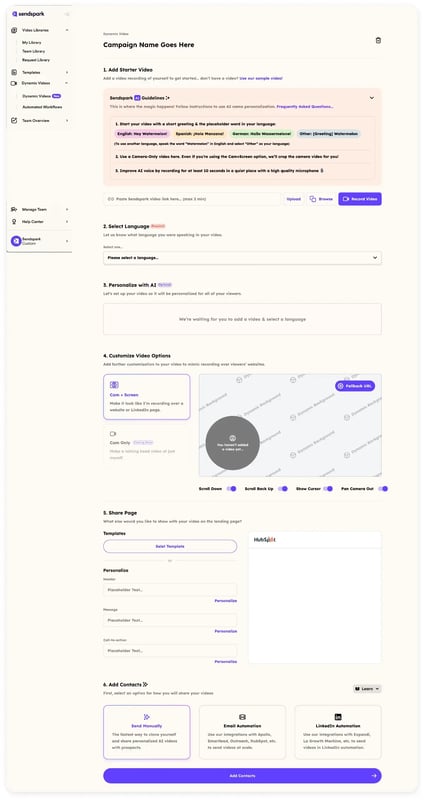
The key ingredient was AI-powered personalization at scale. Instead of recording 40 individual videos, the sales rep recorded one video once, then used Sendspark’s AI personalization to automatically customize the intro for each account — name, company, and dynamic background — without re-recording anything.
What They Did
- Built a target account list of 40 HR platform companies, filtered by headcount (200-1,000 employees) and active job postings
- Recorded one core video explaining their value proposition
- Used AI personalization to generate unique intros for each account showing the prospect’s careers page as the video background
- Sent via Gmail with a video thumbnail in the subject line: “Quick note for [First Name] — saw you’re hiring [Role]”
- Followed up with a LinkedIn connection request 48 hours after the email
Results
- 34% reply rate on initial video email (vs. 11% text baseline)
- 12 discovery calls booked from 40 accounts targeted
- 3 closed deals within 90 days — all above $50K ACV
The personalization depth is what separated this from a standard video email blast. Prospects who replied most frequently mentioned “the fact you showed our actual site” as the reason they responded. That level of signal can only be achieved through genuine account-specific research or AI personalization — and the AI route scales. For more on how AI personalization affects ABM results, see our deep-dive on AI personalization in ABM campaigns.
Example 2: LinkedIn + Direct Mail Combo for Financial Services
A fintech company selling compliance software to regional banks combined LinkedIn messaging with physical direct mail — a handwritten note and a small relevant gift — for a list of 30 target accounts. The LinkedIn message arrived first to warm up the decision-maker, then the physical package followed 5 days later. Meeting booking rate hit 28% of targeted accounts, more than triple the team’s previous cold email rate.
The sequence mattered as much as the individual components. LinkedIn InMail alone rarely converts for high-value accounts because decision-makers receive dozens of connection requests and messages per week. The physical package stood out precisely because it arrived after digital contact had already been made.
What They Did
- Identified the VP of Compliance or Chief Risk Officer at each of 30 regional banks
- Sent a LinkedIn connection request with a short, non-pitchy message referencing a recent regulatory update affecting their sector
- Mailed a handwritten note (on branded notecards) and a small gift — a relevant industry report in physical book form — to their business address
- Followed up by email 3 days after the package was expected to arrive, referencing both the LinkedIn message and the package
Results
- 28% meeting booking rate from 30 accounts
- Average deal size of the booked meetings: $85K ARR
- Direct mail cost per account: approximately $35, yielding a pipeline value far exceeding the investment
According to the Demand Gen Report’s B2B Buyer survey, 66% of B2B buyers say vendor personalization at the account level influences their decision to engage. This campaign delivered that personalization physically — a channel almost no other vendor was using.
Example 3: Intent-Data-Triggered Outreach for B2B Tech
A sales intelligence platform used its own intent data product to identify companies actively researching competitor tools, then triggered a targeted outreach sequence to those accounts within 24 hours of the intent signal. The combination of timing (reaching prospects at peak research interest) and relevance (directly addressing what they were searching for) produced a 41% email open rate and a 19% reply rate — well above industry averages.
Intent data changes the timing equation in ABM. Most outreach hits prospects at a random point in their buying journey. Intent-triggered outreach hits them when they are actively considering a purchase decision — the moment they are most receptive to relevant information.
What They Did
- Used intent data (from their own platform, supplemented by Bombora signals) to flag accounts showing 3+ intent signals for competitor category keywords in the past 14 days
- Triggered an automated 3-email sequence the day an account crossed the signal threshold
- Personalized each email with the specific intent topics detected — for example, if an account was researching “sales engagement platform integrations,” the email opened by addressing that exact use case
- Added a video thumbnail in email 2 showing the rep doing a live demo comparison for their specific use case
Results
- 41% email open rate (vs. 22% industry average for B2B sales sequences)
- 19% reply rate on the 3-email sequence
- Pipeline generated: $1.2M in 60 days from 200 triggered accounts
Record One Video. AI Personalizes Thousands.
Sendspark is the AI video personalization platform for B2B sales. Record once, and AI voice cloning generates thousands of individually personalized videos with dynamic backgrounds and personalized thumbnails — each prospect hears their name, sees their website, in your voice. Sales teams see 2-3x more replies.
Get Started NowExample 4: Executive Gifting Campaign to Unlock Stalled Deals
A revenue management software company had 15 deals stalled at the final stage — procurement delays, executive sign-off pending, or internal budget reviews holding things up. Instead of sending another follow-up email, the sales team ran a targeted gifting campaign: a personalized package sent directly to each economic buyer, paired with a brief video message referencing the specific stall reason. Eight of the 15 deals moved to close within 30 days.
Stalled deals are a distinct ABM use case — the relationship already exists, but the momentum has stopped. Generic check-in emails rarely work because the prospect already knows the product. What they need is a reason to re-prioritize internally, and a personal, tangible gesture can provide that nudge.
What They Did
- Identified 15 stalled deals by age (30+ days without a response) and deal value ($75K+ ARR)
- Researched each economic buyer’s LinkedIn and company news to find a relevant personal or business detail
- Sent a curated gift package (branded merchandise plus a handwritten note) to the buyer’s office address
- Recorded a 45-second personalized video acknowledging the deal stage and offering a specific next step — a 20-minute call to address procurement questions
- Sent the video by email the same day the package was expected to arrive
Results
- 8 of 15 stalled deals moved to close within 30 days
- Average gift cost: $120 per account
- Revenue recovered: $680K ARR from the 8 closed deals
Common mistake
Don’t send executive gifts without verifying company gift acceptance policies first. Many enterprise companies prohibit gifts above a certain value ($50-100). A gift that gets returned or flagged damages the relationship rather than strengthening it.
Example 5: Custom Landing Pages for Each Target Account
A B2B cybersecurity company created custom landing pages for each of its top 50 target accounts — not fully custom from scratch, but dynamically generated pages that included the prospect’s company logo, industry-specific statistics relevant to their security posture, and a customer story from the same vertical. Prospects who landed on these pages converted to a demo request at 18%, versus 3% on the generic product page.
Personalized landing pages solve the “last mile” problem in ABM. You can personalize the outreach email and the video message, but if the prospect clicks through to a generic product page, you’ve broken the personalization thread at the most critical moment — when they are actively considering whether to take action.
What They Did
- Used a tool like Mutiny or Clearbit to dynamically swap content based on the account’s domain when the prospect clicked through from outreach
- Customized four elements: hero headline (industry-specific), social proof (customer story from same vertical), statistics block (industry breach data), and the demo CTA copy
- Tracked page visits at the account level via HubSpot and triggered a same-day notification to the assigned AE when a target account visited
- Connected with HubSpot CRM integration to log engagement data automatically against the deal record
Results
- 18% demo conversion rate from personalized landing pages (vs. 3% generic)
- AE response time reduced to under 2 hours for target account visitors via real-time CRM alerts
- Pipeline influenced: $3.4M in 6 months from 50 target accounts
Example 6: Podcast Invite Campaign for C-Suite Buyers
A professional services firm targeting CFOs at mid-market manufacturing companies ran an ABM campaign built around podcast interview invitations. Instead of cold pitching their service, they invited each target CFO to be a guest on a short-form podcast they hosted. Acceptance rate was 24% — far higher than any cold outreach they’d run — and 60% of those conversations eventually led to a sales conversation.
The podcast invite flips the value exchange. In a traditional cold outreach, the prospect is being asked to give time in exchange for information they may or may not want. In a podcast invite, the prospect is offered a platform to share their expertise — the ask feels like an opportunity, not an interruption. According to Harvard Business Review’s research on B2B buying behavior, executive buyers consistently engage more with outreach that respects their expertise and treats them as peers rather than leads.
What They Did
- Built a list of 50 CFOs at mid-market manufacturers ($50M-$500M revenue) using Zoominfo and LinkedIn Sales Navigator
- Sent a personalized LinkedIn InMail inviting each CFO to discuss “the current state of manufacturing finance” on their podcast — no pitch, no product mention in the invitation
- Recorded a 20-30 minute podcast episode with each participant, then distributed it via their own company LinkedIn page and emailed a copy to the guest
- Followed up 2 weeks after publication: “You mentioned [specific challenge from the episode] — we work on exactly that with several manufacturing CFOs. Would you like to see how?”
Results
- 24% invitation acceptance rate (12 of 50 CFOs agreed to record)
- 7 of 12 podcast guests converted to sales conversations within 60 days of episode publication
- 4 proposals submitted, 2 contracts signed within the quarter
Example 7: Multi-Touch Video Sequence That Reopened Cold Accounts
An enterprise SaaS team had 60 accounts that had gone cold — prospects who had engaged with content or attended a webinar but never responded to follow-up outreach. Rather than accepting these accounts as dead, the team ran a 4-week video sequence using AI-personalized video, targeting each contact within the account with a video specifically referencing the content they had previously engaged with. The sequence reopened 22 of 60 accounts and generated $420K in new pipeline.
Cold accounts are not the same as unqualified accounts. These prospects showed buying signals at some point — they just went quiet. A well-timed, highly personalized reach-out can surface the reason for the silence (timing, budget, internal priority shift) and give you a path forward.
What They Did
- Pulled a list of 60 accounts from Salesforce that had been inactive for 90+ days but had prior engagement (webinar attendance, content download, or prior discovery call)
- Week 1: Sent a personalized video email from the original AE referencing the prior engagement — “When we talked in [month], you mentioned [specific challenge]. I want to share how we’ve addressed that since then.”
- Week 2: Sent a brief case study video (90 seconds) showing a customer in the same industry who had solved the challenge the prospect had mentioned
- Week 3: Sent a LinkedIn video message with a direct question: “Is [challenge] still on your priority list for this quarter?”
- Week 4: Sent a final “breaking up” email with a personalized video — warm in tone, offering to reconnect whenever timing was right
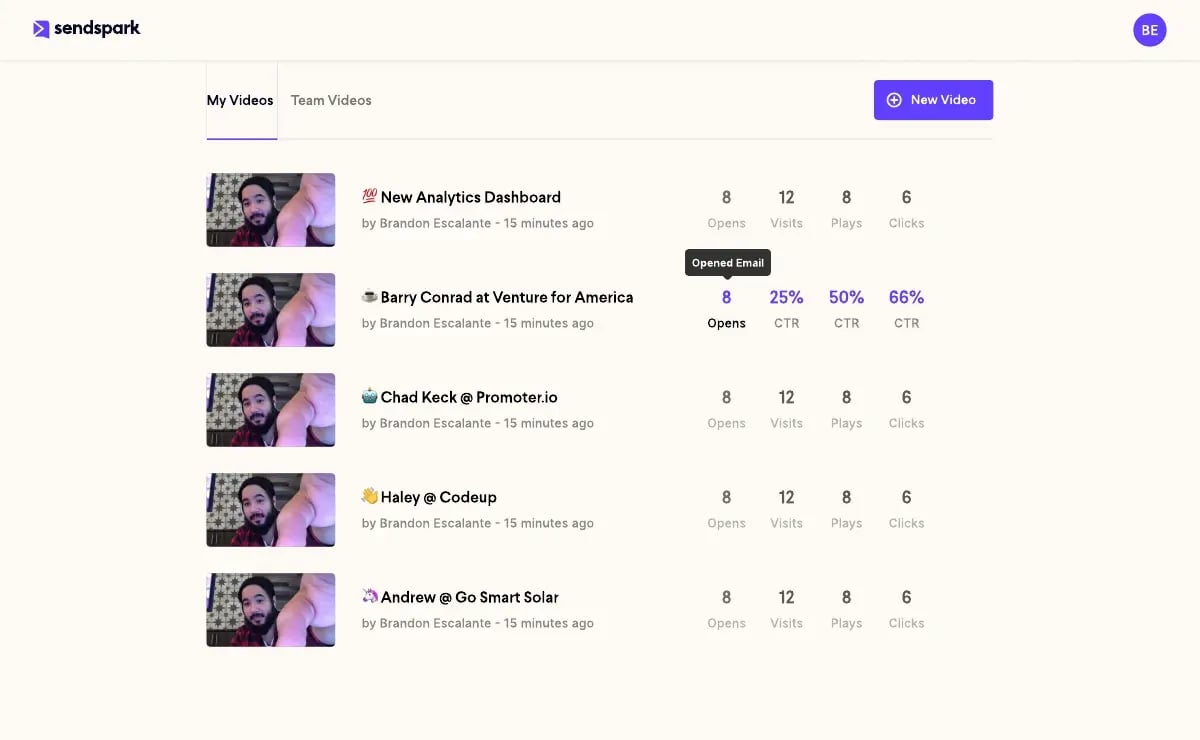
- Used Sendspark’s video analytics to see which prospects watched, replayed, or paused on specific sections — prioritizing follow-up by engagement level
Results
- 22 of 60 accounts reopened (37% reactivation rate)
- $420K in new pipeline generated within 30 days of the final sequence email
- Average video watch rate: 78% completion, with 14 prospects replaying sections of the case study video
The video personalization was what separated this from a generic re-engagement drip. Each video referenced the prospect’s prior engagement specifically, signaling that the outreach was thoughtful and current — not a mass blast. See our guide on AI video in ABM case studies for more examples of how teams are applying this approach across different verticals.
ABM Campaign Quick-Comparison Table
Use this table to match each example to your team’s constraints and ICP before choosing which tactic to run first.
| Example | Primary Channel | Team Size Needed | Approx. Cost Per Account | Best For | Key Result |
|---|---|---|---|---|---|
| 1: Personalized Video | Email + AI video | 1 SDR | $5-15 | Enterprise SaaS prospecting | 34% reply rate |
| 2: LinkedIn + Direct Mail | LinkedIn + physical mail | 1-2 reps | $35-75 | High-ACV financial services | 28% meeting rate |
| 3: Intent-Data Triggered | Email + video | 1 SDR + marketing | $10-20 | Competitive displacement | 19% reply rate |
| 4: Executive Gifting | Physical gift + video | 1-2 AEs | $100-150 | Unlocking stalled late-stage deals | 53% deals closed |
| 5: Custom Landing Pages | Web + CRM alert | Marketing + sales | $20-50 (tooling amortized) | Mid-market inbound follow-up | 18% demo conversion |
| 6: Podcast Invite | LinkedIn + audio | 1-2 content + sales | $50-100 | C-suite enterprise buyers | 24% acceptance rate |
| 7: Multi-Touch Video Sequence | Email + LinkedIn video | 1 SDR or AE | $10-20 | Re-engaging cold accounts | 37% reactivation rate |
How to Build Your Own ABM Campaign
Building an ABM campaign from scratch takes four steps: define your target account list, select your channels based on the buyer profile, personalize each touchpoint beyond the contact’s first name, and track engagement at the account level — not just the individual level. Most B2B teams can execute a basic ABM campaign within 2-3 weeks once the account list is confirmed.
For more on the strategic foundations, see our complete ABM strategy guide and our article on B2B demand generation to understand how ABM fits into your broader pipeline strategy.
Step 1: Build a Tight Target Account List
Start with 25-50 accounts, not 500. The most common ABM mistake is trying to “personalize” outreach to hundreds of accounts simultaneously — the personalization becomes superficial and the results look like generic outbound. Filter your ICP by firmographic fit (industry, headcount, revenue), technographic fit (are they using tools that integrate with yours or that yours replaces?), and timing signals (hiring for roles that suggest budget, recent funding, or competitive movement).
Step 2: Choose Channels Based on Where Buyers Spend Time
Different buyers have different channel preferences. CFOs tend to be active on LinkedIn but rarely respond to cold calls. SDR and VP of Sales personas respond well to email + video. IT decision-makers often engage with technical content and case studies. Match your channel mix to the persona you’re targeting, not to what’s easiest for your team to execute.
The sales prospecting guide on Sendspark’s site covers how to combine LinkedIn video outreach with email sequences for top-of-funnel ABM effectively.
Step 3: Personalize at the Account Level, Not Just the Contact Level
First-name personalization is table stakes. ABM-grade personalization means referencing the account’s specific business context: their industry challenge, a recent company announcement, a role they’re hiring for, or a technology they’re currently using. The goal is for the prospect to think: “This person actually researched us.” That level of specificity requires either genuine research or AI tools that can surface and incorporate account-level data at scale.
Tools like Sendspark AI Intros automatically personalize video with each prospect’s name, company, and website — letting a single rep run account-specific video outreach to dozens of target accounts without recording individual videos. This is how small teams punch above their weight in ABM.
Step 4: Track and Measure at the Account Level
Individual-level metrics (one contact opened an email) undercount ABM success because multiple stakeholders at one account may engage without coordinating. Set up account-level dashboards in your CRM that show total engagement across all contacts at a target account — emails opened, videos watched, landing pages visited, LinkedIn connections accepted. Accounts with high aggregate engagement scores should be prioritized for direct outreach by an AE, regardless of whether any individual contact has replied.
According to Salesforce’s ABM guide, teams that track account-level engagement rather than contact-level metrics close 30% more of their target accounts than those measuring individual contact activity alone.
Frequently Asked Questions
What is account-based marketing with an example?
Account-based marketing (ABM) is a B2B strategy where sales and marketing coordinate to target specific high-value companies rather than broad audiences. A simple example: instead of running LinkedIn ads to all IT managers, an ABM team sends personalized video emails to the VP of IT at 30 specific companies that match their ideal customer profile — with content referencing each company’s specific tech stack.
What are the best account-based marketing examples for B2B?
The highest-performing B2B ABM examples combine personalization with multiple channels. Personalized video campaigns consistently produce reply rates of 25-40% compared to 8-12% for plain-text outbound. Executive gifting campaigns are effective for unlocking stalled deals. Intent-data-triggered sequences are best for competitive displacement — reaching prospects when they’re actively researching alternatives.
How much does an account-based marketing campaign cost?
ABM campaign costs range from $5-15 per account for digital-only approaches (personalized video + email) to $100-150 per account for campaigns that include physical direct mail or executive gifts. Most B2B teams targeting 25-50 accounts can run an effective ABM campaign for $2,000-5,000 in total spend, including tools and materials — with pipeline returns that typically justify the cost 10x or more.
How do you measure the success of an account-based marketing campaign?
Measure ABM success at the account level, not the contact level. Key metrics: target account engagement rate (percentage of accounts that respond to at least one touchpoint), meeting booking rate from target accounts, pipeline influenced by the campaign, and average deal size from ABM-sourced accounts versus non-ABM accounts. Track all contacts within a target account, not just the primary decision-maker.
How many accounts should I target in an ABM campaign?
Start with 25-50 accounts for your first ABM campaign. This is small enough to achieve genuine personalization but large enough to generate meaningful pipeline data from your target account database within one quarter. As you refine your playbook — which channels work best, which messaging resonates — you can scale to 100-200 accounts. Trying to ABM 500+ accounts without a proven playbook typically results in generic outreach that performs no better than standard outbound.
What channels work best for account-based marketing examples?
The top-performing ABM channel combinations are: (1) personalized video email + LinkedIn, (2) LinkedIn InMail + physical direct mail, and (3) intent-data-triggered email + retargeting ads. Single-channel ABM consistently underperforms multi-channel approaches because buyers need multiple touchpoints across different contexts before engaging. According to Demand Gen Report, 66% of B2B buyers say they’re more likely to respond to a vendor they’ve seen on multiple channels.
How is ABM different from standard outbound prospecting?
Standard outbound targets contacts based on persona fit and reaches out with broadly relevant messaging. ABM targets specific companies based on account fit and reaches out with messaging personalized to that company’s specific context — their industry challenges, recent announcements, or technology stack. ABM requires more research per account but produces significantly higher reply and meeting rates because the relevance is immediately apparent to the prospect.
Sources & References
- Forrester Research — “Organizations with aligned ABM programs report 200% higher ROI than those running standard outbound programs.” (2023)
- Gartner — “75% of B2B purchases now involve 3 or more stakeholders in the decision-making process.” (2024)
- Demand Gen Report B2B Buyer Survey — “66% of B2B buyers say vendor personalization at the account level influences their decision to engage.” (2023)
- Harvard Business Review — “Executive buyers consistently engage more with outreach that respects their expertise and treats them as peers rather than leads.” (2022)
- Salesforce — “Teams that track account-level engagement rather than contact-level metrics close 30% more of their target accounts.” (2024)
Record One Video. AI Personalizes Thousands.
Sendspark is the AI video personalization platform for B2B sales. Record once, and AI voice cloning generates thousands of individually personalized videos with dynamic backgrounds and personalized thumbnails — each prospect hears their name, sees their website, in your voice. Sales teams see 2-3x more replies.
Get Started Now