Most B2B leads aren’t ready to buy the day they find you. Research from Gartner shows that B2B buyers spend only 17% of their total buying journey actually meeting with vendors — the rest of the time, they’re researching, comparing, and building internal consensus. If you’re not nurturing those leads throughout that process, you’re invisible when it matters most.
B2B lead nurturing is how you stay in the room without being in the room. It’s a systematic approach to building relationships with prospects until they’re ready to make a decision — using the right content, on the right channel, at the right moment. Done well, it turns cold prospects into warm conversations and warm conversations into signed contracts.
This guide covers everything: what B2B lead nurturing actually involves, which strategies move the needle, how to build a sequence that converts, and how to measure whether your program is working.. For a step-by-step guide, see our lead nurturing campaign examples and step-by-step framework.
Key Takeaways
- B2B buyers take 6-12 months to convert — systematic lead nurturing keeps you top of mind through the entire decision cycle
- Companies with strong nurturing programs generate 50% more sales-ready leads at 33% lower cost (Forrester Research)
- Effective B2B nurturing requires 8+ touchpoints across email, LinkedIn, and video channels before a prospect is sales-ready
- AI-personalized video outreach in nurture sequences drives 2-3x more replies than text-only emails
- The best B2B nurturing programs segment by buyer stage and engagement behavior — not just job title
What Is B2B Lead Nurturing?
B2B lead nurturing is the process of building relationships with prospects who aren’t yet ready to purchase, by delivering relevant content and outreach across multiple touchpoints over time. The goal is to move buyers through their decision journey — from awareness to consideration to decision — so that when they’re finally ready to buy, your solution is the obvious choice. Unlike B2C nurturing, B2B programs must account for longer sales cycles, multiple stakeholders, and higher-stakes decisions.
The key differences that make B2B nurturing unique:
- Longer sales cycles. B2B deals often take 6-12 months from first contact to close. A prospect who downloaded your whitepaper in January may not be ready to talk pricing until September. Your nurturing program needs to sustain engagement across that entire window.
- Multiple decision-makers. According to Salesforce’s State of Sales report, the average B2B buying committee now includes 6 or more stakeholders. Each person has different priorities — the CFO cares about ROI, the end user cares about ease of use, IT cares about security. Effective nurturing speaks to all of them.
- High-value, considered purchases. B2B buyers do extensive research before committing. They want case studies, ROI data, competitive comparisons, and proof of implementation success — not just product features.
Three core components drive every effective B2B nurturing program: relevant content (matched to the buyer’s stage and pain point), right timing (triggered by behavior or pre-set schedule), and right channel (email, LinkedIn, video, or direct outreach — matched to where your buyer spends time).
The difference between B2B lead nurturing and generic email marketing is intent. Nurturing is personalized, sequential, and response-driven. Generic marketing blasts the same message to everyone. Nurturing sends the right message to the right person based on what they’ve done and where they are in the buying journey. If you want to explore the automation side of this, our guide to automated lead nurturing covers how to build systems that run without manual intervention.
Why B2B Lead Nurturing Matters in 2026
B2B lead nurturing directly impacts pipeline quality and close rates. According to Forrester Research, companies with mature lead nurturing programs generate 50% more sales-ready leads at 33% lower cost per lead than companies without structured nurturing. In a market where cost-per-acquisition keeps rising and sales cycles keep lengthening, those numbers represent a significant competitive advantage.
The business case gets sharper when you look at what happens without nurturing:
- Most leads go cold. The majority of B2B leads who enter your funnel aren’t ready to buy immediately. Without follow-up, the vast majority will never convert — they’ll simply move on to a competitor who stayed in touch.
- Buyers research independently. Gartner research shows B2B buyers spend only 17% of their buying journey meeting with potential vendors. The other 83% is spent reading, researching, and talking to colleagues. If you’re not providing useful content during that self-education phase, you have no influence over the outcome.
- Nurtured leads buy more. When buyers do convert, nurtured leads make significantly larger purchases than non-nurtured leads. The relationship built over the nurturing period translates directly into deal size and trust.
“Companies that excel at lead nurturing generate 50% more sales-ready leads at 33% lower cost. The ROI is undeniable for organizations willing to invest in systematic nurture programs rather than relying on cold outreach alone.”
— Forrester Research, B2B Lead Nurturing Benchmark Study
There’s also the multi-stakeholder reality to contend with. When six or more people have a say in the final decision, the risk of going dark between touchpoints is enormous. A champion inside the buying org needs content they can share with skeptical colleagues — ROI calculators, case studies, competitive breakdowns. Your nurturing program is what keeps that internal champion armed and motivated.
For B2B SaaS and tech companies specifically, the stakes are even higher. Switching costs are real, contracts are annual or multi-year, and buyers know it. They’re going to take their time. Your nurturing program has to match that reality by providing genuine value — not just promotional messages — across a timeline that respects their process.
B2B Lead Nurturing Strategies That Actually Work
The most effective B2B lead nurturing programs combine multiple channels, behavioral segmentation, and personalization at scale. Relying on a single email drip sequence is no longer sufficient — top-performing teams layer email, LinkedIn outreach, and AI-personalized video to create a multi-touch experience that stands out from the noise. Here are the strategies that consistently move leads through the funnel.
Multi-Channel Nurturing
Single-channel nurturing caps your reach. The best programs create coordinated touchpoints across email, LinkedIn, and video — each channel serving a different purpose. Email delivers detailed content. LinkedIn builds social presence and credibility. Video creates personal connection. RAIN Group research shows it takes 8 or more touches to get a first meeting with a cold B2B prospect — which means you need multiple channels to reach that number without burning out a single inbox.
A practical multi-channel cadence might look like: introduction email → LinkedIn connection request → educational content email → LinkedIn message → AI-personalized video → follow-up email with case study → phone call. Each touchpoint reinforces the others. When a prospect sees your name across multiple platforms, recognition builds, and skepticism drops.
Behavior-Based Segmentation
The biggest mistake in B2B nurturing is treating all leads the same. A prospect who downloaded your pricing guide has very different intent than one who read your introductory blog post. Behavior-based segmentation means triggering different sequences based on what people actually do — what they click, read, download, and how long they engage.
Segment your leads by:
- Funnel stage — Awareness (educational content), Consideration (comparison content), Decision (case studies, ROI data)
- Engagement level — High engagement (accelerate to direct outreach), low engagement (re-engagement sequence)
- Company profile — Enterprise vs. mid-market require different messaging, proof points, and sales approaches
- Content consumed — A prospect who read three articles about AI sales tools has signaled intent that a generic lead hasn’t
AI-Personalized Video Outreach
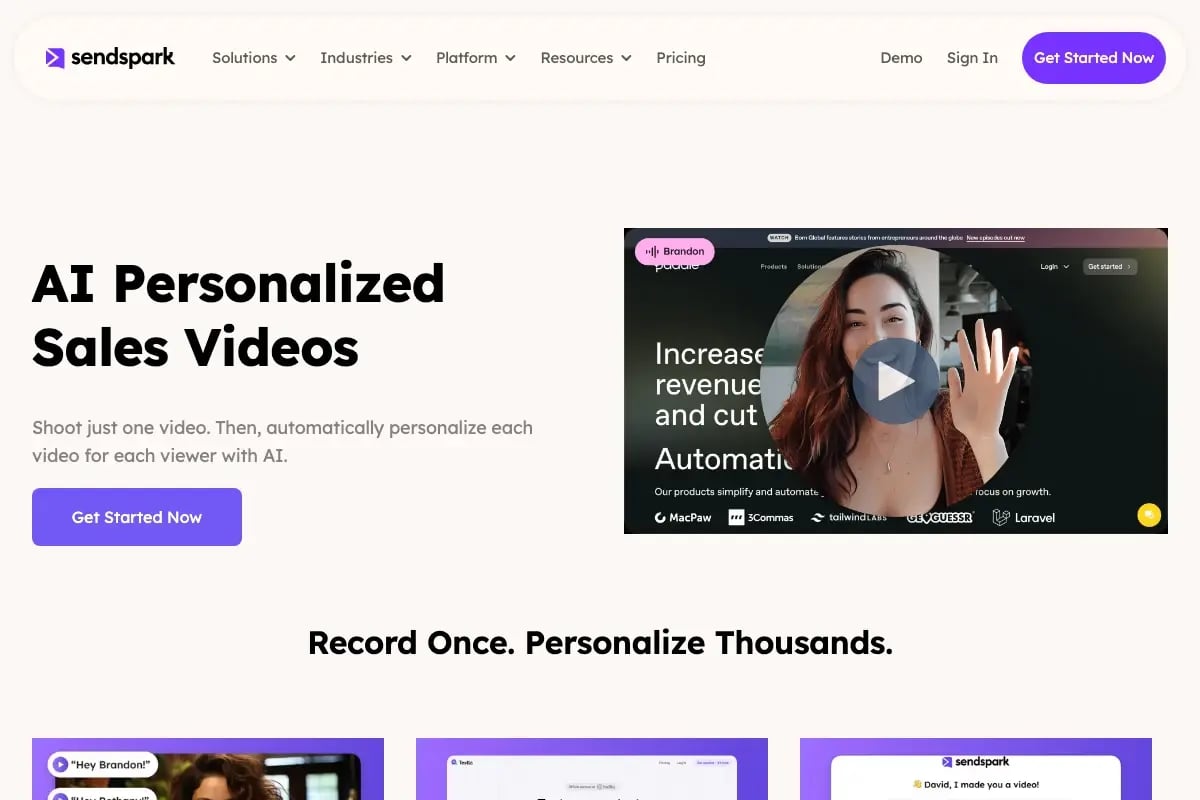
Text emails blend together in crowded inboxes. AI-personalized video outreach is one of the highest-performing additions to a B2B nurture sequence precisely because it’s unexpected and personal. Sendspark’s AI video personalization platform lets sales reps record a single video once, then uses AI voice cloning and dynamic backgrounds to generate thousands of individually personalized versions — each one addressing the prospect by name and showing their company website as the background.
The result: prospects hear their name in your voice, see their own brand behind you, and feel like you recorded specifically for them. Sales teams using this approach see 2-3x more replies compared to standard text emails. The video personalization creates a human connection that text can’t match — and it scales to thousands of prospects without thousands of hours of recording time.
Pro tip
Use AI-personalized video for the highest-intent touchpoints in your sequence — especially the Day 7 check-in and the Day 21 re-engagement. These moments benefit most from the personal connection video creates. For nurture content delivery (whitepapers, case studies), standard email works fine.
Content-Led Nurturing by Stage
Different content serves different stages of the B2B buying journey. Mapping your content to buyer stage is what makes nurturing feel relevant rather than spammy. At awareness stage, prospects want education — industry research, problem-framing content, and how-to guides. At consideration stage, they want comparison — side-by-side breakdowns, ROI calculators, and methodology guides. At decision stage, they want proof — customer case studies, implementation timelines, and security/compliance documentation.
If you’re building out your nurturing infrastructure, our AI lead nurturing guide covers how to automate content delivery based on behavioral triggers rather than a fixed schedule.
Record One Video. AI Personalizes Thousands.
Sendspark is the AI video personalization platform for B2B sales. Record once, and AI voice cloning generates thousands of individually personalized videos with dynamic backgrounds and personalized thumbnails — each prospect hears their name, sees their website, in your voice. Sales teams see 2-3x more replies.
Get Started NowHow to Build a B2B Lead Nurturing Sequence
A B2B lead nurturing sequence is a pre-planned series of touchpoints — typically 6-10 over 30-60 days — designed to move a prospect from initial interest to sales conversation. Start by defining your buyer stages, mapping content to each stage, then setting timing rules based on engagement signals rather than a rigid calendar. Here’s how to build one that actually converts.
Step 1: Define Your Buyer Stages
Every effective nurture sequence starts with clarity on where your buyer is in their journey. For most B2B SaaS and tech companies, three stages cover the full arc: Awareness (they know they have a problem), Consideration (they’re actively evaluating solutions), and Decision (they’re ready to choose a vendor). Each stage requires different content and a different level of personalization.
Step 2: Map Content to Each Stage
Awareness stage: educational blog posts, industry research, problem-definition videos. Consideration stage: comparison guides, ROI calculators, feature breakdowns, customer testimonials. Decision stage: case studies, implementation timelines, pricing discussions, personalized demo invitations. The mistake most teams make is jumping straight to decision-stage content with leads who are still in awareness — it feels pushy and kills the relationship.
Step 3: Build Your Touch Cadence
Here’s a proven 30-day B2B lead nurturing sequence structure:
| Touch | Day | Channel | Content Type | Goal |
|---|---|---|---|---|
| 1 | 0 | Welcome / value resource | Deliver immediate value, set expectations | |
| 2 | 3 | Connection request | Establish social presence | |
| 3 | 7 | Email / Video | AI-personalized video check-in | Personal connection, surface questions |
| 4 | 10 | Case study (relevant industry) | Social proof, build confidence | |
| 5 | 14 | Direct message with insight | Keep top-of-mind, add value | |
| 6 | 21 | Email / Video | Re-engagement video with specific value prop | Re-engage cold prospects |
| 7 | 30 | Soft CTA — demo invite or content offer | Conversion attempt |
After Day 30, engaged leads move into a long-term nurture cadence — monthly value emails with no hard sell. Unengaged leads get a final break-up email before being paused. The goal is always to protect sender reputation while staying front-of-mind for the moment the prospect’s timing changes.
You can integrate this sequence directly with your CRM using HubSpot to track opens, clicks, and video views — so you know exactly which prospects are warming up and which ones need a different approach. For a deeper look at how to automate the mechanics, see our guide to the best lead nurturing software for B2B teams.
Advanced strategy
For high-value accounts, insert a deal progression video at Day 21 that shows the prospect’s specific website as the background while you address their exact pain point by industry. This signals you’ve done your homework and drives response rates well above generic outreach.
Measuring B2B Lead Nurturing Success
The most important B2B lead nurturing metrics are pipeline contribution (what percentage of closed deals came from nurtured leads), lead-to-MQL conversion rate, and time-to-convert. Track these at the program level, not just the individual email level — nurturing success shows up in deals closed months later, not just this week’s open rates. Here’s the full metrics stack you should be monitoring.
| Metric | What It Measures | B2B Benchmark |
|---|---|---|
| Email open rate | Subject line quality and sender reputation | 25-35% for B2B nurture |
| Click-through rate | Content relevance and CTA effectiveness | 3-5% for B2B nurture |
| Video play rate | Video personalization engagement | 40-60% for personalized video |
| Lead-to-MQL conversion | How many nurtured leads become marketing-qualified | 10-20% for mature programs |
| MQL-to-SQL rate | Lead quality and sales-marketing alignment | 10-15% target |
| Time-to-convert | Days from lead creation to closed deal | Track quarter-over-quarter |
| Pipeline contribution | % of closed revenue from nurtured leads | Target 30%+ from nurture |
The most common measurement mistake is optimizing for open rates when you should be optimizing for pipeline contribution. A 40% open rate on a sequence that generates zero pipeline is worthless. A 22% open rate on a sequence that contributes 35% of your closed revenue is excellent. Build your measurement framework around revenue outcomes, not email vanity metrics.
Lead scoring helps you identify which behavioral signals predict conversion. Assign point values to actions: +5 for opening an email, +15 for clicking a CTA, +25 for watching a video past 50%, +50 for visiting the pricing page. When a prospect crosses your MQL threshold, trigger immediate sales outreach. This ensures your sales team focuses on the leads most likely to convert. Our article on B2B lead engagement covers how to build engagement scoring that actually predicts pipeline.
Finally, use HubSpot’s marketing research benchmark data to calibrate your expectations — what’s normal for your industry and deal size matters. A $100K enterprise deal will take longer to nurture than a $10K SMB sale. Track your metrics against segment-specific benchmarks rather than global averages.
Frequently Asked Questions
What is B2B lead nurturing?
B2B lead nurturing is the process of building relationships with prospects who aren’t yet ready to buy by delivering relevant content, outreach, and touchpoints over time. It moves buyers through the awareness-consideration-decision journey so that when they’re ready to purchase, your solution is their first call. Unlike B2C nurturing, B2B programs must manage longer sales cycles (6-12 months) and multiple stakeholders (often 6+ decision-makers).
How many touchpoints does B2B lead nurturing require?
According to RAIN Group research, it takes an average of 8 or more touches to get a first meeting with a B2B prospect. Most effective nurture sequences run 7-10 touches over 30-60 days, combining email, LinkedIn, and video outreach. High-value enterprise accounts may require 12-15 touches spread across 90+ days before they’re sales-ready.
What’s the difference between B2B and B2C lead nurturing?
B2B lead nurturing involves longer sales cycles, multiple stakeholders, higher deal values, and more educational content needs. B2C nurturing is typically shorter (days to weeks), involves one decision-maker, and leans toward emotional and promotional messaging. B2B buyers need ROI data, case studies, and security documentation — not discount codes.
How do I segment my B2B lead nurturing campaigns?
Segment B2B leads by buyer stage (awareness, consideration, decision), engagement behavior (what they clicked and viewed), company profile (size, industry, tech stack), and intent signals (pricing page visits, demo requests). Behavior-based segmentation consistently outperforms demographic segmentation alone because it responds to what prospects actually do, not just who they are.
How does AI-personalized video improve B2B lead nurturing?
AI-personalized video outreach — like the kind Sendspark’s platform delivers — uses AI voice cloning and dynamic backgrounds to generate individually personalized videos at scale. Each prospect hears their name in the rep’s cloned voice and sees their company website as the video background, creating a personal connection that text emails can’t replicate. Sales teams using AI-personalized video in nurture sequences see 2-3x more replies compared to text-only outreach.
What metrics should I track for B2B lead nurturing?
Track pipeline contribution (what percentage of closed deals came through nurtured leads), lead-to-MQL conversion rate (target 10-20%), MQL-to-SQL rate (target 10-15%), email open rate (benchmark: 25-35% for B2B), click-through rate (3-5%), and time-to-convert. Optimize for pipeline metrics rather than vanity email metrics.
How long should a B2B lead nurturing sequence be?
Most B2B nurture sequences run 30-60 days for the active phase, covering 7-10 touchpoints. After that, engaged leads move to a long-term nurture program with monthly check-ins. The right length depends on your sales cycle — if deals typically close in 3 months, your nurture should run 60-90 days. If cycles are 6-12 months, plan for ongoing touchpoints across the full window.
Sources & References
- Salesforce State of Sales Report — “The average B2B buying committee includes 6 or more stakeholders across the decision process” (2025)
- Gartner Sales Research — “B2B buyers spend only 17% of their total buying journey time meeting with potential suppliers” (2025)
- Forrester Research — “Companies with mature lead nurturing programs generate 50% more sales-ready leads at 33% lower cost per lead” (Lead Nurturing Benchmark Study)
- HubSpot Marketing Statistics — B2B marketing benchmark data on email open rates, click-through rates, and conversion benchmarks
- RAIN Group Sales Research — “It takes an average of 8 touches to get a first meeting with a B2B prospect” (Top Performance in Sales Prospecting Study)
Record One Video. AI Personalizes Thousands.
Sendspark is the AI video personalization platform for B2B sales. Record once, and AI voice cloning generates thousands of individually personalized videos with dynamic backgrounds and personalized thumbnails — each prospect hears their name, sees their website, in your voice. Sales teams see 2-3x more replies.
Get Started NowPublished July 2026