What Is Sales Call Preparation?
Sales call preparation is the research, planning, and rehearsal a rep does before talking to a prospect, covering company background, stakeholder mapping, agenda design, and objection handling. Gong research found that reps who prepare for 15 minutes or more before a call win 50% more deals than those who wing it. Preparation is the single highest-impact activity a rep can control, yet according to Salesforce, 62% of B2B reps spend less than 10 minutes preparing for any individual call. The gap between those two statistics is where deals are won or lost.
Preparation is not the same as over-researching. The goal is a focused, 15-20 minute routine that gives you enough context to ask sharp questions and guide the conversation toward a next step. Sales call preparation covers four areas: who you are calling, why they agreed to talk, what you need to learn, and what outcome you want. Without all four, you are improvising, and prospects can tell.
Key Takeaways
- Sales call preparation is the research, planning, and rehearsal before a prospect call, and reps who prep 15+ minutes win 50% more deals (Gong, 2024).
- Pre-call research covers four areas: company background, stakeholder mapping, trigger events, and prior engagement history stored in your CRM.
- A written call agenda with 3-5 objectives and 8-12 discovery questions keeps calls on track and prevents feature-dumping.
- AI-personalized video warm-ups sent before the call increase show rates by up to 30% and give prospects context before the conversation.
- The best pre-call routines include a one-page prep brief, a rehearsed opening, and a contingency plan for common objections.
Published August 2026
Every sales call is an investment. A 30-minute call with a qualified prospect costs real pipeline opportunity. Yet most reps treat preparation as optional, walking into calls with nothing but a name and a vague hope. According to a Gartner sales research report, 77% of B2B buyers describe their last purchase experience as “very complex,” meaning reps who show up unprepared are walking into a maze blindfolded. This guide breaks down a repeatable pre-call preparation framework you can run in 15-20 minutes, plus how AI-personalized video warm-ups can increase show rates and give prospects context before you even pick up the phone.
The 4-Step Pre-Call Research Framework
Pre-call research is the systematic gathering of context about a prospect and their company before a sales conversation, organized into four areas: company background, stakeholder mapping, trigger events, and prior engagement history. The goal is not to become an expert on their business, but to know enough to ask questions that show you did your homework. According to LinkedIn’s State of Sales report, top-performing reps research 3.4 data points per prospect before first contact, compared to 1.2 for average performers. The framework below covers the four research areas that matter most.
Step 1: Company Background and Industry Context
Start with the basics: what the company does, how big it is, who they sell to, and what industry they operate in. Check their website homepage and recent press releases. Look at their LinkedIn company page for employee count and growth trajectory. If they are public, scan their latest earnings call summary for strategic priorities. According to Forrester, 53% of B2B buyers say sellers fail to demonstrate knowledge of their business, which is the fastest way to lose credibility in the first five minutes of a call.
Use your CRM integration to pull company data automatically. HubSpot enriches company records with industry, employee count, and revenue range, so you do not need to manually hunt for this information. Spend no more than 5 minutes here, you need context, not a PhD in their business model.
Step 2: Stakeholder Mapping and Buying Committee
B2B deals involve an average of 6-10 decision-makers, according to Gartner. Walking into a call knowing only your single contact’s name is how deals stall. Before the call, identify who else is likely involved: the economic buyer, the technical evaluator, the champion, and any blockers. Check the prospect’s LinkedIn for peers and reporting structure. Look at the CRM for other contacts at the same account.
Map the buying committee in your notes. Even confirming one or two names during the call helps you ask the right questions: “Who else is involved in evaluating solutions like this?” and “What does the evaluation process look like on your team?”
Common mistake
Skipping stakeholder mapping is the #1 reason deals get stuck in “we need to talk to our team” limbo. Even a 3-minute LinkedIn scan of the prospect’s reporting line gives you enough to ask smarter questions.
Step 3: Trigger Events and Timing Signals
A trigger event is something that recently changed in the prospect’s world that makes your outreach timely: a funding round, a leadership change, a product launch, a layoff, or a new strategic initiative. According to HubSpot research, reps who reference a trigger event in their first call see 2.2x higher connection rates. Triggers give you a reason for the call that goes beyond “I saw you fit our ICP.”
Check the company’s LinkedIn for recent posts, Google News for mentions in the last 30 days, and your CRM for any notes from prior touchpoints. If you find a trigger, weave it into your opening: “I saw you just raised your Series B, congratulations. That kind of growth usually means scaling the sales team, which is what I wanted to talk about.”
Step 4: Prior Engagement and CRM History
The most overlooked research area is your own CRM history. Before every call, check: Has anyone on your team contacted this prospect before? Have they visited your website? Did they open a previous email? Did they watch a video you sent? According to Salesforce, 67% of lost deals have prior engagement history that was never reviewed before the losing call. Your CRM is a goldmine of context that most reps ignore.
If you use Sendspark’s video analytics, you can see whether a prospect watched a video you sent, how much they watched, and whether they clicked through. That data tells you exactly what they are interested in before the call starts. A prospect who watched 90% of a video about AI voice cloning is telling you what to lead with. For a deeper look at when to lead with video versus a call, see our cold calling vs. video prospecting comparison.
Record One Video. AI Personalizes Thousands.
Sendspark is the AI video personalization platform for B2B sales. Record once, and AI voice cloning generates thousands of individually personalized videos with dynamic backgrounds and personalized thumbnails — each prospect hears their name, sees their website, in your voice. Sales teams see 2-3x more replies.
Get Started NowHow to Build a Sales Call Agenda That Works
A sales call agenda is a written document that defines 3-5 objectives, the discovery questions you plan to ask, and how you will allocate time across the call. Reps who use written agendas see 34% higher meeting-to-next-step conversion, according to RAIN Group, because an agenda prevents the two most common call failures: rambling and feature-dumping. An agenda is not a script. It is a guardrail that keeps the conversation productive while leaving room for genuine discovery.
Setting 3-5 Clear Objectives
Every call needs 3-5 specific objectives, not vague goals like “build rapport” or “qualify the lead.” Good objectives are concrete: “Confirm the prospect’s current sales process pain,” “Identify the buying committee,” “Understand their evaluation timeline,” “Agree on a follow-up demo,” and “Determine budget range.” Write these down before the call and refer to them during the conversation. If you have not hit at least 2 of your 5 objectives by the 20-minute mark, you need to steer the conversation back.
The first sales call has different objectives than a mid-funnel qualification call. For an initial call, objectives should lean toward discovery: understanding the prospect’s situation and pain points. For a qualification call, you are validating fit against BANT or MEDDIC criteria. Match your objectives to the call stage. If your team is still deciding which qualification framework to standardize on, see our comparison of SPIN, Challenger, MEDDIC, and Sandler. For a call late enough in the cycle that you are agreeing on next steps toward a close date, one strong objective is proposing a mutual action plan the buyer helps build with you, rather than a plan you send afterward.
Discovery Question Selection
Select 8-12 discovery questions before the call, drawn from your qualification framework. The 30 discovery call questions framework and the qualifying questions guide both provide categorized question banks. You will not ask all 12, but having them ready means you never freeze when the conversation takes an unexpected turn.
Organize questions by priority: start with the 3 must-ask questions that determine whether this deal is worth pursuing, then layer in 5-9 questions that deepen understanding. According to Gong, top reps ask 11-14 questions per discovery call, while average reps ask only 4-6. The difference is not natural talent, it is preparation.
Time Allocation Across Call Segments
A 30-minute call has finite time, and how you allocate it determines whether you reach a next step. The table below shows the ideal time split for a standard 30-minute discovery call versus what unstructured calls typically look like:
| Call Segment | Agenda-Driven | Unstructured | Why It Matters |
|---|---|---|---|
| Opening & Rapport | 3 min | 8 min | Over-long small talk wastes the window when prospects are most attentive |
| Discovery Questions | 15 min | 10 min | Discovery is where deals are won; it needs the majority of call time |
| Value Pitch (Tailored) | 7 min | 12 min | Unstructured reps pitch too early and too long, talking at the prospect |
| Next Steps & Close | 5 min | 0 min | Agenda-driven reps always secure a next step; unstructured calls end with “let me think about it” |
The pattern is clear: unstructured calls over-invest in small talk and pitching, and under-invest in discovery and next steps. Agenda-driven calls flip that ratio. The RAIN Group found that 82% of buyers agree to a next step when the rep explicitly proposes one, compared to 28% when the rep leaves it open. That same discipline applies to the tailored pitch itself — rehearse a tight B2B sales elevator pitch beforehand so you are not improvising it live.
Pro tip
Share your agenda with the prospect at the start of the call: “I put together a quick agenda for our 30 minutes, want me to walk you through it?” This signals preparation and gives the prospect a chance to redirect if their priorities differ.
Pre-Call Tools and AI Video Warm-Ups
Pre-call tools are the software and workflows that streamline research, agenda-building, and prospect warm-up before a sales call. The right tool stack cuts preparation time from 45 minutes to 15 while producing higher-quality context. According to McKinsey, sales teams that use AI-assisted preparation tools see a 40% productivity boost in pre-call work. The key tools fall into three categories: CRM research, agenda templates, and AI-personalized video warm-ups.
CRM Research Workflow
Your CRM is the single most important pre-call tool. A well-configured HubSpot integration surfaces company data, contact history, email opens, meeting notes, and deal stage in one view. Before every call, run a 3-step CRM check: (1) review the contact record for prior touchpoints, (2) scan the deal record for notes from other team members, and (3) check the company record for enrichment data. This takes 3-5 minutes and gives you the full engagement history that 67% of reps skip, per Salesforce.
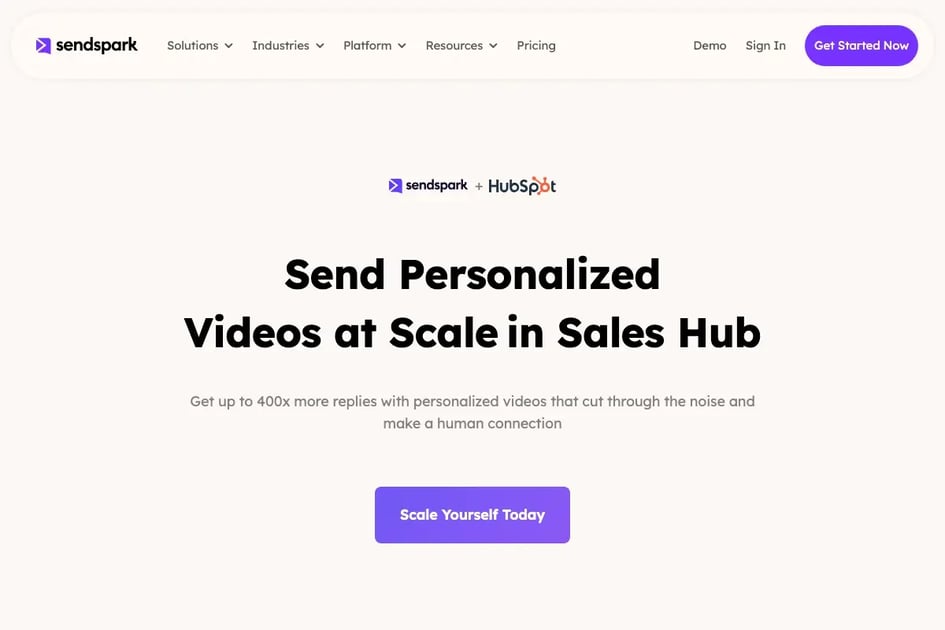
If you are preparing for an outbound prospecting call, your CRM should show whether the prospect has visited your website, opened your emails, or engaged with content. These behavioral signals tell you how warm the prospect is and what they care about.
AI-Personalized Video Warm-Ups
Sending a short, personalized video before a sales call is one of the highest-impact preparation tactics available. According to Sendspark data, prospects who receive a pre-call video show up 30% more often than those who only receive a calendar invite. The video gives the prospect context: who you are, what you want to talk about, and why it is worth their time.
Sendspark’s AI-personalized video platform lets you record one video and use AI voice cloning to personalize it for each prospect by name, company, and context. Dynamic backgrounds show the prospect’s website behind you, which signals that you researched them. You can send at scale, meaning a single recording becomes thousands of individually personalized warm-ups.
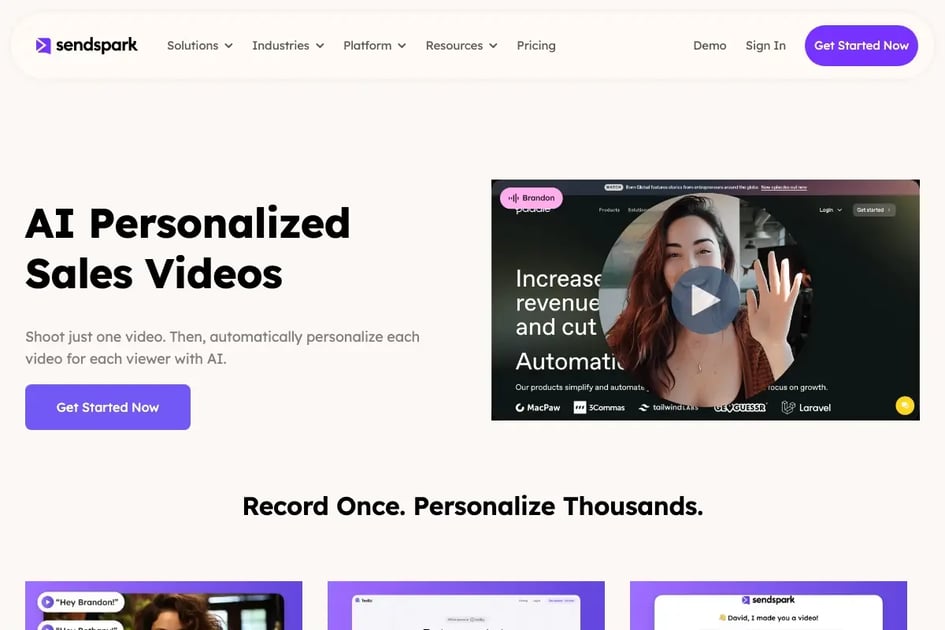
For pre-call warm-ups, keep videos under 45 seconds. The goal is not to pitch, it is to confirm the meeting and give the prospect a reason to show up prepared: “Hi [Name], looking forward to our call on [day]. I did some research on [Company] and noticed [trigger event]. I have a few questions about your current [process], and I think you will find the conversation valuable. Talk soon.”
“According to HubSpot’s State of Sales report, personalized outreach that references specific prospect details achieves 2.2x higher engagement rates than generic outreach, and video is the most personalizable medium available to B2B sales teams.”
— HubSpot State of Sales Report, 2024
The Pre-Call Checklist Template
Use this checklist before every call. It takes 15 minutes and covers all four research areas plus agenda and warm-up:
| Preparation Task | Time | Source |
|---|---|---|
| Review company website and LinkedIn | 5 min | Browser + LinkedIn |
| Map stakeholders and reporting structure | 3 min | LinkedIn + CRM |
| Check for trigger events (news, funding, hires) | 3 min | Google News + LinkedIn |
| Review CRM history and prior engagement | 2 min | HubSpot CRM |
| Write 3-5 objectives and 8-12 questions | 4 min | Note template |
| Send AI-personalized video warm-up (if not sent) | 2 min | Sendspark |
This 19-minute routine covers everything a rep needs to walk into a call with confidence. The sales call coaching framework emphasizes that managers should audit this checklist with reps during 1:1s, not just after calls fail.
Common Sales Call Preparation Mistakes to Avoid
Sales call preparation mistakes fall into five patterns that consistently derail deals: over-researching, skipping stakeholder mapping, showing up without a written agenda, feature-dumping instead of discovering, and failing to plan for objections. According to Gong, 74% of failed discovery calls trace back to one or more of these preparation gaps. Each mistake has a straightforward fix that takes less time than the mistake costs. The table below summarizes the five most common mistakes and their fixes:
| Mistake | Impact on Deal | Fix |
|---|---|---|
| Over-researching (45+ min) | Wastes selling time; paralysis by analysis | Cap prep at 15-20 min using the checklist above |
| No stakeholder mapping | Deal stalls at “need to check with the team” | 3-min LinkedIn scan of reporting structure |
| No written agenda | Rambling call, no next step secured | Write 3-5 objectives before every call |
| Feature-dumping | Prospect disengages; feels pitched at | Ask 11-14 discovery questions before pitching |
| No objection plan | Caught off guard, fumbles the response | Rehearse 3 most likely objections and responses |
Over-Researching and Analysis Paralysis
Some reps swing too far the other direction, spending 45-60 minutes researching a single prospect. They read every blog post, scroll through years of LinkedIn activity, and build a profile that would impress a forensic analyst. Then they run out of time to actually call. Preparation has diminishing returns: the first 15 minutes of research produce 80% of the value. Beyond that, you are procrastinating, not preparing. If you find yourself researching for more than 20 minutes, stop and make the call.
Feature-Dumping Instead of Discovering
The most expensive preparation mistake is preparing the wrong thing. Many reps spend their prep time memorizing product features and demo flows, then recite them on the call. According to Gartner, 65% of B2B buyers say sellers pitch features without understanding their needs first. Discovery must come before pitch. Your prep time should go to questions, not memorizing your product’s feature list. You already know your product. What you do not know is the prospect’s situation, and that is what the call should uncover.
The fix is simple: spend 80% of your prep time on research and questions, 20% on product positioning. If you cannot articulate the prospect’s problem in one sentence before the call, you are not prepared.
Common mistake
Don’t rehearse a product demo as your call prep. Rehearsing discovery questions and objection responses is what actually moves deals forward. A prospect who feels heard will sit through a demo later; a prospect who feels pitched at will not.
Failing to Plan for Objections
Every prospect has objections, and you can predict 90% of them before the call. Common B2B objections: “We already use [competitor],” “Send me some information,” “We are not in a buying cycle right now,” “I need to talk to my boss,” and “It is not in the budget.” If you have not rehearsed a response to each, you will stumble, and stumbling kills credibility. According to Gartner, reps who rehearse objection responses handle them 3x more effectively than those who improvise.
Write down the 3 most likely objections for this specific prospect and your response to each, drawing on scripts from our full sales objection handling guide if you need a starting point. This takes 3 minutes and is the difference between a call that ends with a next step and one that ends with “let me think about it.” For more on handling common prospect responses, see the follow-up email after a sales call framework.
Sales call preparation is the highest-ROI activity in a rep’s day. Fifteen minutes of structured research, agenda-building, and AI-personalized video warm-up can double your win rate. Start with the one-page prep brief, use the 4-step research framework, write 3-5 objectives before every call, and send a video warm-up. For more on building a complete sales prospecting workflow, explore Sendspark’s AI video personalization platform.
Frequently Asked Questions
What is sales call preparation?
Sales call preparation is the research, planning, and rehearsal a rep does before a prospect call. It covers company background research, stakeholder mapping, trigger event identification, CRM history review, agenda creation, and objection rehearsal. According to Gong, reps who prepare for 15+ minutes win 50% more deals than those who do not.
How long should you spend preparing for a sales call?
The ideal preparation time is 15-20 minutes for a standard 30-minute discovery call. The first 15 minutes of research produce 80% of the value, and spending more than 20 minutes leads to diminishing returns. Use a structured checklist to stay within this window and avoid analysis paralysis.
What should you research before a sales call?
Research four areas before every sales call: company background and industry context, stakeholder mapping and buying committee, trigger events like funding or leadership changes, and prior engagement history from your CRM. LinkedIn’s State of Sales report found top reps research 3.4 data points per prospect, compared to 1.2 for average performers.
How do you write a sales call agenda?
A sales call agenda should include 3-5 specific objectives, 8-12 discovery questions organized by priority, and a time allocation plan for each call segment. Share the agenda with the prospect at the start of the call. RAIN Group found that 82% of buyers agree to a next step when the rep explicitly proposes one, compared to 28% when left open.
What are the most common sales call preparation mistakes?
The five most common mistakes are over-researching beyond 20 minutes, skipping stakeholder mapping, showing up without a written agenda, feature-dumping instead of asking discovery questions, and failing to rehearse objection responses. Gong found that 74% of failed discovery calls trace back to one or more of these preparation gaps.
Should you send a video before a sales call?
Yes, sending a short personalized video before a sales call increases show rates by up to 30%. The video gives the prospect context about who you are and what you want to discuss. AI-personalized video platforms like Sendspark let you record once and personalize at scale using AI voice cloning and dynamic backgrounds that show each prospect’s website.
What is the 3 3 3 rule in sales?
The 3-3-3 rule in sales is a follow-up cadence guideline that suggests contacting prospects 3 times over 3 days using 3 different channels (email, phone, social). It is meant to create persistent but varied touchpoints. For sales call preparation, the principle applies to pre-call warm-ups: use multiple channels to confirm the meeting and build context before the conversation.
Sources & References
- Gong Labs — “Reps who prepare 15+ minutes before calls win 50% more deals” (2024)
- Gartner Sales Research — “77% of B2B buyers describe their purchase experience as very complex” (2024)
- LinkedIn State of Sales Report — “Top performers research 3.4 data points per prospect vs 1.2 for average reps” (2024)
- HubSpot Sales Blog — “Reps who reference trigger events see 2.2x higher connection rates” (2024)
- RAIN Group — “82% of buyers agree to a next step when the rep explicitly proposes one” (2024)
- McKinsey & Company — “Sales teams using AI-assisted preparation see 40% productivity boost” (2024)
- Salesforce Sales Resources — “62% of B2B reps spend less than 10 minutes preparing for calls” (2024)
Record One Video. AI Personalizes Thousands.
Sendspark is the AI video personalization platform for B2B sales. Record once, and AI voice cloning generates thousands of individually personalized videos with dynamic backgrounds and personalized thumbnails — each prospect hears their name, sees their website, in your voice. Sales teams see 2-3x more replies.
Get Started Now