Most B2B sales reps believe their job is to convince buyers. But Gartner research shows that 77% of B2B buyers describe their last purchase as complex or difficult — not because the product was hard to understand, but because aligning an entire buying committee is hard. The content you give buyers to share internally is what closes deals. That’s buyer enablement. For a broader set of tactics, explore our B2B sales tips that align with every buyer enablement content type — ranked by impact.
Published August 2026
Key Takeaways
- Buyer enablement gives B2B prospects the content, data, and confidence to move deals forward — without waiting on a sales rep for every question
- The average B2B buying committee involves 6-10 stakeholders; each needs role-specific content to say yes
- AI-personalized video is the highest-impact buyer enablement content type — it shows each stakeholder exactly what matters to them, at scale
- Buyer enablement is not the same as sales enablement: one arms your sellers, the other arms your buyers
- Sendspark’s AI voice cloning lets you record one video and auto-personalize it for every member of the buying committee
What Is Buyer Enablement?
Buyer enablement is the practice of giving B2B prospects the content, data, and tools they need to make purchasing decisions faster — and with more internal confidence. Instead of relying on sales reps to educate every stakeholder one conversation at a time, buyer enablement creates scalable resources that buyers can use independently — sharing them across their committee to build consensus and remove blockers.
The concept emerged from a fundamental shift in how B2B buying happens. According to Gartner’s research on the B2B buying journey, today’s typical buying group includes 6 to 10 decision-makers — each with their own concerns, priorities, and veto power. The economic buyer wants ROI data. The security team needs compliance documentation. The end users want to see the product in action. Your sales rep can’t be in every room for every conversation.
Buyer enablement solves that problem. You create content that travels with the deal — so buyers can champion your solution internally, answer their colleagues’ objections, and move toward a decision even when you’re not in the room.
“Buying has fundamentally changed. Buyers don’t want to be sold — they want to be enabled. The teams that win are those that make it easy for champions to build internal consensus, not those that pressure a single decision-maker.”
The B2B sales cycle has gotten longer as buying committees have grown. Buyer enablement is the most direct lever for shortening that cycle — by reducing the back-and-forth between your champion and their colleagues who haven’t heard your pitch yet.
Buyer Enablement vs. Sales Enablement: What’s the Difference?
Sales enablement helps your sales team sell more effectively. Buyer enablement helps your prospects buy more easily. Both involve content, training, and data — but they serve opposite audiences. Sales enablement arms your reps; buyer enablement arms your buyers. Most B2B teams invest heavily in sales enablement and barely think about buyer enablement, which is exactly why their deals stall after the first meeting.
| Sales Enablement | Buyer Enablement | |
|---|---|---|
| Focus | Making sellers more effective | Making buyers more confident |
| Primary audience | Your sales reps | Your prospects and their buying committee |
| Typical content | Pitch decks, battlecards, call scripts | ROI calculators, case studies, personalized video walkthroughs |
| Goal | Higher win rates for your team | Faster decision confidence for your buyers |
| Owner | Sales leadership / enablement team | Sales + marketing working together |
| When it matters most | Before and during prospect-facing meetings | Between meetings, when buyers are evaluating internally |
The two strategies are most powerful when they work together. Your sales coaching programs can train reps to proactively deliver buyer enablement content at each stage — turning your sales team into buyer advocates, not just closers.
The critical insight: deals don’t die during your sales calls. They die in the days and weeks between calls, when your champion is trying to sell the rest of the committee internally without your help. Buyer enablement gives your champion the ammunition they need to win those internal debates.
7 Types of Buyer Enablement Content (Ranked by Impact)
The most effective buyer enablement content combines personal relevance with scalable delivery. AI-personalized video tops the list because it achieves both — speaking directly to each stakeholder’s concerns at scale. The seven types below are ranked by their impact on deal velocity, based on how well they address the buying committee’s core need: confidence to move forward.
| Content Type | Impact on Deal Velocity | Scalability | Best Stage |
|---|---|---|---|
| AI-personalized video | Very high | Very high (AI generates at scale) | All stages |
| Interactive demos / sandboxes | Very high | High | Evaluation |
| ROI calculators | High | Very high (self-serve) | Decision |
| Role-specific case studies | High | Medium | Awareness / Evaluation |
| Digital sales rooms | High | High | Evaluation / Decision |
| Competitive comparison guides | Medium | High | Evaluation |
| Technical / security docs | Medium | Very high (reusable) | Decision |
1. AI-Personalized Video
AI-personalized video is the most impactful buyer enablement content type because it combines personal relevance with scale. A personalized video that addresses a VP of Finance by name, shows their company’s specific use case, and speaks in a voice that feels genuinely engaged gets watched. A generic “here’s our platform overview” recording gets skimmed — or ignored.
With Sendspark’s AI video personalization platform, reps record a single video and AI voice cloning auto-personalizes the greeting and key points for each member of the buying committee. Dynamic backgrounds show each prospect’s company website. The result: every stakeholder gets a video that feels made for them — without your rep spending hours recording individual messages.
Sales teams using AI-personalized video outreach see 2-3x more replies than text-only email. At the deal progression stage, personalized walkthroughs sent to each buying committee member dramatically reduce the “internal alignment” delay that kills most B2B deals.
2. Interactive Demos and Product Sandboxes
Interactive demos let buyers explore your product on their own schedule — without needing a rep on the call. Sandbox environments go one step further: prospects can actually try the product with their own data or use cases. Both formats serve a critical buyer enablement purpose: they give skeptical stakeholders a way to evaluate independently, which is often what converts them from neutral to supportive.
The key insight is that buyers increasingly want to self-educate before talking to sales. Forrester research estimates that between 60-75% of the B2B purchase evaluation now happens before a buyer ever engages a sales rep. Interactive demos capture that self-serve window.
3. ROI Calculators and Business Case Builders
Every B2B deal eventually hits an economic buyer who needs to justify the spend. ROI calculators and business case builders enable that conversation — letting buyers input their own numbers and generate a customized case for investment. These tools are particularly effective for multi-stakeholder deals because they convert your champion’s enthusiasm into CFO-ready data.
An ROI calculator is also highly shareable: your champion can send it to the budget holder without needing to schedule another meeting. For deals where procurement or finance is the final gatekeeper, a well-built calculator can save weeks of back-and-forth.
4. Role-Specific Case Studies
Generic case studies underperform because buying committee members see through the signal: if every case study features a VP of Sales, what does the security team get? Role-specific case studies — written for CFOs, CTOs, security teams, or end users separately — deliver social proof that each stakeholder can personally relate to.
Visit Sendspark’s customer stories to see how B2B sales teams use AI video personalization to close deals faster. The best buyer enablement case studies lead with the stakeholder’s specific pain, show measurable outcomes in that stakeholder’s terms, and quote someone in a similar role from a similar company.
5. Digital Sales Rooms
A digital sales room is a shared online workspace — a single URL where your champion can find everything related to the deal: your proposal, demo recording, ROI data, technical documentation, and any personalized videos. Instead of losing track of attachments across a dozen emails, buyers have one place to return to and share with colleagues.
Digital sales rooms also give reps visibility into who’s engaging: which stakeholders viewed the content, what they watched, and for how long. That engagement data feeds directly into video analytics and CRM records, helping reps prioritize follow-up and identify hidden champions or blockers in the buying committee.
6. Competitive Comparison Guides
Buyers compare vendors. You can either participate in that comparison or let it happen without you. Competitive comparison guides — honest, well-structured, side-by-side comparisons of your product versus alternatives — give buyers the clarity they need to defend their choice internally. The most effective versions acknowledge competitor strengths and clearly explain why your differentiators matter for this buyer’s specific situation.
Common mistake
Don’t make your comparison guide a one-sided hit piece on competitors. Buyers can see through it, and it undermines your credibility. Acknowledge what competitors do well, then explain clearly why your approach is better for this buyer’s use case.
7. Technical Documentation and Security Questionnaires
For B2B software deals, procurement and security reviews are often the final blockers. Proactively providing security questionnaire templates, compliance documentation, data processing agreements, and API documentation removes those blockers before they become delays. A well-prepared security packet that answers 90% of a buyer’s IT team’s questions before they ask them is a buyer enablement asset worth its weight in closed deals.
Record One Video. AI Personalizes Thousands.
Sendspark is the AI video personalization platform for B2B sales. Record once, and AI voice cloning generates thousands of individually personalized videos with dynamic backgrounds and personalized thumbnails — each prospect hears their name, sees their website, in your voice. Sales teams see 2-3x more replies.
Get Started NowHow to Build a Buyer Enablement Strategy in 5 Steps
A buyer enablement strategy starts with mapping your buying committee, then building content that addresses each stakeholder’s specific concerns at each stage. Most teams can launch a basic buyer enablement program within 2-3 weeks by repurposing existing sales content into buyer-facing formats — no need to build everything from scratch.
Step 1: Map Every Member of the Buying Committee
Start by identifying every stakeholder who touches the deal. This typically includes the economic buyer (budget owner), the technical buyer (evaluates fit), the user buyer (end users), and the security/procurement team. For each, write down their primary concern, their definition of success, and the question they most need answered before they’ll say yes.
During your discovery calls, ask your champion: “Who else needs to be involved in this decision?” Most reps stop at the obvious answer. The real question is: who can say no but hasn’t said yes yet?
Step 2: Identify Content Gaps by Stage and Persona
Audit your current content library against the buying committee map. For each stakeholder role and deal stage, ask: do we have something they can take away and share? Common gaps include CFO-ready ROI data (most companies have rep-facing ROI assumptions, not buyer-facing calculators), security documentation (usually lives in a Google Drive folder no one can find), and role-specific social proof (most case studies are written for the VP of Sales, not for the IT Director).
Step 3: Create Scalable Content — Not One-Offs
The worst buyer enablement trap is building one-off materials per deal. Instead, build templates and scalable formats: an ROI calculator that works for any prospect with configurable inputs, a security packet PDF that covers 90% of standard questions, and AI-personalized video sequences that adapt to each recipient automatically.
With deal progression workflows in Sendspark, you can build a single video template and auto-personalize it for every stakeholder in your pipeline — AI voice cloning handles the individual greeting, and dynamic backgrounds show each prospect’s company website as the backdrop.
Step 4: Deliver Through Channels Buyers Actually Use
Buyer enablement content fails if it doesn’t reach the right people. Your champion is the distribution channel — but they need easy-to-share formats. Embed personalized videos in follow-up emails. Use HubSpot sequences to trigger the right enablement content at each deal stage. Create a single shared link your champion can forward to the entire buying committee.
Step 5: Measure Engagement and Iterate
Track which buyer enablement content actually moves deals. Video analytics show exactly who watched your personalized video, how long they watched, and whether they clicked the CTA. Document view tracking shows which stakeholders engaged with your proposal. Over 3-6 months, you’ll see clear patterns: the content that consistently correlates with faster deal close rates is worth scaling; the content nobody looks at can be cut.
Connect this data to your lead qualification process — stakeholders who engage deeply with buyer enablement content are often signals of a deal that’s ready to accelerate.
How AI-Personalized Video Powers Buyer Enablement at Scale
AI-personalized video is the most scalable and highest-impact form of buyer enablement content because it combines the persuasive power of video with the conversion lift of personalization. Research from Salesforce’s State of Sales report consistently shows that buyers respond significantly better to personalized outreach — and video combines the credibility of a live conversation with the efficiency of asynchronous delivery.
Traditional video fails at scale for one reason: it’s generic. A polished “overview” video addresses nobody in particular. Buying committee members — particularly those who weren’t at the first meeting — get a video that could have been sent to anyone. They don’t watch it carefully, and they don’t forward it to their colleagues.
AI voice cloning changes the math. With Sendspark’s AI video personalization platform, you record a single video once — your pitch, your demo walkthrough, your product story. Then AI clones your voice to auto-generate a personalized intro for each member of the buying committee: “Hi Sarah, I know your team’s main concern is integration with Salesforce…” Each recipient hears their name, their specific concern, and a message that feels genuinely made for them.
Advanced strategy
Map your buying committee personas to video templates. Create one AI-personalized video variant for the economic buyer (ROI focus), one for the technical buyer (integration/security focus), and one for end users (workflow focus). Sendspark’s AI generates each variant automatically — one recording session, three targeted messages.
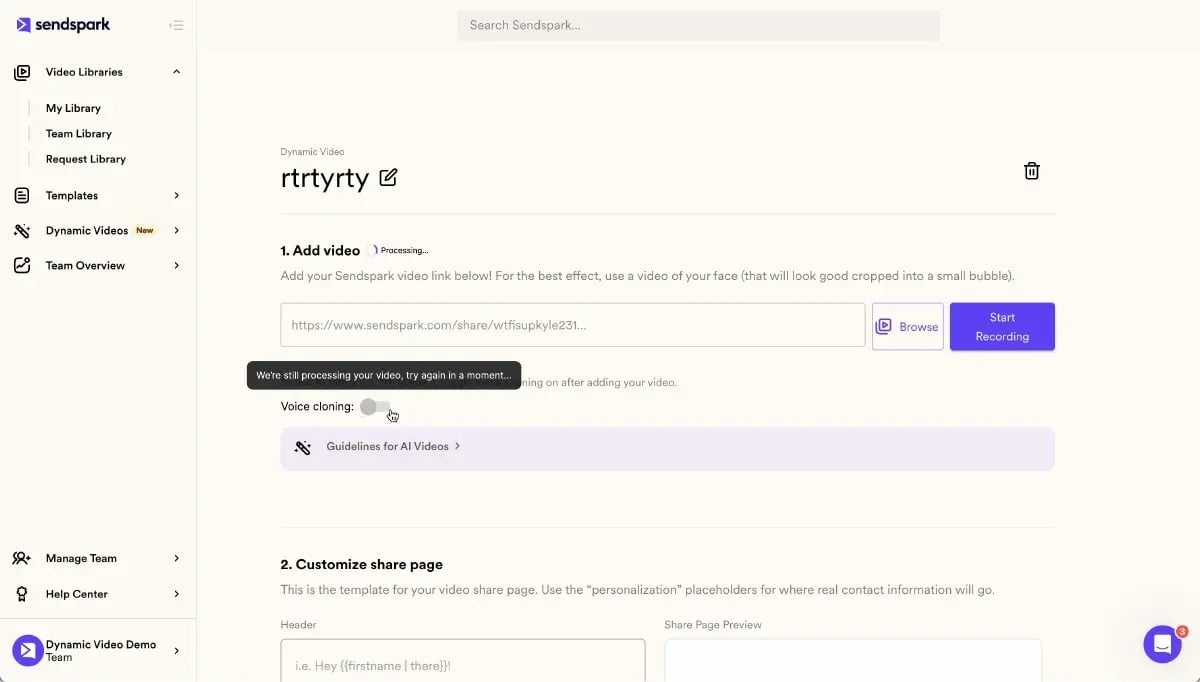
Dynamic backgrounds take personalization further: each video shows the prospect’s own company website behind the presenter, signaling that this content was built specifically for their context. Personalized thumbnails in the email preview show the prospect’s name or logo, driving 3x higher click-through rates than plain video thumbnails.
The operational benefit is significant. Instead of your reps spending 15-20 minutes recording individual follow-up videos for each stakeholder in a complex deal, Sendspark generates a full suite of personalized videos in minutes. Those videos go out through HubSpot or Outreach sequences, triggered automatically at the right stage of the deal.
Sales teams using Sendspark’s AI-personalized video outreach for buyer enablement report 200-300% increases in email response rates and 50% higher click-through rates compared to text-only follow-ups. At the deal stage, where every week of delay costs real pipeline, that speed matters.
Quick Reference: Buyer Enablement Content by Stakeholder and Stage
| Content Type | Primary Stakeholder | Best Stage | Time to Create |
|---|---|---|---|
| AI-personalized video | All stakeholders | All stages | Minutes (AI-generated) |
| Interactive demo | Technical buyer, end users | Evaluation | Weeks (one-time setup) |
| ROI calculator | Economic buyer (CFO/VP Finance) | Decision | Days (one-time build) |
| Case study | Role-matched stakeholder | Awareness / Eval | Days per study |
| Digital sales room | All stakeholders (shared) | Evaluation / Decision | Hours per deal |
| Competitive guide | Champion, technical buyer | Evaluation | Days (one-time build) |
| Security / tech docs | Security / IT / procurement | Decision | Days (one-time build) |
Frequently Asked Questions
What is buyer enablement?
Buyer enablement is the practice of giving B2B prospects the content, data, and tools they need to make purchasing decisions faster and with more confidence. Rather than relying on sales reps to educate every stakeholder individually, buyer enablement creates scalable resources — personalized videos, ROI calculators, case studies, and digital sales rooms — that buyers can use independently to build internal consensus and move deals forward.
What is the difference between buyer enablement and sales enablement?
Sales enablement helps your sales team sell more effectively by providing reps with pitch decks, battlecards, call scripts, and training. Buyer enablement helps your prospects buy more easily by providing them with content that addresses their specific concerns, builds internal consensus, and removes decision blockers. The two are complementary: sales enablement prepares your reps to deliver buyer enablement content at the right time.
What types of content work best for buyer enablement?
The seven most effective buyer enablement content types are: AI-personalized video, interactive demos, ROI calculators, role-specific case studies, digital sales rooms, competitive comparison guides, and technical or security documentation. AI-personalized video ranks highest because it combines personal relevance with scalable delivery — each stakeholder gets content that feels made for them, without the rep spending hours recording individual messages.
How does buyer enablement shorten the B2B sales cycle?
Buyer enablement shortens sales cycles by reducing the time between meetings. Most B2B deals don’t die during sales calls — they stall in the weeks when your champion is trying to build internal consensus without the right materials. When buyers have personalized videos, ROI data, and clear competitive comparisons to share with their colleagues, internal alignment happens faster and deals progress without waiting for the next scheduled meeting.
How do you build a buyer enablement strategy?
Start by mapping your buying committee — identify every stakeholder who influences the deal, their primary concern, and what they need to say yes. Then audit your existing content against each stakeholder’s needs. Build scalable formats (AI-personalized video templates, reusable ROI calculators, security documentation packets), deliver them through channels buyers actually use, and track engagement to identify what drives faster decisions.
How does video fit into buyer enablement?
Video is the highest-impact buyer enablement content type because it builds trust faster than text and works well asynchronously — buyers can watch on their own schedule and share with colleagues who weren’t on the original call. AI-personalized video from platforms like Sendspark takes this further by auto-personalizing the content for each stakeholder: AI voice cloning and dynamic backgrounds make every recipient feel like the video was made specifically for them.
How do you measure buyer enablement effectiveness?
Measure buyer enablement by tracking the metrics that map to deal velocity: video watch rates and completion percentages, document view and share rates, time-to-next-meeting (faster is better), number of stakeholders engaged per deal, and win rate for deals that used buyer enablement content versus those that didn’t. Video analytics tools show exactly who watched what and for how long — use this data to identify which content consistently correlates with faster deal close rates.
Sources & References
- Gartner — B2B Buying Journey Research — “The average B2B purchase decision involves 6 to 10 decision-makers” (2024)
- Harvard Business Review — “Making the Consensus Sale” — Research on buying committee dynamics and consensus-driven B2B purchasing (2015)
- Forrester Research — “Death of the B2B Salesman” — Findings on buyer self-service and the shift to buyer-led purchasing (2015, updated 2022)
- Salesforce — State of Sales Report — Annual research on B2B sales trends, buyer behavior, and personalization impact (2026)
Record One Video. AI Personalizes Thousands.
Sendspark is the AI video personalization platform for B2B sales. Record once, and AI voice cloning generates thousands of individually personalized videos with dynamic backgrounds and personalized thumbnails — each prospect hears their name, sees their website, in your voice. Sales teams see 2-3x more replies.
Get Started Now