The average B2B sales cycle has stretched to 84 days in 2026, up from 73 days five years ago, and Gartner now puts the typical buying group at 11 stakeholders per deal. Translation: closing revenue takes longer, requires more buy-in, and punishes sales teams that treat every prospect like a one-call close. This guide maps the seven stages of the modern B2B sales cycle, gives you length benchmarks by deal size, and shows the specific tactics, AI personalized video included, that high-performing teams use to compress cycles by 20 to 30 percent.
One of the most effective ways to speed up multi-stakeholder deals is through buyer enablement content — resources that give buyers what they need to align internally between your meetings.
Key Takeaways
- The B2B sales cycle is the sequence of stages from first prospect contact to closed deal, typically lasting 1 to 9 months depending on deal size.
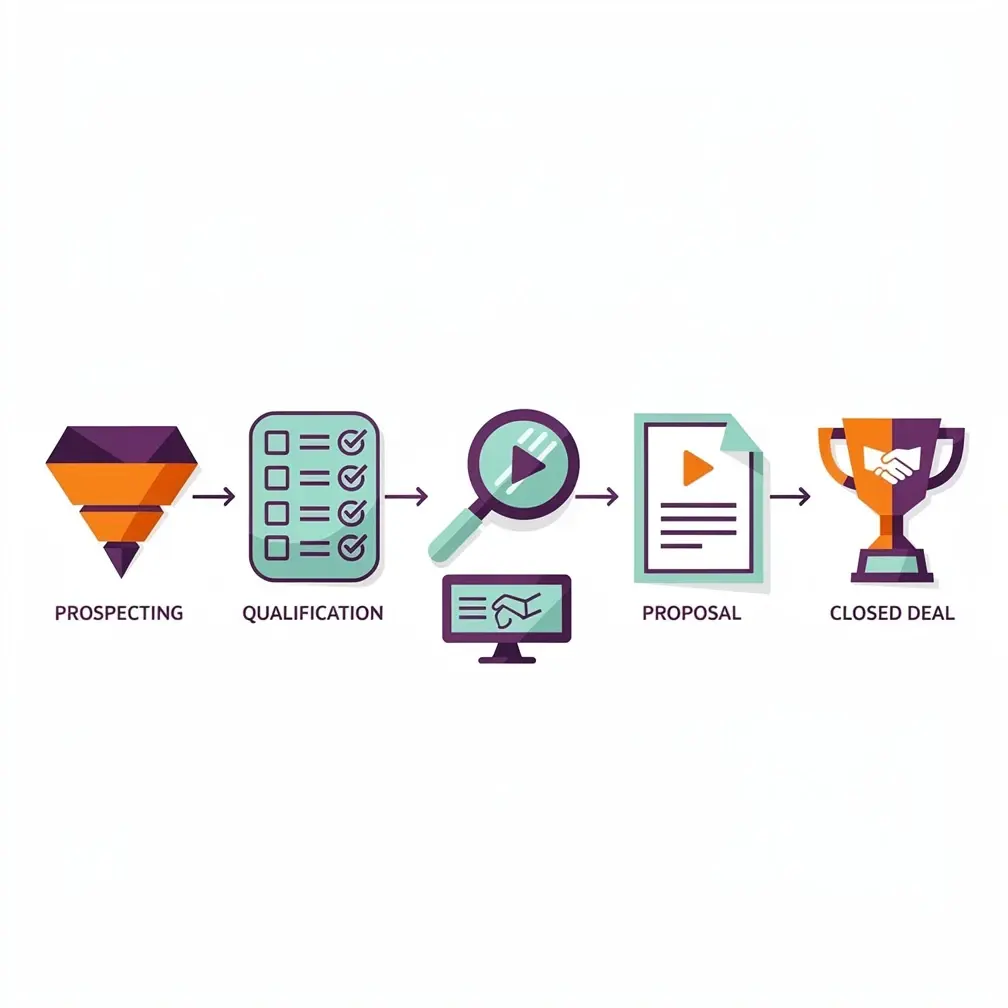
- Standard B2B sales cycles run through 7 stages: prospecting, qualification, discovery, presentation, proposal, negotiation, and close.
- Enterprise deals average 6 to 9 months while SMB cycles close in 30 to 90 days, with buying groups now averaging 11 stakeholders per deal (Gartner).
- AI personalized video at discovery and proposal stages cuts cycle length by 20 to 30 percent by accelerating buy-in across multi-threaded stakeholders.
- Tracking cycle velocity (deal value times win rate divided by cycle length) is more predictive of revenue than win rate alone.
What Is the B2B Sales Cycle?
The B2B sales cycle is the structured sequence of stages a deal moves through from the moment a sales rep first identifies a prospect to the moment a contract is signed. Unlike B2C purchases that close in minutes, the average B2B cycle runs 1 to 9 months because it involves multiple stakeholders, formal procurement, and high-consideration decisions where the wrong choice carries real career risk for the buyer.
A clean B2B sales cycle gives every rep on a team a shared map. It tells you what activity is appropriate at each stage, what exit criteria move a deal forward, and where time is being lost. Without one, pipeline forecasts are guesses, coaching is anecdotal, and reps spend the same effort on a $5K SMB deal as a $500K enterprise contract. Running effective pipeline review helps ensure deals keep moving and your team gets the coaching they need to close.
The cycle is not the same as a sales funnel. The funnel describes volume: how many leads enter at the top and how many close at the bottom. The cycle describes time and activity: what happens, in what order, and how long each step takes. Most modern sales orgs run both views in parallel, with stage definitions tied directly to CRM fields in HubSpot or Salesforce.
How B2B differs from B2C cycles
B2C transactions are almost always single-decision-maker and emotion-led. A consumer sees an ad, clicks, buys. The cycle compresses into a single session. B2B is the opposite. Gartner’s research shows the typical enterprise buying group has expanded to 11 stakeholders, each with distinct concerns: a CFO who cares about ROI, an IT lead who cares about security, a department head who cares about workflow disruption.
That stakeholder expansion is the single biggest reason B2B cycles have gotten longer. Every additional decision-maker adds review loops, internal sell-ins, and consensus meetings. Sales reps who try to drive the cycle through a single champion almost always lose to competitors who multi-thread early.
The 7 Stages of the B2B Sales Cycle
The seven stages of the B2B sales cycle are prospecting, qualification, discovery, presentation, proposal, negotiation, and closing. Each stage has a specific buyer state, a defined seller activity, and an exit criterion that must be met before the deal advances. Skipping a stage or advancing a deal without meeting the exit criteria is the single most common cause of stuck pipeline and inaccurate forecasts. For the full list, see our 30 discovery call questions.
Stage 1: Prospecting
Prospecting is where reps identify and reach out to net-new accounts that fit the ideal customer profile (ICP). The seller activity is targeted outreach across email, LinkedIn, phone, and increasingly, multi-channel sales outreach with personalized video. The exit criterion is a booked meeting or live conversation with a relevant contact. Most modern teams use B2B prospecting software to combine contact data, sequencing, and engagement signals in one workflow.
Stage 2: Qualification
Qualification confirms that the prospect has a real problem you can solve, budget to spend, authority to buy, and a timeline to act. Most teams use a framework like BANT, MEDDIC, or CHAMP to score this rigorously. The exit criterion is a documented “yes” on all qualification dimensions, plus a calendared next step. A documented lead qualification process separates teams that hit quota from teams that pile up “interested” leads that never close.
Stage 3: Discovery
Discovery is the deepest conversation in the cycle. The rep asks open-ended questions to map the buyer’s current state, desired future state, business impact, and decision criteria. Strong reps spend 60 to 70 percent of discovery listening, not talking. Exit criterion: a written summary of pain, impact, and success criteria, agreed to by the prospect.
Stage 4: Presentation
Presentation is the tailored demo. Generic product walkthroughs lose. Discovery-driven demos win. The presentation should mirror back the buyer’s exact words from discovery, show only the workflow they described, and link every feature to a specific business outcome they care about. Exit criterion: stakeholder validation that the solution maps to their needs.
Stage 5: Proposal
The proposal documents pricing, scope, timeline, and terms. The best proposals are co-built with the champion during a working session, not emailed cold. A proposal that arrives in the inbox without preview almost always triggers a 7 to 14 day stall. Exit criterion: champion confirms internal review can begin.
Stage 6: Negotiation
Negotiation covers price, contract terms, deployment timelines, and procurement objections. This is where mutual action plans (MAPs) earn their keep. A MAP is a shared document listing every step from now to signed contract, with owners and dates. Exit criterion: agreement on commercial and legal terms.
Stage 7: Closing
Closing is contract signature, often handled by the buyer’s legal and procurement teams. The rep’s job here is to remove friction: send redlines back fast, get the right exec on the line for last-mile questions, and pre-warm onboarding. Exit criterion: countersigned contract and confirmed start date.
Record One Video. AI Personalizes Thousands.
Sendspark is the AI video personalization platform for B2B sales. Record once, and AI voice cloning generates thousands of individually personalized videos with dynamic backgrounds and personalized thumbnails — each prospect hears their name, sees their website, in your voice. Sales teams see 2-3x more replies.
Get Started NowAverage B2B Sales Cycle Length by Deal Type
The average B2B sales cycle ranges from 30 days for transactional SMB deals to 9 months for enterprise contracts above $250K ACV. Cycle length scales almost linearly with deal size, stakeholder count, and required compliance review. Mid-market deals between $25K and $100K ACV typically close in 90 to 180 days. Understanding where your cycles sit against these benchmarks is the first step in identifying compression opportunities.
| Deal Segment | ACV Range | Avg. Cycle Length | Typical Stakeholders | Forecast Confidence |
|---|---|---|---|---|
| SMB (transactional) | Under $10K | 30 to 60 days | 1 to 3 | High |
| SMB (considered) | $10K to $25K | 60 to 90 days | 3 to 5 | Medium-high |
| Mid-market | $25K to $100K | 90 to 180 days | 5 to 8 | Medium |
| Enterprise | $100K to $250K | 4 to 6 months | 8 to 12 | Medium-low |
| Enterprise (strategic) | $250K+ | 6 to 9 months | 11 to 20+ | Low without MAP |
These benchmarks come from blended industry data including HubSpot’s State of Sales report, Gartner buyer-behavior research, and revenue intelligence platforms tracking millions of recorded sales calls. Your own cycle will skew shorter if you sell PLG-adjacent software, and longer if you sell into regulated industries like financial services, healthcare, or government.
Why cycles have gotten longer
Three structural shifts have stretched B2B cycles since 2020:
- Buying group expansion. Gartner’s research shows the average B2B buying group grew from 6.8 in 2017 to over 11 today. Each new stakeholder adds review cycles.
- Budget scrutiny. Post-2022 economic conditions pushed CFO involvement into deals as small as $25K ACV. Finance teams now review 60 percent more deals than they did pre-2020.
- Tool fatigue. B2B buyers face hundreds of similar SaaS pitches per quarter. Differentiation through generic email and text-only follow-up is essentially zero.
“The hardest part of selling now isn’t finding prospects, it’s coordinating consensus across the buying group. Sellers who help their champion sell internally win. Sellers who only sell to the champion lose.”
— Brent Adamson, co-author of The Challenger Customer (Gartner)
Common mistake
Forecasting cycle length from average historical close rates without segmenting by deal size. A team with a “120-day average” is usually averaging 45-day SMB deals with 240-day enterprise deals, which means every forecast is wrong twice.
How to Shorten Your B2B Sales Cycle
You shorten the B2B sales cycle by compressing the time between stages, not by skipping stages. The four tactics that consistently move the needle are multi-threading early, using AI personalized video to accelerate stakeholder buy-in, tightening qualification gates, and building written mutual action plans that pre-commit the buyer to next steps. Each tactic targets a specific source of stall, and stacking them produces compounding gains.
Multi-thread to 3+ stakeholders before discovery
Single-threaded deals where the rep only talks to one contact stall 3.4x more often than deals with active relationships across three or more stakeholders. Multi-threading is not “adding people to the CC line.” It means having actual conversations with the economic buyer, the technical evaluator, and the day-to-day user before you present.
The fastest path: ask your champion during discovery, “Who else needs to be comfortable with this decision?” and request introductions before the demo. Pair the request with a short personalized video to each new stakeholder so they walk into the next meeting already warm.
Use AI personalized video at high-stall transitions
Two stage transitions account for the majority of B2B deal slippage: qualification-to-discovery, and proposal-to-close. Both involve handing off context to a new stakeholder, which is exactly where AI personalized video shines. Instead of sending a 6-paragraph “summary email” that the new stakeholder skims, send a 90-second video that walks them through the relevant context, with their company website as the background and their name in the greeting.
With Sendspark’s AI video personalization, you record one walkthrough and the platform generates a unique personalized version for every stakeholder in the deal, each with their first name and company branding. Watch rates on these stakeholder-specific videos run 4 to 7x higher than equivalent text follow-ups, which translates directly into faster internal sell-in.
Advanced strategy
When your champion forwards your proposal internally, attach a 60-second personalized video addressed to the CFO. AI voice cloning generates it in your voice but with the CFO’s name and company website on screen, so your champion’s forward feels like a curated 1:1 from you.
Tighten qualification with mandatory exit criteria
Most stuck pipeline traces back to a qualification stage that was advanced on optimism instead of evidence. The fix is mandatory exit criteria: a documented, prospect-confirmed answer on budget range, decision process, timeline, and success metrics before any deal is allowed to enter discovery. Teams that enforce this see 25 to 40 percent shorter cycles because the wrong deals never enter pipeline in the first place.
Build a written mutual action plan
A mutual action plan (MAP) is a shared document, usually a Google Doc or Notion page, that lists every step from current stage to signed contract. Each step has an owner (you or the buyer), a date, and a deliverable. MAPs surface delays in real time and give the buyer permission to push their own internal teams. Deals with MAPs close 30 percent faster on average because they remove the “what’s next?” friction from every check-in.
B2B Sales Cycle Metrics to Track
The four B2B sales cycle metrics that matter most are cycle velocity, stage conversion rates, time in stage, and pipeline coverage. Cycle velocity (deal value times win rate divided by cycle length) is the master metric because it captures all three levers a sales leader can pull: bigger deals, higher win rates, or shorter cycles. Watching velocity weekly is more predictive of next-quarter revenue than any single input metric.
Cycle velocity
The formula: (Number of opportunities × Average deal value × Win rate) ÷ Average cycle length in days = Daily pipeline velocity. A team with 100 open opps at $40K ACV, 25 percent win rate, and 90-day cycles is generating $11,111 of pipeline velocity per day. Moving the cycle from 90 to 75 days lifts that number to $13,333, a 20 percent revenue increase with zero new pipeline added.
Stage conversion rates
Track the percentage of deals that advance from each stage to the next. Healthy benchmarks for mid-market SaaS: 30 to 40 percent prospecting-to-qualified, 60 to 70 percent qualified-to-discovery, 50 to 60 percent discovery-to-presentation, 40 to 50 percent presentation-to-proposal, 60 to 70 percent proposal-to-close. Your weakest stage is your biggest leverage point. For deeper context on which numbers belong in a sales dashboard, see our breakdown of sales metrics to track.
Time in stage
Track the median number of days a deal spends in each stage. A deal that sits in proposal for more than 2x the median is almost certainly dead and should be either re-qualified or removed from forecast. Set automated alerts in your CRM when deals exceed time-in-stage thresholds.
Pipeline coverage
Pipeline coverage is the ratio of open pipeline value to remaining quota. The healthy benchmark is 3x to 4x: meaning if a rep has $300K of quota left, they should have $900K to $1.2M of weighted pipeline. Lower coverage triggers prospecting; higher coverage means qualification is too loose. Stage-segmented pipeline coverage tells the whole truth about cycle health and follows closely with strong sales cadence best practices.
A simple ritual that ties all four metrics together: a weekly “deal velocity review” where the team picks the 5 deals with the longest time-in-stage and pressure-tests whether they’re still real. This single habit is responsible for double-digit forecast accuracy gains at most teams that adopt it.
Summary: Cycle stages, exit criteria, and acceleration tactics
| Stage | Exit Criterion | Best Acceleration Tactic |
|---|---|---|
| 1. Prospecting | Booked meeting with ICP-fit contact | AI personalized video in cold outreach |
| 2. Qualification | Documented budget, authority, need, timeline | Mandatory exit criteria in CRM |
| 3. Discovery | Written summary of pain and success criteria | Multi-thread to 3+ stakeholders |
| 4. Presentation | Stakeholder validation of fit | Discovery-mirrored, not generic demo |
| 5. Proposal | Champion confirms internal review starts | Personalized video walkthrough for CFO/exec |
| 6. Negotiation | Agreement on commercial terms | Written mutual action plan (MAP) |
| 7. Closing | Countersigned contract | Fast redline turnaround + exec sponsorship |
The deal-progression motion built into Sendspark’s deal progression solution automates personalized video at exactly these high-stall transitions, so you don’t have to remember to record one manually every time a new stakeholder enters the deal.
Frequently Asked Questions
What is the average B2B sales cycle length?
The average B2B sales cycle is approximately 84 days across all deal sizes as of 2026, up from 73 days in 2020. SMB deals close in 30 to 90 days, mid-market in 90 to 180 days, and enterprise deals in 4 to 9 months. The single biggest factor is the size of the buying group, which Gartner now puts at an average of 11 stakeholders per deal.
How many stages are in a B2B sales cycle?
Most modern B2B sales cycles use 7 stages: prospecting, qualification, discovery, presentation, proposal, negotiation, and closing. Some teams add an eighth onboarding stage to track post-sale handoff, and some compress qualification and discovery into a single stage for SMB cycles. The exact stage count matters less than having defined exit criteria for each stage.
How do I shorten my B2B sales cycle?
You shorten a B2B sales cycle by compressing time between stages, not by skipping stages. The four most effective tactics are multi-threading to three or more stakeholders before presentation, using AI personalized video at qualification-to-discovery and proposal-to-close transitions, enforcing mandatory exit criteria, and building written mutual action plans. Teams that stack all four typically see 20 to 30 percent cycle reduction.
What is sales cycle velocity?
Sales cycle velocity is the speed at which pipeline converts to revenue. The formula is (number of opportunities times average deal value times win rate) divided by average cycle length in days. The result is dollars of pipeline value generated per day. Velocity is the single best leading indicator of next-quarter revenue because it captures all three levers a sales leader can pull.
Why do B2B sales cycles get stuck?
B2B cycles most often stall at qualification-to-discovery and proposal-to-close, both of which require context transfer to a new stakeholder. The two most common causes are single-threading (the rep only talks to the champion) and missing exit criteria (the deal advanced on optimism instead of evidence). Multi-threading and mandatory exit criteria together fix 80 percent of stall cases.
What CRM stages should I use for a B2B sales cycle?
Map your CRM pipeline stages directly to the 7-stage B2B sales cycle: Prospect, Qualified, Discovery, Demo, Proposal, Negotiation, Closed. Each stage in your CRM should have an associated probability percentage (e.g., 10/20/40/60/75/90/100) and a required field that must be filled to advance. Automation alerts fire when deals exceed time-in-stage thresholds.
How does AI personalized video shorten B2B cycles?
AI personalized video accelerates B2B cycles by improving stakeholder buy-in speed at high-stall transitions. Instead of sending a generic follow-up email when a new decision-maker enters the deal, you send a 60 to 90 second video with their name, their company website as the dynamic background, and your cloned voice greeting them by name. Watch rates run 4 to 7x higher than text follow-ups, which compresses internal sell-in time.
Sources & References
- Gartner — Research on B2B buying groups now averaging 11 stakeholders per deal (2024)
- Harvard Business Review — “The New Sales Imperative” on buying-group expansion and consensus selling (2017, updated 2023)
- HubSpot State of Sales Report — Average B2B sales cycle benchmarks by company size (2024)
- Gong Revenue Intelligence Research — Single-threaded deals stall 3.4x more often than multi-threaded deals (2023)
Record One Video. AI Personalizes Thousands.
Sendspark is the AI video personalization platform for B2B sales. Record once, and AI voice cloning generates thousands of individually personalized videos with dynamic backgrounds and personalized thumbnails — each prospect hears their name, sees their website, in your voice. Sales teams see 2-3x more replies.
Get Started Now