Most SaaS sales funnels built in 2021 are leaking revenue in 2026 — not because the framework is wrong, but because everything that used to require a human at each stage can now be automated with AI. If your funnel still relies on manual list-building, generic drip emails, and reps chasing cold leads one at a time, you're competing against teams that have already automated it.
Updated September 2026
A SaaS sales funnel is the structured path a prospect follows from first hearing about your product to becoming a paying (and ideally expanding) customer. Get the stages, the metrics, and the automation layer right, and your funnel becomes a predictable revenue engine instead of a leaky bucket. This guide walks through the classic top-middle-bottom structure, the KPIs that actually matter, and — new for 2026 — how AI-driven automation, intent data, and AI video personalization are reshaping every stage of the process.
Key Takeaways
- A SaaS sales funnel typically breaks into three phases — TOFU, MOFU, and BOFU — but the right number of stages depends on your product's price point and sales motion.
- AI SDRs, intent data platforms, and sales engagement tools now automate work that used to require manual reps, and search demand for "automated sales funnel" (590 searches/month) has overtaken generic funnel-strategy queries.
- The metrics that matter are CAC, CLV, the CLV:CAC ratio, and MRR — vanity metrics like raw traffic or email opens will send you in the wrong direction.
- B2B and B2C funnels differ mainly in cycle length and decision-maker count, which is why B2B funnels need more nurturing content and multi-threaded outreach.
- AI video personalization lets a single recorded video become thousands of individually personalized touchpoints across every funnel stage, without adding headcount.
Why SaaS Sales Funnels Matter
A SaaS sales funnel matters because subscription revenue compounds slowly, which means every dollar spent acquiring a customer has to be recovered over months of retained usage, not a single transaction. Without a structured funnel, SaaS teams either overspend on acquisition or lose leads that needed more nurturing before they were ready to buy.
SaaS businesses live and die by the relationship between two numbers: Customer Lifetime Value (CLV) and Customer Acquisition Cost (CAC). Growth only compounds when CLV meaningfully exceeds CAC, and a well-built funnel is the mechanism that keeps that ratio healthy at scale. Before you can build a funnel worth optimizing, you need a solid B2B lead generation strategy feeding qualified prospects into the top of it.
A sales funnel earns its place in your GTM stack because:
- It's largely automated, so it scales without a proportional increase in headcount.
- It delivers a consistent experience instead of relying on individual rep performance.
- Most buyers need repeated exposure before they trust a pitch — a funnel keeps cold leads warm until they're ready.
- It forces you to track conversions instead of vanity metrics like raw traffic or open rates.
SaaS teams that want real-time visibility into funnel-adjacent metrics — MRR, churn, and trial conversion — without building custom dashboards often use a tool like Baremetrics, which connects natively to billing platforms to surface exactly where revenue is leaking.
SaaS Sales Funnel Stages: TOFU, MOFU, BOFU
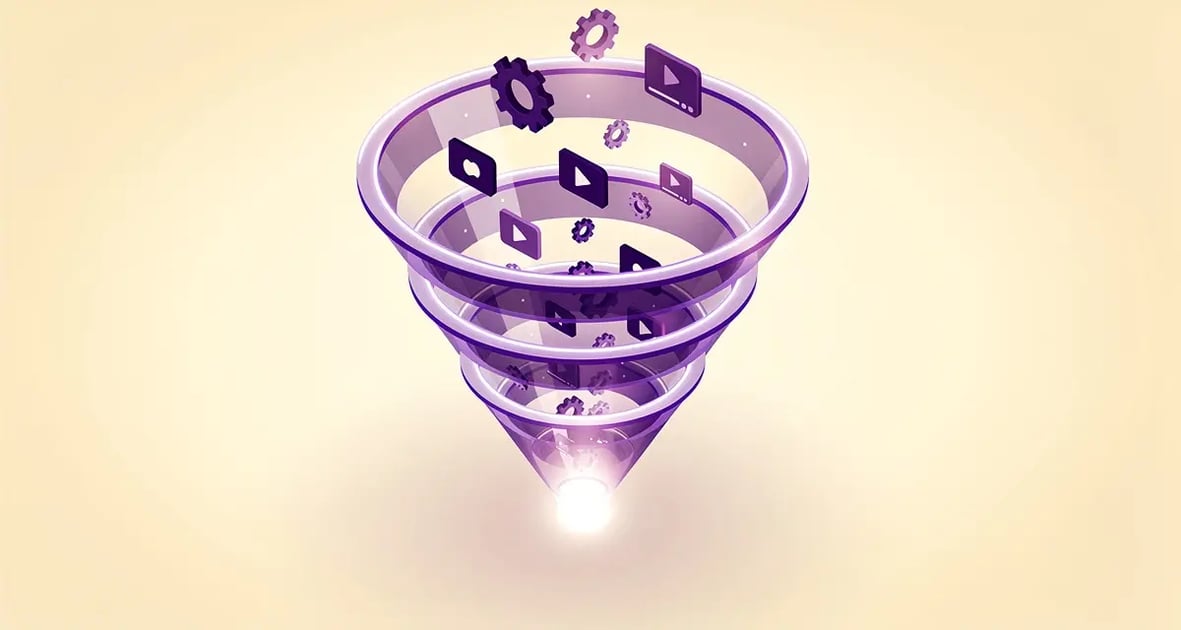
Every SaaS sales funnel breaks into three functional phases — top, middle, and bottom of funnel — even if the exact number of named stages varies by business. Top of funnel builds awareness, middle of funnel drives evaluation, and bottom of funnel converts intent into a signed deal.
The classic AIDA model (Attention, Interest, Desire, Action) still holds up as a mental model for what a prospect experiences, but the right number of formal stages depends entirely on your product's maturity and price point. Selling a $49/month self-serve tool is a different exercise than selling a $50,000/year enterprise contract, even though both are SaaS.
Top of Funnel
Top of funnel (TOFU) is marketing and lead generation — you're attracting people who might have the problem your product solves, through organic search, social, paid ads, email, and events. The strongest TOFU content types are how-to guides, explainer videos, blog posts, and downloadable lead magnets. Track the transition point closely: it's usually when a visitor hands over contact details in exchange for something of value.
Middle of Funnel
Middle of funnel (MOFU) is where a prospect actively evaluates your solution against alternatives, often across multiple site visits and touchpoints. Presentations, video demos, case studies, product comparisons, and webinars all perform well here. The video sales letters we've covered before are a textbook MOFU asset — they show prospects why your solution fits, not just what it does.
Bottom of Funnel
Bottom of funnel (BOFU) is where interest converts into action: addressing final objections, minimizing perceived risk, and maximizing the promised return. You'll want pricing and comparison pages, video testimonials, reviews, a fast sign-up flow, and onboarding materials ready to go the moment a prospect is ready to commit.
Advanced strategy: B2B funnels aren't just longer B2C funnels
B2B and B2C sales funnels differ in more than length. B2B deals typically involve three to seven decision-makers, longer evaluation windows, and higher-stakes budget approval — which is why B2B funnels lean harder on case studies, ROI calculators, and multi-threaded outreach that reaches every stakeholder, not just the first contact.
How AI Is Automating the Modern SaaS Sales Funnel
AI now automates work at every stage of the SaaS sales funnel that used to require a human: identifying which accounts are actually in-market, drafting and sending first-touch outreach, and personalizing follow-up content at a scale no rep could manage manually. This is the biggest shift in funnel construction since the 2021 version of this guide, and it's why "automated sales funnel" now outranks generic funnel-strategy searches in monthly volume.
At the top of the funnel, intent data platforms track buyer intent signals across the web — content consumption, review-site visits, competitor research — so marketing can prioritize accounts that are already showing purchase signals instead of blasting a generic list. Paired with enrichment tools, this is what makes account-based marketing (ABM) at scale practical for teams that don't have an army of researchers.
In the middle of the funnel, AI SDRs and conversational AI chatbots handle first-line qualification and scheduling around the clock, while predictive lead scoring models rank which leads are worth a rep's time based on behavioral patterns from your best historical deals. Sales engagement platforms increasingly plug directly into this layer, triggering personalized outreach the moment a lead crosses a scoring threshold.
The most under-used lever, though, is AI video personalization. Instead of recording a separate video for every prospect, a rep records one video and AI voice cloning generates thousands of individually personalized versions — each one addressing the prospect by name, referencing their company, and matching their funnel stage — without adding a single hour of production time. Combined with workflow automation tools and a broader revenue operations (RevOps) approach that unifies marketing, sales, and customer success data, this turns funnel automation from a cost-cutting exercise into a genuine differentiator. Watch how SaaS teams are applying this in practice below:
None of this replaces the funnel structure covered above — TOFU, MOFU, and BOFU still exist. What's changed is that CRM-native video and automation tools now handle the repetitive execution, freeing reps to spend their time on the conversations that actually need a human.
Record One Video. AI Personalizes Thousands.
Sendspark is the AI video personalization platform for B2B sales. Record once, and AI voice cloning generates thousands of individually personalized videos with dynamic backgrounds and personalized thumbnails — each prospect hears their name, sees their website, in your voice. Sales teams see 2-3x more replies.
Get Started NowMetrics That Actually Matter
The metrics that actually matter for a SaaS sales funnel are Customer Acquisition Cost (CAC), Customer Lifetime Value (CLV), the CLV:CAC ratio, and Monthly Recurring Revenue (MRR) — everything else is secondary. Vanity metrics like page views or email opens feel productive but don't tell you whether the funnel is actually making money.
- Customer Acquisition Cost (CAC) — your average sales and marketing spend per new user. Rising CAC without a corresponding rise in deal size is an early warning sign.
- Customer Lifetime Value (CLV) — what the average customer spends over their time with you. Early churn hurts CLV more than almost anything else, so pay close attention to who you're signing up and how you onboard them.
- CLV:CAC Ratio — if this drops below 1, you're losing money on every new customer you acquire, and it's time to rethink the funnel fast.
- Monthly Recurring Revenue (MRR) — for most SaaS companies, this is the single clearest signal that the funnel is working at a business level.
Beyond the top-level numbers, the real optimization work happens at the micro-level: tracking conversion rate at every single transition point in the funnel, not just the overall top-to-bottom rate. A funnel that converts well overall can still hide a broken transition — say, a 90% drop-off between demo request and demo attendance — that no top-level metric will surface on its own. Review stage-to-stage conversion monthly, not just quarterly, so you catch a leak before it compounds into a quarter of missed pipeline.
10 Tactics for a High-Converting SaaS Sales Funnel
The ten tactics that consistently improve SaaS sales funnel conversion rates combine funnel design discipline with modern automation: build around a strong hero offer, adapt messaging as leads move down the funnel, and layer in AI-personalized video and workflow automation everywhere a human touchpoint used to be required.
- Design around your hero content. Whether it's a lead magnet, webinar, or demo, the rest of your funnel content should revolve around that centerpiece.
- Evolve your messaging as leads progress. A prospect's needs and objections change as they move down the funnel — plan for that shift instead of repeating the same pitch.
- Study competitor funnels. Walk through a competitor's funnel yourself to see what they do well and where the gaps are that you can fill.
- Push the advantage after conversion. An upsell on the "thank you" page catches buyers while they're already in a purchasing mindset; a downsell can recover an abandoned cart.
- Keep nurturing. Most reps give up too soon. An automated funnel doesn't get tired of following up, and most buyers need several touchpoints before they trust a pitch.
- Plug funnel leaks. Remove navigation options on landing pages and forms that don't move a prospect toward the next stage.
- Use stories, not specs. People respond to emotional framing about the problem being solved, not a feature list.
- Deploy exit-intent offers. A well-timed final offer can recover visitors who are about to abandon the funnel.
- A/B test every touchpoint. Continuous testing, not a one-time build, is what keeps conversion rates climbing.
- Use AI video wherever you can. Video outperforms text for emotion, storytelling, and a sense of individual attention — and AI personalization means you can deploy it at every stage without a production bottleneck.
Quick Comparison: Funnel Stage, Goal, and Automation
| Funnel Stage | Primary Goal | Best Content Types | Common Automation Layer |
|---|---|---|---|
| Top (TOFU) | Awareness & lead capture | Blog posts, explainer video, lead magnets | Intent data, SEO, paid social |
| Middle (MOFU) | Evaluation & trust-building | Case studies, demos, video sales letters | AI SDR outreach, predictive lead scoring |
| Bottom (BOFU) | Conversion & onboarding | Pricing pages, testimonials, personalized video | Sales engagement platforms, AI video personalization |
Common mistake
Automating a broken funnel just makes the leak faster. Fix the transition points where prospects drop off before layering on AI SDRs or workflow automation — otherwise you're scaling a problem, not a solution.
If you want to go deeper on the outreach side specifically, our comprehensive guide to AI video personalization for outbound sales covers how to apply this at the top and middle of the funnel in detail. For funnel stages further along, see how video email fits into a converting sales funnel, or brush up on virtual selling best practices for the human-led parts of the process. If you haven't formalized the earlier stages yet, start with how to build a sales pipeline before layering in funnel automation.
Frequently Asked Questions
What is a SaaS sales funnel?
A SaaS sales funnel is the structured path a prospect follows from first awareness of your product to becoming a paying, retained customer. It typically breaks into top, middle, and bottom stages, each with different content and conversion goals.
How many stages should a SaaS sales funnel have?
There's no universal number — it depends on your product's price point, sales motion, and audience. Most SaaS funnels work fine with the simple top/middle/bottom structure, though enterprise motions often add formal evaluation and procurement stages.
How do you automate a SaaS sales funnel?
You automate a SaaS sales funnel by layering intent data and predictive lead scoring at the top, AI SDRs and sales engagement platforms in the middle, and AI video personalization plus workflow automation at the bottom — while keeping a human involved wherever trust or complex objections are on the line.
What's the difference between a B2B and B2C sales funnel?
B2B sales funnels involve longer cycles and multiple decision-makers, so they lean more heavily on case studies, ROI justification, and multi-threaded outreach. B2C funnels are typically shorter and driven more by individual, emotional purchase decisions.
What metrics should you track in a SaaS sales funnel?
Track Customer Acquisition Cost (CAC), Customer Lifetime Value (CLV), the CLV:CAC ratio, and Monthly Recurring Revenue (MRR) at the business level, plus the conversion rate at every individual transition point within the funnel.
How does AI improve sales funnel automation?
AI improves sales funnel automation by identifying which accounts are actually in-market through intent data, qualifying and scheduling leads through AI SDRs and conversational AI, and personalizing outreach at scale through AI video personalization — work that previously required proportional headcount growth.
What is the AIDA model in a sales funnel?
AIDA stands for Attention, Interest, Desire, and Action — a classic model describing the mental states a prospect moves through on the way to becoming a customer. It remains a useful mental model even though most modern funnels don't map to it stage-for-stage.
Sources & References
- HubSpot Sales Statistics — ongoing roundup of B2B sales benchmark data, including buyer touchpoint and follow-up statistics (2026)
- Userpilot: SaaS Product Adoption — breakdown of the Innovators/Early Adopters/Early Majority/Late Majority/Laggards adoption curve applied to SaaS (2025)
- Gartner Sales Technology Research — ongoing research hub on AI and automation adoption across B2B sales technology (2026)
- McKinsey Growth, Marketing & Sales Insights — research on AI-driven personalization and sales productivity gains (2026)
- Baremetrics — SaaS subscription analytics platform referenced for MRR and churn tracking methodology
Record One Video. AI Personalizes Thousands.
Sendspark is the AI video personalization platform for B2B sales. Record once, and AI voice cloning generates thousands of individually personalized videos with dynamic backgrounds and personalized thumbnails — each prospect hears their name, sees their website, in your voice. Sales teams see 2-3x more replies.
Get Started Now