Sales reps who send personalized video sales letters see reply rates 2-3x higher than those relying on plain text emails alone. Yet most teams still treat VSLs as one-off recordings that take hours to produce and land in inboxes looking identical to every other prospect’s copy. That gap is now a serious competitive disadvantage. In 2026, AI video personalization platforms let you record a single VSL and ship thousands of individually tailored versions, each with the prospect’s name, company, and website baked in, in minutes.
Updated August 2026
Key Takeaways
- A video sales letter (VSL) is a scripted video presentation that replaces or supplements a long-form written sales letter, combining visuals, voice, and storytelling to move prospects toward a buying decision.
- According to Wyzowl’s 2026 Video Marketing Statistics report, 91% of businesses now use video as a marketing tool, and 87% say video gives them a positive ROI.
- AI voice cloning and dynamic backgrounds mean one recorded VSL can generate thousands of individually personalized variants — eliminating the biggest bottleneck in B2B VSL outreach.
- Real B2B teams see concrete results: Brikl increased demo bookings 43% by sending a Sendspark video within 24 hours of a new lead, and Qwilr closed deals faster after swapping PDF proposals for short video walkthroughs.
- Sendspark’s AI video personalization platform is the only VSL tool in this guide that combines AI voice cloning, dynamic backgrounds, personalized thumbnails, and CRM enrichment in a single workflow.
What Is a Video Sales Letter?
A video sales letter is a scripted video presentation designed to do exactly what a long-form written sales letter does, but faster and with far greater emotional impact. Instead of asking a prospect to read thousands of words, you walk them through a problem, a solution, and a clear call to action using your voice, face, and visuals. VSLs range from a 90-second cold-outreach clip to a 20-minute product walkthrough, depending on where the prospect sits in the funnel.
The term “VSL” was popularized in direct-response marketing, where copywriters discovered that putting their written letters on video dramatically lifted conversion rates. That pattern has migrated wholesale into B2B sales. Today, an SDR might send a short VSL instead of a cold email. A demand generation team might embed a VSL on a landing page. An account executive might record a deal-specific VSL to accelerate a stalled opportunity.
What makes a VSL different from a casual video message is the script. A good VSL follows a proven copywriting structure: hook, problem, agitation, solution, proof, and call to action. Every word earns its place. The best VSLs feel like a conversation, but every line was written and rehearsed before the camera turned on. If you want help building your script, Sendspark’s scripts and teleprompter tool lets you write, edit, and scroll your VSL copy in the same platform where you record.
VSLs also differ from webinars. A webinar is live, interactive, and typically an hour long. A VSL is asynchronous, tightly scripted, and built for a single viewing experience. One is an event. The other is a conversion asset you can send to thousands of people.
Why Video Sales Letters Convert (and What the Data Says in 2026)
Video sales letters convert because they combine the persuasive structure of a written sales letter with the trust-building power of seeing and hearing a real person. Prospects process voice tone, facial expression, and pacing in ways that text simply cannot replicate. When you add personalization, the effect compounds dramatically.
The numbers back this up. According to Wyzowl’s 2026 Video Marketing Statistics report, 87% of marketers say video delivers positive ROI, and 82% say video has directly helped them increase dwell time on landing pages. For B2B specifically, HubSpot’s State of Marketing report consistently shows video as the top-performing content format for both engagement and pipeline generation. And Gong Labs data on sales conversations shows that reps who use personalized video in outreach book meetings at significantly higher rates than those who rely on text alone.
The core reason VSLs work is psychological. Humans are wired to respond to storytelling and human voices. A well-structured VSL walks a prospect through a problem they recognize, shows them the cost of inaction, then presents your product as the logical solution. That arc triggers the same cognitive and emotional responses as a great sales conversation, but at scale and on the prospect’s own time.
Personalization amplifies every one of those effects. When a prospect hears their company name, sees their website in the video background, and gets a thumbnail with their name on it, the video stops feeling like broadcast content. It feels like a message sent specifically to them. That shift in perception is why video personalization has become the most important variable in modern VSL performance. For a deeper look at how video fits into your broader sales motion, see our guide to video for sales.
Pro tip
Add a personalized thumbnail showing the prospect’s name and company logo before you hit send. Thumbnails are the first thing a prospect sees in their inbox. A thumbnail that says “Hey Sarah, quick video for HubSpot” gets clicks that a generic play button never will. Sendspark generates these automatically through its AI personalized intros feature.
How to Create a Video Sales Letter That Converts
Creating a VSL that actually converts comes down to four things: a tight script, a credible delivery, the right length, and a clear single call to action. Miss any one of those and even a technically polished video will underperform.
Step 1: Write a Script Before You Record
The biggest mistake people make with VSLs is hitting record before they have a script. Improvised VSLs ramble. They bury the hook, repeat themselves, and trail off without a clear ask. A video sales letter script should follow a proven structure. The most reliable for B2B outreach is: Hook (name the problem or call out the prospect’s situation), Agitate (show the cost of the status quo), Solution (introduce your product as the answer), Proof (a stat, a case study, a quick demo moment), and CTA (one specific next step, not three).
Keep your script tight. Read it out loud before you record. If it takes longer than 90 seconds to read a cold-outreach script, cut it. For mid-funnel VSLs, longer is acceptable, but every section should earn its runtime. Our VSL script templates for sales prospecting give you proven starting points you can adapt in minutes.
Step 2: Record with the Right Setup
You do not need a studio. You need decent lighting (a window or a ring light), a quality microphone (USB condenser mics cost $50-$80), and a clean or branded background. Face the camera directly and use your natural speaking voice. Prospects buy from humans, not polished presenters. One useful approach: record a quick test clip, watch it back on mute, and check whether your expressions and energy match what you want to communicate.
Step 3: Personalize Before You Send
A generic VSL is better than no VSL. But a personalized VSL is in a different category entirely. At minimum, address the prospect by name in your opening line. At the next level, reference something specific to their company: a recent funding round, a job posting that signals a pain point, a competitor they just lost a deal to. At the AI-powered level, you can use signal-based VSL personalization to automatically pull CRM data and generate a personalized intro for each recipient without recording separately for each one. We cover exactly how that works in the next section.
Step 4: Build a VSL Funnel Around Your Video
A video sales letter funnel is the sequence of touch points that surrounds your VSL. For cold outreach, that might be: personalized email with VSL thumbnail, follow-up LinkedIn message, and a reply sequence if they watch but do not respond. For mid-funnel, it might be: VSL on a landing page, retargeting ad for viewers who did not convert, and a one-to-one follow-up from an AE. Think of your VSL as the centerpiece of a sequence, not a standalone asset. The video prospecting guide walks through how to build this sequence end to end.
Step 5: Send, Track, and Iterate
Use a platform that gives you view analytics: who watched, how far they got, and whether they clicked your CTA. That data tells you whether your hook is working, where people drop off, and which prospect segments respond best. Iterate on the script for the segments that underperform. Double down on what works. For tips on structuring your pitch delivery, see our video sales pitch guide.
Record One Video. AI Personalizes Thousands.
Sendspark is the AI video personalization platform for B2B sales. Record once, and AI voice cloning generates thousands of individually personalized videos with dynamic backgrounds and personalized thumbnails. Each prospect hears their name, sees their website, in your voice. Sales teams see 2-3x more replies.
Get Started NowReal-World Video Sales Letter Results: Case Studies and 2026 Benchmarks
Video sales letters deliver measurable business impact, not just theoretical appeal. Teams that lead with a personalized video message report a demo-booking lift of over 40%, and personalization more broadly can push cold outreach reply rates to nearly double the industry average. These are not hypothetical gains. They come from real B2B companies using video in their sales process today.
Brikl: 43% Demo-Booking Lift with First-Contact Video
Brikl’s sales team sends a Sendspark video message within the first 24 hours of a new lead arriving. This simple change increased demo bookings by 43%. The case study shows how a proof-of-concept video delivered at the right moment can dramatically improve pipeline velocity. Replacing a generic first-touch email with a short personalized video created an immediate connection that moved prospects toward the next step faster than a plain-text follow-up ever could.
Qwilr: Faster Deal Cycles with Video Walkthroughs
Qwilr reps replaced bulky PDF proposals with a short Sendspark video that walks through the proposal and explains key parts. This reduced back-and-forth and helped close contracts faster. The case study is a useful reminder of why video engagement analytics matter here: a strong completion rate on a proposal walkthrough is one of the clearest signals of real sales cycle compression, since a prospect who watches to the end is a prospect who is close to a decision, not one still guessing at your pricing page from a static PDF.
2026 Benchmark: Personalization Doubles Cold Outreach Reply Rates
The data backs up what these case studies show. According to Sopro’s 2026 cold outreach research, campaigns with advanced personalization achieve reply rates up to 18%, compared with 9% for generic, non-personalized outreach — a 100% reply-rate lift. That benchmark is a strong signal that personalization is no longer a nice-to-have in B2B outreach. Layer video on top of it and the effect compounds: watch-through rate tells you exactly who is genuinely engaged, and a healthy video CTA click-through rate from those viewers is what turns that attention into a booked meeting.
These results are repeatable because of how Sendspark’s AI video personalization platform works. You record one video sales letter, and AI voice cloning personalizes your voice and message for every prospect at scale. That means every lead in a 500-account list gets the same high-quality proof-of-concept video, tailored to their name and company, without a rep recording it 500 separate times. The resulting video engagement analytics then show you exactly what is and is not working, so you can refine the script instead of guessing.
AI Video Sales Letters: Record One VSL, Personalize Thousands (2026 Shift)
Until recently, personalizing a VSL meant recording a new video for every prospect. That was fine for a handful of high-value accounts, but completely unworkable at the scale modern B2B outreach demands. Generative video and AI voice cloning have changed that equation entirely. You now record one base VSL, and AI generates individually personalized variants for every prospect on your list, each one sounding and looking like you recorded it specifically for them.
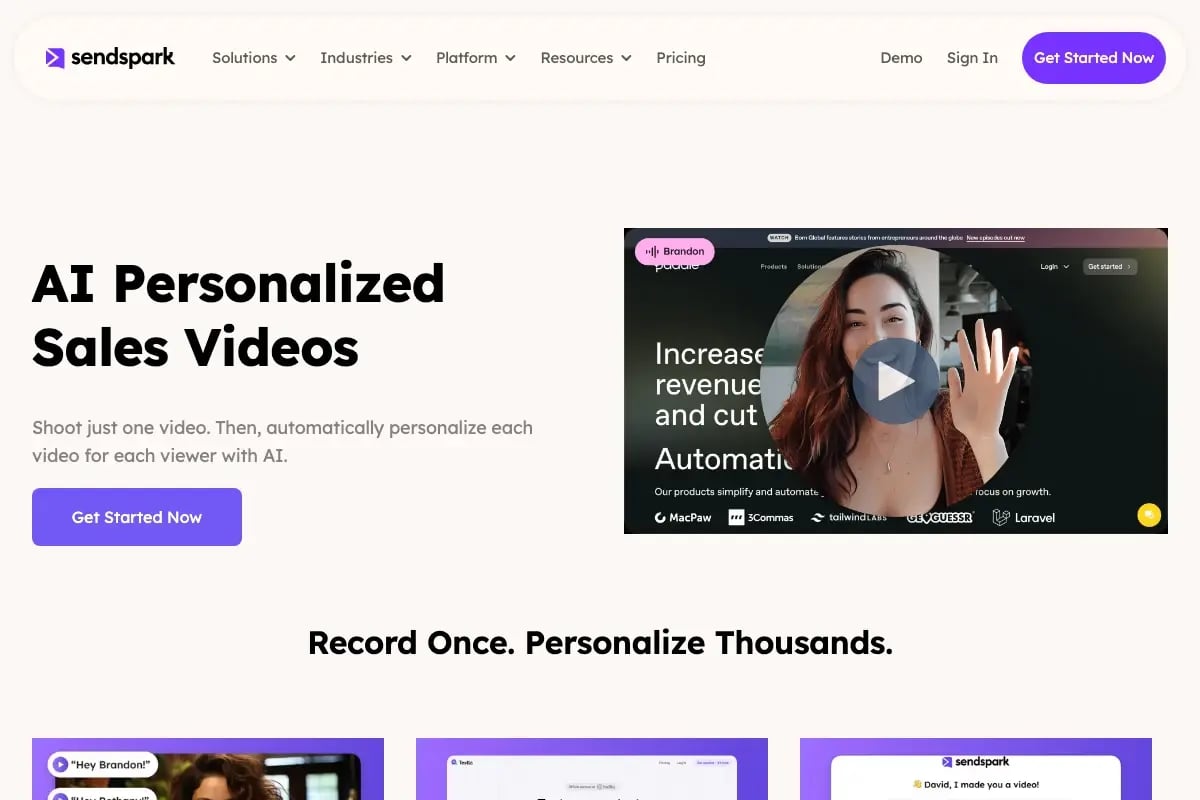
Here is how it works in practice. You record your VSL once: your hook, your core message, your CTA. That recording becomes your master file. You then upload a contact list, and the platform pulls each prospect’s name, company, and relevant CRM data. Using zero-shot voice cloning, the AI replicates your voice to insert each prospect’s name naturally into the audio. Dynamic backgrounds swap in each prospect’s website or LinkedIn profile as the visual backdrop. Personalized thumbnails are generated automatically with each recipient’s name and company logo visible before they even click play.
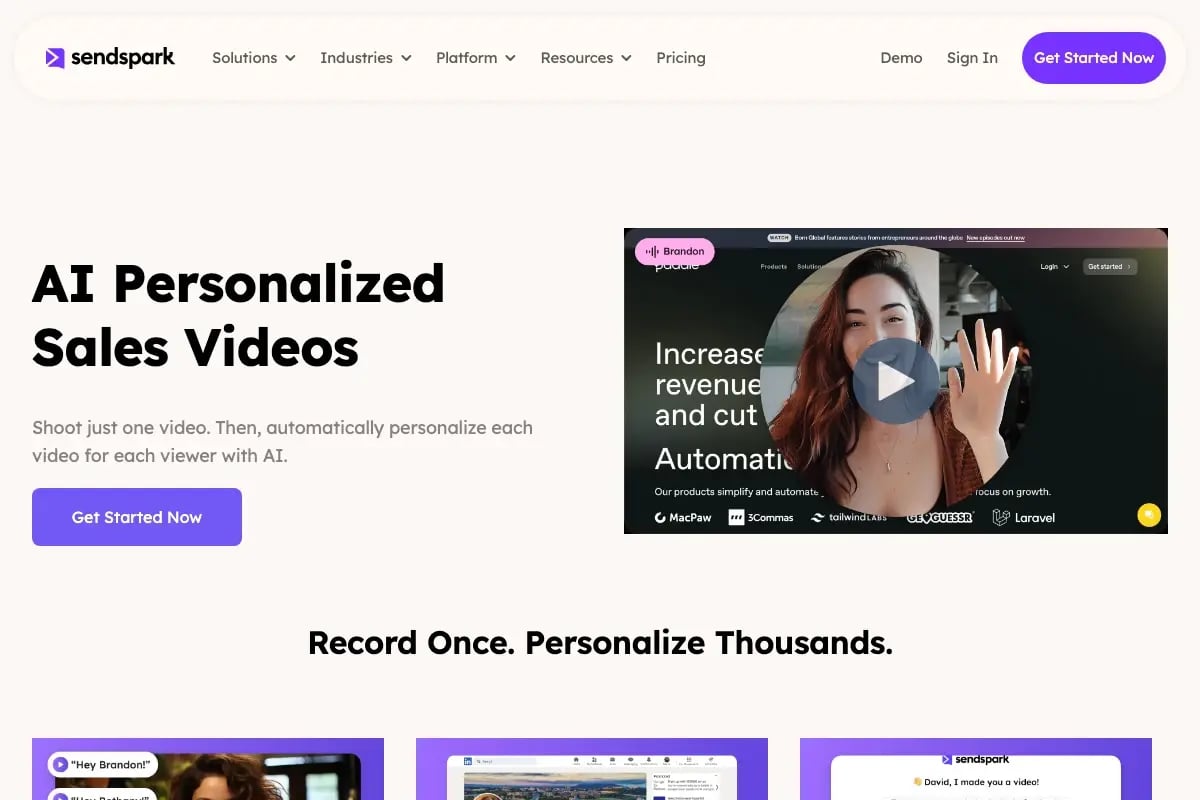
The result is what Sendspark calls Sendspark Combined Videos: a workflow where a short personalized AI intro is stitched to your base VSL, creating a seamless, individually addressed video for every recipient. An SDR working a 500-account list can send 500 genuinely personalized VSLs in the same time it previously took to record five manual ones. That is not a marginal improvement. It is a fundamentally different way to run outreach. You can watch the example to see what a combined personalized VSL looks like in a real inbox context.
Signal-based VSL personalization takes this further. Instead of just inserting a name, the AI can pull intent signals from your CRM, recent web activity data, or firmographic enrichment to customize the message itself. A prospect who just viewed your pricing page gets a VSL that acknowledges they have been researching. A prospect from a company that just posted three SDR job openings gets a VSL that speaks directly to scaling outreach. Paired with Sendspark’s HubSpot integration, this kind of signal-based triggering can run automatically, launching personalized VSLs at exactly the right moment in a prospect’s buying journey.
There is also a growing use case for account-based VSLs. For enterprise accounts, teams record a VSL that speaks directly to the target company’s industry, size, and known pain points, then use AI personalization to address multiple stakeholders at the same account with role-specific variants. The head of sales gets a VSL about pipeline. The CFO gets one about cost reduction. Both versions use the same base recording. The AI handles the personalization layer. The sales prospecting solution and the AI video personalization outbound sales guide cover the full playbook for running account-based VSL campaigns this way.
It is worth addressing the “AI avatar VSL” question directly. Some platforms now offer fully synthetic presenters, where no real person ever appears on camera. For certain use cases, like onboarding video or product explainers, AI avatar VSLs are genuinely useful. But for B2B sales outreach, data consistently shows that real human faces outperform AI avatars on trust and reply rate. The winning formula in 2026 is a real recording of the sales rep, augmented by AI personalization, not replaced by it. Salesforce’s State of Sales report confirms that buyers still rank authentic human interaction as the top factor in choosing a vendor, even as AI becomes more prevalent in sales workflows. The full breakdown of how AI fits into video sales strategy is in our AI video sales and marketing guide.
3 Ways SaaS Teams Book Meetings at Scale with AI Video — Sendspark
The 11 Best Video Sales Letter Tools for 2026
Choosing the right VSL tool depends on your use case, your team size, and how much personalization you need at scale. The tools below cover everything from AI-powered personalization platforms built for B2B outreach to animation tools for marketing-led VSL funnels. Here is a quick comparison, followed by a full breakdown of each.
| Tool | Best For | AI Personalization | Starting Price |
|---|---|---|---|
| Sendspark | B2B sales outreach at scale | AI voice cloning, dynamic backgrounds, personalized thumbnails | Free plan available |
| Camtasia | Screen-based VSLs and tutorials | Limited (basic AI audio cleanup) | $179.88/yr |
| Potion | Personalized video prospecting | AI face and background personalization | $99/mo |
| EasyVSL | Slide-based VSL creation | No | $49 one-time |
| Pictory | Script-to-video for marketing VSLs | AI voice, auto scene generation | $19/mo |
| Vyond | Animated explainer VSLs | AI script assistant | $49/mo |
| Biteable | Quick branded video ads and VSLs | AI text-to-video | $29/mo |
| Doodly | Whiteboard-style VSLs | No | $39/mo |
| VideoScribe | Animated whiteboard presentations | No | $14/mo |
| InVideo | Template-based marketing VSLs | AI script and voiceover | $20/mo |
| CreateStudio | High-production animated VSLs | AI character animation | $69 one-time |
1. Sendspark
Sendspark is the only AI video personalization platform in this list built specifically for B2B sales teams. You record one VSL, upload your contact list, and Sendspark’s AI voice cloning generates thousands of individually personalized versions, each with the prospect’s name spoken in your voice, their company website as the dynamic background, and a personalized thumbnail showing their name before they click play.
The platform’s CRM enrichment integrations, including the native HubSpot integration, let you trigger personalized VSLs automatically based on deal stage, intent signals, or contact activity. Sendspark Combined Videos stitch a personalized AI intro to any existing VSL, so your master recording stays evergreen while every send feels bespoke. For teams running high-volume sales prospecting, this is the biggest time multiplier available. See Sendspark’s pricing for plan details, including the free tier.
Best for: SDR teams, AEs, and revenue organizations running personalized outreach at scale. See a live example of what a personalized VSL looks like in the real world at this Sendspark demo.
2. Camtasia
Camtasia by TechSmith is a long-standing screen recording and video editing tool well suited to VSLs that rely heavily on product demos, slide walkthroughs, or tutorial-style presentations. It offers robust editing capabilities, including captions, callouts, and zoom animations, that help you direct viewer attention to key parts of your screen recording.
Camtasia lacks native personalization features, so it is best used for creating polished base VSLs that another tool then personalizes. It is a strong choice for teams producing evergreen product-led VSLs for landing pages or sales decks, less so for high-volume one-to-one outreach. Pricing starts at $179.88 per year.
3. Potion
Potion offers AI-powered personalized video prospecting with a focus on dynamic website backgrounds and face-based personalization. You record once, upload a list, and Potion generates individually addressed videos. It competes in a similar space to Sendspark but has a narrower integration ecosystem and less mature voice cloning capabilities.
Potion works well for teams that want a simple personalized video workflow without building out a full CRM-connected campaign. Starting price is around $99 per month.
4. EasyVSL
EasyVSL is a desktop software tool designed specifically for creating slide-based video sales letters. You type your script, add slides and images, and the tool generates a video from your content. It is one of the few tools built explicitly around the VSL format rather than general video creation.
The trade-off is that EasyVSL produces a somewhat dated visual style, and there is no AI personalization or cloud-based distribution built in. It is best suited to direct-response marketers building long-form VSL landing pages. The one-time price of $49 makes it accessible, but the output requires additional hosting and distribution work.
5. Pictory
Pictory is the natural successor for users who previously relied on Vidnami, which shut down in 2021 after its acquisition by GoDaddy. Vidnami was a popular script-to-video tool that let marketers paste a script and receive an auto-edited video. Pictory replicates and expands that workflow with stronger AI capabilities, including automatic scene selection from stock footage libraries, AI voiceover, and auto-captioning.
For marketing-led VSLs where you need to produce a polished video from a script without appearing on camera, Pictory is a strong option. It is less suited to B2B sales outreach personalization. Starting at $19 per month, it is also the most accessible paid tool in this list for solo marketers and small teams.
6. Vyond
Vyond is an animation platform that lets you create character-driven explainer videos and animated VSLs. It is popular in L&D and corporate communications, but sales teams use it for creating polished product explainer VSLs that sit at the top of a funnel. The AI script assistant helps you draft narration quickly, and the library of pre-built characters and scenes reduces production time significantly.
Vyond is not a personalization tool. It is best used for producing a single, high-quality animated VSL that can be embedded on a landing page or shared broadly, not for one-to-one sales outreach. Pricing starts at $49 per month.
7. Biteable
Biteable is a browser-based video creation platform with a large library of animated and live-action templates. Its AI text-to-video feature lets you convert a script into a rough video draft quickly. It is strongest for short VSL-style ads and social content rather than long-form B2B sales videos.
Biteable works well for demand generation teams that need to produce a high volume of short, branded video content without heavy production overhead. It is not suited to personalization at scale. Pricing starts at $29 per month.
8. Doodly
Doodly is a whiteboard animation tool that lets you create the “hand drawing on a whiteboard” style of video that was extremely popular in explainer and VSL marketing a few years ago. That visual style has become somewhat saturated, but it still performs well in certain verticals, particularly education, professional services, and financial products.
Doodly has no AI personalization capabilities and is a purely creative production tool. It is worth considering if your audience responds well to simplified visual storytelling. Pricing starts at $39 per month.
Worth knowing
Whiteboard-style and heavily animated VSLs often underperform in cold B2B outreach because they feel like marketing content rather than a personal message. For cold email and LinkedIn outreach, real-face video consistently outperforms animation on reply rate. Reserve Doodly, VideoScribe, and similar tools for landing pages and paid ads where your audience is already warm.
9. VideoScribe
VideoScribe by Sparkol is one of the original whiteboard animation platforms and remains a solid choice for producing clean, animated VSLs from a script. It offers a larger asset library than Doodly and slightly more flexible customization. Like Doodly, it has no personalization features and is best used as a production tool for top-of-funnel VSL content.
VideoScribe starts at $14 per month, making it the most affordable animation-focused VSL tool in this list.
10. InVideo
InVideo is a cloud-based video creation platform with an AI-assisted workflow that can convert a text script into a fully produced video using stock footage, motion graphics, and automated voiceover. It is a strong option for marketing teams that need to produce multiple VSL variants for different audience segments without filming anything.
InVideo’s AI voiceover and script tools have improved significantly, and it now supports a wide range of VSL templates designed for e-commerce, SaaS, and professional services. It does not offer prospect-level personalization. Starting at $20 per month with a free tier available.
11. CreateStudio
CreateStudio is a desktop animation software that punches above its price point for producing high-quality animated and character-based VSLs. It supports 3D animations, character lip-syncing, and motion graphics at a level usually reserved for much more expensive tools. For teams that want cinema-quality animated VSLs without an agency budget, CreateStudio is worth evaluating.
Like the other animation tools in this list, CreateStudio produces beautiful content but offers no prospect-level personalization or B2B sales distribution features. It is best used for producing evergreen VSL content. Available as a one-time purchase starting at $69.
Frequently Asked Questions
What is a video sales letter?
A video sales letter is a scripted video presentation designed to move a prospect toward a buying decision. It follows the same persuasive structure as a written long-form sales letter, including a hook, problem statement, solution, proof, and call to action, but delivers that message through video for greater emotional impact. VSLs are used in both B2C direct response marketing and B2B sales outreach, from cold email prospecting to landing page conversion funnels.
How long should a video sales letter be?
The ideal length depends on where the prospect is in their buying journey. For cold outreach VSLs sent via email or LinkedIn, 60-120 seconds is the sweet spot. For mid-funnel VSLs on a landing page, 3-7 minutes performs well for most B2B products. For complex enterprise solutions or high-ticket offers, VSLs of 15-20 minutes are appropriate when the audience is already engaged and actively evaluating. The rule of thumb: as commitment required increases, so can video length, but only if every minute earns its place.
How do you write a video sales letter that converts?
Start with a hook that names the exact problem your prospect is experiencing, not a generic pain point. Then agitate that problem by showing what it costs them to leave it unsolved. Introduce your solution clearly and specifically, then back it up with proof: a relevant case study, a specific result, or a live product demonstration. Close with one clear call to action. Use Sendspark’s teleprompter and scripts tool to write and deliver your script without memorizing every line.
What is the ideal video sales letter funnel structure?
A high-converting video sales letter funnel typically has three stages. At the top, a personalized VSL in an outreach email or LinkedIn message generates the first reply or click. In the middle, a longer VSL on a landing page or sent post-discovery call deepens interest and handles objections. At the bottom, a tailored VSL addressing deal-specific concerns or showing a custom demo accelerates the close. Each stage uses a different length and depth of VSL, but all three share the same scriptwriting principles.
Can AI generate personalized video sales letters at scale?
Yes. AI video personalization platforms like Sendspark let you record one VSL and use AI voice cloning to generate thousands of individually personalized versions, each with the prospect’s name spoken in your voice, a dynamic background showing their website, and a personalized thumbnail. This workflow, sometimes called record-once-personalize-at-scale, has become the standard approach for B2B SDR teams running high-volume outreach. The Harvard Business Review research on personalization confirms that individually tailored outreach consistently outperforms broadcast messaging across industries.
What is the difference between a VSL and a webinar?
A VSL is asynchronous, tightly scripted, and typically watched individually by a single prospect at a time of their choosing. A webinar is a live event with real-time interaction, audience Q&A, and a fixed schedule. VSLs are conversion assets you record once and distribute at scale. Webinars are events that require attendance coordination and live presentation. Both can be part of a B2B sales motion, but they serve different purposes: VSLs for scalable personalized outreach, webinars for group education and live engagement.
How much does it cost to make a video sales letter?
A basic VSL can cost nothing beyond your time if you record it yourself using a webcam or smartphone with natural light and a simple script. At the professional end, a studio-produced animated VSL can cost $5,000-$50,000 through an agency. For B2B sales teams, the practical middle ground is a self-recorded VSL using a quality USB microphone ($50-$80), a ring light ($30-$60), and an AI video personalization platform like Sendspark that handles the distribution and personalization layer at scale. That entire setup costs less than a single hour of agency production time and produces better results for one-to-one outreach.
Sources & References
- Wyzowl 2026 Video Marketing Statistics — “87% of marketers say video gives them positive ROI; 91% of businesses use video as a marketing tool” (2026)
- HubSpot 2026 Marketing Statistics — “Short-form video delivers the highest ROI of any content format for marketers” (2026)
- Gong Labs — “Personalized video in outreach correlates with significantly higher meeting booking rates versus text-only sequences” (2025)
- Sopro 2026 Cold Outreach Statistics — “Campaigns with advanced personalization achieve reply rates up to 18%, compared with 9% for generic outreach” (2026)
- Salesforce State of Sales — “Buyers continue to rank authentic human interaction as a top factor in vendor selection, even as AI use grows in sales workflows” (2026)
- Harvard Business Review — “Personalization Done Right” — “Companies that treat personalization as a strategic capability outperform those that treat it as a marketing tactic” (2024)
Record One Video. AI Personalizes Thousands.
Sendspark is the AI video personalization platform for B2B sales. Record once, and AI voice cloning generates thousands of individually personalized videos with dynamic backgrounds and personalized thumbnails. Each prospect hears their name, sees their website, in your voice. Sales teams see 2-3x more replies.
Get Started NowTopics: Tips & Tricks