Most B2B outbound teams still spend their day emailing strangers. They buy a list, write a template, send it to 500 people, and hope 2% reply. That model is collapsing. Buyers research privately, inboxes are saturated, and the best-performing revenue teams have already moved on. They target prospects who have already shown interest — a visit to the pricing page, a company browsing a competitor comparison, a lead returning to the site three times in a week. That shift has a name: intent-based prospecting. And with the right stack, it turns the 97% of website traffic that leaves without converting into your highest-quality pipeline source.
Key Takeaways
- Intent-based prospecting replaces cold-list spray-and-pray with outreach targeted at buyers who have already shown interest — companies visiting your site, consuming your content, or researching your category. It lifts reply rates by 3-5x compared to unqualified outbound.
- The modern stack has three layers: identify anonymous visitors (website de-anonymization), enrich and route (CRM + fit-and-signal rules), and reach out with a channel that earns attention (AI-personalized video, not generic email).
- Gartner research shows 67% of the B2B buying journey now happens digitally before a buyer talks to sales — intent data is the only way to reach buyers during that invisible window.
- Sendspark’s integration with Leadfeeder turns identified-visitor lists into personalized video outreach at scale: one recording, AI voice cloning, and dynamic backgrounds generate thousands of individually tailored videos — each referencing the prospect’s company and website.
- Teams running intent-based prospecting with personalized video see 200-300% higher email response rates and book 40-50% more meetings compared to traditional cold outbound — because the message reaches a warm buyer with a reason to listen.
What Is Intent-Based Prospecting?
Intent-based prospecting is the practice of prioritizing outbound activity toward accounts that have already signaled interest — a website visit, repeated pricing-page views, competitor comparisons, or third-party research behavior — rather than working an undifferentiated cold list. The prospect has done something; you respond. That reversal of the traditional outbound direction is what makes it work.
Cold outbound asks an SDR to guess. Pick a title, pick a company, craft a message, hope it lands. Intent-based prospecting removes the guessing: the buyer has already raised a hand, even if they don’t know they did. The SDR’s job is no longer “find someone who might care” — it’s “reach the person who already cares, before the competition does.”
Intent signals fall into two broad categories:
- First-party intent — Behavior on your own properties: website visits, content downloads, pricing-page views, demo-request starts, returning visitors, and form abandons. You own this data and it’s the strongest signal you’ll ever get.
- Third-party intent — Behavior elsewhere on the internet: researching topics on industry sites, reading category comparisons, attending webinars, or appearing in provider datasets like Bombora or G2. Weaker signal per data point, but useful for accounts that haven’t visited you yet.
Most teams starting with intent-based prospecting get the biggest lift from first-party signals — specifically, identifying the anonymous companies visiting their website. That’s where platforms like Leadfeeder come in, and it’s where this guide will spend most of its time. Understanding how intent fits into your broader sales prospecting workflow is the first step toward systematically replacing cold volume with warm precision.
Why Intent Signals Change the Outbound Game
Three shifts make intent-based prospecting the right approach for 2026, not a nice-to-have.
The buyer’s journey went private. Gartner’s B2B buyer research shows that 67% of the B2B buying journey is now completed digitally before a buyer ever talks to a sales rep. If you wait for a form-fill or a demo request, you’re meeting the prospect at 67% — after they’ve already built a shortlist. Intent signals are the only way to see those buyers earlier, while you can still influence the list.
Inboxes are saturated. The average B2B buyer receives dozens of cold emails per day. HubSpot’s sales statistics show that average cold email reply rates sit around 1-5%, and most of that is noise. An email to someone who just visited your pricing page is not the same email — it’s a relevant follow-up to an action they took. Reply rates on well-timed outbound prospecting to high-intent accounts routinely clear 15-20%.
Budgets compressed. Revenue teams are being asked to book more meetings with fewer SDRs. Spraying 1,000 cold emails to hit one meeting doesn’t scale when headcount is tight. Working 50 high-intent accounts with deep personalization books more meetings, in less time, for less cost. The unit economics of intent-based prospecting simply beat volume outbound in a constrained environment.
Salesforce’s State of Sales report highlights a consistent pattern: top-performing sales teams are significantly more likely to use behavioral signals and personalized outreach than their underperforming counterparts. The gap between the best and the rest is no longer about hustle. It’s about which signals you act on, and how fast.
The Modern Intent-Based Prospecting Stack
The right stack has three layers. Each one is a distinct capability, and trying to combine them in a single tool usually produces a weak version of each. Teams that run intent-based prospecting well tend to pick a best-in-class tool for each layer and stitch them together.
Layer 1 — Identify
You can’t prospect what you can’t see. The identification layer turns anonymous website traffic into named accounts — Company X from San Francisco visited the pricing page three times this week. Leadfeeder is a category leader here: it uses reverse-IP resolution plus proprietary data sources to tell you which companies are on your site, what pages they viewed, how often they returned, and where they dropped off. The output is a ranked list of companies with behavior-level detail — not just “someone visited,” but “this account visited the integration page for HubSpot twice this week and then opened the comparison to our top competitor.”
Layer 2 — Enrich and Route
A visiting company is not yet a contact. The enrichment layer adds the people (names, titles, emails, LinkedIn profiles) and the routing layer decides who on your team should reach out. Most teams route by territory, ICP fit, and signal strength: a tier-1 ICP company that visited the pricing page goes to an AE; a tier-3 company that read a blog post goes to an SDR sequence. Your CRM (HubSpot, Salesforce) handles the routing, and enrichment tools like Clay, Apollo, or ZoomInfo fill in the people layer.
Layer 3 — Reach Out
The outreach layer is where most intent-based prospecting programs fall apart. Teams get the signals right, enrich beautifully, route intelligently — and then send a generic templated email. The signal was warm; the message feels cold. That mismatch kills conversion.
The outreach that actually converts intent signals into replies is personalized, fast, and delivered in a format that breaks through. Text email alone increasingly doesn’t — not because email is dead, but because a templated text email to a warm prospect looks identical to a templated text email to a cold one. AI-personalized video outreach solves that problem: the prospect sees a video that opens with their name, shows their website as the background, and references their specific behavior — all generated from a single recording. (For a deeper dive on the tactical side, see our guide to video prospecting for B2B sales teams.)
Record One Video. AI Personalizes Thousands.
Sendspark is the AI video personalization platform for B2B sales. Record once, and AI voice cloning generates thousands of individually personalized videos with dynamic backgrounds and personalized thumbnails — each prospect hears their name, sees their website, in your voice. Sales teams see 2-3x more replies.
Get Started NowFrom Anonymous Visitor to Personalized Video Outreach
Here’s what an intent-based prospecting workflow looks like when all three layers work together. This is the exact shape of the new Sendspark and Leadfeeder integration, and it’s the workflow that our joint customers are running today.
- Leadfeeder identifies the visitor. A company in your target ICP lands on your pricing page, returns twice more that week, and views your comparison to a competitor. Leadfeeder surfaces that account with full behavioral context — which pages, in what order, how long, returning versus new.
- Your CRM routes the account. The visit syncs to HubSpot or Salesforce and triggers a rule: if the company matches your ICP and the behavior includes a pricing-page view, the account is routed to the assigned AE. Otherwise it enters an SDR sequence for top-of-funnel follow-up.
- Sendspark generates a personalized video. The assigned rep has already recorded a 45-second intro video once. AI voice cloning and dynamic backgrounds kick in: the video now opens with “Hi Sarah at Acme Corp” in the rep’s voice, with Acme’s website rendered behind the speaker. Each identified visitor receives a unique video — tens, hundreds, or thousands — from a single recording.
- Send through your existing sequence. The personalized video drops into your normal email cadence in Outreach, SalesLoft, Apollo, HubSpot Sequences, or wherever your reps already live. No parallel tool, no new workflow for the rep. The only thing that changes is that the first email now has a personalized video asset, embedded with a personalized thumbnail that stops the scroll.
- Track engagement back to the account. Sendspark reports video opens, plays, watch percentage, and CTA clicks per recipient. That data flows back into HubSpot or Salesforce, attached to the account record — so the next touch is informed by whether the prospect actually watched.
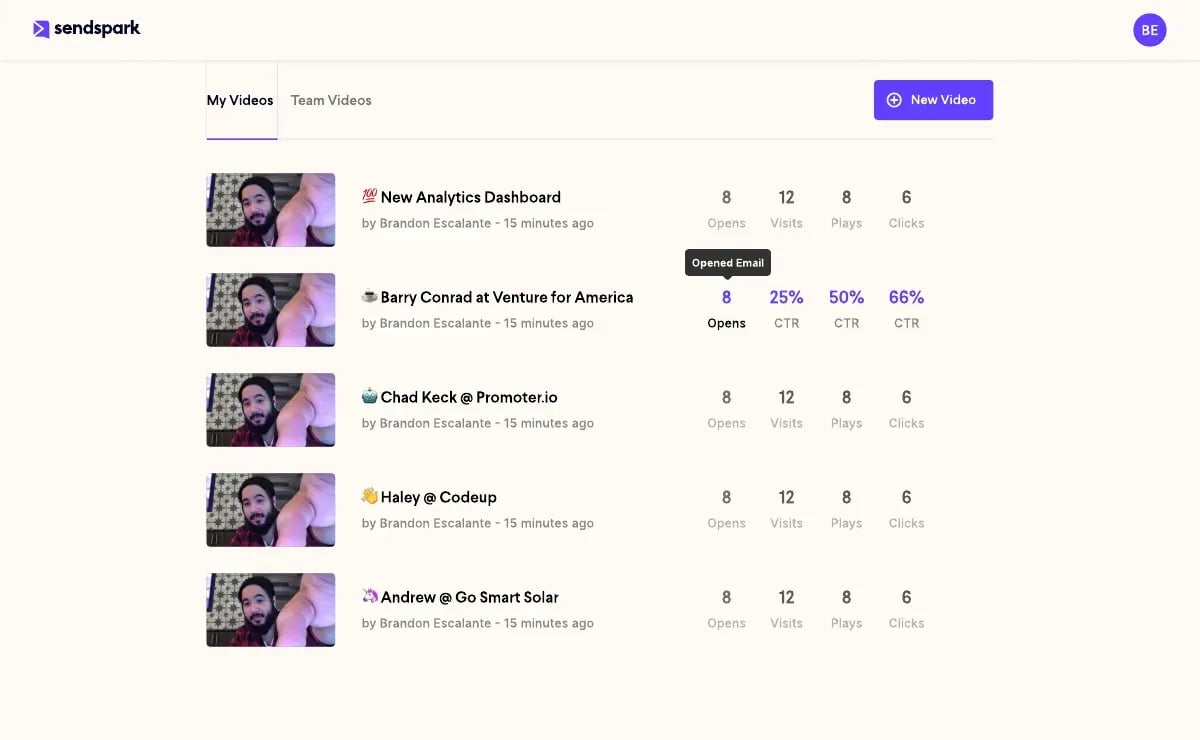
The result is a fundamentally different outbound motion. Instead of 1,000 cold emails to hit 15 meetings, a single rep can work 75 high-intent accounts with a personalized video apiece and book 12 meetings — in a quarter of the time. That’s not a small efficiency gain; it’s a different game.
Pro tip
When setting up the Sendspark + Leadfeeder workflow, don’t try to video every identified visitor. Reserve personalized video for accounts that match your ICP AND have a high-intent behavior (pricing view, repeat visits, competitor page). Send text-only nurture to the rest. Your reply rates will climb and your rep efficiency will double.
A 5-Step Intent-Based Prospecting Playbook
If you’re starting from scratch, here’s the order we’d recommend building the program in. Each step is a prerequisite for the next — skipping ahead is the most common way these programs fail.
Step 1 — Define Your Intent Criteria
Before instrumenting anything, write down what “high intent” actually means for your business. At minimum: which pages on your site signal buying intent (pricing, demo, integrations, a specific product feature), which behaviors are meaningful (3+ visits in a week, returning after a content download, a pricing view following a blog read), and what account-level fit criteria you’ll layer on top (industry, size, region). Intent without fit is just traffic.
Step 2 — Instrument Identification
Deploy a visitor identification tool like Leadfeeder on your site. Confirm the data flows correctly: you should be able to see a daily feed of identified companies with their behavior, and the data should sync to your CRM as custom properties on the account or company record.
Step 3 — Route Intelligently
Build the routing rules in your CRM. A simple starting point: if an ICP-matched company views the pricing page OR visits 3+ times in 7 days, create a task for the account owner or assigned AE. For weaker signals, enroll the company in an SDR nurture sequence. Don’t route everything to sales — you’ll crush them and lose the signal value.
Step 4 — Build the Video + Email Templates
Record one 30-60 second intro video per rep, designed to be personalized at scale. Keep it simple: “Hi [name] at [company], I noticed you were looking at [page]. Here’s the 30-second version of what we do and why it’s relevant.” Sendspark’s AI Intros auto-generate the personalized opener from the base recording. Pair the video with a short email that references the specific behavior. See our guide to cold email personalization for the email copy pattern.
Step 5 — Measure and Iterate
Track three things: identified-visitor → contacted rate, video engagement rate (plays and watch percentage), and identified-visitor → meeting-booked rate. Iterate on whichever is weakest. If visits-to-contact is low, your routing is broken. If video engagement is low, your opener needs work. If contact-to-meeting is low, your follow-up cadence or ICP fit isn’t right.
Measuring Intent-Based Prospecting Success
The metrics that matter for intent-based prospecting are different from the metrics that matter for volume outbound. Volume outbound optimizes for activities per rep per day. Intent-based prospecting optimizes for the percentage of high-intent signals that convert into pipeline.
| Metric | What It Measures | Healthy Benchmark |
|---|---|---|
| Identified-visitor → contacted rate | % of identified ICP-fit visits that receive outreach within 48 hours | 70%+ |
| Video engagement rate | % of sent personalized videos that are played, weighted by watch time | 35-50% |
| Reply rate | % of outreach that generates a response | 15-25% for high-intent segments |
| Identified-visitor → meeting booked | % of high-intent identified accounts that convert to a meeting | 8-15% |
| Pipeline from intent signals (%) | Share of total pipeline sourced from identified-visitor motions | 20-40% after 2 quarters |
Teams who invest in the full stack — identification plus enrichment plus personalized video outreach — tend to see 200-300% lifts in email response rates and 40-50% more meetings booked versus their prior cold outbound program. That’s not marginal. It’s the difference between hitting plan and missing it. Pair the measurement approach above with a clear view of how intent signals move through your sales pipeline stages, and you’ll see which conversion points need the most attention as you scale. The ROI math holds up across pricing tiers because the video-per-rep cost is flat, while the pipeline impact compounds with volume of intent signals.
For scaling beyond the initial pilot, pair intent-based prospecting with a strong multi-channel outreach strategy — video + email + LinkedIn — so a single high-intent signal gets three well-timed touches rather than one. And make sure video engagement data flows back to your CRM so the rep’s next move is informed by whether the prospect actually watched. More on that in our guide to lead engagement.
Frequently Asked Questions
What is intent-based prospecting?
Intent-based prospecting is an outbound approach that prioritizes accounts showing active interest — website visits, content engagement, competitor research, or category-relevant behavior on third-party sites — instead of working an undifferentiated cold list. The goal is to reach buyers while they’re already researching, not before they’ve started.
How is intent-based prospecting different from traditional outbound?
Traditional outbound picks a target list based on static firmographics (industry, size, title) and sends the same message to everyone. Intent-based prospecting starts from behavioral signals — a specific prospect took a specific action — and sends a relevant, timely response to that action. The activity count is lower; the conversion rate is 3-5x higher.
What kind of intent signals matter most?
First-party intent — behavior on your own site — is the strongest signal because it’s observed, not inferred. Pricing-page views, repeated visits, and competitor-comparison reads are the most actionable first-party signals. Third-party intent data (Bombora, G2, industry site activity) is useful for expanding to accounts that haven’t visited you yet, but should be weighted lower than first-party data.
How do I identify anonymous website visitors?
Deploy a visitor identification tool like Leadfeeder on your site. These tools use reverse-IP resolution, proprietary company databases, and — in some cases — cookie-based signals to match visits to named accounts. You get a ranked feed of companies that visited, with the specific pages and return frequency. This data then syncs to your CRM so sales can act on it.
How do Sendspark and Leadfeeder work together?
Leadfeeder identifies the companies visiting your site and the behavior they exhibited. Sendspark turns that identified-visitor list into AI-personalized video outreach at scale — one recording becomes thousands of individually tailored videos, each opening with the prospect’s name and showing their own website as the background. The combined workflow takes you from anonymous visit to personalized video reply in a single sequence.
Does intent-based prospecting replace cold outbound entirely?
Not quite. Intent-based prospecting handles the highest-converting portion of the pipeline — warm accounts that have already engaged. Traditional outbound still has a role for net-new accounts that haven’t shown behavior yet, and for category-creation motions where intent data doesn’t exist. The best teams run both, but shift the majority of their rep hours to intent-based work because the unit economics are better.
What reply rates should I expect with intent-based video outreach?
Teams running intent-based prospecting with AI-personalized video typically see 15-25% reply rates on high-intent segments, compared to 1-5% on unqualified cold outbound. The lift compounds: higher reply rates mean more meetings booked per rep per week, which means a smaller team can produce more pipeline. Most teams pay back their investment in the stack within a single quarter.
Sources & References
- Gartner B2B Buyer Journey Research — “67% of the B2B buying journey is completed digitally before a buyer ever speaks with a sales rep” (2024)
- HubSpot Sales Statistics — Benchmark data on average cold email reply rates of 1-5% and the impact of personalization on response rates (2024)
- Salesforce State of Sales — “Top-performing sales teams are significantly more likely to use behavioral signals and personalization in outbound outreach” (2024)
- Leadfeeder — Visitor identification methodology and B2B website de-anonymization category leadership (2026)
Turn Identified Visitors Into Pipeline.
Sendspark pairs with Leadfeeder to turn anonymous website visits into AI-personalized video outreach at scale — each prospect hears their name and sees their website, all from a single recording. Teams see 2-3x more replies and 40-50% more meetings booked.
Get Started Now