More than 60% of sales organizations admit their pipeline management is inconsistent or informal — yet companies with a formally defined pipeline process generate 28% more revenue than those without one. The difference isn’t talent or budget. It’s structure. For teams evaluating tools, see our breakdown of the best sales analytics tools.
A well-defined sales pipeline breaks every deal into predictable stages, from the first outbound touch to post-sale onboarding. When your team knows exactly where each deal stands, what action moves it forward, and what signal means a deal is stalling, close rates and forecast accuracy both improve. For a full breakdown of how stages map to deal length and acceleration tactics, see our guide to the 7-stage B2B sales cycle.
This guide walks through the 7 sales pipeline stages used by high-performing B2B sales teams — with the specific actions, metrics, and outreach tactics that make each stage work. Running effective pipeline review helps ensure deals keep moving and your team gets the coaching they need to close.
Key Takeaways
- A B2B sales pipeline has 7 stages: Prospecting, Qualification, Meeting/Discovery, Demo, Proposal, Negotiation, and Closing/Post-Sale — each with its own actions and exit criteria.
- According to HubSpot research, companies with a formal pipeline management process see 28% higher revenue growth than those without one.
- AI-personalized video outreach at the prospecting stage increases reply rates by 2–3x compared to text-only cold email, helping you fill the top of the pipeline faster.
- Pipeline velocity — the average time deals spend in each stage — is as important as conversion rate for identifying where your process is breaking down.
- Sales teams that use personalized video at the demo and proposal stages report higher engagement and faster time-to-close, because follow-ups are harder to ignore.
What Are Sales Pipeline Stages?
Sales pipeline stages are the defined steps a deal moves through from initial contact to close and beyond. Each stage represents a specific milestone — a meeting booked, a proposal sent, a contract signed — with clear entry and exit criteria. They give sales teams a repeatable, measurable structure for moving revenue forward instead of managing deals by gut feel.
The most common confusion is pipeline vs. funnel. A sales funnel is a marketing model that visualizes how a broad audience narrows into customers — it describes buyer awareness and intent. A sales pipeline is a sales operations model that tracks where specific deals are in the buying process at any given moment. Your funnel fills the top of your pipeline. Your pipeline turns those leads into closed revenue.
For B2B companies, pipeline stages are especially important because deals involve multiple stakeholders, long evaluation cycles, and high deal values. According to Gartner research, B2B buyers spend only 17% of their total purchase journey actually meeting with potential suppliers. The rest of the time they’re doing independent research, building consensus internally, and comparing options. Well-defined pipeline stages let your team stay relevant and visible throughout that entire process.
The number of stages varies by company. Most B2B sales teams use between 5 and 8 stages. Fewer stages create ambiguity about deal status; more stages create unnecessary complexity. For most teams, 7 stages provide the right level of granularity without administrative overhead.
The 7 Stages of a B2B Sales Pipeline
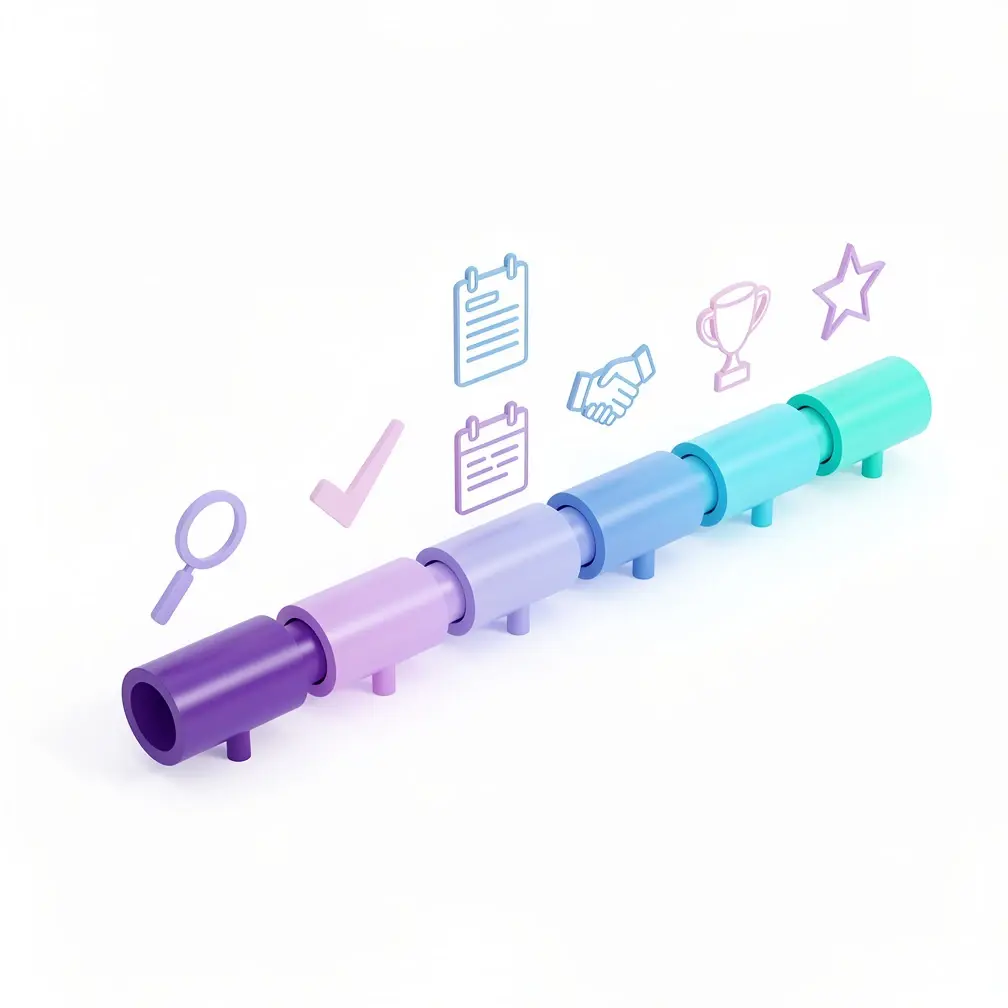
These seven stages represent the standard B2B pipeline structure used by most sales teams, from SDR-led outbound to full-cycle AE workflows. Each stage has a clear goal, a set of actions, and an exit criterion that moves the deal forward.
Stage 1: Prospecting
Prospecting is the first and most critical stage of the sales pipeline. Your goal is to identify potential buyers who fit your ideal customer profile (ICP) and get their attention through outbound outreach — cold email, LinkedIn messages, phone calls, or targeted content. Without a consistent flow of qualified prospects entering the pipeline, every downstream stage starves.
The best prospecting combines signal-based targeting (job changes, funding announcements, product usage signals) with personalized outreach that speaks to the specific buyer’s situation. Generic “spray and pray” outreach at this stage produces response rates under 1%. Personalized outreach — with context specific to the prospect’s company and role — consistently achieves 3–8x higher reply rates.
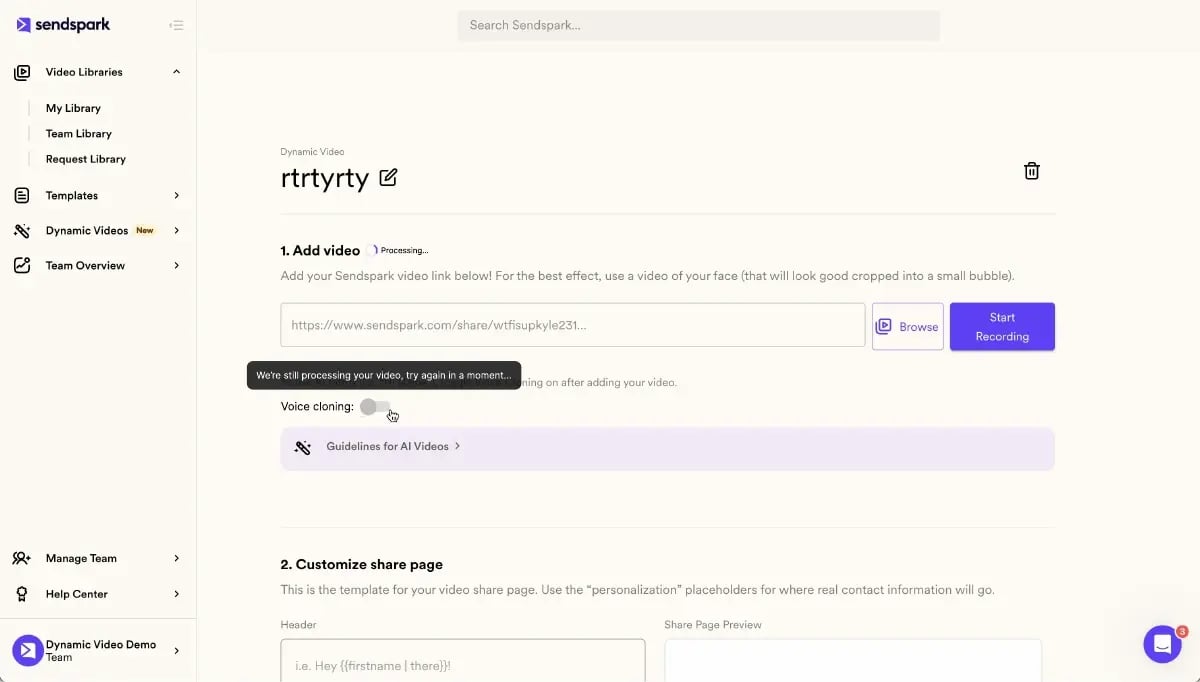
One of the most effective tactics at this stage is AI-personalized video outreach. Instead of sending another text email, you record one video and use Sendspark’s AI voice cloning to automatically generate individually personalized versions for each prospect — each one addresses them by name, references their company, and plays in their voice. Sales teams using this approach see 2–3x more replies compared to text-only cold email campaigns.
Pro tip
Record one 60-second prospecting video, then use Sendspark’s AI voice cloning to personalize it for 500 prospects in minutes. Each prospect gets a unique version with their name and company mentioned — without you recording 500 separate videos.
Exit criteria: The prospect responds positively and agrees to a discovery call or meeting. They are moved to Stage 2 for qualification. Check out our guide on outbound prospecting tactics for a deeper look at building a high-conversion prospecting system.
Stage 2: Lead Qualification
Lead qualification filters out prospects who are unlikely to buy — protecting your team’s time and focusing effort on deals with genuine potential. The two most widely used qualification frameworks are BANT (Budget, Authority, Need, Timeline) and MEDDIC (Metrics, Economic Buyer, Decision Criteria, Decision Process, Identify Pain, Champion). BANT works well for SMB deals; MEDDIC is more rigorous for enterprise or complex sales.
At this stage, your SDR or AE is asking questions to determine: Does this company have the budget for your solution? Are you talking to the right decision-maker or an influencer? Is there a genuine business problem your product solves? Is there a real timeline for buying? If the answer to most of these is no or unknown, the deal belongs in a nurture sequence, not in your active pipeline.
Strong qualification also helps you forecast accurately. A pipeline full of unqualified leads creates false confidence — it looks healthy until end of quarter when everything stalls. For more on qualification techniques, see our guide to sales prospecting techniques.
Exit criteria: The prospect meets your minimum qualification criteria. They have budget, authority, need, and at least a soft timeline. They agree to a discovery call.
Stage 3: Meeting / Discovery Call
The discovery call is where you uncover the prospect’s real pain, goals, and buying process. A strong discovery call answers four questions: What is the business problem? What does it cost them to leave the problem unsolved? Who else is involved in the buying decision? And what does success look like in 6–12 months? Most deals are won or lost at this stage — not during the pitch.
According to Gartner, B2B buyers spend only 17% of their total purchase time meeting with potential suppliers. That means your discovery call is precious. Come prepared with a clear agenda, open-ended questions, and genuine curiosity about their situation — not a feature list.
A practical tactic after every discovery call: send a personalized video recap within 24 hours. Summarize what you heard, confirm next steps, and reference something specific from the conversation. This separates you from every rep who sends a generic “great to meet you” email. RAIN Group research shows it takes an average of 8 touches to book a first meeting — a personalized video recap is one of the highest-value touches you can use.
Exit criteria: Clear fit confirmed on both sides. The prospect agrees to see a demo or formal presentation. You understand their decision process and can name all key stakeholders.
Record One Video. AI Personalizes Thousands.
Sendspark is the AI video personalization platform for B2B sales. Record once, and AI voice cloning generates thousands of individually personalized videos with dynamic backgrounds and personalized thumbnails — each prospect hears their name, sees their website, in your voice. Sales teams see 2-3x more replies.
Get Started NowStage 4: Demo / Presentation
The demo stage is where you show the prospect how your solution solves their specific problem. Generic demos fail — buyers want to see relevance to their situation, not a product tour. The most effective demos are tailored to the pain points uncovered in discovery, using the prospect’s own language and examples from their industry.
Before the live demo, send a personalized video preview — a 30-second teaser that references what you learned in discovery and builds anticipation. After the demo, send a personalized video follow-up within 24 hours. This keeps your solution top of mind while the prospect is discussing internally. According to HubSpot research, deals with consistent multi-touch follow-up after demos are significantly more likely to progress to proposal.
Sendspark’s deal progression workflow is built for exactly this stage. You record a demo follow-up video once, and AI voice cloning personalizes it for each stakeholder on the buying committee — including those who weren’t on the original call.
Exit criteria: The prospect has seen the full solution, expressed genuine interest, and requested pricing or a formal proposal.
Stage 5: Proposal
The proposal stage is when you formally present pricing, scope, and commercial terms. A strong B2B proposal connects your solution to the specific outcomes the prospect shared in discovery — it doesn’t just list features and costs, it quantifies the ROI of solving the problem. Proposals that open with the business case (“Here’s what this problem is costing you today…”) consistently outperform those that lead with product specs.
One increasingly common tactic at this stage: send a personalized video walk-through of the proposal instead of — or alongside — the PDF. Studies from Salesforce’s State of Sales research consistently show that deals with stronger buyer engagement post-proposal have higher close rates. A video walk-through that explains each section in context, addresses likely objections proactively, and ends with a clear call to action keeps deals moving in multi-stakeholder environments where your PDF will get forwarded to people you’ve never met.
Exit criteria: The prospect acknowledges receiving the proposal and provides feedback — either moving to negotiation, asking questions, or requesting modifications.
Stage 6: Negotiation and Objection Handling
Negotiation is not a red flag — it signals serious buying intent. Most B2B deals go through at least one round of negotiation, typically around price, contract length, implementation timeline, or scope. Your goal is to find a commercial structure that works for both sides while protecting deal value and avoiding deep discounting that sets a bad precedent for the relationship.
The most common B2B objections at this stage: “The price is too high,” “We need to see X feature,” “We need sign-off from someone else,” and “We’re still evaluating another option.” Each of these has a specific counter-strategy — and most can be addressed before they come up if you’ve done thorough discovery and maintained consistent contact.
Personalized video is particularly valuable when deals stall in negotiation. A timely video that re-states the ROI case, addresses a specific objection by name, and proposes a concrete next step often re-activates conversations that have gone cold without being aggressive. This is one of the highest-leverage uses of AI-personalized video outreach in the entire sales cycle.
Common mistake
Don’t leave a deal sitting in “Negotiation” for more than 30 days without a documented next step and owner. If you can’t name the specific outstanding issue and who is responsible for resolving it, the deal is stalled, not in negotiation.
Exit criteria: Commercial terms are agreed. The contract is sent for signature and the deal moves to Closing.
Stage 7: Closing and Post-Sale Onboarding
Closing is when the contract is signed — but the revenue relationship is just beginning. Post-sale onboarding is the final and most often underinvested stage of the sales pipeline. Poor onboarding increases churn, kills referrals, and destroys the customer lifetime value that justified the acquisition cost in the first place.
The best sales teams have a defined handoff process from sales to customer success: a shared context document from the discovery and demo calls, a kick-off call within 5 business days, and a personalized welcome video from the account executive. That welcome video — sent through Sendspark with dynamic personalization referencing the customer’s specific goals — sets the tone for the relationship and signals that they made the right decision.
For more on building the pipeline that feeds this entire process, see our guide on how to build a lead pipeline for B2B sales.
Exit criteria: Onboarding kick-off completed, customer success ownership confirmed, first value milestone defined with a timeline.
How to Manage Each Pipeline Stage Effectively
Effective pipeline stage management comes down to three practices: setting clear entry and exit criteria for each stage, reviewing pipeline health weekly (not just at end-of-quarter), and having a defined follow-up cadence that prevents deals from stalling. Teams that conduct weekly pipeline reviews are significantly more likely to hit quota than those that rely on monthly or quarterly reviews — the earlier you spot a stuck deal, the more options you have to move it.
Define Entry and Exit Criteria
Every stage needs a written definition of what qualifies a deal to enter and what must be true before it can exit. Without these guardrails, “Proposal Sent” can mean anything from “we emailed a price sheet” to “they’ve verbally agreed to terms and are reviewing the final contract.” That ambiguity makes forecasting worthless. A structured B2B lead qualification framework helps you apply consistent criteria at each stage so deals only advance when they’re genuinely ready.
Document your criteria in your CRM as required fields or stage-gating rules. When a rep moves a deal to “Negotiation,” the CRM should require them to log the specific outstanding issue and the agreed next action. This discipline sounds administrative, but it’s the foundation of accurate forecasting and effective coaching — see our guide to sales forecasting methods for how stage hygiene like this feeds a weighted-pipeline forecast.
Maintain CRM Hygiene
A pipeline is only as reliable as the data in it. Stale deals, missing contact info, and stages that don’t reflect reality undermine everything downstream. Schedule a 20-minute weekly pipeline hygiene review per rep — either in your 1:1 or as a team exercise. Any deal with no logged activity in the past 14 days needs attention: either a follow-up is triggered, or the deal is downgraded or archived.
Sendspark’s HubSpot integration automatically logs video send and view events directly to the deal record — so when a prospect watches your proposal walk-through video for the third time, that engagement signal appears in HubSpot without any manual entry. This gives managers real signal about deal health beyond just “stage and close date.”
Use Personalized Video to Prevent Stagnation
Every pipeline has deals that stall. The most common stall points: end of Stage 3 (discovery to demo), end of Stage 5 (proposal to negotiation), and during Stage 6 (negotiation drags on). At each stall point, a personalized video follow-up outperforms a text email by a wide margin. The combination of a familiar face, a specific reference to the last conversation, and a direct ask for a next step tends to re-engage dormant buyers.
Harvard Business Review research on sales process formalization shows consistently that structure and discipline in the sales process — not individual rep talent — is the primary driver of revenue predictability. Pipeline stage management is the operational expression of that discipline.
Sales Pipeline Stage Metrics to Track
The four metrics that matter most across pipeline stages are: stage conversion rate, deal velocity (average time in stage), pipeline coverage ratio, and win rate. Together they answer whether your pipeline is healthy, where deals are getting stuck, and whether you have enough volume to hit your revenue target. Track them at the individual rep level and the team level — the patterns often differ.
Stage Conversion Rate
Stage conversion rate is the percentage of deals that exit one stage and enter the next. If 100 qualified leads enter Stage 2 (Qualification) and 40 of them book a discovery call, your Stage 2–3 conversion rate is 40%. Track this at each stage to identify your biggest drop-off. Most B2B pipelines leak most heavily between Stage 3 (Discovery) and Stage 4 (Demo) — usually because discovery didn’t establish enough urgency or the demo wasn’t relevant enough. If terms like qualified lead or MQL feel fuzzy, our sales terms glossary defines them alongside 60+ other pipeline and revenue terms.
Deal Velocity
Deal velocity is the average number of days a deal spends in a given stage. Unusually long deal velocity in Stage 5 (Proposal) usually signals either a pricing problem or a missing stakeholder. Long velocity in Stage 3 (Discovery) often means reps are holding onto low-quality leads too long. Tracking velocity alongside conversion rate gives you a complete picture of stage health — not just how many deals convert, but how fast.
Pipeline Coverage Ratio
Pipeline coverage ratio is total pipeline value divided by revenue target. A 3:1 ratio is the widely cited minimum for reliable forecasting — meaning if your quota is $1M, you should have $3M of open pipeline. Less than 3:1 and you’re at risk of missing even if every deal progresses. Higher-performing teams with strong qualification often operate closer to 2.5:1 because their pipeline is cleaner. Track this at the start of each month and each quarter.
Win Rate and Video Engagement Metrics
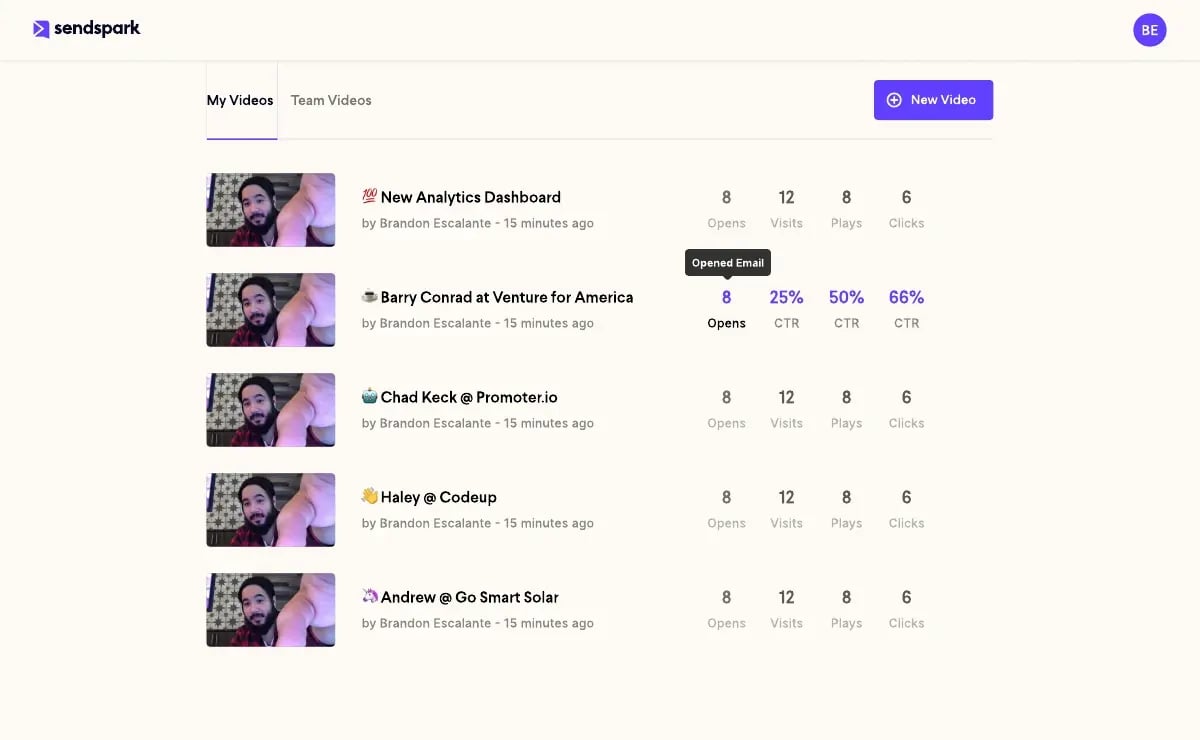
Win rate — the percentage of deals that reach Stage 5 (Proposal) that ultimately close — is the final health check. Below 25% usually indicates a qualification problem or a competitive positioning issue. Pairing win rate with video engagement data (which prospects watched your demo follow-up, how many times, for how long) from Sendspark’s video analytics gives you a leading indicator of deal health before a deal officially stalls.
Pipeline Stage Summary Table
| Stage | Goal | Key Action | Key Metric | Sendspark Use |
|---|---|---|---|---|
| 1. Prospecting | Identify ICP-fit buyers | Cold email + LinkedIn outreach | Response rate | AI-personalized video intro at scale |
| 2. Qualification | Filter for genuine fit | BANT / MEDDIC scoring | # qualified leads | Warm-up video after initial response |
| 3. Meeting / Discovery | Understand pain & process | Open-question discovery call | # meetings booked | Personalized video recap within 24hr |
| 4. Demo | Show relevant solution | Tailored product demo | # demos completed | Video follow-up for all stakeholders |
| 5. Proposal | Present ROI-focused offer | Send pricing + business case | # proposals sent | Video walk-through of proposal |
| 6. Negotiation | Align on commercial terms | Address objections systematically | Avg. days in negotiation | Re-engagement video for stalled deals |
| 7. Closing / Post-Sale | Win deal and retain | E-sign + onboarding kick-off | Win rate, churn rate | Personalized welcome video post-close |
Frequently Asked Questions
What are the stages of a sales pipeline?
A B2B sales pipeline typically includes 7 stages: Prospecting (identifying ICP-fit buyers), Lead Qualification (filtering for genuine fit using BANT or MEDDIC), Meeting/Discovery (uncovering pain and buying process), Demo/Presentation (showing the relevant solution), Proposal (presenting pricing and ROI), Negotiation (aligning on commercial terms), and Closing/Post-Sale (signing the contract and onboarding). The exact number of stages varies by company size, deal complexity, and sales motion.
How many pipeline stages should a B2B sales team have?
Most B2B sales teams use between 5 and 8 pipeline stages. Fewer than 5 creates ambiguity about deal status and makes forecasting unreliable. More than 8 adds administrative complexity without meaningful insight. Seven stages is a strong starting point for most B2B teams — adjust based on your average deal cycle length, stakeholder count, and the complexity of your buying process.
What is the difference between a sales pipeline and a sales funnel?
A sales funnel is a marketing model that describes how a broad audience narrows into leads and customers — it tracks awareness, interest, and intent at the population level. A sales pipeline is a sales operations model that tracks individual deals moving through specific stages from first contact to close. Your funnel generates leads that enter the top of your pipeline. The two models work together but measure different things.
How do you measure sales pipeline health?
Pipeline health is measured by four metrics: stage conversion rate (the percentage of deals that move from one stage to the next), deal velocity (average days spent in each stage), pipeline coverage ratio (total pipeline value divided by revenue target — aim for at least 3:1), and win rate (percentage of proposals that close). Together, these metrics reveal not just how much pipeline you have, but how likely it is to convert and where deals are stalling.
How long should a deal stay in each sales pipeline stage?
Target stage durations vary by deal size and complexity. For a typical mid-market B2B deal with a 60-90 day average sales cycle: Prospecting (1-5 days), Qualification (3-7 days), Discovery (7-14 days), Demo (7-14 days), Proposal (7-21 days), Negotiation (7-30 days), Closing (3-10 days). If deals consistently exceed these benchmarks in a specific stage, that stage has a process problem that needs coaching or tooling attention.
How can video outreach improve sales pipeline progression?
Personalized video outreach improves pipeline progression at three key stages: Prospecting (AI-personalized video emails get 2-3x more replies than text-only cold outreach), Demo follow-up (personalized video recaps keep your solution top of mind while the buying committee deliberates internally), and Negotiation (re-engagement videos for stalled deals are more compelling than a follow-up email). Sendspark’s AI video personalization platform lets you record one video and automatically generate thousands of personalized versions — one for each prospect, in your cloned voice, with dynamic backgrounds showing their company website.
What is pipeline velocity in sales?
Pipeline velocity is a metric that measures how quickly deals move through your pipeline and how much revenue they generate per unit of time. The formula is: Pipeline Velocity = (Number of Deals × Win Rate × Average Deal Value) ÷ Average Sales Cycle Length. A higher velocity means more revenue generated per day. Improving any one of the four variables — more deals, higher win rate, larger deal size, or shorter cycle — increases pipeline velocity. It is one of the most actionable metrics for sales leadership because it ties specific process improvements to revenue impact.
Sources & References
- HubSpot Sales Blog — “Companies with a well-defined pipeline management process see 28% higher revenue growth” (2024)
- Gartner B2B Buying Research — “B2B buyers spend only 17% of their total purchase journey meeting with potential suppliers” (2023)
- RAIN Group Sales Research — “It takes an average of 8 touches to secure a first meeting with a new prospect” (2023)
- Harvard Business Review — “Companies with a formal, defined sales process generate significantly more revenue than those without one” (2015)
- Salesforce State of Sales — Pipeline management and quota attainment benchmarks for B2B sales teams (2024)
Record One Video. AI Personalizes Thousands.
Sendspark is the AI video personalization platform for B2B sales. Record once, and AI voice cloning generates thousands of individually personalized videos with dynamic backgrounds and personalized thumbnails — each prospect hears their name, sees their website, in your voice. Sales teams see 2-3x more replies.
Get Started Now