
Loom vs Vidyard: Which Is Better for B2B Sales Outreach in 2026?
Most sales teams debate Loom vs Vidyard as if they’re choosing between two versions of the same thing — they’re not. Loom was built for async internal communication and was acquired by Atlassian in 2023 for $975 million, while Vidyard was purpose-built for sales with CRM-linked analytics and pipeline tracking. But here’s the real story: neither platform lets you record one video and personalize it for thousands of prospects at scale — and in 2026, that gap defines whether your outreach wins or loses. Vidyard alternatives for B2B sales
Key Takeaways
- Loom excels at async internal communication — it’s now part of Atlassian’s productivity suite and is best suited for team walkthroughs, not prospect outreach.
- Vidyard is the stronger sales tool of the two, with CRM integrations, viewer analytics, and a Video Agent automation layer — but true one-to-many personalization is still missing.
- Neither Loom nor Vidyard supports AI voice cloning or dynamic backgrounds, meaning you still have to record a separate video for each prospect if you want real personalization.
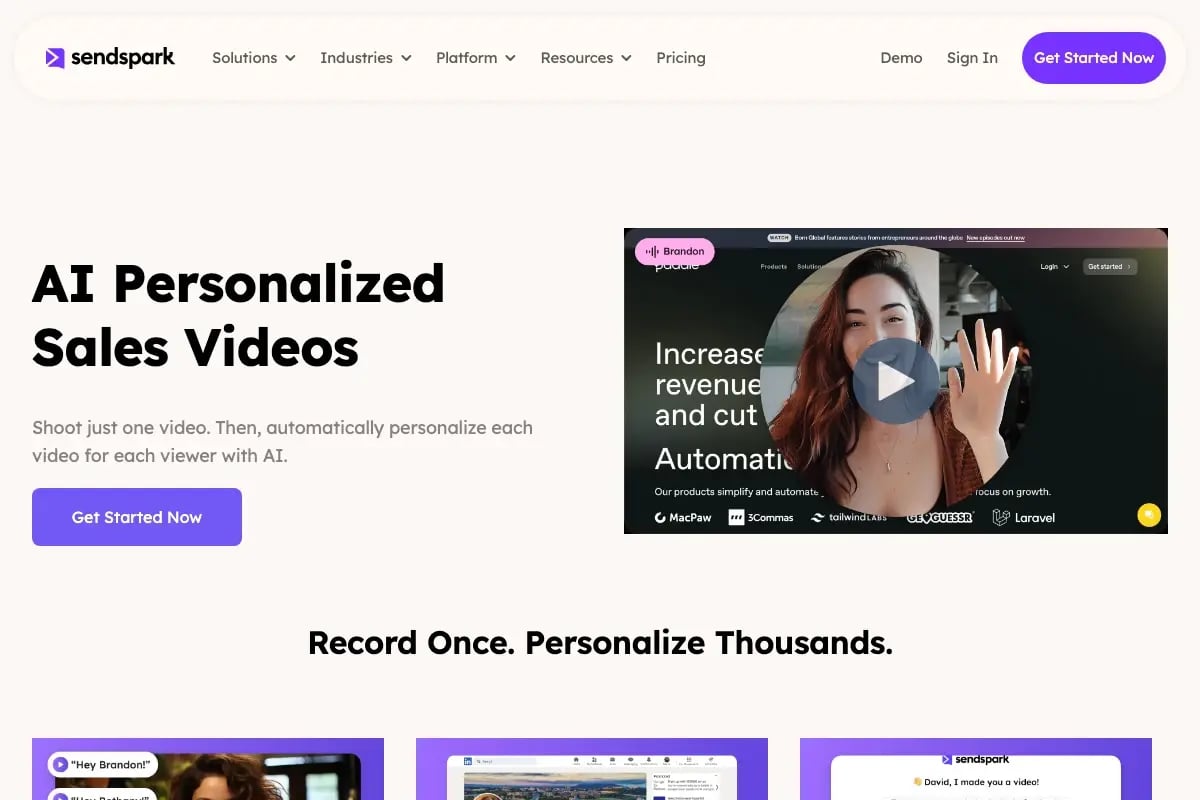
- Sendspark is the AI video personalization platform for B2B sales — it lets you record one video and AI generates thousands of personalized versions with each prospect’s name, company, and website in the background.
- Sendspark customers report 200–300% increases in email response rates and 40–50% more meetings booked compared to generic video outreach.
How Do Loom and Vidyard Actually Compare?
Loom and Vidyard serve fundamentally different audiences. Loom is a team communication tool that happens to be useful in sales, while Vidyard is a dedicated sales video platform with pipeline-aware analytics. For pure B2B sales outreach, Vidyard has a structural advantage — but neither platform has cracked AI-personalized video outreach at scale.
Loom, now owned by Atlassian, is optimized for async collaboration: engineering handoffs, product walkthroughs, and customer support explainers. It’s fast to record, easy to share, and widely adopted across tech companies. But its DNA is internal — the features it keeps adding (AI summaries, task detection, Jira integration) point toward productivity, not pipeline.
Vidyard leans into the sales workflow. It connects natively to Salesforce and HubSpot, tracks who watched your video and for how long, and recently launched an AI Video Agent that can automate prospecting sequences. It’s a more deliberate choice for revenue teams. That said, if you’ve read our Loom vs Vimeo breakdown, you’ll notice that article focused on async team communication — this comparison is squarely about who wins for outbound B2B sales outreach.
Here’s a side-by-side look at how the three platforms stack up across the features that matter most to sales teams:
Pro tip
When comparing Loom vs Vidyard, ask your team one question first: do you need video for internal communication or for external sales outreach? The answer determines everything — Loom excels at async team collaboration, while Vidyard focuses on revenue-facing use cases.
| Feature | Loom | Vidyard | Sendspark |
|---|---|---|---|
| Best Use Case | Async internal communication, team walkthroughs | Sales video outreach, pipeline-linked analytics | AI-personalized video outreach at scale |
| Recording Quality | Up to 4K (paid plans) | Up to 1080p HD | Up to 1080p HD |
| AI Features | Auto-titles, filler word removal, meeting summaries | AI Avatars, Video Agent automation | AI voice cloning, dynamic backgrounds, personalized thumbnails |
| Analytics Depth | Basic view counts, engagement heatmaps | Per-viewer analytics, CRM-linked pipeline tracking | AI-powered video analytics, per-prospect engagement data |
| CRM Integrations | Limited (no native Salesforce sync) | Salesforce, HubSpot, Salesloft, Outreach | HubSpot, Salesforce, Salesloft, Clay, ZoomInfo |
| Price Range | Free – $20/user/mo | Free – $59/user/mo (Starter) | $49/mo – $299/mo |
| Personalization at Scale | ❌ Not available | ❌ Not available | ✅ Record one video, personalize at scale |
AI Features, Analytics, and CRM Integrations: What Sales Teams Actually Need
For B2B sales outreach, the AI features that matter are the ones that reduce recording time, increase open rates, and feed data back into your CRM. Loom’s AI is squarely aimed at internal productivity — useful if you’re running an async-first team, but not built for prospect engagement. Vidyard goes further with sales-focused automation, though neither platform gets you to true one-to-many video personalization.
Loom AI centers on post-recording cleanup: it removes filler words, auto-generates titles and summaries, and can detect action items from meeting recordings. These are genuinely useful features for internal documentation and customer success teams. But Loom’s AI does nothing to help a sales rep personalize outreach to a new prospect — it’s optimizing the creation experience, not the conversion outcome.
Vidyard AI operates closer to the sales workflow. Its AI Avatars let you create a digital version of yourself that can deliver scripted messages without recording fresh video every time. Its Video Agent can fire automated video sends based on CRM triggers. And its per-viewer analytics — integrated with Salesforce and HubSpot — tell you exactly who watched, how far they got, and whether they clicked your CTA. That’s meaningfully more useful for pipeline management.
According to Salesforce’s State of Sales report, 87% of business buyers expect sales reps to act as trusted advisors — which means generic outreach has a lower ceiling than ever. Personalized, context-aware video is increasingly the standard, not a differentiator. Yet neither Loom nor Vidyard lets each prospect receive a unique video personalized to them without a rep recording it manually.
💡 Tip: What “AI Personalization” Actually Means in 2026
Real AI personalization isn’t just adding a prospect’s first name to a subject line. It means their name is spoken aloud in the video in your voice via AI voice cloning, their company website appears as the video background via dynamic backgrounds, and their name appears on the video thumbnail — all generated automatically from a single recording. Neither Loom nor Vidyard does this. Sendspark does.
Sendspark’s HubSpot integration and Salesforce integration don’t just log video sends — they pull prospect data to power personalization signals, so the right personalized video reaches the right person at the right moment in your sequence. That’s a fundamentally different use of CRM data than what Loom or Vidyard offers.
Record One Video. AI Personalizes Thousands.
Sendspark is the AI video personalization platform for B2B sales. Record once, and AI voice cloning generates thousands of individually personalized videos with dynamic backgrounds and personalized thumbnails — each prospect hears their name, sees their website, in your voice. Sales teams see 2-3x more replies.
Pricing and Ease of Use: Which Tool Fits Your Budget?
Loom is the cheapest entry point for video messaging — its free tier is generous and Business runs just $15/user/month. Vidyard’s Starter plan at $59/user/month is harder to justify unless you’re actively using the CRM analytics and automation features it’s built around. Sendspark sits in the middle, priced per team rather than per seat, which gives it a structural cost advantage for growing sales teams.
Loom pricing breakdown:
- Free: $0 — 25 videos, 720p recording, 5-minute limit per video
- Business: $15/user/month — unlimited videos, 4K recording, basic analytics
- Business + AI: $20/user/month — adds filler word removal, AI titles, meeting summaries
Loom’s free plan is one of the most accessible in the category — it’s why so many teams default to it. But the 25-video cap and 5-minute recording limit mean you’ll hit the ceiling fast if you’re doing real outreach volume. There are also common Loom performance issues around buffering and load times that affect the prospect experience on video landing pages.
Vidyard pricing breakdown:
- Free: $0 — limited recordings, basic viewer notifications
- Starter: $59/user/month — CRM integrations, viewer analytics, custom CTAs
- Teams / Enterprise: Custom pricing — advanced automation, Video Agent, SSO
Vidyard’s Starter tier is expensive for a solo rep or small team. You’re paying for analytics depth and CRM connectivity, which is only valuable if your team is disciplined about using those signals. If you’re just recording and sending, $59/month is hard to justify.
Sendspark pricing breakdown:
- Solo: $49/month — 1 seat, AI personalized video, dynamic backgrounds
- Growth: $99/month — 3 seats, AI voice cloning, personalized thumbnails
- Team: $299/month — 10 seats, full AI personalization suite, CRM integrations
See the full Sendspark pricing plans to compare tiers. At $299/month for 10 seats, Sendspark costs roughly $30/user/month — less than Vidyard’s Starter plan, with AI personalization at scale that neither competitor offers at any price point.
✅ Pro Tip: Think Cost Per Booked Meeting, Not Cost Per Seat
According to HubSpot’s sales statistics, it takes an average of 8 touchpoints to book a first meeting with a new prospect. If AI-personalized video cuts that number in half by increasing reply rates 200–300%, the per-seat cost becomes secondary. The right question isn’t “which tool is cheapest?” — it’s “which tool books the most meetings per dollar spent?”
Ease of use: Loom wins on setup time — you can install the Chrome extension and record your first video in under two minutes. Vidyard takes slightly longer to configure if you want CRM sync and pipeline analytics working correctly. Sendspark has a slightly steeper initial setup because you’re connecting data sources (Clay, ZoomInfo, HubSpot) for personalization signals — but once it’s running, the time savings from not recording individual videos per prospect are substantial. This is the core value proposition for sales prospecting at volume.
Topics: blog