Most demos don’t close on the call. That’s not a failure — it’s just how B2B buying works. Research from RAIN Group shows that 80% of sales require at least five follow-up touches after a first meeting. Yet most reps send one vague recap email and hope for the best. The post-demo follow-up is where deals close — or die quietly in someone’s inbox.
This guide gives you a complete system: the right timing, proven email templates, and a video follow-up approach that converts 2–3x better than text alone. Whether you’re an AE following up on a 30-minute discovery demo or an SDR who just ran a product walkthrough, you’ll have everything you need to turn that demo into a deal.
Key Takeaways
- Follow up the same day as your demo — interest fades fast, and waiting 24 hours significantly reduces your chance of a reply.
- Personalized video follow-ups convert 2–3x better than plain text email because they recreate the human connection from the demo.
- Your follow-up must reference the specific pain points discussed in the demo — generic recap emails dramatically underperform.
- A four-touch sequence (same-day video recap, Day 2 proof email, Day 5 direct ask, Day 10 breakup) covers the full post-demo conversion window.
- AI-powered platforms like Sendspark let you send a personalized video follow-up to every prospect — without recording a separate video for each one.
Why Post-Demo Follow-Up Is Where Deals Are Won or Lost
Post-demo follow-up is where the deal actually gets decided. Your prospect left the call impressed — or at least interested — but they didn’t sign anything. What you do in the next 48 hours determines whether that interest converts into a deal or gets buried under their next meeting. Most reps lose deals not in the demo itself, but in the silence that follows.
Here’s why this window matters so much: B2B prospects almost never make a decision immediately after a demo. They have other priorities, other vendors to evaluate, internal stakeholders to consult, and budget conversations to have. According to Gartner’s research on B2B buying journeys, the average buying group includes 6–10 decision-makers — meaning your champion from the demo needs to convince colleagues who weren’t even in the room. Your follow-up has to do the selling for you when you’re not there.
The problem is how most reps follow up. They send some version of “Great chatting today — here’s the deck” and wait. That email says nothing about the prospect’s specific problem. It doesn’t advance the conversation. It doesn’t make the case for why this deal should move forward now. It’s the equivalent of ending the demo and walking out the door without shaking hands.
“80% of prospects say ‘no’ four times before they say ‘yes.’ But 92% of salespeople give up after just four attempts. The follow-up game is where most deals are actually won — or abandoned.”
— RAIN Group, How Many Touches Does It Take to Make a Sale
The urgency is real too. Harvard Business Review research shows companies that contact leads within one hour of initial interest are seven times more likely to have a meaningful conversation than those who wait even a few hours. The same principle applies post-demo: the longer you wait, the colder the lead gets. Your prospect’s excitement from the demo fades quickly when they have 30 other emails waiting.
What separates top performers isn’t having a better product demo — it’s having a better follow-up system. That system starts with timing.
When to Send Your Post-Demo Follow-Up
The best time to send your post-demo follow-up is the same day, within two hours of the call ending. Not tomorrow morning. Not “later this afternoon.” Within two hours. That’s when the demo is freshest in your prospect’s mind, when their interest is at peak, and when a timely message signals that you take their time seriously.
But one touchpoint isn’t enough. Here’s the four-touch cadence that top-performing sales teams use after demos:
| Touch | Timing | Channel | Goal |
|---|---|---|---|
| Touch 1 | Day 0, within 2 hours | Video + Email | Recap key pain points, confirm next step |
| Touch 2 | Day 2 | Add proof (case study, stat, social proof) | |
| Touch 3 | Day 5 | Direct ask — move the deal or identify the blocker | |
| Touch 4 | Day 10 | Breakup or re-engagement — close the loop |
If your prospect has a defined timeline — “we need this by end of quarter” — compress the cadence. If they said they need two weeks to loop in their VP, push Day 3 and Day 5 touches back accordingly. The cadence adapts to the deal, but the structure stays the same.
Advanced strategy
Set up your post-demo follow-up sequence as a template in your CRM (HubSpot, Outreach, Apollo) before your first demo of the day. When the call ends, you’re enrolling the prospect in the sequence within minutes — not scrambling to write a personalized email while your memory of the call fades.
Post-Demo Follow-Up Email Templates That Convert
The best post-demo follow-up emails do three things: recap the specific pain point you discussed (not the whole demo), reinforce why your solution is the answer to that pain point, and propose one clear next step. Not two next steps. One. If you give a prospect three options, they pick none.
Here are four word-for-word templates you can use and adapt. Replace anything in brackets with real details from your demo.
Template 1: Recap + Next Step (Day 0, send within 2 hours)
Subject: [Prospect Name] — quick recap from today
Hi [First Name],
Really enjoyed our conversation today. Based on what you shared about [specific pain point they mentioned — e.g., “your team spending 3+ hours personalizing outreach manually”], here’s what I think will move the needle most for you:
[One-sentence description of the key solution from the demo that addresses their pain point]
Here’s what I’d suggest as a next step: I’ll send over a short proposal by [specific date]. If that looks good to you, we can get your team set up in the first week of [month].
Does that timing work on your end?
[Your name]
Template 2: Proof + Social Proof (Day 2)
Subject: How [Similar Company] solved [their pain point]
Hi [First Name],
Wanted to share something relevant to what we talked about Monday. [Similar Company in their industry] was dealing with the same challenge — [restate their pain point in one sentence]. Here’s what happened when they used [your solution]:
[One or two specific results — quote from a case study or stat. Never fabricate. Use only real results you can source.]
Happy to send over the full case study if it’s useful. Are you still planning to bring this to your team by [date they mentioned]?
[Your name]
Template 3: Soft Close (Day 5)
Subject: Still the right timing?
Hi [First Name],
Checking in — I know things get busy. I wanted to make sure [their main pain point] is still something you’re actively looking to solve before [their stated deadline or end of quarter].
If it is, I’m ready to move quickly. If priorities have shifted, just let me know — no pressure either way.
What’s your read on the timeline?
[Your name]
Template 4: Breakup Email (Day 10)
Subject: Closing the loop
Hi [First Name],
I haven’t heard back, which usually means one of two things: either the timing isn’t right, or I missed the mark somewhere. Either way, completely understand.
I’ll stop following up for now. If things change and [their pain point] becomes a priority again, I’m one email away.
[Your name]
The breakup email often gets the highest response rate of any touchpoint in the sequence. Giving people a graceful exit prompts them to reply — either to close the loop or to re-engage.
Record One Video. AI Personalizes Thousands.
Sendspark is the AI video personalization platform for B2B sales. Record once, and AI voice cloning generates thousands of individually personalized videos with dynamic backgrounds and personalized thumbnails — each prospect hears their name, sees their website, in your voice. Sales teams see 2-3x more replies.
Get Started NowWhy Video Follow-Up After a Demo Converts 2–3x Better
Video follow-up after a demo outperforms text email because it extends the human connection from the call directly into the inbox. When your prospect opens your email and sees a video thumbnail with their name on it, it triggers the same feeling as the live conversation — not a cold, transactional email from a sales rep they barely remember.
Here’s what makes video follow-up especially effective at the post-demo stage. During the demo, your prospect saw your product, heard your voice, and (hopefully) got excited about what it could do for them. A personalized video recap keeps that energy alive. Text email doesn’t. Text email feels like paperwork.
Research comparing cold email vs video email consistently shows video driving 2–3x more replies across B2B sales sequences. At the post-demo stage — where interest is already established — that advantage is even stronger.
What to say in your 60-second video follow-up:
- Open with their name and the demo context (5 seconds): “Hey [Name], great talking with you earlier about [their pain point].”
- Recap the one thing that resonated most (20 seconds): “What I kept thinking about after our call was [specific moment in the demo where they reacted positively]. That tells me [why your solution is the right fit for them].”
- Reinforce the outcome (15 seconds): “Teams like [their industry] using [your product] typically see [specific relevant result]. I think you’d hit a similar number.”
- Single clear next step (10 seconds): “I’m going to [send a proposal / set up a trial / loop in your technical team] by [date]. Does that work?”
Instead of ending with a question that requires a reply, add a calendar booking link directly to the video itself so the prospect can book the next step in one click — see our guide to adding a calendar booking link to your sales videos for the exact setup.
The secret to making video follow-up scalable is AI-powered video personalization. With Sendspark, you record one video template — the demo recap, the value prop, the ask — and Sendspark’s AI voice cloning generates a personalized greeting for each prospect. Every recipient hears their name. Every video shows their company’s website as the background. No recording individual videos. No generic screen-capture messages. It’s the fastest way to move deals forward after a demo without burning hours on manual personalization.
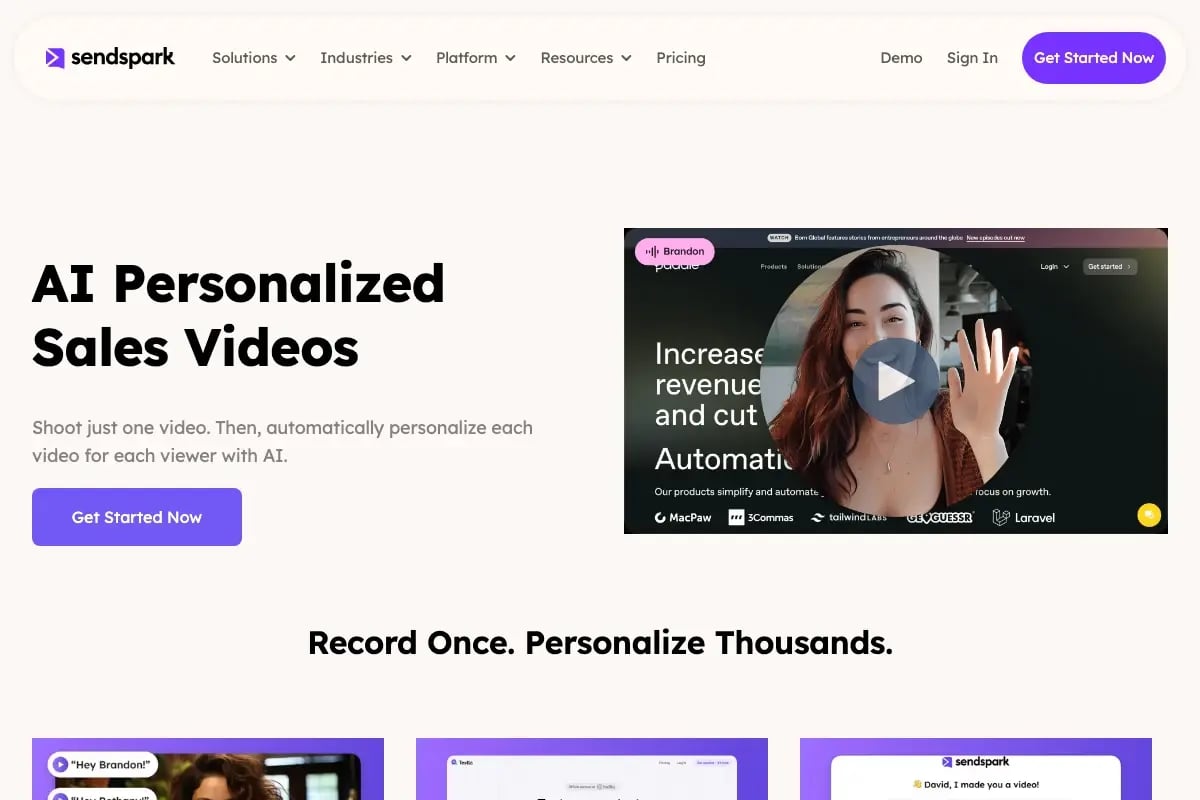
After you send the video, use video analytics to track who watched, how much they watched, and whether they clicked your CTA. A prospect who watches your video three times in two days is telling you something. That’s your signal to follow up with a phone call — not another email.
For more examples of how top reps structure their video follow-ups, see our collection of 10 video sales follow-up examples that win deals.
5 Post-Demo Follow-Up Mistakes That Kill Your Close Rate
The five most common post-demo follow-up mistakes are easy to make and easy to fix once you know what to look for. Most reps make at least two of them consistently — and the combined effect is a dramatically lower close rate than the quality of your demos deserves.
1. Waiting More Than 24 Hours
This is the most expensive mistake in post-demo follow-up. By the next morning, your prospect has had six more meetings, four Slack threads, and a competing vendor email. Your demo is no longer fresh. Send the same-day recap — even if it’s late in their afternoon — and you stay at the top of their mental stack.
2. Sending a Generic Recap Email
“Great chatting today — here’s our deck.” This email says nothing about why your product is the right fit for this specific prospect. It doesn’t reference anything they said. It doesn’t address their main objection. It’s a data dump, not a conversation. Write one sentence about their specific pain point before anything else.
Common mistake
Attaching a PDF or slide deck as the primary follow-up content. Prospects don’t want to read a 40-slide deck. They want to know you understood their problem. Lead with that understanding, and let the deck be optional supporting material — not the main event.
3. No Clear Next Step
If your email ends with “Let me know if you have any questions,” you’ve handed control of the deal timeline to the prospect. Always end with a proposed next step: a specific action, a date, and a clear yes/no question. “I’ll send the proposal by Wednesday — does that give you enough time to review before your Thursday team meeting?” is a complete close.
4. Over-Explaining Instead of Confirming Fit
Post-demo is not the time to re-deliver the entire demo in text form. Your prospect already saw the product. What they need now is confirmation that their specific situation maps to your solution. One sentence about the problem, one sentence about the fit, one next step. That’s the email.
5. Giving Up Too Early
One follow-up email with no response does not mean no. Two with no response doesn’t mean no either. The RAIN Group data is clear: 80% of sales require five or more touches. The average AE sends two and moves on. Keep going with a polite, value-adding sequence — and don’t interpret silence as rejection until you’ve explicitly asked for a decision. Once you do get an explicit no, that’s the moment to request a short win-loss analysis interview, while the reasoning is still fresh in the buyer’s mind.
Quick Reference: Post-Demo Follow-Up Checklist
| Element | Best Practice | Common Mistake |
|---|---|---|
| Timing | Within 2 hours same day | Next morning or later |
| Personalization | Reference their specific pain point from the call | Generic “great chatting” opener |
| Format | Video recap + short email text | Long email with attached slide deck |
| CTA | Single proposed next step with a date | “Let me know if you have questions” |
| Sequence length | 4 touches over 10 days minimum | 1–2 emails then giving up |
| Content | Pain point → fit → specific result | Feature list or full product recap |
Frequently Asked Questions
How soon should you follow up after a demo?
Follow up the same day as the demo, within two hours of the call ending. Research consistently shows that response rates drop significantly when follow-up is delayed beyond 24 hours. If you can’t send a full email within two hours, send a quick text or LinkedIn message to acknowledge the call and let them know your recap is coming.
What should a post-demo follow-up email include?
A post-demo follow-up email should include three things: a reference to the specific pain point or outcome discussed in the demo, a clear statement of why your solution addresses that exact problem, and a single proposed next step with a specific date or ask. Keep it under 150 words. Long recap emails get skimmed or ignored.
How many follow-up emails should I send after a demo?
Send at least four follow-up touches over 10 days: Day 0 (same-day recap), Day 2 (social proof or case study), Day 5 (direct ask), Day 10 (breakup or re-engagement). If the prospect has given you a specific decision timeline, adjust the cadence accordingly. Most deals that close require five or more touches — stop after four only if you’ve received an explicit “no.”
Should I send a video follow-up after a demo?
Yes — especially for your Day 0 touchpoint. Video follow-ups after demos convert 2–3x better than plain text emails because they recreate the personal energy from the call. A 60-second personalized video that recaps their pain point and proposes the next step outperforms any text email of the same length. Tools like Sendspark let you personalize the video for each prospect using AI voice cloning without recording separate videos.
What comes after a demo in the B2B sales process?
After a demo, the next steps in the B2B sales cycle typically include sending a follow-up recap with next steps, delivering a proposal or pricing information, facilitating an internal evaluation by the prospect’s team, addressing technical or security questions, and scheduling a second call to handle objections and advance to close. The follow-up system you put in place immediately after the demo sets the pace for all of these stages.
How do you follow up after a demo without being annoying?
Follow up with value, not just check-ins. Each touchpoint should add something new: the first email recaps the pain point, the second adds a relevant case study, the third asks a direct question, the fourth gives the prospect an easy exit. Sending the same “just checking in” email repeatedly is what feels annoying. A structured, value-driven sequence that respects their time is professional persistence — not pestering. For more on this, see our guide on how to follow up without being annoying.
What’s the best subject line for a post-demo follow-up email?
The best subject lines for post-demo follow-up emails are specific and brief. Include the prospect’s company name or a reference to your conversation: “[Company] — next steps from today,” “One thing from our call,” or “Recap + a thought on [their pain point].” Generic subject lines like “Following up” or “Checking in” have the lowest open rates. The more the subject line signals you actually remember the conversation, the better.
Sources & References
- RAIN Group — “80% of sales require 5+ follow-up touches after a first meeting; 92% of reps give up after 4 attempts” (research on B2B sales follow-up)
- Harvard Business Review — “The Short Life of Online Sales Leads” — companies that contact leads within 1 hour are 7x more likely to have a meaningful qualification conversation
- Gartner — B2B buying groups include 6–10 decision-makers on average, requiring follow-up materials that sell to stakeholders who weren’t in the demo
- HubSpot — B2B sales follow-up email statistics and benchmarks (State of Sales research)
- Salesforce State of Sales — research on B2B buyer behavior and the multi-touch sales process
Record One Video. AI Personalizes Thousands.
Sendspark is the AI video personalization platform for B2B sales. Record once, and AI voice cloning generates thousands of individually personalized videos with dynamic backgrounds and personalized thumbnails — each prospect hears their name, sees their website, in your voice. Sales teams see 2-3x more replies.
Get Started NowPublished July 2026