Most B2B sales reps give up too early. They send one or two emails, hear nothing back, and move on. The truth is, your prospects are not ignoring you because they are uninterested — they are busy, overwhelmed, and have not prioritized your message yet. This is where a well-crafted follow-up cadence becomes your most powerful sales tool. It is how you cut through the noise, build familiarity, and ultimately book more meetings.
Key Takeaways
- Most deals require 8–12 follow-up touchpoints — but 44% of reps quit after just one follow-up, leaving pipeline on the table
- An effective follow-up cadence mixes email, LinkedIn, phone, and AI-personalized video across 3–4 weeks
- Adding AI-personalized video from Sendspark to your cadence generates 2–3x more replies than text-only emails
- Timing matters: follow up within 24 hours of initial contact, then space touchpoints at Day 3, 7, 14, and 21
- Generic “just checking in” follow-ups kill reply rates — every touchpoint needs a distinct, specific value hook
What Is a Follow-Up Cadence?
A follow-up cadence is a structured, multi-step sequence of outreach designed to engage a prospect after an initial touchpoint — planned across multiple channels, timed deliberately, and each step carrying a distinct message and value hook. It is the opposite of a random “just checking in” email; it is a strategic system for staying present until your prospect is ready to engage.
This systematic approach differs vastly from ad-hoc follow-ups. Instead of sending a sporadic email when you remember to, a cadence ensures consistent, purposeful contact. You are not just reminding someone you exist — you are delivering new value with each interaction.
The core problem in B2B sales is not disinterest; it is distraction. Prospects are juggling multiple priorities, handling urgent tasks, and sorting through a crowded inbox. Your first outreach, no matter how well-crafted, often lands at the wrong moment. They might see it, mentally flag it for later, and then simply forget. A follow-up cadence acknowledges this reality. It gives you multiple structured chances to connect when the timing is right for them.
Psychologically, persistence builds trust. Each time a prospect sees your name — even without a reply — you become more familiar. This familiarity lowers perceived risk and builds a subconscious level of credibility. When they are finally ready to engage, your name is top of mind. A strategic cadence does exactly that: it keeps you relevant without feeling pushy, because every touch delivers something genuinely useful.
A follow-up cadence is not the same as a sales cadence, which covers your entire prospecting sequence from cold outreach onward. A follow-up cadence specifically governs what happens after that initial outreach — the structured steps you take when you have not yet received a reply or when you are nurturing a warm lead toward a decision.
How Many Follow-Up Touchpoints Do You Actually Need?
You need far more follow-up touchpoints than most reps think. The common misconception is that one or two touches are sufficient. In B2B cold outreach, the number required to book a meeting is consistently far higher — which is why so many reps leave revenue on the table by stopping too soon.
“It takes an average of eight touchpoints to get an initial meeting with a new prospect. Most salespeople give up after the first or second attempt — that is exactly where the opportunities are left for those willing to keep going.”
— RAIN Group, Top Performance in Sales Prospecting Research
According to HubSpot’s sales research, 44% of sales reps quit after just one follow-up. This means nearly half of all sales professionals are abandoning prospects long before those prospects were ever likely to convert. The reps who consistently outperform their quota are the ones running disciplined, multi-touch follow-up cadences — not hoping one email does the job.
Two popular frameworks help new reps build their cadence instincts quickly. The 3-3-3 rule recommends at least 3 touchpoints, using 3 different channels, spaced 3 days apart. For example: an email on Day 1, a LinkedIn follow-up messages message on Day 4, and a phone call on Day 7. It is a minimal viable cadence — not a final system, but a foundation that stops reps from quitting after a single ignored email. If you’re also working the phone, see our guide to integrating power dialers with email.
For longer sales cycles or enterprise deals, the 2-2-2 rule offers an extended approach: follow up at 2 days, 2 weeks, and 2 months. This recognizes that some prospects operate on slower decision timelines and require a longer nurturing window. It prevents you from being forgotten without requiring daily outreach.
| Prospect Type | Recommended Touches | Typical Timeline |
|---|---|---|
| Cold outbound | 8–12 touches | 21–28 days |
| Warm inbound lead | 5–7 touches | 7–10 days |
| Post-demo follow-up | 4–6 touches | 7–14 days |
The key insight: effective follow-up is a marathon, not a sprint. Consistency and channel variety in your cadence are what break through inbox noise and secure those initial conversations. Do not be the 44% who quit too soon.
Record One Video. AI Personalizes Thousands.
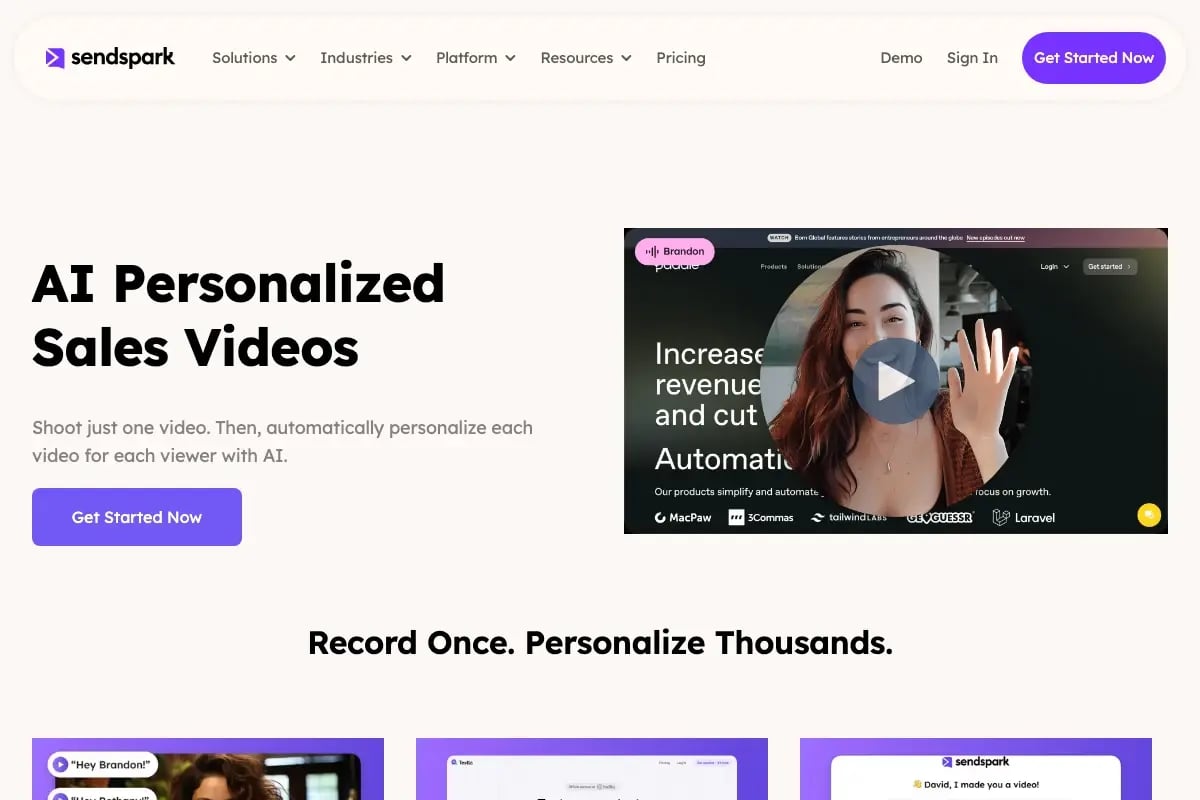
Sendspark is the AI video personalization platform for B2B sales. Record once, and AI voice cloning generates thousands of individually personalized videos with dynamic backgrounds and personalized thumbnails — each prospect hears their name, sees their website, in your voice. Sales teams see 2-3x more replies.
Get Started NowHow to Build a Follow-Up Cadence Step by Step
Building an effective follow-up cadence requires deliberate design, not a series of random messages. You need to define your goal, choose your channels, set timing, and give every touch a reason to exist. Here is how to build one from scratch that actually moves prospects forward.
Step 1 — Define Your Objective
Before writing a single message, clarify your goal. Are you trying to book an initial discovery call with a cold prospect? Re-engage a dormant lead who downloaded a resource but never replied? Or close an open deal after a demo? Each objective demands a different cadence shape, message tone, and number of touchpoints. A cadence aimed at setting a first meeting is shorter and more direct than one designed to nurture a complex enterprise deal across multiple decision-makers. post-demo follow-up sequence
Step 2 — Choose Your Channel Mix
Relying solely on email limits your reach. Effective cadences combine multiple channels to meet prospects where they are most active. Consider a mix of email, CRM-triggered sequences, LinkedIn DMs, phone calls, voicemails, text messages, and AI-personalized video outreach.
Gong’s conversation intelligence research consistently shows that multi-channel cadences significantly outperform single-channel approaches. When a prospect sees your email, your LinkedIn request, and a personalized video in the same week, the compound effect builds recognition that one channel alone never achieves.
On video specifically: Sendspark’s AI video personalization platform lets you record one video and AI voice cloning automatically generates individually personalized versions for each prospect — with their name spoken in your voice and their company website shown as a dynamic background. This makes video outreach practical at cadence scale, not just a one-off tactic for your best accounts.
Step 3 — Set Your Timing Intervals
The spacing between touchpoints is critical. Too frequent, and you risk appearing spammy. Too slow, and your prospect forgets you entirely. A reliable starting template for most B2B cadences:
- Day 1: Initial outreach (email)
- Day 3: First follow-up (email or LinkedIn)
- Day 7: Second follow-up (new channel or new angle)
- Day 14: Third follow-up (video or phone)
- Day 21: Final touch (“break-up” email)
This spacing allows enough time for the prospect to process your message while keeping you top of mind. Adjust based on your target audience and deal size. Enterprise deals may need longer gaps between touches; warm inbound leads who just raised their hand may need faster, more frequent contact within the first 48 hours.
Step 4 — Write a Distinct Value Hook for Each Touch
This is the most critical step — and where most reps fail. Every follow-up must bring something new. Never send the same message twice with different subject lines. Instead, give each touch a specific purpose: For a full breakdown of what to say next, see our guide to responding to a cold email reply.
- A relevant case study or customer success story
- A compelling data point or industry insight the prospect has not seen
- A short, AI-personalized video showing a specific feature or use case
- A link to a useful article or whitepaper tied to a current challenge they face
- A question that invites a simple yes/no response (lower friction = more replies)
Pro tip
Add AI-personalized video to touch 2 or touch 3 of your cadence, not touch 1. By that point, the prospect has already seen your name, which makes the personal video feel warm and relevant rather than intrusive. It is the single highest-impact swap you can make to a standard email-only cadence.
Follow-Up Cadence Examples and Templates
The best way to understand follow-up cadences is to see them in action. Here are three detailed sequence examples — cold outbound, post-demo, and inbound — each with day-by-day breakdowns and a multi-channel approach. Adapt them to your own sales process and prospect profile.
Cold Outbound Cadence (7 touches, 21 days)
This cadence is designed to book an initial meeting with a prospect who has had no prior contact with you. It mixes email, LinkedIn, video, and phone to maximize reach.
- Day 1 — Cold Email: Personalized subject line (e.g., “Quick question, [First Name]”), 3-sentence body referencing a specific pain point, single low-friction CTA (“Would a 15-minute chat make sense?”).
- Day 3 — LinkedIn Connection: Send a simple connection request — no pitch. Just: “Hi [Name], I came across your profile and would love to connect with others in [industry].”
- Day 5 — LinkedIn DM: Once connected, send a brief value message referencing their role or a relevant company challenge. Link to a useful article or case study. No ask yet.
- Day 7 — Follow-Up Email: New angle. Share a specific stat or a one-paragraph case study: “Many teams in [industry] struggle with [pain point] — one of our clients solved it by [result]. Curious if that resonates.”
- Day 10 — AI-Personalized Video Email: Use Sendspark’s AI video personalization platform. Record one general video, and the platform uses AI voice cloning to say each prospect’s name and dynamically shows their company website as the background. The personalized thumbnail alone significantly boosts open rates. Keep the video under 60 seconds.
- Day 14 — Phone + Voicemail: Leave a concise voicemail referencing your previous email. Mention one specific value point and your contact info. Keep it under 30 seconds.
- Day 21 — Break-Up Email: “This will be my last outreach. Totally understand if the timing is off or if [problem] is not a priority right now. If that changes, you know where to find me.” These often get the highest reply rates because they create a sense of finality.
Post-Demo Follow-Up Cadence (5 touches, 10 days)
This cadence reinforces value and guides the prospect toward a decision after a product demo. Speed is critical — momentum drops fast after a meeting ends. For more templates, see our guide to follow-up emails after a sales call.
- Day 1 (same day) — Thank-You Email: Send within 2 hours. Brief meeting recap, confirmed next steps, any resources you promised. “Great speaking today — here is a summary of what we discussed and what comes next.”
- Day 3 — Address a Specific Question: Follow up on a particular question or concern raised during the demo with additional information or a direct answer. Shows you were listening.
- Day 5 — AI-Personalized Video Recap: Use Sendspark to send a short, personalized video (60-90 seconds) recapping the 2-3 value points most relevant to their specific use case. AI voice cloning delivers it in your voice with their company’s site visible in the background.
- Day 7 — Relevant Case Study: Share a customer success story from a company similar to theirs. “[Client] faced the same challenge and achieved [result] within [timeframe].”
- Day 10 — Decision-Timeline Check-In: A polite, direct check-in. “Do you have a sense of your timeline for making a decision? Happy to jump on a quick call to answer any remaining questions.”
Inbound Lead Follow-Up Cadence (6 touches, 7 days)
Speed is everything with inbound leads. Research from Sales Gravy shows your odds of qualifying an inbound lead drop by 80% if you wait longer than 5 minutes to respond. This cadence capitalizes on the prospect’s expressed interest before it cools. For trade show leads specifically, see our trade show follow-up guide with event-specific templates and a 5-touch cadence.
- Within 5 Minutes — Auto-Triggered Email: Sent from your CRM or marketing automation. Acknowledge their download or request and confirm receipt.
- Day 1 — Personal Rep Follow-Up: A direct personal email (or call) from the assigned rep. Reference what they requested and offer a quick conversation to see how it applies to their specific situation.
- Day 2 — LinkedIn Connect: Send a connection request, optionally mentioning what they downloaded.
- Day 3 — AI-Personalized Video: Use Sendspark to send a short personalized video (under 60 seconds). Acknowledge their interest, introduce yourself on camera, and highlight one specific benefit related to their initial inquiry. AI voice cloning delivers personalization at scale across your entire inbound pipeline.
- Day 5 — New Angle Email: ROI data, a testimonial, or an invitation to a live demo or webinar. Gives prospects who are still evaluating another reason to move forward.
- Day 7 — Final Check-In: Low-pressure last touch: “Just a quick check-in — if you are still exploring [solution area], I am here to help. If not, no worries at all.”
| Cadence Type | Total Touches | Timeframe | Channel Mix |
|---|---|---|---|
| Cold outbound | 7 touches | 21 days | Email + LinkedIn + Video + Phone |
| Post-demo | 5 touches | 10 days | Email + Video |
| Inbound lead | 6 touches | 7 days | Auto-email + Email + LinkedIn + Video |
Follow-Up Cadence Mistakes That Kill Your Reply Rates
Even experienced reps run follow-up cadences that underperform — not because they are not persistent, but because they are making structural mistakes that actively reduce the odds of a reply. Here are the five most common mistakes, and exactly how to fix each one.
1. Stopping after 1–2 touches. The data is unambiguous: 44% of reps stop after one follow-up, yet most B2B deals require 8 or more touchpoints. If you are not following up at least five times, you are statistically giving up before most prospects would ever have replied. Persistence is not harassment — it is professionalism, when done with genuine value at each step.
2. Using only one channel. Email-only cadences miss prospects who are highly responsive on LinkedIn but who treat email as a low-priority inbox. Phone-only cadences miss prospects who prefer async communication. A multi-channel approach is not just “best practice” — it is the mechanism by which you reach different communication preferences within the same prospect base. See our guide to cold email follow-up strategy for channel-specific frameworks.
3. Sending generic “just circling back” messages. “Just wanted to follow up on my last email” delivers zero value and gives the prospect zero reason to reply. Every touch in your cadence must bring something new — a data point, a case study, a question, a short video — or it is just inbox noise. If you cannot answer the question “why would this person want to read this specific email today?”, do not send it.
4. Following up too aggressively. Daily follow-ups feel harassing, not helpful. Spacing your touches at 2–4 day intervals initially, then extending to weekly, gives prospects time to process and respond without feeling cornered. If you are using AI-personalized video outreach, this is especially important — a well-placed personalized video lands as a gift, not spam, when it arrives at the right interval.
5. No clear CTA on every touch. Every follow-up needs one specific, low-friction ask. “Would you be open to a 15-minute call?” is better than “Let me know if you want to chat.” “Yes or no — is this worth a quick conversation?” is better than “Looking forward to connecting.” Vague CTAs produce vague replies — or no reply at all.
Common mistake
Treating follow-up as a reminder rather than a value delivery. Every touch should educate, inform, or inspire — not just notify the prospect that you still exist. If your follow-up does not give the prospect a reason to care, it will not give them a reason to reply.
| Mistake | Why It Fails | The Fix |
|---|---|---|
| Stopping after 1–2 touches | Most prospects need 8+ to convert | Run a 7-touch cadence minimum for cold outbound |
| Email-only cadence | Misses prospects active on LinkedIn or phone | Add LinkedIn, video, and phone to every cadence |
| “Just circling back” message | Zero new value = zero reason to reply | Each touch needs a specific, distinct hook |
| Daily follow-ups | Feels harassing, gets marked as spam | Space touches: Day 1, 3, 7, 14, 21 |
| Vague or missing CTA | Prospect does not know what action to take | One specific, low-friction ask per touch |
If you want templates for re-engaging prospects who have gone completely silent, see our collection of no-response follow-up templates. And if you need proven subject lines for your follow-up emails, our follow-up email subject line guide covers 35+ tested options.
Published July 2026
Sources & References
- RAIN Group — Top Performance in Sales Prospecting Research — “It takes an average of 8 touchpoints to get an initial meeting with a new prospect; most salespeople give up after the first or second attempt.”
- HubSpot Sales Statistics — “44% of sales reps give up after just one follow-up, leaving significant pipeline on the table.” (2024)
- Gong Conversation Intelligence Research — Multi-channel cadences consistently outperform single-channel outreach sequences across B2B sales teams.
- Sales Gravy (Jeb Blount) — Research on inbound lead response speed: qualifying odds drop by 80% if response is delayed beyond 5 minutes.
Frequently Asked Questions
What is a follow up cadence?
A follow-up cadence is a structured, multi-step outreach sequence that engages a prospect after an initial touchpoint. It defines how many times you follow up, which channels you use (email, LinkedIn, phone, video), the timing between each touch, and what specific value you deliver at each step. Unlike ad-hoc “checking in” emails, a cadence is planned in advance and designed to build familiarity and trust across multiple interactions until the prospect is ready to engage.
How many follow-up emails should I send before giving up?
For cold B2B outbound, most research suggests at least 7–12 touchpoints before moving on. RAIN Group data shows it takes an average of 8 touchpoints to book an initial meeting, yet 44% of reps quit after just one. For warm inbound leads, 5–7 touches over 7–10 days is a solid baseline. For post-demo follow-ups, 4–6 touches over 10–14 days is standard. The answer depends on prospect type and deal size — but almost always, you should be following up more than you currently are.
What is the 3-3-3 rule in sales?
The 3-3-3 rule is a simple follow-up framework for sales reps: make at least 3 touchpoints, use 3 different channels (such as email, LinkedIn, and phone), and space them roughly 3 days apart. It is a minimum viable cadence designed to stop reps from quitting after a single ignored email. It is not a complete system — experienced reps typically run longer cadences — but it provides a structured starting point for building the persistence habit.
What is the 2-2-2 rule in sales?
The 2-2-2 rule is a longer-arc follow-up framework: follow up at 2 days, 2 weeks, and 2 months after initial contact. It is especially useful for enterprise deals or prospects with longer decision cycles, where pursuing a compressed short-term cadence would feel premature. The 2-month touch in particular keeps you relevant with prospects who were genuinely interested but had their timeline shift — a common reality in complex B2B sales.
What is the best time to send a follow-up email?
Research consistently points to Tuesday through Thursday as the highest-performing days for B2B follow-up emails, with 8–10 AM and 3–4 PM in the prospect’s local timezone showing the best open and reply rates. Avoid Monday mornings (prospect inbox is overwhelmed) and Friday afternoons (people are checked out). That said, the best time is always the time you actually send — a well-crafted follow-up at 2 PM Thursday outperforms a poorly-written one at 9 AM Tuesday every time.
How do I follow up without being annoying?
The key is delivering new value with every touch rather than simply reminding the prospect you exist. A follow-up that brings a relevant case study, a useful insight, or a personalized video is not annoying — it is genuinely helpful. You also reduce annoyance by respecting spacing (avoid daily contact), using different channels instead of blasting the same email repeatedly, and always including a clear, low-friction CTA rather than an open-ended ask. For more on this, see our guide on how to follow up without being annoying.
Should I use video in my follow-up cadence?
Yes — and it is one of the highest-impact changes you can make to any follow-up cadence. AI-personalized video outreach via Sendspark generates 2–3x more replies than equivalent text-only emails. The ideal placement is touch 2 or 3, after the prospect has already seen your name once. Sendspark’s AI video personalization platform lets you record one video and automatically generate individually personalized versions for your entire prospect list — each one addresses the prospect by name using AI voice cloning and shows their company website as the dynamic background. It is the fastest way to stand out in a crowded follow-up cadence.
Record One Video. AI Personalizes Thousands.
Sendspark is the AI video personalization platform for B2B sales. Record once, and AI voice cloning generates thousands of individually personalized videos with dynamic backgrounds and personalized thumbnails — each prospect hears their name, sees their website, in your voice. Sales teams see 2-3x more replies.
Get Started Now