Most B2B reps lose margin before the negotiation even starts. They lead with a discount, talk to only one stakeholder, and cave the moment a buyer goes quiet. Gong's analysis of B2B sales conversations found that win rates are 10% higher when pricing gets discussed on the first call, not saved for a defensive scramble at the end. The reps who protect their margin aren't better talkers. They just run a different playbook.
Published September 2026
Key Takeaways
- Win rates are 10% higher when pricing is discussed on the first call, and sales cycles run 19% longer whenever a rep uses "list price" or "standard price" language, according to Gong.
- On average, five decision-makers are involved in every B2B sale, per HubSpot — negotiating with only one of them is the single biggest reason deals stall or reopen.
- RAIN Group's global negotiation study found top-performing negotiators are 9.3x more likely to have received dedicated negotiation training than the rest.
- Every concession should be traded for something — a shorter contract, a faster timeline, a case study — never given away just to keep the conversation moving.
- Sendspark lets a rep record one negotiation recap video, then use AI voice cloning to personalize it by name and role for every buying-committee stakeholder, so agreed terms don't get diluted as they're relayed internally.
Why B2B Sales Negotiations Stall (And Cost You Margin)
B2B sales negotiations stall because a purchase decision usually runs through a committee, not a single buyer, and reps default to discounting the moment that committee goes quiet. On average, five decision-makers are involved in every sale, according to HubSpot's compiled sales research. Each one weighs a different risk, and silence from any single one of them gets misread as a price problem.
A CFO is scanning for total cost of ownership. A VP of IT is scanning for integration risk. An end user just wants the thing to work on day one. If your negotiation strategy only accounts for the person who invited you to the call, you're negotiating with a fraction of the room — and you won't find out about the objections you missed until the deal reopens two weeks later.
That reopening is what actually erodes margin. A rep who discounted 12% to "get it done" finds out the real blocker was a procurement stakeholder who was never in the room, and now there's a second round of concessions stacked on top of the first. RAIN Group's negotiation research, based on a global study of 713 buyers and sellers, found that procurement professionals cite cost as their primary negotiation success metric 12 times more often than quality — they are trained and incentivized to find a reason to ask for a lower number, and an under-prepared rep gives them an easy one.
"Win rates are 10% higher when pricing is discussed on the first call."
Common mistake
Waiting until the final call to discuss price feels safer, but it backfires. Gong's research found win rates are 10% higher when pricing is discussed on the first call — early pricing conversations filter out bad-fit deals before you've invested weeks in them.
None of this means negotiation is unwinnable. It means the stall is rarely about your price — it's about which stakeholders you've actually reached and how clearly they each understand the value case. Fix that, and you negotiate from a position where discounting is a choice, not a reflex.
9 B2B Sales Negotiation Tactics That Protect Your Margin
The reps who protect margin in B2B negotiations rely on a specific set of tactics: knowing their walk-away point, anchoring first, trading every concession instead of giving it away, and keeping every relevant stakeholder in the loop. None of these require being a better talker — they require preparation and discipline before the call starts.
| Tactic | What It Does | Use It When |
|---|---|---|
| Know your BATNA | Sets your real walk-away point | Before every negotiation, not during one |
| Anchor first | Sets the reference point for the whole conversation | When you understand the deal's value better than the buyer |
| Trade, don't cave | Preserves the value of every concession | Any time a buyer asks for a discount |
| Discuss price early | Filters bad-fit deals before they cost you time | On the first or second call |
| Drop "list price" language | Removes the anchor that invites comparison shopping | In every pricing conversation |
| Reframe objections as value gaps | Surfaces the real blocker instead of a symptom | When a buyer says "it's too expensive" |
| Multi-thread the committee | Reaches every stakeholder before they can stall the deal | As soon as a deal moves past a single champion |
| Bundle value, don't cut price | Adds perceived value instead of removing revenue | When a buyer needs to justify the number internally |
| Close with a mutual plan | Locks in terms before internal memory fades | The moment verbal agreement is reached |
1. Know Your BATNA and Walk-Away Point
Your best alternative to a negotiated agreement (BATNA) is the single biggest source of leverage in any negotiation, a concept popularized by Harvard's Program on Negotiation. Before the call, set your reservation price — the number below which you'd genuinely rather walk away than sign. Reps who skip this step negotiate from fear instead of information, and buyers can tell the difference.
2. Anchor First
The first number spoken in a negotiation becomes the reference point everyone measures against — a well-documented effect Harvard's Program on Negotiation calls anchoring. If you know the deal's value better than the buyer does, which is usually true, open with a value-justified number instead of waiting for them to anchor low.
3. Trade, Don't Cave on Concessions
Never hand over a concession for nothing. If a buyer asks for a lower price, ask for something back: a longer contract term, a case study, a faster signature. Harvard Business School professor Deepak Malhotra's research, published through Harvard's Program on Negotiation, also found that the same concession lands better broken into smaller installments than given away all at once — buyers report more satisfaction from two smaller moves than one equivalent big one.
Advanced strategy
If you must move on price, split the move into two smaller concessions instead of one large one. The total dollar amount can be identical — buyers consistently report more satisfaction when a concession arrives in installments.
4. Discuss Price Early
Delaying the pricing conversation to "build value first" is a common instinct, but Gong's data shows win rates are 10% higher when pricing comes up on the first call. Early pricing conversations surface budget mismatches before you've invested weeks building a proposal nobody can approve.
5. Drop "List Price" Language
The words "list price," "typical price," and "standard price" invite a buyer to negotiate down from an arbitrary number. Gong found that sales cycles run 19% longer whenever any of those phrases gets used at any point in a deal. Talk about the investment and the outcome it buys instead of a "price" that sounds negotiable by name.
6. Reframe Price Objections as Value Gaps
When a buyer says "it's too expensive," they rarely mean the number itself — they mean they haven't connected the number to a result they care about. Ask what specifically feels expensive relative to what. That question usually surfaces the real objection: a competing priority, a trust gap, or a stakeholder who hasn't seen the ROI case yet. Our guide to sales objection handling has scripts for the eight most common versions of this objection.
7. Multi-Thread the Buying Committee
A single champion cannot carry a deal through procurement, IT security review, and budget sign-off alone. Map every stakeholder early and make sure each one has seen a version of your value case that speaks to their specific risk. Our guide to multi-threading in B2B sales covers how to identify and reach every stakeholder before they can quietly stall a deal.
8. Bundle Value Instead of Discounting
When a buyer needs a lower number to get internal approval, add scope instead of cutting price: extra onboarding, an extended pilot, a training session. This gives the champion something concrete to justify the deal internally without teaching every future buyer that your price is soft.
9. Close With a Mutual Action Plan
Verbal agreement fades fast once a call ends and each side goes back to their own priorities. Document the agreed terms, the next steps, and who owns each one, and get it in writing immediately. This is also the moment to plan how you'll reinforce the agreement with every stakeholder, not just the person who said yes on the call — more on that in the final section below. If the deal came down to a genuine standoff on price, our sales closing techniques guide covers when to hold firm and when a small trade is worth making.
Record One Video. AI Personalizes Thousands.
Sendspark is the AI video personalization platform for B2B sales. Record once, and AI voice cloning generates thousands of individually personalized videos with dynamic backgrounds and personalized thumbnails — each prospect hears their name, sees their website, in your voice. Sales teams see 2-3x more replies.
Get Started NowHow to Prepare for a B2B Sales Negotiation
Preparing for a B2B sales negotiation means setting your numbers before the call, not during it: your BATNA, your target price, and your reservation price, plus a map of every stakeholder who has to say yes. Reps who walk in with these four things pre-decided negotiate from a plan instead of reacting in real time.
- Set your BATNA and reservation price. Decide the walk-away point before the buyer can pressure you into moving it live on the call.
- Estimate the buyer's BATNA and target, too. Understanding what they'd do without you tells you how much leverage you actually have.
- Map every stakeholder in the buying committee. Identify the economic buyer, the champion, the technical evaluator, and procurement before you walk in, not after the deal stalls.
- Build a concession ladder. Decide in advance what you'd trade, in what order, and what you'd want in return for each move.
- Prepare proof, not just a pitch. Have a case study or reference ready for the specific objection you expect from each stakeholder — our customer stories library is a useful source if you need a comparable result to point to.
The goal of preparation isn't a script. It's removing every decision you'd otherwise have to make under pressure, so the only thing you're doing live on the call is listening and responding to what the buyer actually says.
Common B2B Sales Negotiation Mistakes That Kill Margin
The most common B2B sales negotiation mistakes all share one root cause: reacting to pressure instead of following a plan set before the call. Leading with a discount, negotiating with only one stakeholder, and caving to silence are the three that cost the most margin, and all three are avoidable with basic preparation.
| Mistake | Why It Costs Margin | The Fix |
|---|---|---|
| Leading with a discount | Signals your price was never firm | Anchor on value first; only discount in exchange for something |
| Negotiating with the wrong person | Deal reopens once the real approver sees it | Multi-thread the committee before final terms are set |
| No BATNA | You negotiate from desperation, not leverage | Set a walk-away point before the call |
| Using "list price" language | Sales cycles run 19% longer, per Gong | Talk in terms of investment and outcome, not "price" |
| Caving to silence | Trains buyers that silence gets them a discount | Ask an open question instead of filling the pause with an offer |
| No written recap | Verbal terms get renegotiated internally | Document terms and reinforce them with every stakeholder |
Every one of these mistakes is a pressure response — something a rep does live on a call because they didn't decide it in advance. Fixing them is less about developing a thicker skin and more about doing the preparation work covered above so pressure has nothing to exploit.
How to Reinforce Negotiation Outcomes Without Renegotiating
Negotiated terms get renegotiated internally when the agreement only lives in one person's memory, and reinforcing it with every stakeholder — not just the champion who said yes on the call — is what keeps a signed deal from reopening. A single generic recap email gets skimmed or forgotten; a version of that recap addressed to each specific stakeholder tends to actually get read.
This is the gap Sendspark's AI video personalization platform is built to close. Instead of sending one templated thank-you email to the whole distribution list, you record one video recapping the agreed terms, the ROI case, and next steps — then AI voice cloning personalizes it, in your own voice, for every stakeholder by name and role. The CFO's version can lead with the cost case. The technical evaluator's version can lead with integration timeline. Same recording, same negotiated terms, different opening frame for each of the five decision-makers who, on average, had to say yes to get the deal done.
That matters because the moment a negotiation ends is exactly when a champion has to go re-sell the deal internally, often to people who weren't on the calls at all. A personalized recap video gives that champion something concrete and specific to forward instead of asking them to paraphrase the negotiation from memory — which is usually where "agreed" terms start to drift.
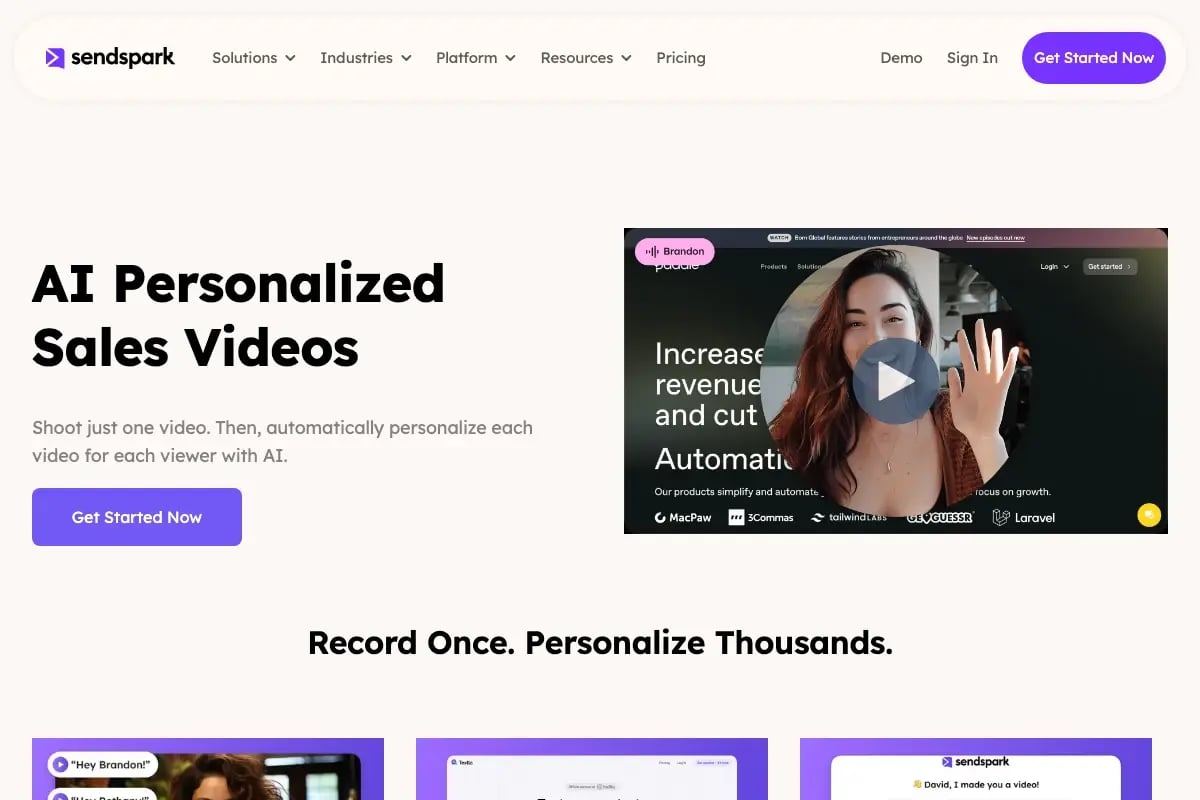
Sendspark's AI-personalized video capability works the same way for the whole deal cycle Sendspark supports for deal progression: one recording, personalized at scale, distributed through your existing CRM and outreach tools. If your team already sends personalized follow-up videos after demos, extending that same motion to post-negotiation recaps is a small workflow change with an outsized effect on whether a signed deal actually stays signed. For the mechanics of building this into your outreach — subject lines, timing, and when video actually outperforms plain text — see our comprehensive guide to personalized video email.
Pricing for this doesn't require a separate tool or a new line item on the deal you just closed. It runs on the same Sendspark plan your team already uses for prospecting and demo follow-ups, since a negotiation recap is just another AI-personalized video sent to a defined list of recipients.
Frequently Asked Questions
What is BATNA in sales negotiation?
BATNA stands for Best Alternative to a Negotiated Agreement — the outcome you'd pursue if this specific deal fell through. Knowing your BATNA before a sales negotiation sets a clear walk-away point and prevents you from making concessions out of desperation rather than strategy.
How do you handle a price objection without discounting?
Reframe the objection as a value gap instead of a price problem by asking what specifically feels expensive relative to what. Most price objections in B2B sales negotiations are really unaddressed concerns about ROI, competing priorities, or a stakeholder who hasn't seen the business case, not a genuine budget ceiling.
Should you discuss price on the first call or wait?
Discuss price on the first call whenever possible. Gong's analysis of B2B sales conversations found win rates are 10% higher when pricing comes up on the first call, since early pricing conversations filter out budget mismatches before both sides invest weeks in a proposal that was never approvable.
What's the biggest mistake reps make in B2B sales negotiation?
The biggest mistake is negotiating with only one stakeholder. On average, five decision-makers are involved in every B2B sale, according to HubSpot, and a deal negotiated with just the champion frequently reopens once procurement, IT, or a budget holder reviews it for the first time.
How many negotiation tactics should a sales rep know?
A rep doesn't need dozens of tactics — a small, well-practiced set covering preparation (BATNA, stakeholder mapping), execution (anchoring, trading concessions), and close (a written mutual action plan) covers the vast majority of B2B sales negotiations. Depth on a few tactics beats shallow familiarity with many.
Why does using "list price" language hurt a sales negotiation?
The phrase "list price" implies there's a lower price available, which invites the buyer to negotiate down from an arbitrary number instead of evaluating the actual investment. Gong's research found sales cycles run 19% longer whenever "list price," "typical price," or "standard price" language is used at any point in a deal.
How can AI-personalized video help after a sales negotiation closes?
An AI-personalized video lets a rep record one recap of the agreed terms and ROI case, then use AI voice cloning to personalize a version for each buying-committee stakeholder by name and role. This keeps the negotiated agreement consistent as it gets relayed internally, instead of drifting through paraphrased emails and secondhand summaries.
Sources & References
- Gong — "Win rates are 10% higher when pricing is discussed on the first call" and sales cycles extend 19% when "list price" language is used (2026)
- RAIN Group, Center for Sales Research — global study of 713 buyers and sellers found top negotiators are 9.3x more likely to have received effective negotiation training, and procurement cites cost as a success metric 12x more than quality (2026)
- Harvard Program on Negotiation — BATNA and anchoring effect in first-offer negotiations (2026)
- Harvard Program on Negotiation, adapting research by Deepak Malhotra (Harvard Business School) — concessions delivered in installments are received more favorably than a single equivalent concession (2010)
- HubSpot — "On average, five decision-makers are involved in every sale" (2026)
Record One Video. AI Personalizes Thousands.
Sendspark is the AI video personalization platform for B2B sales. Record once, and AI voice cloning generates thousands of individually personalized videos with dynamic backgrounds and personalized thumbnails — each prospect hears their name, sees their website, in your voice. Sales teams see 2-3x more replies.
Get Started Now