
A prospect who raises an objection is still in the conversation. A prospect who ghosts you isn't. That distinction matters more than most sales training admits, because an objection is a buying signal, not a rejection. Gong's analysis of hundreds of millions of B2B cold calls found that the top 5 objections account for 74% of everything reps hear, which means sales objection handling mostly comes down to mastering a short, predictable list of responses rather than improvising a new answer every time a deal gets tense.
Below you'll find word-for-word scripts for the 8 most common B2B objections, a repeatable 5-step framework for anything you haven't scripted yet, and an honest look at when a templated email reply isn't enough to keep a deal moving. Objection handling is one piece of the broader deal progression process, and it pairs well with our comprehensive guide to video prospecting if you're building out a full outreach playbook. It also works differently depending on which sales methodology your team runs, since each one frames objections as a qualification signal rather than a hurdle.
Updated September 2026
Key Takeaways
- The top 5 sales objections account for 74% of all objections reps hear, so mastering a handful of scripted responses covers most real conversations.
- A repeatable 5-step framework, listen, acknowledge, clarify, respond with proof, confirm, resolves objections without sounding defensive or scripted.
- Top-performing sellers are 81% more likely than average reps to overcome price pressure and protect their margins.
- A short AI-personalized video response to a recurring objection often lands better than a templated email, because it puts a real voice and face behind the answer.
- Track which objections recur most in your CRM notes or call recordings so you fix the pattern upstream instead of re-litigating the same objection deal after deal.
What Is Sales Objection Handling?
Sales objection handling is the process of responding to a prospect's stated hesitation, whether about price, timing, or fit, in a way that resolves the underlying concern instead of talking past it. It's different from overcoming a rejection: an objection means the prospect is still evaluating and wants more reassurance, while a rejection means they've already decided not to buy.
That distinction changes how you should react. A rejection ("we're not interested, please stop emailing") should be respected. An objection ("this looks expensive for what we'd use") is an invitation to keep talking, and reps who treat it that way close more deals. As Highspot's own guidance on the topic puts it, "objections indicate that the customer carefully considers their decision and benefits from engaging with you during that process." This is also why preparing for likely objections before the call matters as much as handling them in the moment. Once the objection is resolved, the conversation shifts to asking for the commitment itself, which is its own skill set covered in our guide to sales closing techniques.
The most reliable way to handle any objection, scripted or not, is a five-step sequence:
- Listen — let the prospect finish. Interrupting signals you're more interested in rebutting than understanding.
- Acknowledge — confirm you heard the concern before you respond to it ("That's fair, budget is tight for everyone right now").
- Clarify — ask one question to find the real objection behind the stated one ("When you say it's expensive, is that versus doing nothing, or versus a specific competitor?").
- Respond with proof — answer with a specific example, number, or short demo, not a generic reassurance.
- Confirm — check that the response actually resolved the concern before moving on ("Does that address the budget question, or is there more to it?").
Pro tip
Pause for at least two full seconds after a prospect raises an objection before you respond. Rushing in with a rebuttal is the single most common thing separating average performers from top performers on recorded sales calls.
The 8 Most Common B2B Sales Objections (With Scripts)
The 8 objections below cover budget, competition, timing, authority, information requests, indecision, past failures, and adoption risk, and together they account for the large majority of pushback a B2B rep will hear in a typical sales cycle. Each script follows the listen, acknowledge, clarify, respond, confirm pattern above, so you're never improvising the structure under pressure, only the specifics.
| # | Objection | What It Really Means | One-Line Response |
|---|---|---|---|
| 1 | "It's too expensive" | They haven't connected price to a specific outcome yet | "Compared to what it costs to keep doing this manually, where does the math stop working for you?" |
| 2 | "We already use [competitor]" | Switching costs feel higher than the pain of staying | "What's one thing your current setup still doesn't solve for you?" |
| 3 | "Not the right time" | They don't see urgency, not that timing is literally bad | "What would need to change for this to become a priority?" |
| 4 | "I need to loop in [stakeholder]" | They're not the final decision-maker, or want cover | "Happy to help you make that case — what does [stakeholder] usually need to see?" |
| 5 | "Just send me some information" | A polite way to end the call without committing | "I will — what's the one question that info needs to answer for you?" |
| 6 | "I need to think about it" | An unresolved objection they haven't stated yet | "Totally fair — what's the piece you're still weighing?" |
| 7 | "We tried something like this before" | A past bad experience they're projecting onto you | "What specifically didn't work last time, so we can rule that out here?" |
| 8 | "Not sure my team will use it" | Adoption risk, not product doubt | "What's made past tools stick or not stick with your team?" |
1. Price/budget objections. Don't discount reflexively. Ask what the prospect is comparing the price to, then reframe around the cost of the status quo. RAIN Group's research on top-performing sellers found they're 81% more likely than average reps to overcome price pressure and maintain their margins, mainly because they justify value before they ever discuss discounts.
2. Competitor objections. Never trash the competitor by name. Ask what's missing from the current setup, and let the prospect articulate the gap you're there to fill. A pre-built competitive battlecard for that specific rival keeps this response consistent across the whole team instead of improvised rep by rep.
3. Timing objections. "Not now" is rarely about the calendar. Ask what would have to change, and you'll usually surface the real blocker: budget cycle, a bigger project competing for attention, or lack of a clear trigger event.
4. Authority objections. When a prospect needs to loop in a stakeholder, offer to help build the internal case instead of treating it as a stall. This is where early discovery work pays off, since you should already know who else is involved. Knowing that stakeholder's buyer persona ahead of time, not just their title, is what lets you offer a specific talking point instead of a generic "happy to help."
5. "Send me information" objections. A generic PDF gets forwarded and ignored. Ask what specific question the material needs to answer, then send something targeted, ideally something that shows you were listening rather than a stock brochure. If the objection came in over email rather than on a call, our guide to handling cold email replies has scripts specific to the written version of this objection.
6. Indecision objections. "I need to think about it" almost always means there's an unstated concern. Naming that directly, gently, moves the conversation forward instead of letting the deal go quiet.
7. Past-failure objections. If a prospect tried something similar before and it flopped, your job is to find out exactly what broke, not to promise generically that "it'll be different this time."
8. Adoption-risk objections. Teams don't adopt tools they were never shown how to use. Point to onboarding support and real usage data from similar customers rather than just asserting the product is easy.
Notice the pattern across all 8: none of the responses argue with the prospect. Each one turns the objection back into a question, which does two things at once. It buys you a second or two to think, and it forces the prospect to articulate the real concern instead of you guessing at it. Reps who skip this step and jump straight to a rebuttal tend to solve the wrong problem, which is why the same objection often resurfaces two or three calls later, just worded differently.
Objection-Handling Mistakes That Kill Deals
Most objection-handling failures come down to a handful of repeatable mistakes: reps argue instead of asking questions, reuse one generic response for every objection, drop the follow-up after "send me info," or respond to the stated objection while missing the real one underneath it. Fixing these is usually a bigger lever than learning a new script. If the same objection keeps showing up in lost deals even after reps address it live, a structured win-loss analysis interview is the fastest way to confirm whether it's a scripting problem or a real product gap.
Sales managers often assume objection handling is a talent gap, something a rep either has a knack for or doesn't. In practice, it's closer to a process gap. Reps who consistently perform well on objections tend to have three things average reps lack: a short list of pre-written responses for the most common objections, a habit of asking one clarifying question before responding, and a system for tracking which objections keep coming up so the team can fix the pattern at the source, whether that's a pricing page that undersells value or a demo that skips the one feature every prospect asks about.
Common mistake
Treating every "I need to think about it" as a scheduling problem instead of an unresolved concern. Reps who just ask "when should I follow up?" miss the chance to surface and resolve the real objection while the prospect is still on the call.
| Mistake | Why It Backfires | Fix |
|---|---|---|
| Arguing instead of asking | Prospect gets defensive, objection hardens | Use the acknowledge-then-clarify sequence before responding |
| One generic response for every objection | Feels scripted, ignores the specific concern | Match the response to what the objection actually means (see table above) |
| No follow-up after "send me info" | Requests for information are often a soft no | Set a specific follow-up date and ask what the material needs to answer |
| Responding to the stated objection only | The real blocker stays hidden and resurfaces later | Ask one clarifying question before answering |
| Sending the same follow-up format every time | Templated replies read as low-effort on high-stakes objections | Use a personalized video for price, trust, or adoption objections |
How AI Conversation Intelligence Is Changing Objection Handling in 2026
Conversation intelligence platforms now flag an objection the moment a prospect says it, score how well a rep responded, and surface the talk tracks that closed similar deals, shifting objection handling from a rep's memory and instinct to a coached, data-backed skill teams can systematically improve.
Tools like Gong, Chorus, and Clari built their category on transcribing and analyzing sales calls, but the 2026 shift is real-time objection detection: the system flags an objection live, not in a post-call review days later, and sentiment analysis can catch rising frustration in a prospect's tone before they even state the objection out loud. A rep can see an on-screen prompt the instant a prospect says "it's too expensive," pulling up the team's best-performing response before the call even ends.
That same conversation intelligence layer powers objection heatmaps, dashboards that show which objections are rising or falling in frequency across the whole team, and win-loss signal tracking, which correlates specific objection responses with deals that actually closed versus stalled. Sales managers use these heatmaps to decide which objection needs a refreshed script or a new personalized video response, rather than guessing based on anecdote.
AI role-play simulators are the practice-side complement: reps rehearse objection responses against a simulated buyer persona before ever facing the real thing, building the same muscle memory that used to only come from live call volume. Combined with objection library automation, teams can auto-tag every recorded call by which of the 8 objections above came up, then auto-suggest which pre-recorded personalized video response fits, closing the loop between detecting an objection and answering it at scale.
None of this replaces the fundamentals. Listening, acknowledging, and asking one clarifying question before responding still separates reps who close from reps who argue. What conversation intelligence adds is visibility: teams can finally see which objections are actually costing them deals instead of relying on whichever one a rep remembers most vividly from last quarter.
Scripts vs. Personalized Video: When Text Isn't Enough
A templated email works fine for objections that just need a quick fact-check, like confirming a feature exists. Recurring objections that actually stall deals, price pushback, adoption doubt, or lost trust from a bad past experience with a similar tool, often need more than words on a screen. A short, personalized video response signals effort and answers the tone and body-language questions that text can't.
| Criteria | Templated Email / Script | Personalized Video Response |
|---|---|---|
| Perceived effort | Low — reads as copy-pasted | High — feels recorded specifically for them |
| Trust signal | Words only, tone is guessed | Voice, face, and tone are all visible |
| Reply-rate expectation | Baseline | Meaningfully higher for the same message |
| Scalability | Instant, but generic | Record once, AI-personalize per recipient |
| Best used for | Simple fact-checks, scheduling | Price pushback, adoption doubt, rebuilding trust |
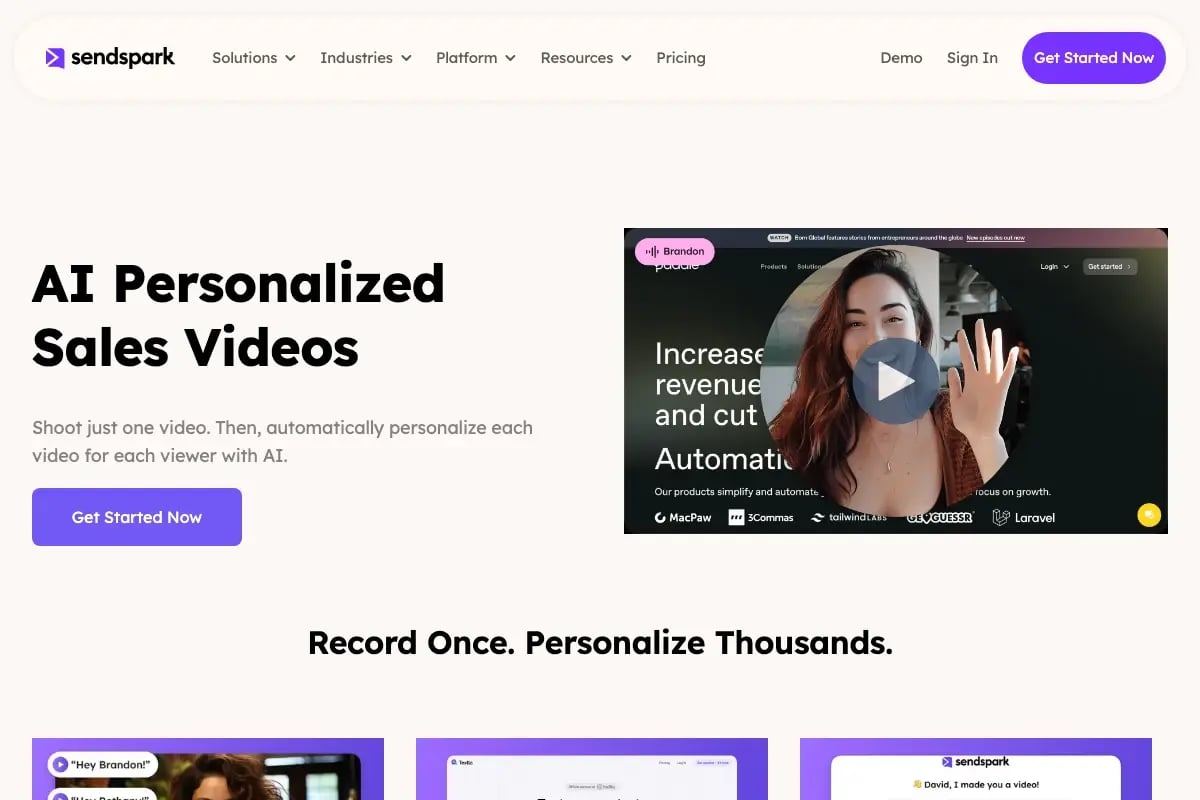
This is exactly the gap Sendspark's AI video personalization platform is built to close. Record one video answering a common objection, say, the price objection, once. Sendspark's AI voice cloning and dynamic video backgrounds then generate an individually personalized version for every prospect who raises that same concern: their name, their company's website behind you, spoken in your actual voice. You get the speed of a template with the felt quality of a reply you recorded just for them. Not every objection needs full voice cloning, though — it's worth deciding how much personalization the situation actually calls for before you take it. Once you're sending these at volume, log the objection type on the deal record in HubSpot so you can see which objections your video responses actually resolve. A price objection you handle well is often just the opening move in a longer negotiation — see our guide to B2B sales negotiation tactics for how to protect margin once the conversation moves past the initial objection.
Record One Video. AI Personalizes Thousands.
Sendspark is the AI video personalization platform for B2B sales. Record once, and AI voice cloning generates thousands of individually personalized videos with dynamic backgrounds and personalized thumbnails — each prospect hears their name, sees their website, in your voice. Sales teams see 2-3x more replies.
Get Started Now"Objections indicate that the customer carefully considers their decision and benefits from engaging with you during that process. How well your team handles sales objections determines whether those conversations turn into closed deals."
Listening matters as much as the delivery format. HubSpot's research points to a "70-30 rule": sales conversations should be roughly 70% listening and 30% talking. A personalized video response doesn't change that math, it just gives you a better channel to demonstrate that you actually listened, since the prospect can see and hear you addressing their specific concern instead of reading a paragraph that could have gone to anyone.
Advanced strategy
Build a small library of 60-90 second objection-response videos, one per common objection, then use Sendspark's AI-personalized intros to swap in the prospect's name, company, and website background for every send. You record each one once; AI handles the personalization at scale, so even the Solo plan's AI credit allowance comfortably covers a full library of objection responses for a single rep.
Frequently Asked Questions
What are the 5 steps of objection handling?
The 5 steps are listen, acknowledge, clarify, respond with proof, and confirm. Listening fully and acknowledging the concern come before you try to resolve anything, clarifying makes sure you're answering the real objection, and confirming checks that your response actually landed before you move on.
What are some examples of common sales objections in B2B sales?
The most common B2B sales objections are price or budget, already using a competitor, bad timing, needing to loop in other stakeholders, requests for more information, general indecision, past failures with a similar tool, and doubts about team adoption. Together, the top 5 of these account for roughly 74% of all objections a rep hears.
How do you handle a price objection without discounting?
Ask what the prospect is comparing the price to before you respond, then reframe the conversation around the cost of the status quo rather than the sticker price. Top-performing sellers are significantly more likely to justify value first and only discuss discounts as a last resort.
Should you respond to an objection by email, phone, or video?
Simple fact-check objections are fine over email. Objections that carry real risk to the deal, like price pushback, adoption doubt, or rebuilding trust after a bad past experience, usually land better as a personalized video, since the prospect can see and hear the response instead of reading a generic paragraph.
What's the difference between a sales objection and a rejection?
An objection means the prospect is still evaluating and wants more reassurance before deciding, while a rejection means they've already decided not to buy. Objections are worth engaging with; a clear rejection should be respected rather than pushed against.
How many times should you follow up after an unresolved objection?
Most B2B deals need several follow-up touches after an objection surfaces, not just one. The key is varying the format and adding new information each time, a personalized video, a relevant case study, or a direct answer to the specific concern, rather than repeating the same message.
What is the best way to practice objection handling?
Role-play the 8 most common objections out loud with a manager or peer until the listen-acknowledge-clarify-respond-confirm sequence feels automatic. Reviewing recordings of real calls where objections came up is one of the fastest ways to see where you're rebutting instead of asking.
Sources & References
- Gong — "The top 5 most common objections actually account for 74% of all objections" (2026)
- RAIN Group — "Top-performing sellers are 81% more likely to overcome price pressure and maintain margins" (2026)
- Highspot — "Objections indicate that the customer carefully considers their decision and benefits from engaging with you during that process" (2026)
- HubSpot — The 70-30 rule: sales conversations should be roughly 70% listening, 30% talking (2026)
Record One Video. AI Personalizes Thousands.
Sendspark is the AI video personalization platform for B2B sales. Record once, and AI voice cloning generates thousands of individually personalized videos with dynamic backgrounds and personalized thumbnails — each prospect hears their name, sees their website, in your voice. Sales teams see 2-3x more replies.
Get Started Now