Most sales reps enter a new quarter with a vague sense of their number and not much else. No documented ICP. No defined pipeline stages. No real plan for how cold outreach, follow-up cadences, and closing conversations connect. The result is inconsistent execution, missed forecasts, and reps reinventing their approach every cycle.
According to the Salesforce State of Sales report, high-performing sales teams are significantly more likely to have a documented sales process than underperformers. A sales plan template forces that documentation — giving every rep and manager a shared framework for who you’re targeting, how you’ll reach them, and what success looks like at each stage.
This guide gives you a complete B2B sales plan template you can adapt today. It covers every core component — from ICP definition and pipeline stages to outreach sequences, KPIs, and how to incorporate AI video personalization to dramatically improve your reply rates.
Key Takeaways
- A sales plan template gives your B2B team a repeatable framework — covering ICP definition, pipeline stages, outreach sequences, and quota goals in one place.
- According to Salesforce research, high-performing reps are far more likely to follow a documented sales process than average or low performers.
- Adding AI-personalized video outreach to your plan can increase email reply rates by 200-300% compared to text-only sequences.
- Track 3-5 leading KPIs — dials, demos booked, open pipeline — alongside closed revenue so you can catch problems before they impact your quarter.
- Review and update your sales plan quarterly — your ICP shifts, messaging evolves, and tools like AI voice cloning change what’s achievable in outreach.
What Is a Sales Plan?
A sales plan is a written document that defines who you’re selling to, what your goals are, and exactly how your team will reach them — covering outreach channels, pipeline stages, follow-up sequences, and the metrics you’ll use to track execution. Unlike a business plan or a high-level sales strategy, a sales plan is operational: it tells individual reps and managers what to do on Monday morning.
The difference between a sales strategy and a sales plan matters. A strategy answers “why” and “what” — which markets to enter, which customer segments to prioritize, which competitive positioning to use. A plan answers “how” and “when” — what activities will drive revenue, at what volume, by which dates. Both are necessary, but most B2B teams skip the plan entirely and wonder why execution is inconsistent.
A well-constructed sales plan typically covers a 90-day or annual horizon. Quarterly plans let you adjust to market changes without locking in stale assumptions. Annual plans give you the strategic arc you need for headcount, tooling, and territory decisions.
Common mistake
Don’t confuse a sales plan with a forecast. A forecast predicts what revenue you’ll close. A plan defines the activities that will generate it. Reps who only track their number — but not the activities driving it — often hit Q4 with no pipeline and no time to recover.
Core Components of a B2B Sales Plan Template
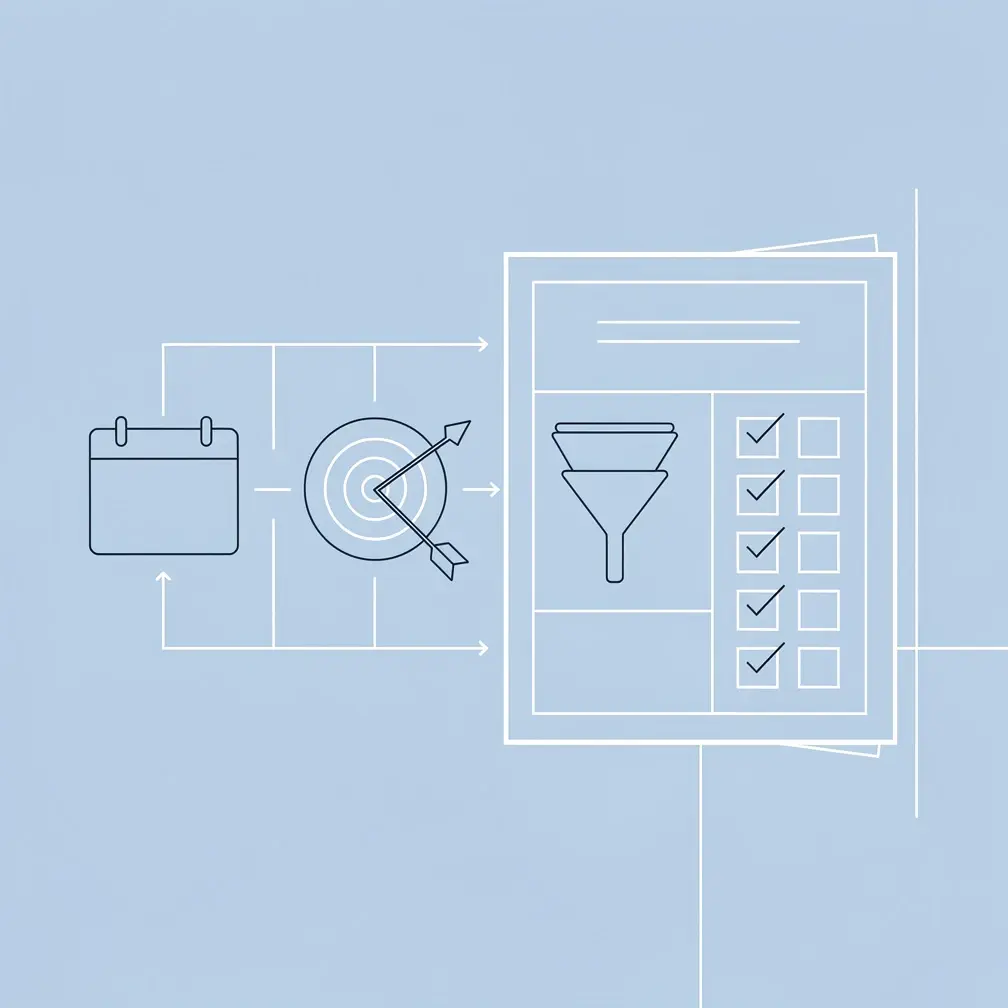
A complete B2B sales plan covers six core components: your ICP and target accounts, revenue goals broken down by period and rep, pipeline stages with conversion benchmarks, outreach channels and sequences, your tools and tech stack, and a review cadence to keep the plan current. Together these give every rep a clear picture of who to target, how to reach them, and how to measure progress.
1. Ideal Customer Profile (ICP) and Target Accounts
Your ICP defines the type of company most likely to buy, stay, and expand. A strong B2B ICP includes: company size (employees and revenue), industry and sub-vertical, tech stack signals, growth indicators, and the buying team structure. Without this, reps waste time on poor-fit prospects that never close.
Your B2B lead qualification framework should flow directly from your ICP — every prospect that enters your pipeline should be screened against these criteria before a rep invests significant time.
2. Revenue Goals and Quota Breakdown
Start with company-level revenue targets, then break them down to team and individual quotas. Use both a top-down method (what does the business need?) and a bottom-up method (what can reps realistically achieve given current capacity?) and reconcile the gap. Build in a buffer — most quota models assume some percentage of reps will miss.
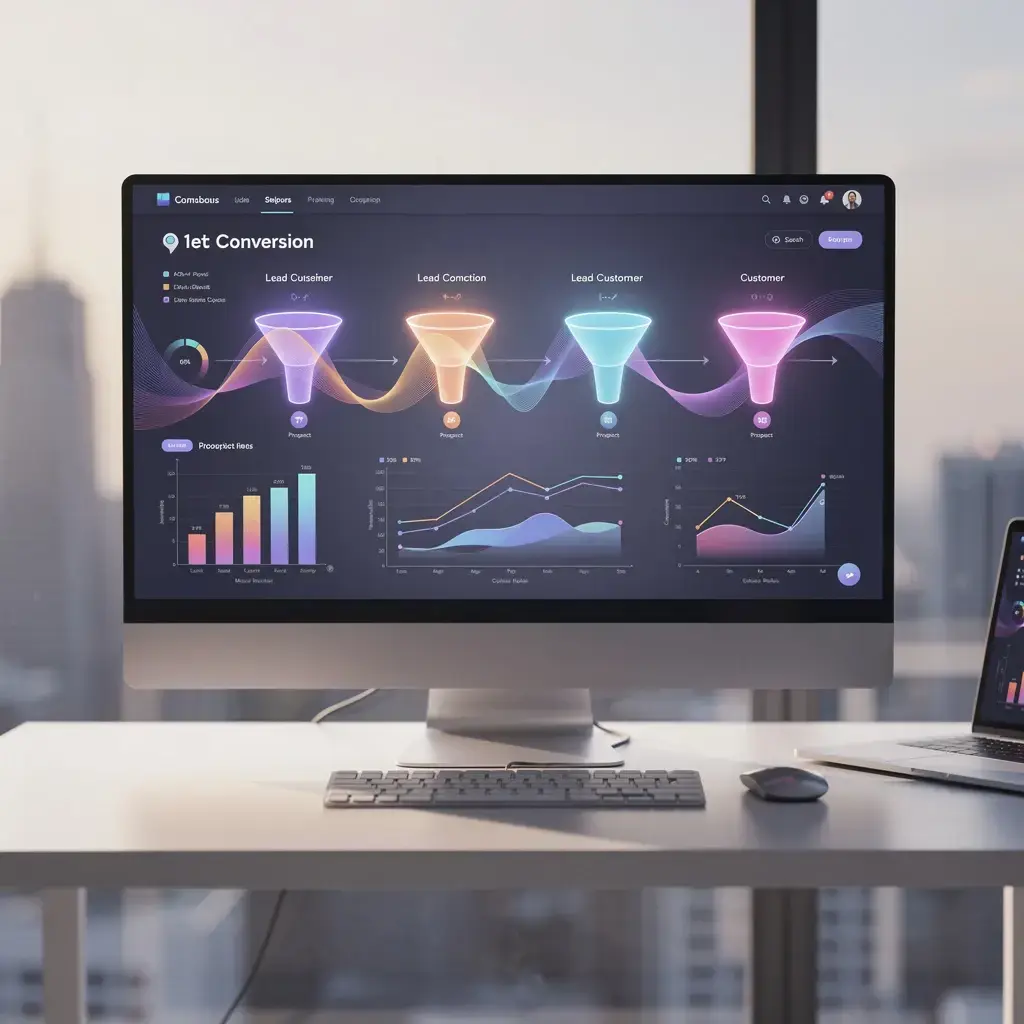
3. Pipeline Stages and Conversion Benchmarks
Define each stage in your pipeline with a clear entry criterion and an exit action. Track the conversion rate between every stage. If your demo-to-proposal rate is 60% but your industry benchmark is 40%, you’re doing well — and now you know where to invest. Build your pipeline from goal backward: if you need 10 closes per month and your close rate is 25%, you need 40 proposals, which means you need enough demos feeding that stage.
For a deeper dive on building your pipeline stages from scratch, see our complete guide to building and managing a B2B sales pipeline.
4. Outreach Channels and Sequences
Your plan should specify which channels you’ll use (email, LinkedIn, phone, video) and in what order. RAIN Group research shows it takes an average of 8 touchpoints to get a meaningful response from a cold B2B prospect. A well-designed multi-channel sequence ensures no prospect falls through the cracks after just one or two attempts.
5. Tools and Tech Stack
Document the tools your team will use for each stage: prospecting (Clay, ZoomInfo), outreach (Outreach, Apollo, SalesLoft), CRM (HubSpot or Salesforce), and video outreach (Sendspark). Specifying tooling in the plan prevents reps from inventing their own workflows and ensures consistent data entry into your CRM.
Quick Reference: Sales Plan Components
| Component | What It Defines | Who Owns It | Review Frequency |
|---|---|---|---|
| ICP & Target Accounts | Who you sell to and why they buy | Sales + Marketing leadership | Quarterly |
| Revenue Goals & Quota | What each rep and team must close | Sales management + RevOps | Quarterly / Annual |
| Pipeline Stages | Entry/exit criteria at each funnel stage | Sales management | Quarterly |
| Outreach Sequences | Channel, message, timing, and touchpoint count | Sales + Enablement | Monthly or by campaign |
| Tech Stack | Tools for each stage and integration requirements | Sales Ops / RevOps | Annually (or on tooling change) |
| KPIs and Metrics | Leading and lagging indicators per role | Sales management + RevOps | Weekly (tracked), Quarterly (reviewed) |
Record One Video. AI Personalizes Thousands.
Sendspark is the AI video personalization platform for B2B sales. Record once, and AI voice cloning generates thousands of individually personalized videos with dynamic backgrounds and personalized thumbnails — each prospect hears their name, sees their website, in your voice. Sales teams see 2-3x more replies.
Get Started NowHow to Build Your Sales Plan Step by Step
Building a sales plan takes about two to three hours the first time and 30-60 minutes each quarter after that. Start by locking your ICP, then work backward from your revenue goal to determine the activity volume required, and finally map the sequences and tools that will generate that volume. Six steps — in this order — will get you a complete, actionable plan.
Step 1: Define Your ICP and Segments
Pull your last 12 months of closed-won deals and look for patterns: company size, industry, tech stack, and the titles of the people who championed the deal. That data is your ICP baseline. If you’re earlier-stage and don’t have enough history, start with your ideal hypothesis and validate it with your first 30-50 prospecting conversations.
Segment your ICP into 2-3 tiers. Tier 1 is your perfect-fit account — allocate 60-70% of prospecting effort here. Tier 2 is adjacent fit — worth pursuing but with less prioritization. Tier 3 is experimental — low allocation, high learning.
Step 2: Set Goals Using Both Methods
Top-down: work from the company’s annual revenue target, allocate a percentage to new business vs. expansion, then split that across your team. Bottom-up: estimate each rep’s realistic capacity (contacts worked per week × response rate × conversion rates through each stage) and see what that produces in aggregate. If the two numbers are more than 20-30% apart, something in your model is wrong — either your ramp assumptions, your conversion benchmarks, or your headcount plan.
Step 3: Map Your Pipeline Stages
List every stage from “new prospect identified” to “closed-won,” define what a rep must do to advance an opportunity to the next stage (not just what the prospect does), and assign a win probability to each stage. That win probability is what drives accurate forecasting.
Step 4: Design Your Outreach Sequences
For each ICP segment and product use case, build a sequence that spans at least 8-12 touchpoints over 3-4 weeks. Mix email, LinkedIn, phone, and video. Your email cadence is the backbone — layer in other channels around it. Personalize the first touchpoint in every sequence; templated mass messaging kills response rates.
Video is the highest-performing channel in the first 1-3 touches of a cold sequence. A personalized video in your opening email consistently generates 2x the reply rate of a text-only equivalent — we’ll cover exactly how to build this into your plan in the AI video section below.
Step 5: Assign Tools and Responsibilities
For each stage in your plan, document: which tool the rep uses, what data gets logged to CRM, and who reviews it. Gaps in tooling documentation lead to inconsistent CRM hygiene and broken pipeline visibility. Check out our list of best B2B prospecting tools if you’re evaluating options for the top of funnel.
Step 6: Set a Review Cadence
Build three review loops into your plan: weekly (manager reviews rep metrics and pipeline), monthly (team reviews conversion rates and messaging), and quarterly (leadership reviews ICP, quota model, and strategic goals). Without scheduled reviews, even a great plan goes stale by week six.
Sales KPIs and Metrics to Track
Every sales plan needs both leading indicators — the activities that drive revenue — and lagging indicators — the results those activities produce. Leading indicators tell you what’s coming; lagging indicators confirm what happened. Teams that only track closed revenue can’t course-correct until it’s too late. Build both into your plan from day one.
Leading vs. Lagging Indicators
Leading indicators include: dials and connects per rep per day, new prospects added to sequences per week, meetings booked per outreach sequence, and demos scheduled. Lagging indicators include: closed-won revenue, average deal size, win rate, and sales cycle length. HubSpot research consistently shows that teams tracking both types of metrics — not just revenue — identify performance problems 4-6 weeks earlier than teams tracking revenue alone.
KPIs by Funnel Stage
| Funnel Stage | Key Metric | Target Benchmark (B2B SaaS) | Who Tracks It |
|---|---|---|---|
| Prospecting | New prospects added per week | 50-100 per SDR | SDR / Manager |
| Outreach | Email open rate | 35-50% | SDR / Enablement |
| Outreach | Reply rate | 5-15% (cold email) | SDR / Manager |
| Meeting Booked | Meeting-to-show rate | 70-80% | SDR / AE |
| Discovery / Demo | Demo-to-proposal rate | 40-60% | AE / Manager |
| Proposal / Negotiation | Proposal-to-close rate | 25-40% | AE / Manager |
| Closed-Won | Average deal size & sales cycle | Varies by segment | Manager / RevOps |
For a deeper breakdown of which metrics matter most at each role level, see our guide on sales metrics to track in B2B.
How to Add AI Video Personalization to Your Outreach Strategy
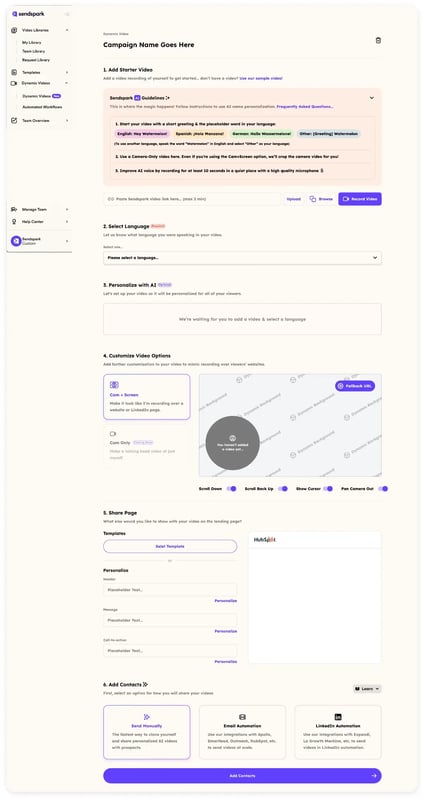
AI-personalized video outreach is now one of the highest-ROI tactics you can add to a B2B sales plan. The core approach: record one video, and AI voice cloning automatically generates individually personalized versions for every prospect — each one addresses the recipient by name, shows their company website as the dynamic background, and speaks in your cloned voice. This gives you the reply-rate lift of 1:1 personalization at the scale of a mass email campaign.
Why Video Outperforms Text in Cold Outreach
According to Harvard Business Review research on digital sales engagement, buyers are increasingly tuning out text-based outreach and responding to formats that feel genuinely personal. A personalized video thumbnail in an email subject line stands out visually in an overcrowded inbox before the prospect even opens the message.
Sendspark customers consistently see email response rates improve by 200-300% when they replace text cold emails with AI-personalized video outreach. Click-through rates improve by 50% and meetings booked increase 40-50% in active campaigns.
How to Build AI Video Into Your Sales Plan
Here’s where video fits into each stage of a typical B2B outreach sequence:
- Touch 1 (Cold outreach): Send an AI-personalized video email. Record your template video once; Sendspark’s AI intro feature clones your voice and generates a custom opening for each prospect — “Hi Sarah, noticed you just raised your Series B…” — with their company website as the background.
- Touch 3 (Follow-up): Reference the video and add a new angle. “Wanted to make sure you saw the video — happy to show you how [Competitor Customer] used this for their team.”
- Touch 5 (Value add): Send a personalized demo snippet or a case study video. Mid-funnel video is where deal progression benefits most.
- Touch 7+ (Break-up): A short, direct video: “This is my last reach-out. Here’s exactly what we’d build for [Company].” This is remarkably effective at re-engaging cold leads.
For sales prospecting teams running high-volume sequences, Sendspark integrates natively with HubSpot, Outreach, Apollo, and SalesLoft — so video engagement data (opens, plays, watch time, CTA clicks) flows directly back into your CRM without manual logging.
Advanced strategy
Use Sendspark’s dynamic background feature to show each prospect’s own website behind you in the video. This is Level 4 personalization — it signals you’ve done your research, stops the scroll, and consistently outperforms generic video thumbnails. Build this into your Touch 1 sequence as standard practice for Tier 1 accounts.
Sales Plan + AI Video: Full Component Checklist
| Sales Plan Component | What to Include | AI Video Touchpoint |
|---|---|---|
| ICP Definition | Company size, industry, tech stack, buying team | Personalize video intro to ICP segment messaging |
| Revenue Goals | Annual target, quarterly breakdown, rep quota | Use video to accelerate pipeline velocity at mid-funnel |
| Pipeline Stages | Entry criteria, exit actions, win probability | Add video at Discovery and Proposal stages to reduce drop-off |
| Outreach Sequences | 8-12 touches, multi-channel, 3-4 weeks | Touch 1: AI-personalized cold video; Touch 5: demo/case study video |
| Tech Stack | CRM, sequencer, prospecting tool, video platform | Sendspark integrates with HubSpot, Outreach, Apollo, SalesLoft |
| KPIs | Dials, connects, demos, close rate | Track video opens, watch time, and CTA clicks per sequence |
Frequently Asked Questions
What is a sales plan template?
A sales plan template is a structured document that defines your target customers, revenue goals, pipeline stages, outreach sequences, key performance indicators, and tools — giving your team a repeatable framework for executing B2B sales. It differs from a sales strategy by focusing on specific activities and timelines rather than high-level positioning.
What should a sales plan include?
A complete sales plan should include your ICP and target account criteria, revenue and quota targets broken down by period and rep, defined pipeline stages with conversion benchmarks, multi-channel outreach sequences, your tools and CRM setup, leading and lagging KPIs, and a scheduled review cadence. Missing any of these creates gaps in execution that compound over time.
How often should you update your sales plan?
Review your sales plan quarterly at minimum. The ICP, messaging, and competitive landscape all shift throughout the year — a plan written in January is often materially wrong by April. Weekly reviews should focus on rep activity metrics; monthly reviews on sequence performance and conversion rates; quarterly reviews on strategic goals and quota models.
How do you set realistic sales targets in a plan?
Use both a top-down method (start from the company revenue goal and allocate by team and rep) and a bottom-up method (model rep capacity times realistic conversion rates). If the two produce numbers more than 20-30% apart, revisit your conversion benchmarks or headcount assumptions. Build in a buffer — most quota models assume 80-90% quota attainment across the team, not 100%.
What is the difference between a sales plan and a sales strategy?
A sales strategy defines the “why” and “what” — which markets to target, how to position against competitors, which customer segments to prioritize. A sales plan defines the “how” and “when” — specific activities, sequences, tools, and metrics that execute the strategy. Both are necessary; most teams have a strategy but skip the plan, which is why execution is inconsistent.
How do I incorporate video outreach into my sales plan template?
Add AI-personalized video as a defined channel in your outreach sequences. Assign it to Touch 1 for cold outreach (highest ROI position) and Touch 5 for deal progression. Use a platform like Sendspark to record one template video and let AI voice cloning generate personalized versions for each prospect at scale — this eliminates the time barrier that prevents reps from using video consistently.
What is a realistic reply rate for B2B cold outreach?
For text-only cold email, a 5-10% reply rate is typical in B2B. For AI-personalized video outreach, Sendspark customers consistently see 2-3x higher reply rates. The exact number varies by ICP, sequence quality, and timing — but personalized video in Touch 1 of a sequence is the single highest-leverage change most sales plans can make to improve top-of-funnel conversion.
Sources & References
- Salesforce State of Sales Report — “High-performing sales teams are more likely to use a documented sales process than average or low performers” (2024)
- RAIN Group Sales Statistics — “It takes an average of 8 touchpoints to get a meaningful response from a cold B2B prospect” (2024)
- HubSpot Marketing & Sales Statistics — “Teams tracking both leading and lagging indicators identify performance problems earlier than those tracking revenue alone” (2024)
- Harvard Business Review — Sales — Research on digital sales engagement and buyer response to personalized formats
Record One Video. AI Personalizes Thousands.
Sendspark is the AI video personalization platform for B2B sales. Record once, and AI voice cloning generates thousands of individually personalized videos with dynamic backgrounds and personalized thumbnails — each prospect hears their name, sees their website, in your voice. Sales teams see 2-3x more replies.
Get Started NowTopics: Harvard Business Review, Harvard Business Review — Sales