
Only about 24% of B2B sales reps hit quota in any given quarter, according to the Salesforce State of Sales report. The gap between teams that consistently hit their number and those that don’t usually comes down to one thing: knowing which sales metrics to track, and acting on them before it’s too late to course-correct. For teams evaluating tools, see our breakdown of the best sales analytics software.
Check out our guide on common sales objections to learn more.
Key Takeaways
- Tracking the right 20 metrics across pipeline, activity, revenue, and engagement gives you a complete view of sales health — without drowning in data.
- Pipeline coverage ratio (target: 3x your quota) and win rate (B2B SaaS average: 20-25%) are the two metrics most directly tied to hitting quota.
- Activity metrics like email reply rate and video engagement rate are leading indicators — they predict revenue outcomes 30-90 days out.
- Sales teams using personalized video outreach see 2-3x higher reply rates compared to text-only email, making video engagement metrics worth tracking.
- A weekly dashboard review with reps and a monthly pipeline review with leadership closes the gap between what your data shows and what action your team takes.
What Are Sales Metrics and Why Do They Matter?
Sales metrics are quantifiable data points that measure how well your sales team is performing across every stage of the funnel. They include pipeline health indicators like win rate and deal size, activity counts like calls made and emails sent, revenue measures like quota attainment, and engagement signals like video watch rate and email click-through. Tracked together, they give sales managers a complete picture of what’s working and what needs fixing — before a bad quarter becomes official. For a broader view of how sales and marketing metrics connect, see our guide to how revenue operations teams track pipeline. For more context, see B2B marketing KPIs that complement these sales metrics.
The problem most B2B sales teams face isn’t a lack of data. It’s too much data and no clear framework for which numbers actually matter. Tracking every available CRM field leads to metric paralysis — your team spends time reporting instead of selling. The goal is to identify a focused set of metrics that signal pipeline health early, measure individual rep performance fairly, and connect outreach activity to revenue outcomes. For a full breakdown of how stages map to deal length and acceleration tactics, see our guide to the average B2B sales cycle and how to measure it.
Sales metrics fall into four categories. Pipeline metrics tell you how healthy your funnel is right now. Activity metrics measure what reps are doing daily to generate that pipeline. Revenue metrics track whether all that activity translates to money. Engagement metrics show how prospects are responding to your outreach — email, video, calls, and demos.
The 20 Sales Metrics to Track
The 20 metrics below cover all four categories of sales performance. Together they create a complete picture of your pipeline, your team’s daily output, your revenue trajectory, and how well your outreach is landing with prospects. Track these consistently and you’ll spot problems weeks before they show up in your revenue numbers.
Pipeline Metrics
Pipeline metrics measure the health and quality of your active opportunities. They answer the question: do we have enough in the funnel to hit our number?
1. Win Rate
Win rate is the percentage of deals you close from all opportunities entered into your pipeline. Calculate it as: closed-won deals ÷ total opportunities × 100. According to the Salesforce State of Sales report, the average B2B win rate sits between 20-25%. If yours is significantly lower, the problem is usually lead quality, late-stage objection handling, or competitive positioning.
2. Average Deal Size
Average deal size tracks the mean contract value of your closed-won deals. Calculate it as: total closed revenue ÷ number of closed deals. Segment this by rep, territory, and product to find which deal types your team closes most efficiently. Rising average deal size over time usually signals better ICP targeting.
3. Sales Cycle Length
Sales cycle length is the number of days from first touch to closed-won. Average cycles vary by segment — 30-45 days for SMB, 60-90 days for mid-market, and 3-6 months for enterprise. Track this per deal stage to identify which stage is stalling most often. A deal stuck in “proposal sent” for 3 weeks needs a different intervention than one stuck in “negotiation.”
4. Pipeline Coverage Ratio
Pipeline coverage ratio compares your total open pipeline value to your quota. Calculate it as: total pipeline value ÷ quota. A 3:1 ratio (three dollars of pipeline for every one dollar of quota) is the standard B2B benchmark, because not every deal closes. If your ratio drops below 2.5:1 mid-quarter, you have a prospecting problem that needs immediate attention.
5. Deals Created Per Week
Deals created measures how many new opportunities your team adds to the pipeline each week. This is the earliest leading indicator in your funnel — it predicts revenue 60-90 days out. If deals created drops for two consecutive weeks, your pipeline will show the gap at close time. Track this per rep and as a team total.
Record One Video. AI Personalizes Thousands.
Sendspark is the AI video personalization platform for B2B sales. Record once, and AI voice cloning generates thousands of individually personalized videos with dynamic backgrounds and personalized thumbnails — each prospect hears their name, sees their website, in your voice. Sales teams see 2-3x more replies.
Get Started NowSales Activity Metrics
Activity metrics measure what your reps are actually doing each day. They’re the inputs that drive pipeline — and the only metrics you can directly control.
6. Outreach Volume
Outreach volume counts the total number of calls, emails, and LinkedIn messages your team sends per week. According to HubSpot research, it takes an average of 8-12 touchpoints to book a meeting with a cold B2B prospect. Track outreach volume per rep to identify who’s under-activating and who may be burning their territory with spray-and-pray volume.
7. Email Reply Rate
Email reply rate measures what percentage of your cold outreach emails receive a response — any response, positive or negative. A reply rate of 5-10% is considered strong for cold email. Below 3% usually signals a problem with your subject line, opening line, or targeting. Use reply rate as a feedback loop to test messaging variations.
8. Video Reply Rate
Video reply rate tracks what percentage of prospects respond after receiving a personalized video message. Teams using personalized video outreach see reply rates 2-3x higher than text-only emails. Track this separately from email reply rate — video messages perform differently, especially when you show the prospect’s own website in the video background using AI personalized intros.
9. Meetings Booked Rate
Meetings booked rate measures what percentage of your outreach sequences result in a booked meeting. Calculate it as: meetings booked ÷ total prospects contacted × 100. A rate above 3% is strong for cold outbound. Track this per rep and per sequence to find which outreach approaches book the most meetings per effort invested. See our outbound sales strategy guide for proven sequence structures.
10. Follow-Up Rate
Follow-up rate measures the percentage of initial outreach attempts that your reps actually follow up on. This is frequently the most impactful activity metric to improve — most reps stop after 1-2 touches, but most deals close after 5-7. A CRM sequence tool enforces follow-up cadence automatically. Track follow-up rate to catch reps who are giving up too early.
Pro tip
Add video as a touchpoint in your follow-up sequence. A 60-second personalized video at touch 3 or 4 interrupts the pattern of text emails and gives a prospect a reason to respond when earlier messages didn’t land.
Revenue Metrics
Revenue metrics measure whether all the pipeline and activity translates into actual closed business. These are the lagging indicators — they confirm what leading metrics predicted weeks or months earlier.
11. Quota Attainment
Quota attainment is the percentage of reps who hit or exceed their assigned quota in a given period. The Salesforce State of Sales report consistently finds that only about half of B2B sales reps hit quota in any given quarter. Track this by rep, team, and region. Widespread quota misses signal a systems or market problem; isolated misses point to individual coaching needs.
12. Revenue Per Rep
Revenue per rep (also called revenue per head) divides total closed revenue by the number of quota-carrying reps on your team. This gives you a normalized view of productivity across team sizes and segments. Use it to model capacity — if each rep generates $400K annually and you want to add $2M in revenue, you need roughly 5 more reps (accounting for ramp time).
13. Customer Acquisition Cost (CAC)
CAC is the total sales and marketing spend divided by the number of new customers acquired in the same period. For B2B SaaS, a CAC payback period under 18 months is considered healthy. Track CAC separately by channel (outbound vs inbound vs partner) to see which acquisition paths are most efficient at your current scale.
14. Average Contract Value (ACV)
ACV measures the annual value of a contract, normalized across different contract lengths. It’s particularly important for teams selling both monthly and annual deals. Rising ACV usually indicates that your ICP is shifting upmarket, or that your team is getting better at selling expanded packages. Declining ACV can signal discount pressure or a drift toward smaller accounts.
15. Expansion Revenue
Expansion revenue tracks revenue generated from existing customers through upsells, cross-sells, and seat additions. For most B2B SaaS companies, 30-40% of total revenue growth comes from the existing customer base. Track it as expansion MRR and as net revenue retention (NRR). NRR above 110% means your existing customers are growing faster than they churn.
Tracking MRR, churn, and net revenue retention manually in spreadsheets breaks down as you scale. Baremetrics connects directly to Stripe, Braintree, and Recurly to surface subscription analytics — MRR trends, churn segmentation, cancellation insights, and financial forecasting — from a single dashboard, without building custom reports.
Engagement Metrics
Engagement metrics show how prospects are interacting with your outreach before they respond — open rates, click rates, video watch rates, and demo acceptance rates. These are often the most overlooked category of sales metrics, but they’re among the most valuable leading indicators.
16. Email Open Rate
Email open rate measures the percentage of prospects who open your outreach emails. According to HubSpot sales data, the average cold email open rate for B2B outreach is 20-30%. Open rate is primarily a function of your subject line and send timing. If your open rate is strong but reply rate is low, the problem is your email body, not your targeting.
17. Video Watch Rate
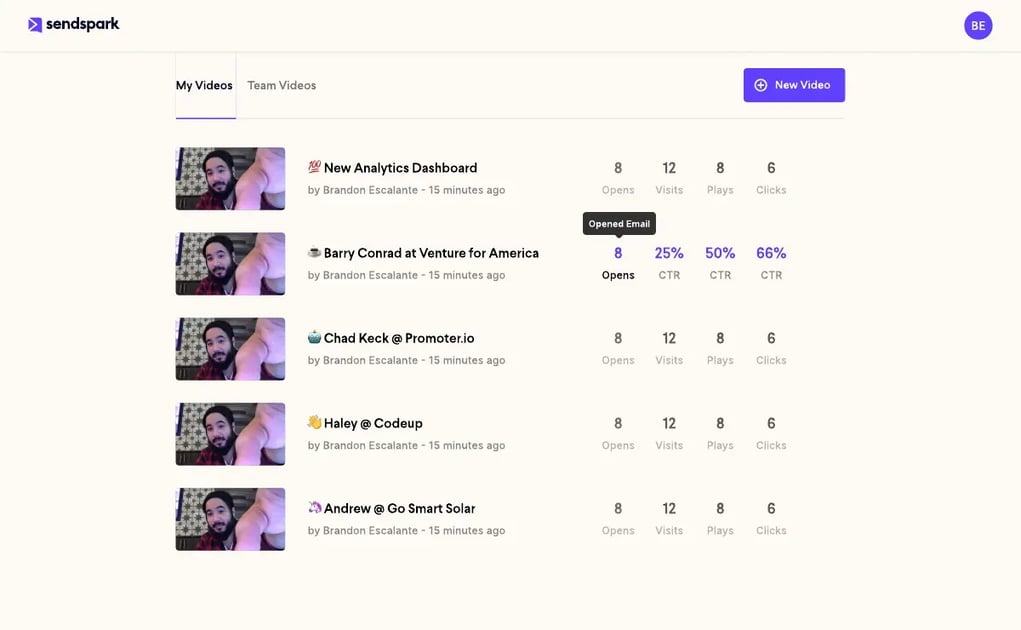
Video watch rate measures the percentage of prospects who watch at least 50% of your video message after clicking play. High watch rate (above 60%) signals strong initial interest. Use the Sendspark video analytics dashboard to see per-recipient watch time, replay counts, and CTA clicks. A prospect who watches your video three times and clicks your CTA link is a strong buying signal worth acting on immediately.
18. Link Click-Through Rate (CTR)
CTR measures what percentage of prospects click the link in your outreach email or video message. A CTR above 5% for cold outreach indicates strong offer relevance. Include one clear CTA per message — multiple links split click data and reduce the effectiveness of any single call to action. Track CTR by CTA type (demo booking, content download, reply CTA) to learn which prompts prospects respond to most.
19. Meeting Acceptance Rate
Meeting acceptance rate measures what percentage of meeting invitations a prospect accepts after an initial positive response. If prospects reply positively but then ghost your calendar link, the problem is usually friction in the scheduling process (too many steps, wrong time slots) or cooling intent between reply and booking. Tools that let prospects book directly from a video message reduce this drop-off.
20. Demo-to-Close Rate
Demo-to-close rate tracks what percentage of demos convert to a closed-won deal. Average for B2B SaaS is 20-30%, per Gartner sales performance research. A low demo-to-close rate usually indicates qualification problems (you’re demoing the wrong prospects), a product-market fit gap, or a weak follow-up process after the demo. This is where many teams benefit from sending a personalized follow-up video that recaps the demo highlights for the full buying committee.
Common mistake
Tracking email open rate while ignoring video watch rate is a blind spot. Email opens only tell you someone saw your subject line. Video watch time tells you they were engaged enough to spend 60-90 seconds with your message — a far stronger buying signal.
Sales Metrics Benchmarks: What Good Looks Like
Sales metric benchmarks vary by company size, segment, and average contract value. Use this table as a starting reference point for B2B sales teams — then calibrate to your own historical data over 6-12 months to set internal benchmarks that reflect your market and product.
| Metric | SMB Target | Mid-Market Target | Enterprise Target |
|---|---|---|---|
| Win Rate | 25-35% | 20-30% | 15-25% |
| Pipeline Coverage Ratio | 3:1 | 3:1 to 4:1 | 4:1 to 5:1 |
| Sales Cycle Length | 30-45 days | 60-90 days | 3-6 months |
| Quota Attainment (% of reps) | 55-65% | 50-60% | 45-55% |
| Email Reply Rate | 5-10% | 4-8% | 3-6% |
| Video Watch Rate | 55-70% | 55-70% | 55-70% |
| Demo-to-Close Rate | 25-35% | 20-30% | 15-20% |
| Net Revenue Retention (NRR) | >100% | >105% | >110% |
“Benchmarks give you direction, but your internal trend line is more important. A team improving from 15% win rate to 22% over two quarters is healthier than one stuck at 25% with no upward movement.”
For a deeper look at individual rep-level performance metrics and how to use them in coaching conversations, see our guide to sales rep productivity metrics. For the broader enablement program metrics that support rep performance, see our breakdown of sales enablement KPIs.
How to Build a Sales Metrics Dashboard
A sales metrics dashboard works when it shows the right metrics at the right frequency to the right people. Most CRM-generated dashboards fail because they show everything equally — pipeline metrics next to activity counts next to revenue breakdowns — with no distinction between what needs daily attention and what belongs in a monthly review.
Choose Your Reporting Tool
Your existing CRM is usually the right place to start. HubSpot’s reporting tools include pre-built sales dashboards that cover pipeline, activity, and deal velocity metrics out of the box. Salesforce offers more customization through report builder and Einstein Analytics. If your team is smaller or less technical, a well-structured spreadsheet pulling from your CRM exports works fine as a starting point — the discipline of pulling the data weekly matters more than the tool.
Set Your Review Cadence
Different metrics need different review frequencies. Use this framework:
- Daily (rep-level): Outreach volume, follow-up tasks, new conversations opened
- Weekly (team-level): Meetings booked, deals created, reply rates, pipeline coverage ratio
- Monthly (management-level): Win rate, average deal size, sales cycle length, quota attainment by rep
- Quarterly (executive-level): Revenue per rep, CAC, ACV, NRR, expansion revenue
Use Metrics in Coaching Conversations
Metrics only create change when they connect to specific behaviors. In weekly 1-on-1s with reps, use a three-step approach: share the metric, identify the root cause, agree on one behavioral change. “Your email reply rate dropped from 8% to 4% this week — let’s look at your last 10 subject lines and pick the strongest pattern to use this week” is far more productive than “you need to improve your reply rate.”
For outbound teams, pair activity metrics with engagement metrics in every coaching session. A rep with high outreach volume but low video watch rate isn’t sending the right messages to the right people. A rep with low outreach volume but high reply rate needs support building more pipeline, not messaging coaching. The combination tells the full story that neither metric tells alone.
Frequently Asked Questions
What are the most important sales metrics to track?
The most important sales metrics to track are pipeline coverage ratio, win rate, quota attainment, email reply rate, and meetings booked rate. These five metrics span all four categories (pipeline, activity, revenue, engagement) and give you an early warning system for revenue problems. If all five are healthy, your team is on track. If any one drops, you know exactly which part of the process to fix.
How many sales metrics should a team track?
Most B2B sales teams should track 15-20 metrics total, split across pipeline, activity, revenue, and engagement categories. More than 20 metrics creates reporting overhead without proportional insight. The key is choosing metrics that reflect the controllable inputs (activity, outreach quality) alongside the revenue outputs (win rate, quota attainment) — not just the end number.
What is a good win rate for B2B sales?
A good B2B win rate is 20-25% for most segments, according to the Salesforce State of Sales report. SMB-focused teams often see win rates of 25-35% due to shorter sales cycles and less competition. Enterprise teams typically land at 15-25% due to longer evaluations and larger buying committees. Win rates below 15% almost always indicate a qualification or competitive positioning problem.
What sales metrics to track in HubSpot?
In HubSpot, the most useful sales metrics to track are deals created, pipeline value, close rate by deal stage, email open and reply rates, and meetings booked. HubSpot’s built-in Sales Analytics reports cover most of these natively. Add a custom report for pipeline coverage ratio (total pipeline value divided by quota) if it’s not in your default dashboard. For video engagement metrics, connect Sendspark to HubSpot for per-recipient watch time and CTA click data.
What is pipeline coverage ratio and why does it matter?
Pipeline coverage ratio is the total value of open deals in your pipeline divided by your quota for the same period. A 3:1 ratio means you have three dollars of pipeline opportunity for every one dollar you need to close. It matters because win rates are never 100% — you need surplus pipeline to account for deals that slip, stall, or go dark. Below 2.5:1 mid-quarter, most sales managers accelerate prospecting activities immediately.
How do you track video engagement as a sales metric?
Track video engagement by measuring watch rate (percentage of the video watched), replay count, and CTA click rate per video recipient. Sendspark’s video analytics dashboard shows per-recipient engagement data that syncs to your HubSpot or Salesforce deal record. A prospect who watches 100% of your video and clicks your CTA link is showing strong buying intent and should be prioritized for immediate follow-up.
What is the difference between leading and lagging sales metrics?
Leading metrics measure inputs and activities that predict future revenue — outreach volume, email reply rate, meetings booked, and pipeline coverage ratio are leading metrics. Lagging metrics measure outcomes that have already occurred — quota attainment, closed revenue, and win rate are lagging metrics. Effective sales management requires both: leading metrics let you course-correct before revenue is impacted, while lagging metrics confirm whether your interventions worked.
Sources & References
- Salesforce State of Sales Report — “Average B2B win rate of 20-25% and quota attainment rates across sales organizations” (2024)
- HubSpot Sales Statistics — “It takes an average of 8-12 touchpoints to book a meeting with a cold B2B prospect; average cold email open rate of 20-30%” (2024)
- Gartner Sales Performance Research — “Demo-to-close rates of 20-30% for B2B SaaS organizations and sales performance management benchmarks” (2024)
Record One Video. AI Personalizes Thousands.
Sendspark is the AI video personalization platform for B2B sales. Record once, and AI voice cloning generates thousands of individually personalized videos with dynamic backgrounds and personalized thumbnails — each prospect hears their name, sees their website, in your voice. Sales teams see 2-3x more replies.
Get Started Now