Videos are reshaping how businesses drive revenue. Here’s why they matter:
- 41% Higher Close Rates: Adding video to proposals boosts deal success.
- 4x More Meetings: Personalized video outreach drives better results.
- 16 Hours Saved Weekly: Teams using agentic AI tools report saving 16 hours a week.
From personalized outreach to AI-generated demos, video is helping teams engage buyers, close deals faster, and improve productivity. With 93% of GTM leaders who use video reporting positive results, video isn’t optional - it’s essential for staying competitive.
What I Learned Tracking Sales From 1 BILLION Views
Implementing these video marketing strategies for sales can help teams replicate this success at scale.
sbb-itb-afd3f9e
Key Findings from the Benchmark Report
These insights demonstrate how video drives measurable engagement, boosts revenue, and improves efficiency across B2B organizations.
Higher Email Engagement with Personalized Video
Personalized video consistently outshines traditional text-based approaches. Emails featuring video thumbnails and tailored messages give recipients a clear reason to click. Even including the word “video” in a subject line increases open rates by 7-13%, according to Zippia data cited by HubSpot.
For example, a HubSpot sales representative saw a 4x increase in booked meetings by using personalized video outreach, prompting wider adoption across their team. Additionally, 70% of sales professionals confirm that custom-recorded videos outperform text-based emails in driving opens, clicks, and responses. These boosts in engagement pave the way for tangible revenue growth, as explored in the next section.
Revenue Growth from AI-Powered Video
Stronger engagement directly impacts revenue. Among GTM leaders who track video KPIs tied to revenue, 44% report improved conversion rates at key funnel stages, according to Vidyard. Adding video to proposals can improve close rates by up to 41%.
In fact, in Wyzowl’s 2024 survey, 87% of video marketers said video has directly increased sales.
Time Savings and Efficiency Improvements
Beyond engagement and revenue, video tools offer notable efficiency gains. Nearly 60% of sales professionals using custom-recorded video report improved productivity.
Video also helps keep deals moving. Pairing personalized video with authentic user-generated video content is a powerful combination that boosts social proof at every stage.
Tyler Lessard, Chief Video Strategist and VP Marketing at Vidyard, highlights the impact: “Not only is video helping sales reps meet their goals, but it’s increasing productivity and expanding their long-term performance potential”.
How Different Industries Use Video to Drive Revenue
Industries are increasingly using video as a powerful tool to drive revenue, adapting their strategies to fit their unique needs. From B2B SaaS to real estate and nonprofits, video has become a way to humanize digital communication and achieve measurable results. While approaches differ, personalization and authenticity remain essential to success.
In behavioral health specifically, measuring the impact of outreach and support programs is a funding requirement, not just a best practice. BeePurple provides the data infrastructure for this — a behavioral health data platform that captures peer support activity, aggregates recovery outcomes, and produces the evidence that recovery community organizations need to secure and sustain government and grant funding.
B2B SaaS and Technology Companies
Sales teams in tech now rely on video throughout the sales process - whether it’s for cold outreach, proposals, or onboarding. Automated video experiences, triggered by CRM or marketing tools, allow teams to send personalized messages at scale. A popular technique combines the presenter’s face with screen recordings, creating a more engaging and relatable experience.
Thomas Buchanan, an Enterprise Account Executive at Modus, shared how using custom videos at every stage of the sales process led to a 4x increase in close rates and shorter deal cycles. He explained, “By creating and sharing custom videos at each stage of the buying process, every stakeholder gets to see me, know me, and learn from me - whether or not I get the chance to meet them on a live call”.
Tech companies are also exploring AI-powered video solutions. For instance, ReviewThatPlace.com used AI avatars to send personalized video messages, achieving a staggering 760% boost in engagement for their sales proposals. Interactive elements like embedded lead forms are also gaining popularity. Videos in proposals have been shown to increase close rates by up to 41%. These methods are now inspiring strategies in other industries, such as marketing agencies.
Lead Generation and Cold Email Agencies
In the competitive world of lead generation, video has become a secret weapon for standing out in crowded inboxes. In Vidyard’s research, more than 70% of sales professionals said custom-recorded video has increased their response rates.
Agencies often use AI tools to personalize video intros and craft messages at scale. Tactics like animated GIF previews and clickable thumbnails with “play” buttons help grab attention and reduce inbox fatigue. Many agencies use video as part of a multi-touch strategy, combining email, LinkedIn, and phone calls. For example, a sequence might start with an explainer video emailed on Day 1, followed by a personalized LinkedIn video on Day 4, and a voicemail referencing the original video on Day 6. This layered approach helps maximize engagement and drive pipeline growth.
To keep viewers engaged, agencies typically keep videos under 60 seconds. Even small tweaks, like including the word “video” in subject lines, can increase email open rates by 7-13%.
Real Estate, Education, and Nonprofits
Outside of traditional B2B industries, sectors like real estate, education, and nonprofits are also seeing major benefits from video. Education companies, for instance, use video for student recruitment, donor outreach, and creating immersive experiences for prospective students.
Real estate professionals are leveraging video to build early connections with clients through personalized property tours, cold outreach, and social media content. Tools that notify agents when a buyer watches a video allow for timely follow-ups, capitalizing on peak interest.
Nonprofits use video to highlight social issues and foster donor loyalty. Whether it’s for high-stakes decisions like buying a home or making charitable contributions, video’s ability to build trust and emotional connection is invaluable.
Colleen Freedman, Director of Revenue Operations at ReviewTrackers, emphasized the value of video: “Using video to prospect has really helped our team focus on personalization, and has yielded amazing results”.
Across these industries, video doesn’t just inform - it drives deeper engagement and accelerates revenue growth.
How Sendspark Enables Scalable Personalized Video Outreach
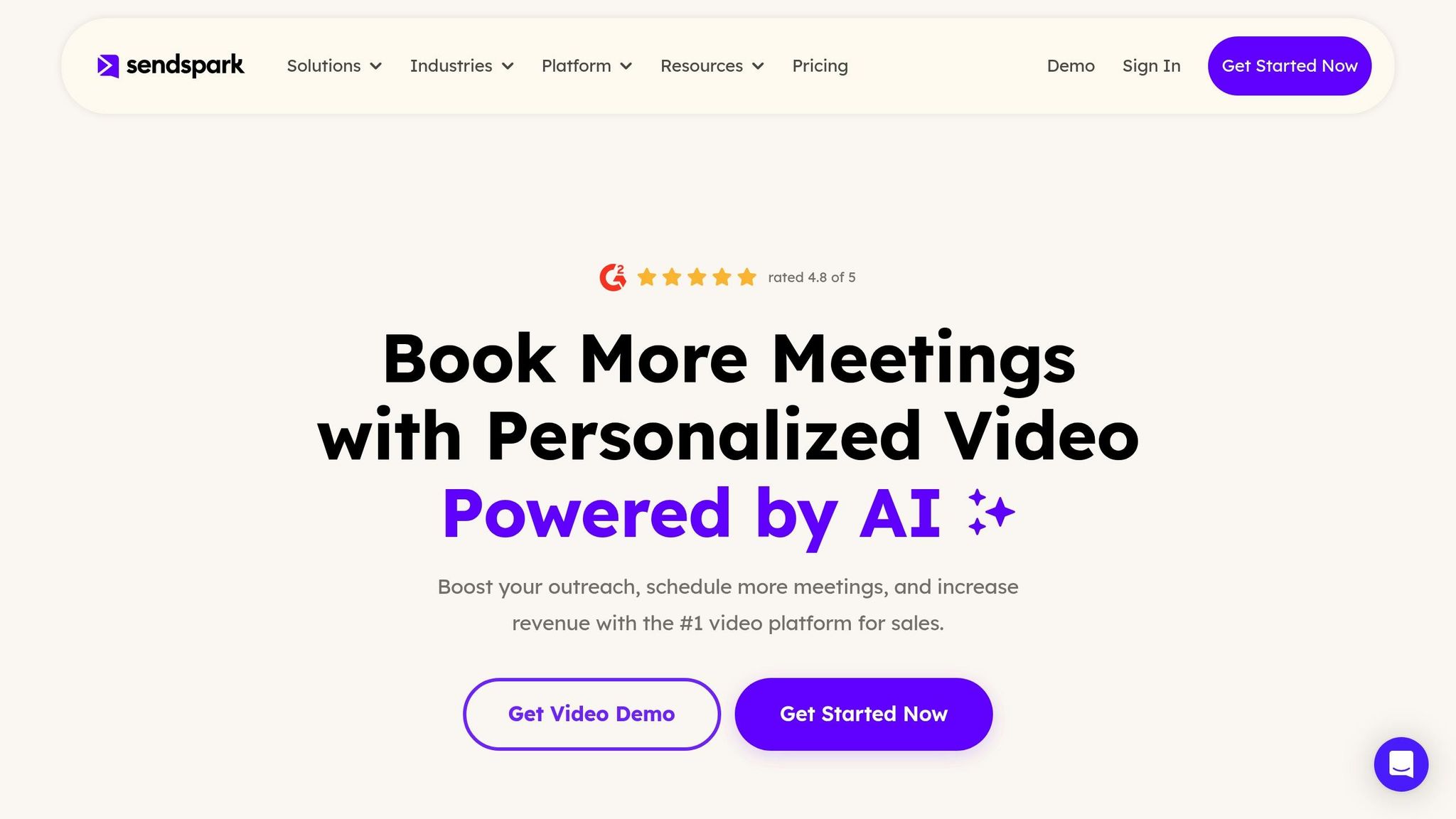
Sales teams know that personalization can make or break their outreach efforts. But here’s the catch: recording a unique video for every prospect just isn’t feasible when you’re working at scale. That’s where Sendspark steps in. Using AI technology, Sendspark allows teams to create one core video and personalize it for thousands of recipients. With features like voice cloning, the platform seamlessly inserts each recipient’s name into the recording. For example, placeholders like “Watermelon” are swapped out for the actual prospect’s name. On top of that, Sendspark adds a dynamic touch by overlaying visuals like a prospect’s website or LinkedIn profile behind the speaker - making the video feel tailored without requiring extra recording time.
AI-Powered Personalization at Scale
Sendspark makes it possible to deliver personalized, engaging videos to large audiences without losing that human touch. The platform’s AI script generator takes the guesswork out of crafting messages by creating tailored scripts for prospecting, follow-ups, or customer success - customized to fit specific products and communication styles. To ensure smooth delivery, Sendspark avoids embedding heavy video files, instead relying on animated thumbnail previews and CNAME whitelabeling, which bypass potential firewall issues. Sales teams can also track engagement in real time, seeing exactly who watched a video and for how long. This data allows for perfectly timed follow-ups, proving how effective personalized video outreach can be in driving revenue growth.
Integration with Sales Technology Stacks
Sendspark doesn’t just stop at personalization - it fits seamlessly into your existing sales tools. With integrations across more than 90 platforms, including CRMs like Salesforce and HubSpot and engagement tools like Outreach and SalesLoft, Sendspark ensures smooth data syncing and workflow automation. For instance, its integration with Clay maps enrichment data fields directly into video placeholders, auto-generating personalized videos for each contact. LinkedIn prospecting becomes easier with Expandi, while tools like SavvyCal or Calendly allow you to embed scheduling links directly on video landing pages. These integrations make personalized video an effortless part of your sales process, rather than an extra step.
Learn more about organizing your video library.
Measured Results and ROI
The results speak for themselves. SD Lab, led by Tom Slocum, saw its close rate jump from 25% to 50%, gained 70% more replies, and booked 40% more meetings after adopting Sendspark’s personalized video outreach. Brikl increased demo bookings by 46% with dynamic video campaigns. Hipersa reached a 50% email reply rate and saved 20 hours a week using Sendspark.
“Video changed the game for me in taking a complex idea and simplifying it. It’s all about being engaging and bringing your personality to the forefront”, said Tom Slocum, Leader at SD Lab.
With Sendspark’s detailed analytics, sales teams can continually refine their strategy. By analyzing viewer engagement, reps can focus on high-priority leads and tailor their follow-ups, turning video outreach into a powerful, measurable tool for driving revenue.
Future Trends: Video-Driven Revenue Growth in 2026 and Beyond
Video continues to revolutionize sales and marketing, and emerging tools like AI and advanced personalization are setting the stage for even greater revenue potential.
AI and Automation in Sales Outreach
AI is changing the game for sales teams, especially with tools that automate personalized video creation. These systems can now analyze buyer intent signals - like downloading a whitepaper or visiting a pricing page - and generate tailored videos automatically.
The impact is clear: Vidyard found that teams using both video and agentic AI are 76% more likely to have seen accelerated deal cycles. Even so, human oversight remains essential to ensure authenticity and maintain trust with buyers. The sweet spot lies in letting AI handle repetitive tasks, freeing up sales reps to focus on fostering real connections.
These automation advancements are paving the way for even smarter personalization strategies.
New Technologies in Video Personalization
Video personalization is evolving rapidly, thanks to new technologies. For example, predictive lead scoring helps prioritize which prospects receive customized video content. AI tools now enable dynamic features, like overlaying a prospect’s LinkedIn profile or website behind the presenter, making videos more engaging and relevant.
Interactive elements such as embedded lead generation forms are also gaining ground. Additionally, AI-powered dubbing and translation tools are making it easier to localize videos for global audiences with natural-sounding audio. Meanwhile, teams are using AI analytics to track engagement and fine-tune their video strategies.
Advantages for Early Adopters
Companies embracing these technologies early are already reaping big rewards. In 2024, ReviewThatPlace.com leveraged AI Avatars for personalized video outreach, leading to a staggering 760% increase in proposal engagement. HubSpot also saw success, with a video outreach pilot resulting in four times more booked meetings, prompting company-wide adoption.
The gap between early adopters and laggards is growing. With 86% of video ad buyers using or planning to use generative AI to build video ad creative, according to the IAB, those who act now will have the advantage of refined processes and tested strategies. Among GTM leaders using video, 93% report positive results, and 47% of those who track video’s revenue impact say hitting revenue targets has become easier.
Conclusion
The numbers speak for themselves: video is now a must-have for B2B sales and marketing teams, and companies that skip it are leaving serious revenue opportunities untapped. Proposals with video show 41% higher close rates, and HubSpot’s sales team booked four times more meetings with video outreach. These results highlight the importance of not just using video but measuring its impact effectively to stay ahead of the competition.
The data also shows that precise measurement is a game-changer. Nearly half (47%) of leaders who track video-specific revenue KPIs say they hit their targets more easily. Yet, 22% of teams still don’t measure video performance at all. This gap creates a massive opportunity for those who align video engagement metrics with pipeline influence and win rates, giving them a clear edge over competitors.
AI-powered personalization tools are taking these gains even further. Tools that allow teams to “create once, personalize for thousands” are making high-quality, scalable video production possible. Vidyard found that teams using agentic AI save 16 hours per week, while video keeps the human connection buyers look for in complex purchasing decisions.
The gap between early adopters and those waiting to jump in is growing fast. Early adopters have already seen significant engagement boosts, often within just a year of implementing AI-powered video strategies. The question isn’t whether to adopt video - it’s how quickly your team can make it part of your workflow and start optimizing its impact.
Video’s effectiveness is undeniable. Teams that integrate video across their sales funnel, measure its revenue outcomes, and use AI to scale personalization will position themselves as market leaders, while others risk falling behind.
FAQs
What revenue KPIs should we track for video?
Key revenue KPIs for video to keep an eye on include conversion rates, sales pipeline impact, deal velocity, and overall revenue contribution. Video content plays a powerful role in generating leads and establishing trust - both of which are critical for driving sales growth.
Where should video be used in the sales funnel first?
Video works best at the top of the sales funnel, during the awareness stage. It’s a great way to grab attention, introduce your brand, and highlight what makes you stand out. Research consistently shows that video is a strong driver of awareness and engagement, making it a key tool for starting the journey of turning prospects into customers.
How do we scale personalization without losing authenticity?
Scaling personalization without losing that genuine, human touch can be tricky, but it’s absolutely doable with the right AI tools. Features like voice cloning, dynamic backgrounds, and CRM integration make it possible to streamline customization while still keeping things personal. The key is to focus on meaningful details - like using the recipient’s name or referencing their specific interests - to ensure your messages feel relevant and sincere. By blending advanced AI capabilities with a solid understanding of your audience, you can expand your reach while building trust and encouraging deeper engagement.
Related Blog Posts
- 7 Ways Video Messages Improve Customer Response Rates
- How AI Video Personalization Helps Revenue Teams
- Top Tools for Personalizing Sales Videos in 2026
- AI Video in ABM: What Case Studies Show
Topics: blog