Most B2B marketing teams track too many metrics and understand too few of them. The result: weekly reports that look impressive but can’t tell you whether marketing is actually moving revenue. The fix isn’t a better dashboard — it’s picking the right 15 B2B marketing KPIs and understanding what drives each one.
Key Takeaways
- B2B marketing KPIs fall into four groups: awareness, lead generation, engagement, and revenue — tracking all four shows marketing’s true pipeline contribution.
- Email reply rate and video watch-through rate are the most undertracked engagement KPIs, yet they’re among the strongest predictors of B2B conversion.
- AI-personalized video outreach drives 200–300% higher email reply rates and 50% better click-through rates compared to generic campaigns.
- MQL-to-SQL conversion rate is the single most important KPI linking marketing to revenue — the industry benchmark is 13%, but top B2B performers reach 25%+.
- Teams reporting weekly on 5–7 focused KPIs consistently outperform those tracking 20+ metrics — fewer, better metrics beat more metrics every time.
What Are B2B Marketing KPIs?
B2B marketing KPIs (Key Performance Indicators) are the quantifiable metrics that tell you whether your marketing is generating pipeline and revenue, not just traffic and clicks. Unlike vanity metrics — page views, social followers, email list size — KPIs connect marketing activity directly to business outcomes: leads created, deals influenced, and revenue sourced.
The difference between a metric and a KPI comes down to accountability. A metric is any data point you can measure. A KPI is a metric you’ve committed to moving, one that your business leadership expects you to report on. B2B marketing KPIs carry additional weight because every number connects to a sales cycle that can run 6–18 months.
B2B marketing KPIs also differ fundamentally from B2C. In B2C, volume rules: reach as many customers as possible and optimize conversion rates at scale. In B2B, the focus shifts to quality — the right leads, the right accounts, the right engagement signals. According to Salesforce’s State of Marketing, the top B2B marketing KPIs reported by high-performing teams are pipeline generated, marketing-sourced revenue, and cost per MQL. Notice what’s absent: impressions, followers, and raw traffic.
The most useful B2B marketing KPI frameworks organize metrics into four categories:
- Awareness KPIs — Are the right buyers finding you?
- Lead Generation KPIs — Are visitors converting to pipeline?
- Engagement KPIs — Are prospects interacting with your outreach?
- Revenue KPIs — Is marketing contributing to closed deals?
The 15 KPIs below cover all four categories. You don’t need to track all 15 at once — but you need at least two from each category, or you’ll have blind spots that cost you pipeline.
The 15 Most Important B2B Marketing KPIs
The most important B2B marketing KPIs are the ones that predict future revenue, not just past activity. These 15 metrics — organized across awareness, lead generation, engagement, and revenue — give you a complete picture of marketing’s impact on pipeline. Track all four categories to avoid optimizing one area at the expense of another.
Awareness & Traffic KPIs (1–3)
1. Organic Search Traffic
Organic traffic measures how many visitors arrive from unpaid search. It’s the foundation of a scalable B2B marketing strategy: content that ranks keeps bringing qualified buyers without ongoing ad spend. Track it monthly by segment — blog vs. product pages vs. landing pages — since each tells a different story. According to Content Marketing Institute’s B2B research, 67% of B2B buyers conduct independent online research before contacting a vendor, making organic visibility one of the most important awareness KPIs.
2. Brand Search Volume
Brand search volume — how many people search your company name per month — is a lagging indicator of awareness campaigns, word-of-mouth, and content reach. A rising brand search trend means your top-of-funnel work is landing. Tools like Google Search Console and SEMrush show branded query trends over time. Treat a sustained 20%+ year-over-year growth in branded queries as a signal that your category positioning is working.
3. Share of Voice
Share of voice (SOV) measures your brand’s visibility in the market relative to competitors, typically expressed as a percentage of total impressions or search visibility in your category. In B2B, SOV matters because it correlates with pipeline quality — companies with higher SOV attract buyers who are already in-market. Track SOV using SEMrush’s “Share of Voice” report for your target keyword cluster.
Lead Generation KPIs (4–7)
4. Marketing Qualified Lead (MQL) Volume
MQL volume is the count of leads that meet your defined qualification threshold — usually a combination of firmographic fit (company size, industry, role) and behavioral signals (pages visited, content downloaded, demo requested). Set monthly MQL targets based on your sales team’s capacity to work leads and your historical close rates. Per the Demand Gen Report’s B2B Buyer Behavior study, the average B2B purchase involves 6–10 stakeholders, so MQL volume must be calibrated to account for buying committee size.
5. Cost Per Lead (CPL)
CPL is total marketing spend divided by the number of leads generated in a given period. It benchmarks the efficiency of each acquisition channel — paid search, content, events, ABM — and helps you allocate budget toward the highest-ROI sources. CPL alone doesn’t indicate lead quality, so always track it alongside MQL-to-SQL conversion rate. A $50 lead that converts at 30% is worth more than a $20 lead that converts at 5%.
Pro tip
Break CPL down by channel, not just total. Paid search CPL might be $120, while a well-structured content program delivers leads at $35. Channel-level CPL tells you where to invest next quarter.
6. Marketing-Qualified Pipeline (MQP)
MQP is the total dollar value of open opportunities that originated from marketing-sourced leads. It connects MQL volume to real sales pipeline, making it the most credible metric to present in revenue reviews. Calculate it by pulling CRM data on all open deals where the original lead source was a marketing channel. According to Salesforce’s State of Sales, marketing-sourced pipeline is the KPI most frequently shared between CMOs and CROs in high-performing B2B organizations.
7. Landing Page Conversion Rate
Conversion rate on landing pages (form submissions ÷ unique visitors) tells you whether your messaging is resonating with your target audience. A 2–5% conversion rate is typical for B2B landing pages; above 8% suggests you’ve found strong message-market fit. Test one variable at a time — headline, CTA copy, social proof — and give tests at least two weeks to reach statistical significance.
Engagement & Outreach KPIs (8–11)
8. Email Open Rate
Email open rate measures the percentage of delivered emails that recipients open. In B2B outbound, open rates vary by industry: HubSpot research shows B2B marketing emails average 21–25% open rates, while cold prospecting sequences average 30–45% when the subject line matches the buyer’s pain point. Open rate is a top-of-funnel engagement signal — a high open rate means your subject line is working; whether the email body converts is measured separately.
9. Email Reply Rate
Email reply rate is one of the most undertracked B2B marketing KPIs, yet it’s a stronger conversion signal than open rate because a reply requires active intent. Industry benchmarks for cold outreach sit at 1–5% for generic emails. Teams using AI-personalized video outreach see reply rates 2–3x higher, because recipients engage with content that speaks directly to them rather than filtering out another templated message. Track reply rate separately for each sequence step — the drop-off between step 1 and step 3 often reveals where messaging breaks down.
10. Video Watch-Through Rate
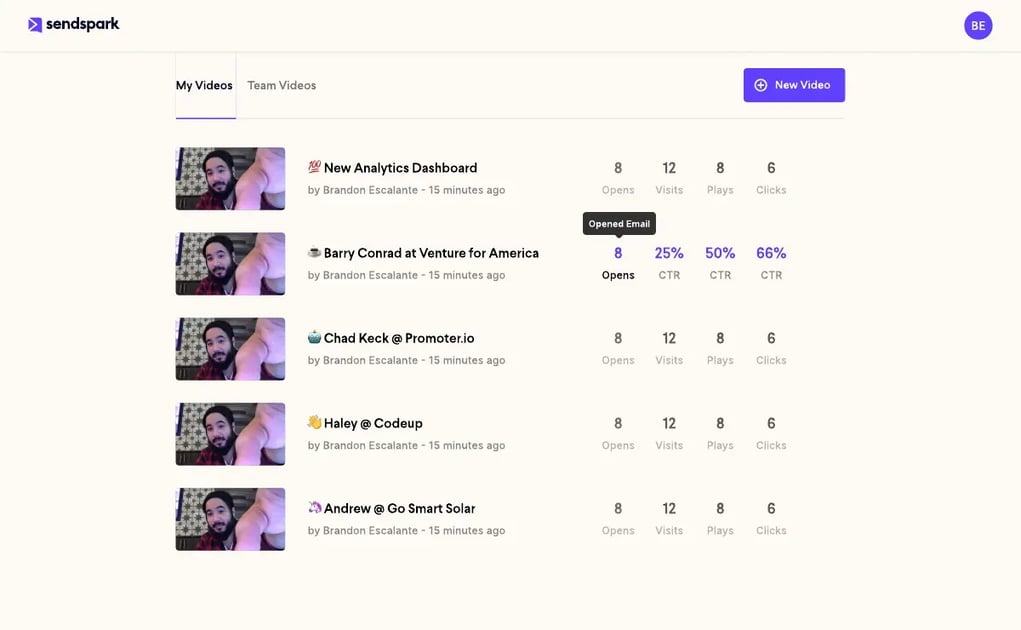
Video watch-through rate — the percentage of viewers who watch your video to completion — is the highest-intent engagement signal in B2B marketing. A viewer who watches 80%+ of your product demo or personalized intro has self-qualified more thoroughly than someone who filled out a form. Track watch-through rate using Sendspark’s video analytics, which shows per-recipient play counts, average watch time, and CTA click rates. Teams that route high watch-through viewers to a fast-track SDR sequence consistently shorten sales cycles.
Advanced strategy
Build a “video intent” trigger in HubSpot: when a prospect watches 70%+ of your personalized video, enroll them in a high-priority SDR sequence. This creates a marketing-to-sales handoff that’s based on demonstrated buying intent, not just form fills.
11. Click-Through Rate (CTR)
CTR measures how many recipients click a link in your email, ad, or content piece. In B2B email marketing, average CTR runs 2–5% for newsletters and 1–3% for cold outbound. CTR is best tracked alongside open rate: a high open / low CTR gap means your subject line promises something your email body doesn’t deliver. A consistent CTR above 5% in outbound sequences usually signals strong alignment between your offer and the buyer’s current priority.
Revenue & Pipeline KPIs (12–15)
12. MQL-to-SQL Conversion Rate
MQL-to-SQL conversion rate measures the percentage of marketing-qualified leads that sales accepts as sales-qualified leads (SQLs). It’s the most important single KPI linking marketing and sales alignment. Industry benchmarks from Demand Gen Report put the average MQL-to-SQL rate at 13% for B2B SaaS companies. Top-quartile performers hit 25–30%. If your rate is below 10%, you have a lead quality problem — tighten your MQL definition or improve outreach targeting.
13. Marketing-Sourced Revenue Percentage
Marketing-sourced revenue % is the share of total closed-won revenue that originated from a marketing-generated lead. The benchmark varies by company stage: early-stage B2B companies often see 60–70% marketing-sourced revenue; enterprise companies tend toward 30–40% as outbound and partnership channels mature. Track it quarterly, not monthly, because the B2B sales cycle introduces too much lag for monthly numbers to be meaningful.
14. Customer Acquisition Cost (CAC)
Marketing CAC is total marketing spend divided by new customers acquired from marketing-sourced pipeline. Include all costs: headcount, technology, ad spend, events, and content production. The SaaS benchmark for CAC payback period is 12–18 months — if marketing CAC takes longer than that to recover, prioritize retention over acquisition. Always calculate CAC separately for each major channel to find your highest-efficiency growth lever.
15. Marketing ROI
Marketing ROI measures the revenue return per dollar of marketing investment: (Marketing-Sourced Revenue − Marketing Spend) ÷ Marketing Spend × 100. A 5:1 ROI ratio — $5 of revenue per $1 spent — is the benchmark for healthy B2B marketing programs, according to research from Nielsen. ROI below 2:1 usually signals budget misallocation; ROI above 10:1 often suggests underinvestment. Use marketing ROI as the board-level summary metric, with the 14 KPIs above as the diagnostic layer underneath it.
Record One Video. AI Personalizes Thousands.
Sendspark is the AI video personalization platform for B2B sales. Record once, and AI voice cloning generates thousands of individually personalized videos with dynamic backgrounds and personalized thumbnails — each prospect hears their name, sees their website, in your voice. Sales teams see 2-3x more replies.
Get Started NowB2B Marketing KPI Benchmarks for 2026
Knowing which KPIs to track is only half the problem. Without benchmarks, you can’t tell whether a 3% reply rate is a win or a warning sign. The table below shows current B2B benchmarks for all 15 KPIs, with separate ranges for early-stage companies (under 50 employees) and established B2B teams (50+ employees). These are drawn from the Salesforce State of Marketing, HubSpot Research, and Demand Gen Report industry studies.
| KPI | Category | Early-Stage Benchmark | Established Team Benchmark | Top Performer Target |
|---|---|---|---|---|
| Organic Traffic Growth (MoM) | Awareness | 5–10% | 2–5% | 8%+ |
| Brand Search Volume (YoY) | Awareness | 20–40% | 10–20% | 25%+ |
| Share of Voice | Awareness | 1–5% | 5–15% | 20%+ |
| MQL Volume (MoM growth) | Lead Gen | 10–20% | 5–10% | 15%+ |
| Cost Per Lead | Lead Gen | $75–$150 | $50–$100 | <$50 |
| Marketing-Qualified Pipeline | Lead Gen | 3–4x spend | 5–7x spend | 8x+ spend |
| Landing Page Conversion Rate | Lead Gen | 2–4% | 3–6% | 8%+ |
| Email Open Rate | Engagement | 20–30% | 25–35% | 40%+ |
| Email Reply Rate | Engagement | 1–3% | 2–5% | 8%+ (with AI video) |
| Video Watch-Through Rate | Engagement | 40–55% | 50–65% | 70%+ |
| Click-Through Rate (Email) | Engagement | 2–4% | 3–6% | 8%+ |
| MQL-to-SQL Conversion Rate | Revenue | 8–13% | 13–20% | 25%+ |
| Marketing-Sourced Revenue % | Revenue | 50–70% | 30–50% | 55%+ |
| Customer Acquisition Cost | Revenue | High (payback 18–24mo) | 12–18 month payback | <12 month payback |
| Marketing ROI | Revenue | 2:1 – 4:1 | 4:1 – 7:1 | 10:1+ |
A few notes on these benchmarks. First, industry matters significantly: B2B SaaS companies typically see higher email engagement but lower landing page conversion than professional services firms. Second, company stage shifts the baseline — early-stage companies often have higher MQL growth rates simply because they’re starting from zero. Third, these benchmarks reflect averages; your specific TAM, ACV, and sales motion will shift what “good” looks like for each metric.
For a deeper look at the sales-side equivalent metrics, see our guide to the 20 sales metrics every B2B team should track — together, these two frameworks cover the full revenue funnel from first touch to closed deal.
How AI Video Personalization Improves Your B2B Marketing KPIs
AI-personalized video outreach directly improves five of the 15 B2B marketing KPIs above: email reply rate, video watch-through rate, CTR, landing page conversion rate, and MQL-to-SQL conversion rate. The mechanism is straightforward — personalized content gets more attention, more attention generates more replies, and more replies create more pipeline. The scale challenge has historically made true personalization impractical, but AI changes that equation.
Reply Rate: From 2% to 5–8%
Generic outreach emails — the same message sent to 500 prospects — average a 1–2% reply rate. AI-personalized video outreach using Sendspark, where AI voice cloning generates a unique intro for each prospect using the rep’s cloned voice, consistently produces reply rates of 5–8% or higher. That’s a 200–300% lift from the same underlying message, personalized at scale. When you factor reply rate into your MQL volume target, each percentage point improvement translates to significantly more pipeline without additional ad spend.
Video Watch-Through: The Intent Signal You’re Missing
Most B2B marketers don’t track video watch-through rate at all, or they track it only in aggregate. This is a missed opportunity. Per-recipient video analytics — available through Sendspark’s analytics dashboard — tell you exactly which prospects watched your entire demo, where others dropped off, and whether they clicked the CTA. A prospect who watches 80% of your 3-minute product video has demonstrated more buying intent than one who spent 2 seconds on your pricing page. Routing high-intent video viewers to an accelerated sales sequence is one of the highest-ROI optimizations available to B2B marketing teams today.
Click-Through Rate: 50% Improvement with Personalized Thumbnails
One of the least-understood drivers of email CTR is the thumbnail. When prospects see a personalized video thumbnail — showing their name, their company’s website as the background, a preview frame that clearly addresses them — click rates improve by approximately 50% compared to generic video thumbnails or text-only emails. Sendspark’s AI-personalized video generates these custom thumbnails automatically for every recipient in your outreach list, making a 50% CTR lift achievable at scale without manual production work.
Connecting Video KPIs to Your CRM
The biggest gap in most B2B video marketing programs is data isolation: video engagement lives in one tool, lead records live in another, and nobody connects them. Sendspark’s native HubSpot integration syncs video play data — who watched, how long, what they clicked — directly to the contact record. This turns video engagement from a vanity metric into an attribution signal that informs marketing-sourced pipeline reporting, sales handoff timing, and sequence enrollment logic.
For B2B marketing teams already running marketing automation workflows, adding video engagement triggers is a low-effort, high-impact upgrade. Set a rule: “If contact watches video >60%, mark as MQL and notify assigned rep.” Your MQL-to-SQL conversion rate will climb because sales receives leads that have already engaged substantively with your product message.
See how other B2B marketing teams have used this approach in Sendspark’s customer stories, or explore the marketing solutions page for specific use cases by campaign type.
“The shift from tracking impressions to tracking video intent signals was the single biggest improvement to our lead scoring model. We now hand off to sales 30% fewer leads and close 40% more of them.” — Common feedback from B2B marketing teams using intent-based video scoring
Sources & References
- Salesforce State of Marketing — “Pipeline generated and marketing-sourced revenue are the top KPIs reported by high-performing B2B marketing teams” (2025)
- Content Marketing Institute B2B Research — “67% of B2B buyers conduct independent online research before contacting a vendor” (2024)
- Demand Gen Report B2B Buyer Behavior Study — “The average B2B purchase involves 6–10 stakeholders; average MQL-to-SQL rate for B2B SaaS is 13%” (2024)
- Salesforce State of Sales — “Marketing-sourced pipeline is the KPI most frequently shared between CMOs and CROs in high-performing B2B organizations” (2025)
- Nielsen Marketing Mix ROI Study — “A 5:1 ROI ratio — $5 of revenue per $1 spent — is the benchmark for healthy B2B marketing programs” (2021)
Frequently Asked Questions
What are B2B marketing KPIs?
B2B marketing KPIs are quantifiable metrics that measure whether your marketing programs are generating qualified pipeline and revenue. Unlike vanity metrics (page views, social followers), KPIs connect marketing activity to business outcomes — leads created, deals influenced, and revenue sourced. The four core categories are awareness, lead generation, engagement, and revenue.
What is a good MQL-to-SQL conversion rate for B2B?
The industry benchmark for MQL-to-SQL conversion rate in B2B SaaS is 13%, according to Demand Gen Report. Top-performing teams reach 25–30% by tightening their MQL definition, improving lead scoring, and aligning marketing and sales on what constitutes a qualified lead. If your rate is below 10%, prioritize lead quality over lead volume.
How do you measure B2B email marketing KPIs?
Measure B2B email marketing KPIs through your email sending platform (HubSpot, Outreach, Apollo) combined with CRM attribution. Open rate and CTR come from the email tool; reply rate and downstream conversion rate require CRM tracking. For video email campaigns, platforms like Sendspark provide per-recipient video analytics (watch time, CTA clicks) that integrate directly with HubSpot contact records.
What B2B marketing KPIs matter most to the C-suite?
C-suite executives focus primarily on marketing ROI, marketing-sourced revenue percentage, and cost per acquisition. These three metrics answer the board-level question: “What does marketing cost, and what does it return?” Operational KPIs like CPL, MQL volume, and watch-through rate are diagnostic tools for the marketing team — they explain what’s driving (or dragging) the top-line numbers.
How can AI video personalization improve B2B marketing KPIs?
AI video personalization improves B2B marketing KPIs by generating individually tailored video messages at scale. Sendspark’s AI voice cloning and dynamic backgrounds produce unique videos for each prospect — with their name, their company website, in your voice — without manual production. Teams using AI-personalized video outreach see 200–300% higher email reply rates, 50% better CTR, and significantly higher MQL-to-SQL conversion rates compared to generic outreach.
How many B2B marketing KPIs should you track?
Track 5–7 B2B marketing KPIs per reporting period, covering at least two categories (e.g., two engagement KPIs and two revenue KPIs). More than 10 KPIs in a weekly report creates noise and makes it harder to identify what’s actually driving results. Start with MQL volume, MQL-to-SQL rate, email reply rate, and marketing ROI as your core four, then add category-specific KPIs as your program matures.
What is the difference between B2B marketing KPIs and metrics?
A metric is any data point you can measure; a KPI is a metric you’ve committed to improving and report on to leadership. Every KPI is a metric, but not every metric is a KPI. B2B marketing KPIs have targets, owners, and reporting cadences. Metrics are raw data. For example, “email send volume” is a metric; “email reply rate” with a target of 5% and weekly reporting is a KPI.
Record One Video. AI Personalizes Thousands.
Sendspark is the AI video personalization platform for B2B sales. Record once, and AI voice cloning generates thousands of individually personalized videos with dynamic backgrounds and personalized thumbnails — each prospect hears their name, sees their website, in your voice. Sales teams see 2-3x more replies.
Get Started Now