
Updated October 2026
The right video hosting platform depends less on storage limits or player branding than on one question most comparisons skip: who can actually open the link once you send it? Sendspark, Vimeo, Wistia, and YouTube all let you host and share video, but they handle link security in completely different ways, from cryptographic signed URLs to simple password protection to no access control at all. This guide compares all four on pricing, analytics, integrations, and the link-security question that decides whether your shared video stays private. For a deeper look at fully private hosting options, see our private video hosting guide.
Key Takeaways
- The query “best video hosting platform with signed urls” already ranks at position 10.5 with real search demand, yet most comparison articles never explain what a signed URL actually is or which platforms support one.
- Vimeo and Wistia both restructured their pricing in 2026: Vimeo is phasing out its Starter/Standard/Advanced tiers for new Creator, Core, Professional, and Studio plans, while Wistia replaced its old Pro and Advanced tiers with Business and Business + Lead Gen.
- The personalization-focused platform in this comparison secures shared links with per-video passwords and viewer-level engagement tracking rather than cryptographic signed URLs, a model built for sales outreach instead of DRM-grade content protection.
- Starbucks used Vimeo to train more than 350,000 employees worldwide and reported a 90% completion rate on its most-watched training videos.
- YouTube remains free with over 2 billion users, but it offers no signed or expiring links, no domain restriction, and no per-viewer lead data for sales teams.
What’s the Best Video Hosting Platform for Shareable B2B Sales Links?
A personalization-first platform is the strongest fit for personalized B2B sales outreach, Vimeo wins on polished ad-free playback, Wistia leads on lead-generation tooling, and YouTube is unmatched for free, public reach. None of the four is objectively “best”: the right choice depends on whether you need a link that identifies the viewer, a link that simply plays cleanly, or a link anyone on the internet can find.
| Platform | Best For | Pricing (Starting) | Link Security | Key Limitation |
|---|---|---|---|---|
| Sendspark | Personalized sales outreach | $49/month | Password protection + viewer identification | Not built for large-scale public hosting |
| Vimeo | Professional, ad-free playback | $9.50/seat/month (Creator) | Domain restriction, password protection (Advanced+) | Enterprise-grade link security costs extra |
| Wistia | Lead generation | $79/month (Business, annual) | Password protection, locked folders, expiring links | Costs climb fast as your video library grows |
| YouTube | Free public reach | Free | None (unlisted links are not access-controlled) | No lead tracking, no viewer-level data |
A hybrid approach is common among B2B teams: YouTube for top-of-funnel awareness, Vimeo or Wistia for gated marketing content, and a personalization-first tool for one-to-one sales prospecting where every link needs to know exactly who opened it.
How Do Signed URLs and Link-Level Security Work for Shared Video?
A signed URL is a video link embedded with a cryptographic token and a timestamp that proves the request is authorized and expires after a set window, often minutes rather than days. Pairing a signed URL with domain restriction and DRM stops a link from being copied, forwarded, and replayed indefinitely once someone outside the intended audience gets hold of it.
The mechanism works like this: when a viewer loads a page, the server generates a unique, time-limited link for that specific session. Anyone who tries to reuse or forward the link after it expires gets a dead URL instead of a working video. The signing key itself never appears in client-side code, so it cannot be extracted by inspecting the page source. For platforms distributing premium training content, paid courses, or confidential product demos at scale, this is the layer that separates casual link-sharing from enterprise-grade viewer authentication.
Advanced strategy
If piracy prevention matters more than personalization (training content, paid courses, premium streaming), look for a platform that stacks signed URLs, domain restriction, and DRM together. Password protection alone stops casual sharing but does not stop someone from forwarding a working link.
Few mainstream video hosts expose true signed URLs to self-serve customers. Vimeo’s higher tiers add domain-level restriction and password protection, which narrows who can embed or open a video but is not the same as a cryptographically signed, time-limited link. Domain restriction works differently from a signed URL: rather than controlling who can watch, it controls where the video player loads at all, checking the page’s referrer against an allowlist on every playback request, as CyberPanel’s breakdown of private video hosting controls explains. Wistia offers password protection, locked folders, and timestamped or expiring links through its Turnstile feature, which covers lead-gating but not full DRM. YouTube has no equivalent: an “unlisted” video is reachable by anyone who has the URL, with no expiration and no authentication layer at all.
Sendspark takes a different approach built for sales rather than piracy prevention. Each shared video can be locked with a password, and because the platform is built around one-to-one outreach, it tracks exactly who opened a link when that link is shared through a CRM like HubSpot or Salesforce. That trades cryptographic link-level security for something a sales rep needs more: viewer-level CRM sync and instant notification the moment a specific prospect presses play. For SOC 2-driven enterprise compliance or protecting content from unauthorized redistribution, a platform with true signed URLs still wins; for knowing which prospect watched your video and for how long, per-viewer identification wins.
Platform-by-Platform Breakdown: Pricing, Analytics, and Link Security
Each platform earns its place in a B2B video stack for a different reason: personalized one-to-one outreach, polished brand presentation, lead capture, or free top-of-funnel reach. The sections below break down pricing, customization, analytics, and integrations for each, starting with the personalization-first option.
Sendspark
It is an AI video personalization platform built for B2B sales teams: record one video, and AI voice cloning plus dynamic backgrounds turn it into thousands of individually personalized versions, each addressing a prospect by name in front of their own website.
Pricing (verified at sendspark.com/pricing): Solo is $49/month for one seat, 5,000 stored videos, and 100 Dynamic Video Minutes. Growth is $99/month for three seats and 250 minutes. Team is $299/month for ten seats and 1,000 minutes. Business is $699/month for twenty-five seats, unlimited video storage, and 3,000 minutes. Agency and Enterprise pricing is custom. Every plan starts with a 7-day free trial; there is no permanent free tier.
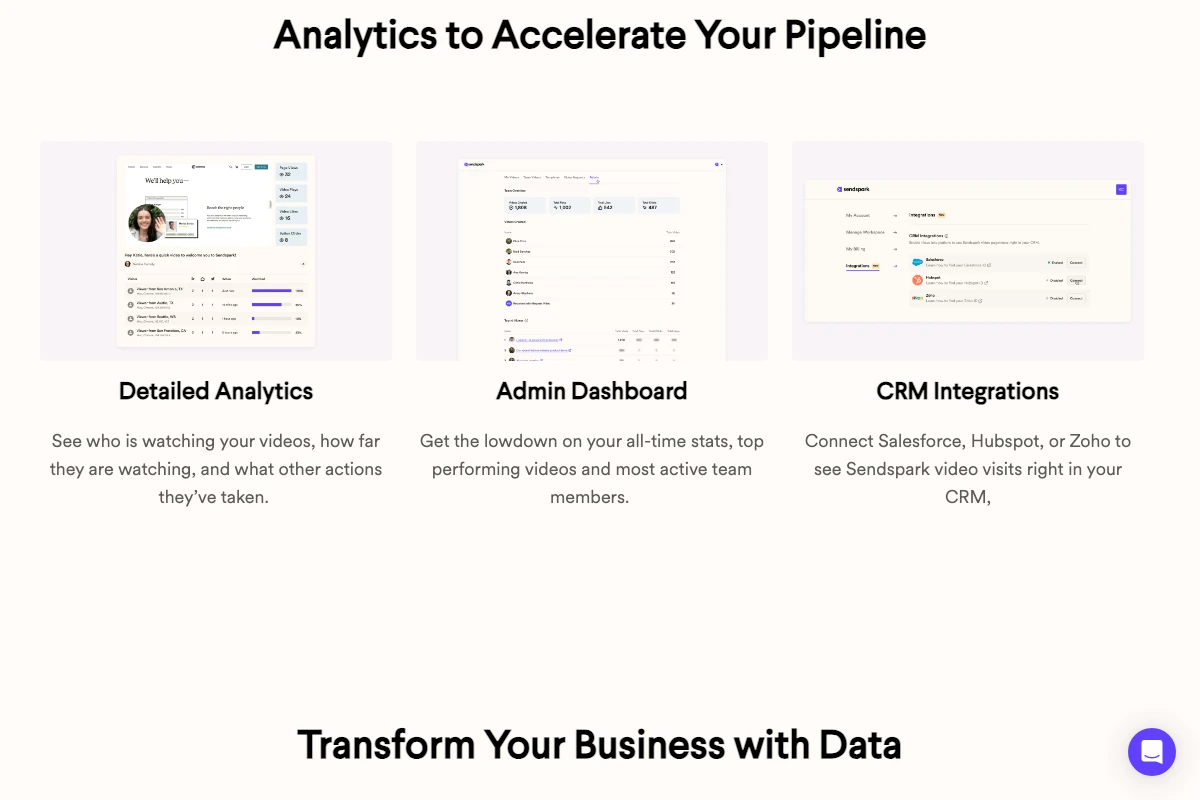
Link customization and security: every shared link can carry a password, and the “Stitch” tool combines a short personalized greeting with a reusable demo. Custom thumbnails and dynamic variables like a prospect’s name or company are built into the link itself.
Analytics: you get an instant notification the moment a specific prospect opens a video, plus watch-through data so you can prioritize follow-ups by engagement level. Connected through HubSpot, Salesforce, or LinkedIn, the platform shows exactly who is watching, not just an aggregate view count.
Integrations: a Chrome browser extension and a macOS desktop app cover recording, and embed codes drop directly into email, social, or a website. Meetings in Zoom or Google Meet still need to be captured manually with the screen recorder, since there is no automatic meeting-capture integration.
B2B sales suitability: it is built for individual reps and small teams running personalized outreach at scale, and it extends naturally into customer success workflows like onboarding. It deliberately stays narrow rather than trying to be a general-purpose hosting platform.
Vimeo
Vimeo remains the choice for teams that prize a polished, ad-free player, supporting playback up to 8K HDR and the only player with Dolby Vision support on Apple devices.
Pricing: Vimeo was in the middle of a 2026 plan overhaul at the time of writing. Its long-standing self-serve tiers, Starter at $12/seat/month, Standard at $25, and Advanced at $75, are being replaced by new Creator ($9.50/month), Core, and Professional ($70/month) plans for individuals, plus a Studio tier for teams reported around $400/month. Enterprise pricing stays custom. Whichever plan names you see, confirm the current tier before budgeting, since the transition is still rolling out.
Link customization: Vimeo’s Review Links feature creates multiple shareable links per video, each with its own access settings, useful when clients, internal teams, and partners all need different permissions. Higher tiers add domain-level restriction, password protection, and branding controls, and URL persistence means you can swap the underlying video without breaking a link you already sent.
Analytics: second-by-second heatmaps show exactly where viewers drop off or rewatch, alongside click tracking on embedded CTAs and lead-capture forms. Starbucks used Vimeo to train more than 350,000 global employees and reported a 90% completion rate on its most-watched videos, crediting the platform’s user-level tracking for showing exactly who had finished training and who hadn’t, according to its own enterprise case study.
“It’s very important for us to know that our partners understand the information we’re putting in front of them via video. To see a 90% completion rate means partners aren’t dropping off until the very end.”
— Eric Pokorny, Starbucks (Vimeo case study)
Integrations: Vimeo connects to HubSpot, Salesforce, Marketo, Mailchimp, Zoom, and Slack natively, plus thousands more through Zapier. Built-in AI generates descriptions, chapters, transcripts, and translations, and reviewers on G2 consistently highlight fast, straightforward setup as one of its strengths.
B2B sales suitability: domain-level privacy keeps videos embeddable only on approved company pages, and Review Links let clients leave time-coded feedback without a Vimeo account. Managing privacy settings per video can get tedious at high volume, so Vimeo fits teams that prioritize presentation quality over rapid, large-scale outreach.
Wistia
Wistia is built to turn video views into leads for its 375,000-plus customers, with a lightweight 43KB ad-free player that loads fast and keeps competitor suggestions off your content.
Pricing: Wistia also restructured its plans in 2026. The permanent Free plan now includes 25GB of storage for one user. Business runs $79/month billed annually for three users, 250GB of storage, and 1TB of bandwidth, replacing the old Pro tier. Business + Lead Gen is $329/month billed annually and bundles Wistia’s marketing and CRM automation suite on top of Business, replacing the old Advanced and Premium tiers. Enterprise pricing is custom, and additional seats run roughly $20 to $25/month each depending on plan.
Link customization: full player branding covers colors, logos, and thumbnails, and videos can carry password protection, locked folders, or specialized links, including direct, expiring, and timestamped formats. The Turnstile feature gates content behind an email capture form, and the Channels feature builds SEO-friendly video galleries for series or webinars.
Analytics: heatmaps and viewer-level tracking show which segments get watched or skipped, along with device type and page location, and automated triggers can alert sales staff when a prospect crosses an engagement threshold worth following up on.
“Wistia’s analytics give us deep insights into our customer journey… Wistia helps us focus our efforts on what matters most.”
— M. Tre Gonzalez, Director of Growth, OnCourse Systems for Education
Integrations: two-way sync covers HubSpot, Marketo, Pardot, Salesforce, Mailchimp, Klaviyo, and ActiveCampaign, with retargeting through Meta and Google Ads and AI-powered translation into 50-plus languages.
B2B sales suitability: Turnstile email capture, heatmaps, and CRM sync make Wistia a strong fit for gating training materials or proposals behind a lead form, though storage limits on lower tiers can pinch teams with large video libraries.
YouTube
YouTube is the largest video platform on earth, reaching over 2 billion users on a completely free, ad-supported model, which makes it the obvious choice for maximizing reach without spending anything upfront.
Pricing: free, with uploads supported up to 12 hours or 128GB. Viewers can pay for YouTube Premium for an ad-free experience, but creators never pay to upload or distribute.
Link customization and security: timestamped links and custom channel URLs cover the basics, but branding options are limited since the default player keeps YouTube’s own logo and colors, and share buttons route traffic back to YouTube rather than your own site. There is no signed-URL equivalent: an unlisted video is reachable by anyone with the link, indefinitely, with no expiration and no domain restriction.
Analytics: detailed aggregate data covers demographics, traffic sources, device types, and retention, with APIs available for custom dashboards. What YouTube does not do is track individual viewers, so there are no per-prospect heatmaps, no lead scoring, and no CRM sync.
Integrations: YouTube has no native CRM or marketing automation integrations, so B2B teams typically pair it with separate tools to connect viewing data to HubSpot or Salesforce.
B2B sales suitability: YouTube wins at top-of-funnel brand awareness and SEO, since Google favors its own video platform in search results. It falls short for deeper engagement: ads and competitor video suggestions can pull viewers away mid-watch, and there is no built-in lead capture or password protection. Most B2B teams use YouTube for early-stage discovery and a dedicated platform for anything that needs tracked, gated, or personalized delivery.
Which Platform Fits Your Sales Motion?
Match the platform to the job: choose a personalization-first platform for one-to-one outreach where you need to know who watched, Vimeo for polished brand-safe presentation, Wistia for gating content behind lead capture, and YouTube for free top-of-funnel reach. Most mature B2B video stacks use more than one.
| Platform | Key Strengths | Key Weaknesses |
|---|---|---|
| Sendspark | AI voice cloning, dynamic backgrounds, and per-viewer tracking simplify personalized sales outreach at scale. | Tailored to outreach, not a general-purpose hosting solution. |
| Vimeo | Professional, ad-free playback with domain restriction, password protection, and URL persistence that preserves SEO when a video is swapped. | Enterprise-grade link security and CRM depth sit behind higher tiers. |
| Wistia | Per-second viewer heatmaps and Turnstile email capture turn views into qualified leads. | Costs rise quickly as your video library and seat count grow. |
| YouTube | Unmatched free reach and strong SEO as the second-largest search engine. | No signed or expiring links, no domain restriction, and limited lead-capture tooling. |
Common mistake
Don’t assume password protection and signed URLs are the same thing. A password can be shared along with the link; a properly signed URL expires on its own and cannot be reused once the window closes.
In practice, a hybrid stack covers more ground than any single platform. Use YouTube for public, top-of-funnel education, route gated marketing assets through Vimeo or Wistia to capture leads, and use a personalization-first tool for the one-to-one sends where knowing exactly who watched matters more than reach. Our video sales enablement guide covers how to build that stack end to end, and our guide on turning a video into a shareable link walks through the mechanics of getting a link in front of a prospect in the first place.
Frequently Asked Questions
What is a signed URL and why does it matter for shared video links?
A signed URL embeds a cryptographic token and expiration timestamp directly in the link, so it only works for a limited window before it stops functioning. That matters whenever a video needs to stay restricted to the person it was sent to, since a plain link can be forwarded indefinitely while a signed one expires on its own.
Which video hosting platforms support signed or expiring links?
Wistia offers expiring and timestamped links through its link customization tools, and Vimeo’s higher tiers add domain restriction and password protection that narrow who can access a video. True cryptographically signed URLs are more common on developer-facing video infrastructure than on self-serve hosting platforms like the ones compared here.
Is Sendspark better than YouTube for B2B sales outreach?
For personalized outreach, yes. A platform built around one-to-one sales workflows offers password-protected links, AI voice cloning, and per-prospect watch tracking synced to your CRM. YouTube has none of that: it is built for public discovery, not tracked, personalized delivery to a named prospect.
How do Vimeo and Wistia differ in customization and analytics?
Wistia’s player is built specifically for marketing teams, with Turnstile email capture and Channels galleries layered on top of its branding options. Vimeo leans toward broadcast-quality playback and domain-level access control. Both offer heatmap-style analytics, but Wistia’s tools lean more toward lead qualification while Vimeo’s lean toward brand-safe distribution.
What should I look for in a video hosting platform for shareable links?
Start with how the platform controls access: password protection, domain restriction, and expiring or signed links all matter if the video shouldn’t be public. From there, weigh analytics depth, CRM integrations, and pricing against your actual use case, whether that’s sales outreach, lead generation, or public reach.
Can I track who opens a shared video link?
It depends on the platform. The personalization-first platform compared here and Wistia both offer viewer-level tracking that shows who watched and how much of the video they completed, with one of the two syncing that data directly to a CRM. Vimeo offers similar depth on its higher tiers. YouTube only reports aggregate analytics, with no per-viewer identification.
Is password protection the same as a signed URL?
No. A password can be shared alongside the link and reused by anyone who has both, while a signed URL expires automatically after a set window regardless of whether someone has the password. Platforms that need DRM-grade protection typically combine both layers rather than relying on either alone.
Sources & References
- Vimeo Enterprise: Starbucks Case Study — “Starbucks trained over 350,000 global partners with a 90% video completion rate” (2026)
- Gumlet: How Signed URLs Work and Why They’re the Smartest Way to Secure Video Access — “Signed URLs are cryptographically generated, per-user, time-limited links that expire after a defined window” (2026)
- CyberPanel: Private Video Hosting for Business — “Domain restrictions control where the video can be played, checking the HTTP Referer header against an allowlist” (2026)
Record One Video. AI Personalizes Thousands.
Sendspark records your video once, then clones your voice to greet each prospect by name in front of their own website.
Get Started NowTopics: blog