Most B2B SaaS teams build their entire outreach motion around winning new logos, then treat the accounts they already have as an afterthought until renewal season. That’s backwards. Existing customers close at 60-70%, compared to just 5-20% for net-new prospects, according to McKinsey research cited by HubSpot. Expansion revenue (upsells, cross-sells, and add-ons sold into accounts you already have) now drives roughly 40% of new ARR across B2B SaaS, and that share keeps climbing the bigger a company gets.
The problem isn’t that teams don’t believe in expansion. It’s that most of them still time the ask around the renewal date instead of around the signals that actually predict readiness. This guide covers what customer expansion really means, the six signals that tell you an account is ready to spend more, how to time and script the conversation, and where a personalized video actually moves the needle instead of just adding noise.
Key Takeaways
- Expansion revenue now makes up roughly 40% of new ARR across B2B SaaS, climbing to 58-67% once a company passes $50M ARR, according to Digital Applied’s 2026 analysis of Benchmarkit and Maxio survey data.
- Existing customers close at 60-70%, versus just 5-20% for net-new prospects, per McKinsey research cited by HubSpot, yet most teams still spend most of their effort chasing new logos.
- Median private B2B SaaS net revenue retention has slipped to about 101% (down from 105% in 2021), meaning a passive, renewal-date-only motion is no longer enough to keep revenue flat, let alone grow it.
- Usage and engagement signals, not the date on the renewal calendar, are the most reliable predictor of when an account is ready for an upsell or cross-sell conversation.
- A short video recorded once per scenario and personalized per account turns a generic expansion ask into a context-aware one, and per-recipient watch data shows exactly who engaged before you ever pick up the phone.
What Counts as Customer Expansion in B2B SaaS?
Customer expansion is any revenue growth that comes from accounts you already have, rather than from a new logo. It splits into three distinct motions: an upsell moves an existing customer to a bigger plan, more seats, or more usage capacity; a cross-sell adds a different product or module to their existing spend; a renewal simply keeps the same deal at the same price. Only the first two actually grow revenue — a renewal just prevents it from shrinking.
That distinction matters because it’s exactly what net revenue retention (NRR) measures. NRR starts with last year’s revenue from a cohort of customers, then adds back expansion and subtracts churn and contraction. A renewal alone holds you at 100%. Upsells and cross-sells are what push you above it. This guide is about accounts that are still active and showing expansion signals — if an account has already gone quiet or churned entirely, see our guide to B2B win-back campaigns for dormant accounts instead.
| Motion | Definition | Effect on NRR |
|---|---|---|
| Upsell | Same product, bigger commitment — more seats, a higher tier, more usage capacity | Grows NRR above 100% |
| Cross-sell | A different product or module added to the account’s existing spend | Grows NRR above 100% |
| Renewal | Same product, same price, same scope, carried forward | Holds NRR at 100% (no growth) |
The stakes for getting this right keep rising. Median private B2B SaaS NRR slipped from roughly 105% in 2021 to about 101% in 2024, according to Digital Applied’s 2026 analysis of Benchmarkit and Maxio survey data. That single blended number also hides a wide spread by segment: enterprise accounts over $100K ACV hold a median 118% NRR, while SMB accounts under $25K ACV sit at just 97%. Customer success teams working the SMB long tail are operating with the least margin for error.
Common mistake
Treating “expansion” as one undifferentiated bucket. An upsell conversation (bigger plan, same stakeholders) and a cross-sell conversation (new product, often new stakeholders) need different signals, different scripts, and often a different owner. Lumping them together is how teams end up with one generic “check-in” email that does neither job well.
The 6 Expansion Signals That Predict a Successful Upsell
An expansion signal is any measurable change in an account’s behavior that shows they’re getting more value from the product or running into the limits of their current plan. The strongest signals combine product usage data, support interactions, and direct engagement with your content — and they predict readiness far more reliably than a calendar date ever can.
| Signal | What It Means | Recommended Action |
|---|---|---|
| Usage velocity increase | Logins, active users, or core actions per user are trending up month over month | Flag the account for a success review; frame the expansion conversation around the ROI already visible in the data |
| Seat or license utilization near the cap | The account is using 85%+ of its licensed seats, storage, or usage allowance | Offer a seat or capacity increase before they hit a hard wall and feel penalized for growing |
| New feature adoption outside the current tier | Users are requesting or trying to use capabilities gated to a higher plan | Demo the specific gated feature in context, not a generic “see what’s new” overview |
| Support ticket pattern shift | Tickets shift from “this is broken” to “how do I do X with this” — a sign of deepening, not frustrated, engagement | Route these to a CSM as a qualified signal, not just a support resolution |
| Rising engagement with CS content and QBRs | High watch percentage and click-through on account-specific video or recap content | Follow up directly with the stakeholder who engaged, referencing what they actually watched |
| Multi-threading into new stakeholders | New job titles or departments start logging in or showing up on calls beyond the original champion | Map the new stakeholders and bring them into the expansion conversation directly, the same way you’d multi-thread a net-new deal |
Of these, the engagement signal is the one most teams track the least rigorously, even though it’s the easiest to measure. If you’re already sending quarterly business review recaps or check-in videos, per-recipient watch data (who opened it, how much they watched, whether they clicked a linked next step) is a direct, non-self-reported readiness signal — similar to how win-loss analysis uses engagement data to cross-check what buyers say against what they actually do.
Record One Video. AI Personalizes Thousands.
Sendspark is the AI video personalization platform for B2B sales. Record once, and AI voice cloning generates thousands of individually personalized videos with dynamic backgrounds and personalized thumbnails — each prospect hears their name, sees their website, in your voice. Sales teams see 2-3x more replies.
Get Started NowHow to Time the Conversation (Instead of Waiting for the Renewal Date)
The best time to raise an upsell or cross-sell is the moment a signal appears, not the month before renewal. Signal-based timing catches an account while it’s actively feeling the value (or the friction) of its current plan; calendar-based timing waits until the relationship is already being evaluated for continuation, which frames every expansion ask as a negotiation instead of a natural next step.
Marilee Bear, Gainsight’s Chief Revenue Officer, points out that around 40% of SaaS revenue now comes from expansion, and that customer success teams are best positioned to identify and influence those opportunities — precisely because they see usage and engagement signals months before a renewal date ever comes up.
“Around 40% of SaaS revenue now comes from just expansion, and CS is absolutely in the best position to identify and influence those opportunities.”
— Marilee Bear, Chief Revenue Officer, Gainsight
Ownership splits cleanly in most team structures: customer success is usually closest to the usage and support data, so they’re best positioned to flag the signal. Whoever owns the commercial relationship (an AE, a CSM with quota, or a dedicated expansion rep, depending on your org) makes the actual ask. The failure mode isn’t picking the wrong owner — it’s CS and sales never agreeing on who owns it, so the signal gets flagged and then sits untouched.
Build the cadence around a monthly signal review, not a once-a-year renewal checklist:
- Monthly signal review — CS or RevOps pulls usage, support, and engagement data across accounts.
- Qualification — Is the signal strong enough, and recent enough, to justify a conversation right now?
- Outreach — Make first contact with a personalized, account-specific touchpoint.
- Discovery — Confirm the need directly with the stakeholder before proposing anything.
- Proposal — Present the specific expansion option tied to the signal you observed.
Scripts and Channels for Upsell and Cross-Sell Conversations
Each expansion scenario needs its own trigger, script structure, and channel — a seat-expansion ask, a cross-sell into a new product, and a usage-overage conversion are three different conversations, even though all three get lumped under “expansion” at most companies. Below are three scenario-based outlines you can adapt directly.
Scenario A: Seat Expansion (Usage Near Cap)
Trigger: License or seat utilization crosses 85-90%.
Script structure: Acknowledge the specific usage pattern you’re seeing → name what it usually means (the team is onboarding more users) → propose a concrete seat increase that removes the friction before it blocks a new hire → close with a direct, low-friction ask to add it to the current contract.
Scenario B: Cross-Sell Into a New Product
Trigger: The account is asking about, or working around the lack of, a capability that lives in a different product line.
Script structure: Reference the specific workaround or gap you’ve observed → connect it to the product that solves it natively → propose a short, scoped demo tied to that exact use case, not a generic product tour.
Scenario C: Usage Overage Conversion
Trigger: The account is paying overage fees or regularly hitting API, storage, or usage-based limits.
Script structure: Show the overage cost in plain numbers → compare it directly to the cost of the next tier → propose the switch as a cost-neutral or cost-saving move, not a straight upsell.
Advanced strategy
Record one short, reusable video per scenario above, then personalize just the intro per account with Sendspark’s AI-personalized video and dynamic backgrounds, which show the viewer’s own company website or LinkedIn behind the speaker. Use Combined Videos to merge that personalized intro with the longer, reusable explainer, so you’re not re-recording the core pitch for every account — just the part that needs to feel specific to them.
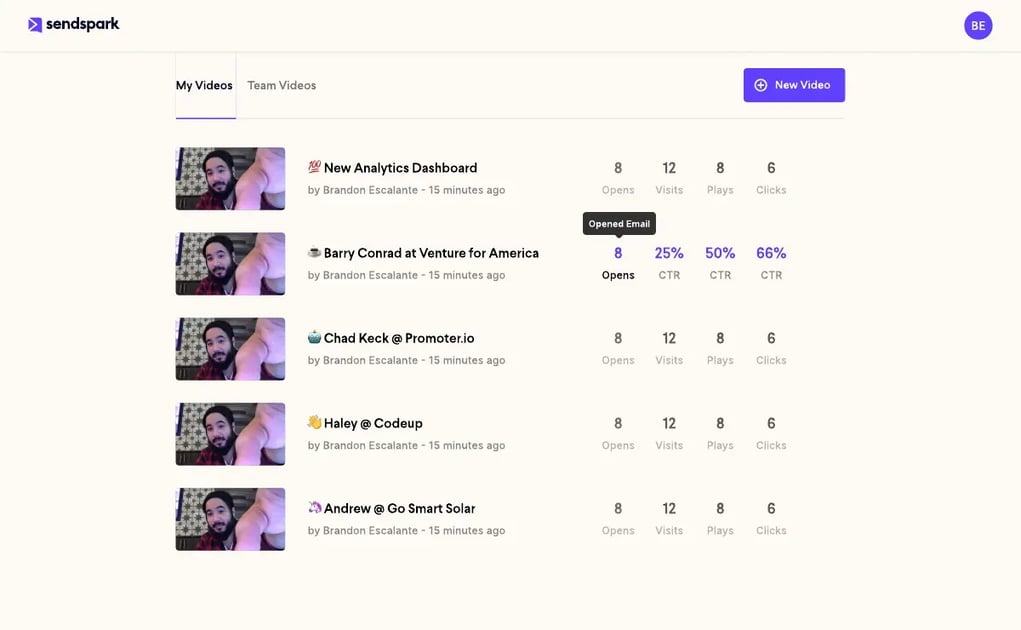
Generic renewal-season emails get skimmed or ignored; a short, personalized video gets watched, and it gives you something a templated email can’t: a read on who actually engaged before you ever pick up the phone. Sendspark’s per-recipient video analytics show watch percentage, plays, and CTA clicks for each recipient, so a stakeholder who watched 90% of your upsell video and clicked the linked proposal is a far stronger, more objective signal than a stakeholder who hasn’t opened anything.
If your customer success platform already tracks a usage or health-score field, and that field is synced into a property in HubSpot or Salesforce, you can enroll an account in a workflow the moment that property crosses your expansion threshold, and have Sendspark generate and send the personalized video automatically. It’s a CRM-workflow trigger built on whatever signal you’re already tracking, not a direct integration with any specific customer success platform — so the mechanism works regardless of which CS tool is the source of that health-score field.
Common Mistakes That Kill Expansion Deals
Most failed expansion attempts trace back to one of five avoidable mistakes: bad timing, a single point of contact, generic messaging, no supporting signal, or ignoring the engagement data you already have. Each one is a direct opposite of a rule already covered above, which makes them easy to audit against your own team’s process.
| Mistake | Why It Fails | The Fix |
|---|---|---|
| Renewal-date-only timing | Reactive by definition — it misses every expansion window that opens mid-contract | Run a monthly signal review instead of a once-a-year renewal checklist |
| Single-threaded ask | Pitching only the original champion risks the whole deal if they leave or lack budget authority | Map and engage every stakeholder the signals surface, not just the first one |
| Generic, templated pitch | A one-size-fits-all proposal signals you don’t actually know the account’s usage pattern | Reference the specific signal (seat count, overage, feature request) that triggered the outreach |
| Asking without a signal | An unprompted upsell ask feels arbitrary and puts the relationship on the defensive | Anchor every ask to a specific, observable signal from the table above |
| Ignoring engagement data | Teams send a video or recap, see no reply, and assume disinterest — missing a high watch percentage that says otherwise | Treat a high watch rate with no reply as a signal to follow up directly, not a dead end |
Frequently Asked Questions
What is customer expansion in B2B SaaS?
Customer expansion is revenue growth that comes from accounts you already have, through upsells (bigger plan, more seats) or cross-sells (a new product added to their spend). It’s distinct from new-logo acquisition and from a flat renewal, which holds revenue steady but doesn’t grow it.
What’s the difference between an upsell and a cross-sell?
An upsell moves an existing customer to a higher tier, more seats, or more usage capacity within the same product. A cross-sell adds a different product or module to their existing spend. Both grow net revenue retention above 100%; a renewal alone does not.
When is the best time to ask for an upsell or cross-sell?
The best time is when a usage, support, or engagement signal appears, not when the renewal date approaches. Waiting for renewal turns every expansion ask into a negotiation instead of a natural next step tied to value the customer is already seeing.
Who should own expansion revenue: sales or customer success?
Customer success typically flags the signal, since they’re closest to usage and support data, while whoever owns the commercial relationship (an AE, a quota-carrying CSM, or a dedicated expansion rep) makes the ask. The structure matters less than making sure both teams agree on the handoff.
How do you know if a customer is ready to expand?
Look for usage velocity increases, seat or license utilization near the cap, adoption of features outside their current tier, a shift in support tickets from “broken” to “how-to,” and high engagement with account-specific video or QBR content. Multiple signals together are a stronger indicator than any one alone.
Can personalized video actually help with upsell and cross-sell conversations?
Yes. A short video personalized per account gets watched more reliably than a generic renewal-season email, and per-recipient watch and click data gives you an objective read on who engaged before you ever make the call. Sendspark lets you record one video per scenario and personalize the intro per account with AI voice cloning and dynamic backgrounds.
What’s a healthy net revenue retention benchmark for a B2B SaaS company?
Bessemer Venture Partners frames 100% NRR as good, 110% as better, and 120%+ as best, though the right target depends heavily on segment: enterprise accounts commonly reach 118%+ median NRR while SMB accounts sit closer to 97%. Median private B2B SaaS NRR overall was about 101% in 2024.
Published October 2026
Sources & References
- Digital Applied — “Median private B2B SaaS NRR ~101% in 2024, down from ~105% in 2021; enterprise (>$100K ACV) at 118% median NRR vs. 97% for SMB (<$25K ACV); expansion ARR rose from ~25% of new ARR in 2022 to 40% in 2024, reaching 58-67% above $50M ARR” (2026)
- Gainsight — “Around 40% of SaaS revenue now comes from expansion, and CS is best positioned to identify and influence those opportunities” — Marilee Bear, Chief Revenue Officer (2025)
- HubSpot — “McKinsey reports cross-selling can increase sales and profits by 20% and 30% respectively; odds of closing a sale are 60-70% with an existing customer vs. 5-20% with a new one” (2026)
- Salesforce — “80% of sales reps say maintaining customer relationships after the close is increasingly important to forge customer loyalty that leads to recurring sales” (State of Sales report, 2026)
Record One Video. AI Personalizes Thousands.
Sendspark is the AI video personalization platform for B2B sales. Record once, and AI voice cloning generates thousands of individually personalized videos with dynamic backgrounds and personalized thumbnails — each prospect hears their name, sees their website, in your voice. Sales teams see 2-3x more replies.
Get Started Now