Seventy percent of the time, sellers and buyers give completely different answers for why a deal was lost. That’s not a guess. It’s what Corporate Visions found after analyzing more than 100,000 B2B sales transactions across 500-plus companies. Your CRM’s close-lost reason codes are mostly fiction, written by a rep who has every incentive to blame the market instead of the pitch.
Win-loss analysis fixes that by going straight to the buyer. Done well, it turns every lost deal into a data point that makes the next one more winnable. Done badly (or not at all), you keep losing the same deal for the same reason, quarter after quarter, and nobody in the building knows why.
Published September 2026
Key Takeaways
- Companies with rigorous, ongoing win-loss programs see up to a 50% improvement in win rate and a 15-30% revenue increase, according to Gartner research cited in Clozd’s 2025 State of Win-Loss Analysis Report.
- Sellers and buyers give different reasons for a lost deal 70% of the time, per Corporate Visions’ analysis of 100,000+ B2B deals, which is why CRM reason codes alone can’t be trusted.
- Buyer interviews should happen within 2-4 weeks of the decision and be led by someone with zero stake in the deal, or buyers soften their answers and their memories drift.
- Video engagement data, like watch-time heatmaps and call-to-action clicks, gives you an objective signal you can weigh against what buyers actually say in an interview.
- 63% of companies with a formal win-loss program report measurable ROI, and running it as a recurring program (not a one-off project) is what separates the programs that work from the ones that don’t.
What Is Win-Loss Analysis?
Win-loss analysis is the structured practice of interviewing buyers after a deal closes, whether they bought or walked, to find out what actually drove their decision. It replaces guesswork with a direct answer from the one person who knows the truth: the buyer.
Most sales teams already think they’re doing this. A rep loses a deal, logs “budget” or “bad timing” as the CRM reason code, and moves on. That data feels like an answer, but it’s really just the rep’s own story, filtered through whatever explanation is easiest to accept. According to HubSpot’s compiled sales research citing Ebsta, B2B sales reps attribute 61% of lost deals to buyer indecision – the single most common self-reported reason, and also the easiest one to blame without looking inward.
The buyer’s actual story is usually different, and rarely one the rep who worked the deal ever hears. Buyers soften bad news to the person they were negotiating with, or simply stop responding rather than deliver an uncomfortable verdict. That’s the gap a neutral, structured win-loss interview is built to close.
“Our data shows that 70 percent of the time, sellers and buyers give different answers for why a sale went askew.”
— Eric Nitschke, VP of Commercial Enablement, Corporate Visions
Common mistake
Treating CRM close-lost reason codes as your win-loss data. They’re a rep’s self-report, not a buyer’s account, and they systematically overweight “no budget” and “bad timing” because those are the easiest explanations for a rep to write down and move on from.
Win-Loss Analysis Methods Compared
No single method gives you the full picture, so most mature programs combine two or three. Neutral buyer interviews produce the richest, most trustworthy insight but take the most effort per deal. Automated surveys scale further but capture shallower answers. CRM mining is free but structurally biased. Video engagement data doesn’t explain “why,” but it tells you what actually happened, which is a useful check on everything else.
| Method | Who Runs It | Bias Risk | Best For |
|---|---|---|---|
| Neutral third-party interviews | Sales enablement, customer success, or an outside firm – never the deal rep | Low | Deep, honest, root-cause insight on your most important lost deals |
| Automated post-close surveys | RevOps or marketing, triggered automatically at deal close | Medium | Volume and trend-spotting across every deal, not just the big ones |
| CRM reason-code mining | Sales reps, self-reported at close | High | A rough historical baseline when you have zero budget for anything else |
| Video engagement analytics | Whoever owns the outreach/demo video tooling | Low (behavioral, not self-reported) | Cross-checking what a buyer says against what they actually watched and clicked |
The fourth row is easy to overlook, but it’s the one most teams are already sitting on without realizing it. If your outbound and demo-follow-up videos are personalized per recipient, the platform behind them is already logging per-viewer watch time, a watch-time heatmap of exactly which section someone replayed, and whether they clicked your call-to-action. That’s real, unprompted behavior, not a story someone tells an interviewer three weeks later. A prospect who tells you “pricing wasn’t the issue” but rewatched the pricing section of your demo recap four times is giving you two different answers, and the second one is harder to fake.
Record One Video. AI Personalizes Thousands.
Sendspark is the AI video personalization platform for B2B sales. Record once, and AI voice cloning generates thousands of individually personalized videos with dynamic backgrounds and personalized thumbnails -- each prospect hears their name, sees their website, in your voice. Sales teams see 2-3x more replies.
Get Started NowHow to Build a Win-Loss Analysis Program in 5 Steps
A win-loss program is five decisions made once and then repeated consistently: what you’re trying to learn, who asks the questions, what you ask, how fast you ask it, and who sees the answers afterward. Skip any one of them and you end up with a pile of interview notes nobody acts on.
1. Define 2-3 learning objectives before you contact a single buyer
Decide upfront whether you’re testing pricing, product gaps, competitive positioning, or sales messaging. A vague goal like “understand why we lose deals” produces a rambling interview and unusable notes. A specific goal like “find out whether our new pricing tier is costing us mid-market deals” produces a question set you can actually act on.
2. Choose a neutral interviewer
The person asking the questions should have had zero involvement in the deal, ideally someone from sales enablement, customer marketing, or an outside firm. Buyers give noticeably more candid answers to someone who has no stake in protecting the rep’s reputation or the future relationship.
3. Standardize your question set
Use the same core questions across every interview so you can compare results deal to deal and quarter to quarter. Mix open-ended questions (“Walk me through how you evaluated vendors”) with specific ones (“Which three vendors made your shortlist?”) so you get both narrative and comparable data.
Pro tip
Interview within 2-4 weeks of the decision. Buyers interviewed six or more weeks later tend to reconstruct a tidy narrative instead of reporting what actually happened, which quietly corrupts your data without anyone noticing.
4. Interview fast, not eventually
Build the interview request into your close-lost (and close-won) workflow so it goes out automatically, not whenever someone remembers. Speed matters more than most teams assume: the further out you get from the decision, the more a buyer’s answer reflects how they feel about the vendor relationship today rather than what actually happened during the sale.
The request itself matters too. A generic “we’d love your feedback” survey email gets ignored by a buyer who has already mentally moved on, especially if they chose a competitor. A short, personalized video request, using the same record-once, personalize-at-scale approach teams already use for outbound, tends to land differently: it’s from a named person, not a form, and it takes ten seconds to watch instead of five minutes to fill out. This matters most for deals in active mid-funnel deal progression, where the buyer relationship is still warm enough to get a real answer.
5. Close the loop cross-functionally
Share findings with sales leadership, product, and marketing on a regular cadence, not as a one-time report. According to Clozd’s 2025 State of Win-Loss Analysis Report, 85% of ongoing, cross-functional win-loss programs report a measurable revenue impact, compared with programs that stay siloed inside a single team. That feedback loop is also where competitive battlecards should get their updates, instead of sitting untouched between quarterly reviews.
Sample Win-Loss Interview Questions
Good win-loss questions map to the buyer’s actual journey, awareness, consideration, and decision, so you can pinpoint exactly where the deal started to slip instead of getting a single vague answer about “fit.” Ask open questions first, then narrow to specifics, and never suggest the answer you’re hoping to hear.
| Stage | Question |
|---|---|
| Awareness | What was the trigger that made you start looking for a new solution? |
| Awareness | How did you first hear about us compared to the other vendors you considered? |
| Consideration | Which vendors made your shortlist, and what earned each of them a spot? |
| Consideration | What specific capability or proof point moved a vendor up or down your list? |
| Consideration | How did our sales process compare to the other vendors you talked to? |
| Decision | What was the single most important factor in your final decision? |
| Decision | Was there a moment in the process where you nearly chose differently? |
| Reflection | Looking back, is there anything we could have done differently to win your business? |
Close every interview with a version of that last question. It’s the one that most often surfaces a fixable, specific miss, like a missing integration or a slow response time, instead of a generic complaint about price.
Turning Win-Loss Data Into Sales Action
Win-loss data only pays off once it changes something concrete: how a rep opens a call, what marketing puts in a one-pager, or what product ships next quarter. Collecting interview notes and filing them away is the single most common way these programs quietly die.
Start with a coaching loop back to reps. Share anonymized findings in team meetings, grouped by the specific skill gap they reveal, like weak competitive positioning or a slow response after the demo, so managers can coach to a pattern instead of a one-off complaint. Pair that with cross-functional distribution: product needs to know which missing features cost you deals, and marketing needs to know which value propositions actually landed versus which ones sounded good internally but never came up in a real buyer conversation. Win-loss interviews often reveal a methodology mismatch, too — a rep who pitched features to a buyer who wanted a trusted advisor, or one who spent three calls on discovery with a buyer who already knew exactly what they needed. See our breakdown of value, consultative, and solution selling for how to coach reps toward the right approach per deal.
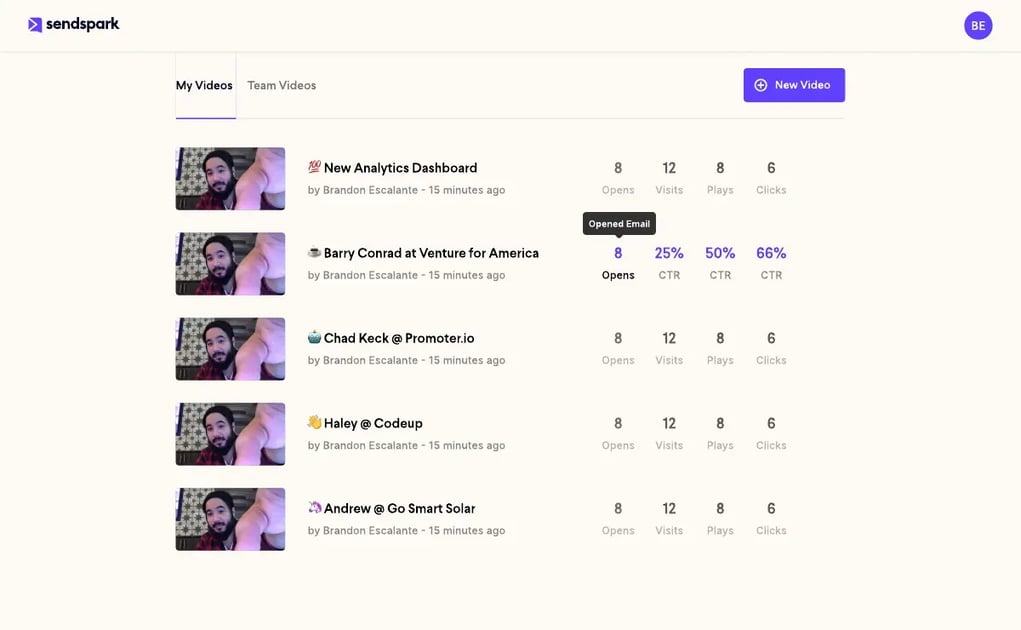
This is also where video engagement data earns its place next to interview transcripts, not as a replacement for them, but as a cross-check. If your outreach or demo-follow-up videos are AI-personalized per recipient, you already have a per-viewer watch-time heatmap, a percentage-watched figure, and a record of every call-to-action click. None of that tells you why a deal was lost on its own. But paired with an interview, it tells you whether the buyer’s story matches their behavior. A prospect who says “your pricing was competitive” but never got past the two-minute mark of a pricing-focused video is telling you something the transcript alone won’t.
| Signal Source | What It Tells You | What It Misses |
|---|---|---|
| Buyer interview | The reasoning and emotion behind the decision | Can be softened, filtered, or misremembered |
| Video watch-time / CTA data | What content actually held attention, and whether the buyer engaged past the intro | Doesn’t explain motivation on its own |
| CRM reason codes | A rough, fast baseline across every deal | Reflects the rep’s story, not the buyer’s |
Teams selling with Sendspark’s video analytics already have this behavioral layer running in the background on every personalized outreach and post-demo follow-up video they send. The data was never built specifically for win-loss analysis, but it’s sitting there, unused, on every deal that goes cold. Feeding it into the same review where you read interview transcripts turns two half-pictures into one that’s much harder to argue with. The same engagement data doubles as an input to the win-rate lever in the sales velocity formula — a clearer read on which stalled deals are actually still live changes how you prioritize the whole pipeline, not just which loss reasons you log.
It’s also worth using a structured discovery-style question set as a model for how to run the interview itself, and comparing what buyers say against the objections your reps are already trained to handle. If the same objection keeps surfacing in win-loss interviews that your team claims to have “solved,” that’s a coaching gap worth fixing before the next quarter’s forecast, not after it. Teams already tracking deal health through a dedicated RevOps platform can pipe win-loss findings straight into the same dashboards they use for pipeline review, closing the loop between what happened in the deal and what the data already showed.
Frequently Asked Questions
What is win-loss analysis?
Win-loss analysis is the practice of interviewing buyers after a deal closes, whether they bought or chose a competitor, to understand the real reasons behind their decision. It replaces self-reported CRM reason codes with a direct account from the person who actually made the choice.
How often should you run win-loss interviews?
Interview within 2-4 weeks of the decision while the details are still fresh in the buyer’s mind. Run it as a continuous, recurring program tied to every closed deal rather than a periodic one-time project, since consistency is what separates programs that produce useful data from ones that don’t.
Who should conduct win-loss interviews?
A neutral party with no involvement in the deal, such as someone from sales enablement, customer marketing, or an outside research firm, should conduct the interview. Buyers give more candid, useful answers when the person asking has no stake in protecting the rep’s reputation or the account relationship.
What’s the difference between win-loss analysis and a customer satisfaction survey?
Win-loss analysis targets buyers who just went through a purchase decision, won or lost, and focuses on why they chose what they chose. Customer satisfaction surveys target existing customers and focus on ongoing product experience and support, which is a different question asked at a different stage of the relationship.
How is win-loss analysis different from just reading CRM reason codes?
CRM reason codes are written by the rep who lost the deal, based on what the rep believes happened. Corporate Visions’ analysis of more than 100,000 B2B deals found that sellers and buyers give different answers 70% of the time, which means reason codes alone are closer to a guess than a finding.
Can you run a win-loss analysis program without buying dedicated software?
Yes. A spreadsheet, a standardized question set, and a calendar reminder to interview every closed deal within a few weeks is enough to start. Dedicated tools help you scale interview scheduling and reporting later, but the discipline of asking consistent questions on a fast timeline matters more than the tooling.
Can video engagement data replace buyer interviews for win-loss analysis?
No. Video watch-time, click, and completion data show you what a buyer actually did, but not why they did it. It works best as a cross-check next to interview data, confirming or challenging what a buyer tells you rather than replacing the conversation entirely.
Sources & References
- Clozd, 2025 State of Win-Loss Analysis Report – “63% of companies see measurable ROI, 84% of programs running for 2+ years report increased win rates, and 85% of ongoing, cross-functional programs report revenue impact,” plus Gartner research showing “up to a 50% improvement in win rate and a 15-30% increase in revenue” (2026)
- Eric Nitschke, VP of Commercial Enablement, Corporate Visions – “our data shows that 70 percent of the time, sellers and buyers give different answers for why a sale went askew,” from an analysis of 100,000+ B2B transactions across 500+ companies (2026)
- HubSpot Blog, citing Ebsta – “B2B sales reps attribute 61% of lost deals to buyer indecision, making it the leading cause of deal failure” (2026)
- ZoomInfo Pipeline – “Win-Loss Analysis: A Step-by-Step Guide for Sales Teams” (2026)
Record One Video. AI Personalizes Thousands.
Sendspark is the AI video personalization platform for B2B sales. Record once, and AI voice cloning generates thousands of individually personalized videos with dynamic backgrounds and personalized thumbnails -- each prospect hears their name, sees their website, in your voice. Sales teams see 2-3x more replies.
Get Started Now