Reactivating a lapsed B2B account costs roughly 5-7x less than acquiring a new one, and win-back probability runs 20-40% versus just 5-20% for a cold prospect. Most sales and customer success teams never act on that math. They let dormant accounts quietly fall off the list instead of running a structured win-back campaign.
That’s a mistake, especially in B2B. Your dormant accounts already cleared procurement, already know your product, and already have a budget history with you. A lapsed customer isn’t a cold lead. They’re a warm one that went quiet, and the right approach can bring a meaningful share of them back.
Key Takeaways
- Reactivating a lapsed account typically costs 5-7x less than acquiring a new one, and win-back probability (20-40%) far outpaces cold-prospect conversion (5-20%).
- Not every churned account deserves a win-back effort — prioritize by ICP fit and prior engagement signal, not just by how recently they went quiet.
- Segment by why the account went dormant (silent churn, price-sensitive churn, competitor-switch churn, involuntary churn) — a single generic “we miss you” blast underperforms a reason-specific sequence.
- Most B2B teams trigger the first win-back touch between 30 and 90 days after an account goes quiet, then suppress non-responders instead of mailing a dead list indefinitely.
- A personalized video that references the account’s own site or last use case outperforms a templated email because it signals the rep actually remembers the relationship.
What Is a B2B Win-Back Campaign?
A B2B win-back campaign is a targeted sequence aimed at re-engaging accounts that have gone dormant or churned, as distinct from a retention campaign, which targets accounts that are still active but showing early risk signals. Win-back starts after the relationship has already lapsed; retention tries to prevent the lapse from happening at all.
The economics make this worth doing. Reactivating a lapsed customer costs roughly 5-7x less than acquiring a new one, and the probability of winning them back sits at 20-40%, compared to just 5-20% for a cold prospect, according to vendor data compiled by Digital Applied’s 2026 retention playbook. In a B2B context, that gap is even wider than it looks on paper. Your dormant accounts already cleared procurement, already know how your product works, and already have a budget line that once included you.
That’s also why a win-back motion can’t just reuse your cold-outreach playbook. A dormant account isn’t unaware of your product — they’re aware, and they left anyway. Jason Lemkin, Founder of SaaStr, puts it plainly when asked how SaaS businesses should approach lapsed customers:
“The #1 thing you can and should do is create a series of marketing campaigns targeted only to churned customers. You will get some back, especially if you have a High NPS in general and most of your customers like / love you.”
— Jason Lemkin, Founder, SaaStr
Lemkin cites data from RevenueCat, which manages subscriptions across more than 10,000 paid apps, showing that roughly 12% of lapsed paying customers eventually come back on their own, without any campaign at all. A structured win-back effort exists to pull that number higher — and to do it faster than waiting years for a lapsed account to wander back.
Should You Even Win This Account Back?
Not every churned account deserves a win-back effort, and chasing all of them equally dilutes your team’s time on accounts that were never going to convert back. The fix is to score dormant accounts on two dimensions before you spend a single send on them: how well they actually fit your ideal customer profile, and how engaged they were before they went quiet.
Start with ICP fit. If an account was a marginal fit from the start — wrong company size, wrong use case, a budget that was always going to get cut in a downturn — their churn was close to inevitable, and a win-back campaign won’t change the underlying mismatch. UnboundB2B’s research on B2B win-back strategy makes this point directly: effective campaigns prioritize accounts that align with the current ICP and show positive signals like prior high engagement or recent website activity, rather than treating every lapsed logo the same.
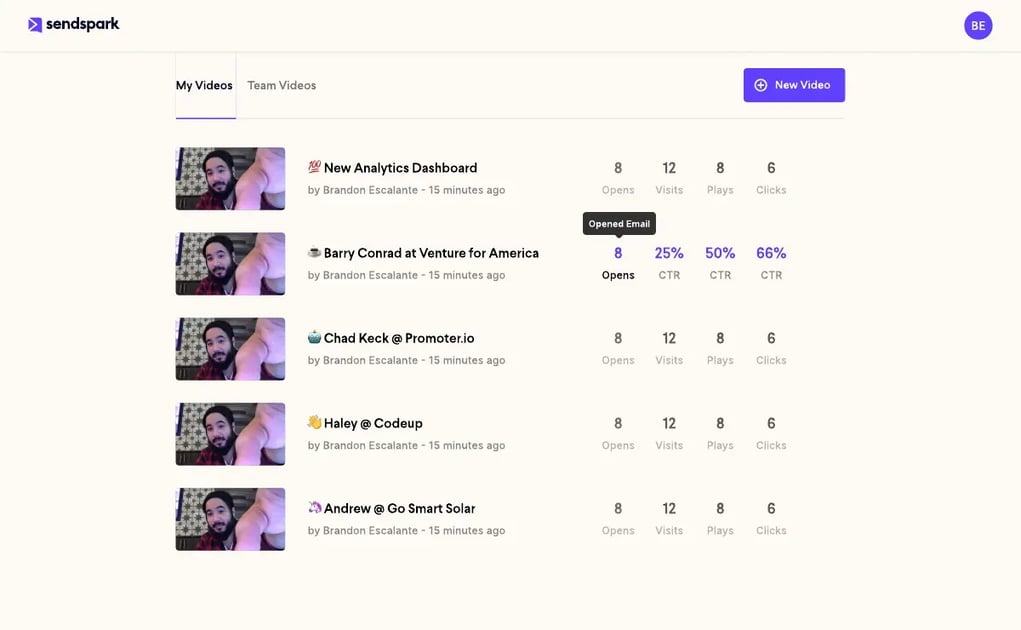
Then layer in engagement history. An account that logged in daily, had multiple stakeholders using the product, and attended your QBRs before they churned is a very different prospect than one that logged in twice and never came back. The first is a reactivation opportunity. The second is a list-hygiene decision. If you already send personalized video as part of your customer success motion, your video analytics — watch time, CTA clicks, who actually opened the last QBR recap — are an objective, non-self-reported engagement signal you can fold into this scoring instead of guessing from CRM activity alone.
Common mistake
Don’t let “they used to pay us” be the only qualifying criteria for a win-back list. Low-engagement, poor-ICP-fit accounts rarely come back regardless of how good your campaign is, and spending reactivation budget on them is really an acquisition-cost problem wearing a retention disguise.
Let an account go if it has downsized past the point where your product fits, if the buying team has turned over entirely with no internal champion left, if someone explicitly asked to be removed from outreach, or if the account has been silent for years with zero signal of interest. Reactivation budget is finite — spend it on accounts with a real shot, not every logo that ever paid you.
The 4 Churn Types (And Why Segmentation Beats a Single Blast)
Segmentation beats a single blast because different churn reasons call for completely different messages, and a generic “we miss you” email ignores why the account actually left in the first place. Diagnose the churn type before you write a single line of outreach copy.
Silent churn happens when an account simply stops logging in without any complaint or cancellation call — the product faded into the background of their routine, or a competitor quietly took its place. These accounts respond best to a reminder of new capabilities or improvements shipped since they left, framed as “here’s what changed,” not “come back.”
Price-sensitive churn happens when the account left over cost — a budget cut, a cheaper alternative, or a renewal conversation that went nowhere. These accounts respond to a value-reframe: what did the cheaper option actually cost them in time, support quality, or missed functionality, not simply a bigger discount.
Competitor-switch churn happens when the account moved to a named rival. These accounts already have a comparison point, so your message needs specific differentiators and proof — case studies from accounts that switched back, not a generic “we’re better” claim.
Involuntary churn happens for reasons that have nothing to do with product satisfaction — a failed payment, a budget freeze, a reorg that eliminated the champion’s role. These accounts often want to stay and just need friction removed: a flexible payment option, an ROI summary their new finance approver can use, or a warm re-intro to a new stakeholder.
Matching message to churn type is the single highest-leverage change most teams can make to an existing win-back motion, and it costs nothing but a few minutes of CRM review per segment.
Building Your Win-Back Playbook: A 5-Step Framework
A repeatable win-back playbook runs on five steps: diagnose why the account went dormant, segment by churn type and ICP fit, time the first touch correctly, sequence outreach across more than one channel, and measure results closely enough to know when to stop.
1. Diagnose. Pull usage history, support tickets, and any cancellation notes for each dormant account. You’re looking for the churn-type signal, not a generic “they left” conclusion.
2. Segment. Group accounts by churn type and ICP-fit score from the section above. Resist the urge to build one big “all dormant accounts” list — a single list with one message is the exact mistake this entire approach is designed to avoid.
3. Time the first touch. There’s no single industry-wide rule here. Baremetrics notes that Klaviyo recommends six months of inactivity before a winback send, while Marketo puts the window at 90 days — the right number depends on your typical usage cadence and sales cycle. Most B2B teams land somewhere in a 30-90 day window for the first touch, since waiting longer risks the contact forgetting the relationship entirely. Worth noting: Baremetrics also found that roughly 50% of paying SaaS customers only log into a product once per month, so “inactive” needs a threshold wider than a few quiet weeks before you label an account dormant.
Worth noting: in the enterprise segment specifically, Lemkin’s SaaStr guidance is that a true win-back can take 3-5 years, not 90 days — set internal expectations accordingly for larger accounts rather than writing them off after one quiet quarter.
Pro tip
Keep a standing cadence for your highest-value churned segments — a check-in every 60 days plus an invite to any new product release or customer event — rather than a single one-and-done win-back blast. Lemkin specifically flags this drip approach as the thing too few companies actually do.
4. Sequence across channels. Don’t rely on a single email. A multi-touch sequence — an opening email, a LinkedIn touch, a personalized video, and for strategic accounts, a direct SDR or AE outreach attempt — gives different contacts within the account more than one way to re-engage.
5. Measure and suppress. Track response and reactivation rate by segment, then stop mailing non-responders after a defined number of attempts (three is a common default). Continuing to send to a dead segment doesn’t just waste effort — it risks your sender reputation and inbox placement for the contacts who are still engaging.
Templated Email vs. Personalized Video: Which Wins Back More Accounts?
A personalized video generally outperforms a templated win-back email because it signals effort and recognition in a way a merge-tagged email can’t — the recipient can tell immediately whether a message was written for everyone on a list or specifically for them. Templated emails are cheap to send but easy to ignore; they look like every other “we miss you” email the account has already deleted from a dozen other vendors.
| Channel | Perceived Effort | Scalability | Best Used For |
|---|---|---|---|
| Generic mass email blast | Low | Very high | Low-value, long-tail dormant accounts |
| Discount/incentive-led email | Low-Medium | High | Price-sensitive churn segment only |
| AI-personalized video (Sendspark) | High | High (automated via workflow) | Mid-to-high ICP-fit accounts worth a real re-introduction |
| SDR/AE manual outreach | Very high | Low | Strategic/enterprise accounts only |
This is where Sendspark’s mechanism changes the math. Sendspark is the AI video personalization platform for B2B sales and customer teams: you record one video, personalize at scale using AI voice cloning, so a rep records a single win-back message once and every recipient hears their own name spoken back to them in the rep’s voice. Dynamic backgrounds show the recipient’s own company website or LinkedIn profile behind the speaker — not a generic industry theme, a specific visual cue that the account was researched individually, not pulled from a list.
Record One Video. AI Personalizes Thousands.
Sendspark is the AI video personalization platform for B2B sales. Record once, and AI voice cloning generates thousands of individually personalized videos with dynamic backgrounds and personalized thumbnails — each prospect hears their name, sees their website, in your voice. Sales teams see 2-3x more replies.
Get Started NowFor a dormant account, that combination does something a templated email structurally can’t: it re-establishes that a human on your team still remembers who they are. See our guide to how many personalization variables to use in a sales video for guidance on how far to push this without it feeling invasive — for most win-back sends, name, company, and dynamic background is the right ceiling; you don’t need every available field. For the broader mechanics of getting a personalized video in front of a cold or lapsed inbox in the first place, our comprehensive guide to personalized video email covers deliverability and setup in more depth than we can here.
Triggering Win-Back Videos Automatically From Your CRM
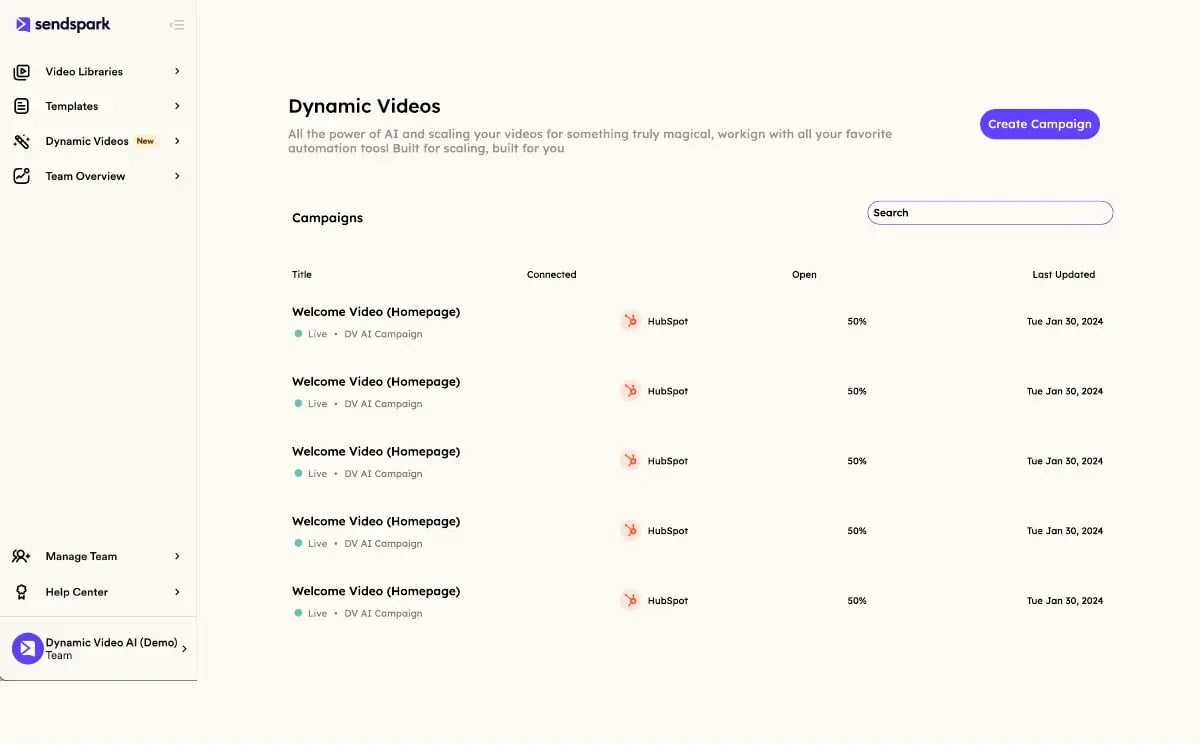
You can trigger a personalized win-back video automatically the moment a CRM record flips to a dormant or churned status, using the same automation mechanism Sendspark already uses for new-lead and demo-booked workflows. This means you don’t have to manually build and launch a win-back campaign every time your health-score dashboard flags a new batch of lapsed accounts.
Sendspark’s Agentic Workflows pair one trigger with one or more actions. The trigger list includes form submissions, demo bookings, webpage visits, and — the one that matters here — a lead status met condition. In a HubSpot workflow, that condition can be “lifecycle stage changes to Churned” or a custom “Account Status” property flipping to “At Risk.” When that condition fires, the connected action generates a dynamic video pulling the contact’s name, company, and website, then routes it into an email send — the exact chain HubSpot’s own workflow actions already support for Sendspark’s “Create a Dynamic Video” step.
Advanced strategy
Build the suppression rule into the same workflow logic, not as an afterthought: cap the sequence at three touches, and have the workflow automatically remove a contact from future win-back triggers once they reply, click, or hit the attempt limit. This keeps a CRM-triggered motion from quietly turning into an un-suppressed drip that erodes deliverability over time. Each video does consume a dynamic video minute against your plan’s AI credit allocation, so the ICP-and-engagement scoring from earlier in this guide isn’t just a targeting exercise — it’s also what keeps a large win-back batch from quietly burning through a month’s credits on accounts that were never going to convert back.
This is the same underlying mechanism covered in our guide to scaling QBRs with video — the goal in both cases is to make proactive, personalized touchpoints a scheduled habit rather than a manual, easy-to-skip task. The difference is timing: a QBR cadence is designed to keep accounts from going dormant in the first place, while a win-back trigger activates after they already have. Most teams running this as a customer success-owned motion pair it with a health-score drop rather than a hard “churned” status, so the first video goes out while the account is still reachable, not months after the relationship is already cold.
If your dormant-account problem is closer to active accounts showing early expansion signals rather than fully churned ones, that’s a different motion — see our customer expansion playbook for the upsell/cross-sell side of this same lifecycle. And for the follow-up cadence once a dormant account actually replies, our reply-handling guide covers how to route different response types without dropping the thread.
| Churn Type | Signal | Message Angle |
|---|---|---|
| Silent churn | Usage drops to zero, no cancellation call | “Here’s what’s new” — new features/updates since they left |
| Price-sensitive churn | Budget cut, cheaper alternative cited at cancellation | Value reframe — cost of the cheaper option, not a bigger discount |
| Competitor-switch churn | Named rival mentioned at cancellation | Specific differentiators + case studies of accounts that switched back |
| Involuntary churn | Failed payment, reorg, budget freeze | Remove friction — flexible terms, ROI summary for a new approver |
Published October 2026
Frequently Asked Questions
What is a B2B win-back campaign?
A B2B win-back campaign is a targeted outreach sequence designed to re-engage accounts that have already gone dormant or churned, as opposed to a retention campaign, which targets accounts that are still active but showing early risk. Win-back campaigns typically combine segmentation by churn reason, a specific timing window, and multi-channel sequencing.
How soon should you send a win-back message after an account goes dormant?
Most B2B teams trigger the first touch between 30 and 90 days after an account goes quiet, though recommendations vary by vendor — Klaviyo suggests waiting six months, while Marketo recommends 90 days. The right window depends on your typical usage cadence and sales cycle length, so it’s worth testing against your own data rather than copying a single benchmark.
Is it worth trying to win back every churned account?
No. Prioritize accounts by ICP fit and prior engagement signal rather than targeting every lapsed account equally. An account that was a poor product fit or showed minimal engagement before churning is unlikely to respond no matter how good the campaign is, and chasing it wastes reactivation budget that would convert better elsewhere.
What are the main types of B2B customer churn?
The four most common types are silent churn (usage quietly drops to zero), price-sensitive churn (the account left over cost), competitor-switch churn (they moved to a named rival), and involuntary churn (external factors like a failed payment or budget freeze forced the exit). Each type responds better to a different message angle than a one-size-fits-all “we miss you” email.
Does personalized video actually work better than email for win-back campaigns?
Personalized video tends to outperform templated email for win-back specifically because it signals individual effort in a way a merge-tagged email can’t — the recipient can tell the difference between a message written for everyone on a list and one that references their own company or situation. AI voice cloning and dynamic backgrounds let a rep get that effect from a single recorded video rather than recording one-off clips for every account.
Can win-back videos be triggered automatically from a CRM?
Yes. Sendspark’s Agentic Workflows can trigger off a “lead status met” condition — for example, a HubSpot lifecycle stage changing to “Churned” — and automatically generate and send a personalized video using the same trigger-and-action mechanism used for new-lead or demo-booked workflows, just pointed at a different signal.
How many times should you follow up with a dormant account before giving up?
Three attempts is a common default before suppressing a non-responding contact from further win-back sends. Continuing to message a dead segment indefinitely risks your sender reputation and inbox placement for the contacts who are still engaging, so build a suppression rule into the sequence rather than relying on manual cleanup.
Sources & References
- SaaStr / Jason Lemkin — “The #1 thing you can and should do is create a series of marketing campaigns targeted only to churned customers,” plus RevenueCat data showing ~12% of lapsed paying subscribers return on their own (2026)
- Digital Applied — “Reactivating a lapsed customer costs roughly 5-7x less than acquiring a new one,” win-back probability 20-40% vs. 5-20% for a cold prospect (2026)
- Baremetrics — “Approximately 50% of paying SaaS customers only use a product once per-month”; Klaviyo recommends six months of inactivity before a winback send, Marketo suggests 90 days
- UnboundB2B — “Prioritize accounts that align with the current ideal customer profile (ICP) and demonstrate positive signals, such as previous high engagement or recent website activity” (2025)
Record One Video. AI Personalizes Thousands.
Sendspark is the AI video personalization platform for B2B sales. Record once, and AI voice cloning generates thousands of individually personalized videos with dynamic backgrounds and personalized thumbnails — each prospect hears their name, sees their website, in your voice. Sales teams see 2-3x more replies.
Get Started Now