Most sales reps lose the deal before the demo ever happens. The first sales call is where prospects decide whether you’re worth their time — and most reps wing it with no clear structure, no agenda, and no plan for what comes next. A prepared, intentional first call is the fastest path from a cold name in your CRM to a booked second meeting. This guide gives you a 5-phase framework, word-for-word scripts, and a follow-up strategy that drives 2-3x more second meetings.
Key Takeaways
- A first sales call’s primary goal is discovery, not closing — reps who ask more questions win 2x more often than those who lead with a pitch.
- Pre-call preparation (research + a personalized AI video warm-up) dramatically increases show rates and makes the first 60 seconds far easier.
- A 5-phase structure — rapport, agenda-setting, discovery, value intro, next steps — keeps calls focused and under 45 minutes.
- Eight open-ended discovery questions beat any pitch: your job is to understand their pain, not recite your features.
- Sending an AI-personalized video recap within 24 hours of the call doubles second-meeting bookings compared to a plain follow-up email.
What Is a First Sales Call?
A first sales call is the first scheduled, one-on-one conversation between a sales rep and a qualified prospect. Its primary purpose is discovery — understanding the prospect’s situation, uncovering real pain, and deciding together whether a deeper conversation makes sense. It is not a demo, not a pitch, and not a close. Reps who treat the first call as a discovery conversation consistently outperform those who treat it as a sales presentation.
First sales calls come in three main forms:
- Cold call — an outbound call placed without prior relationship or prior outreach touchpoint
- Warm outbound call — a call booked after an email, LinkedIn message, or personalized video sequence (the most common scenario in modern B2B sales)
- Inbound booked call — a prospect who found you and booked through your website or calendar link
Regardless of how the prospect arrived, the objective of the first call is the same: build enough rapport and surface enough information to earn a second conversation. According to RAIN Group’s research on top sales performers, buyers are far more likely to advance a deal when the rep leads with genuine curiosity rather than a prepared pitch. The best first sales calls are 70% listening and 30% speaking.
The first call also sets the tone for the entire relationship. Prospects who feel heard and respected after the first call are significantly more likely to show up for follow-on meetings, engage with your follow-up content, and ultimately buy. The stakes are high — which is why preparation matters.
“Buyers don’t want to be sold to — they want to be understood. The reps who win the most deals are the ones who invest the first call entirely in understanding the prospect’s world before they say a word about their product.”
— RAIN Group, What Sales Winners Do Differently (2023 research study, 488 B2B buyers surveyed)
How to Prepare Before Your First Sales Call
Sales call preparation is the single biggest lever on first-call success. Reps who spend 20-30 minutes researching a prospect before the call convert at double the rate of those who dial cold. Strong preparation means you already know their pain before they tell you — and that makes every question land sharper and every answer feel more relevant. Curious how phone-based first calls stack up against video outreach? See our cold calling vs. video prospecting comparison.
1. Research the Prospect and Their Company
Before the call, open LinkedIn and the company website and answer five questions: What’s their title and how long have they been in the role? What does their company actually do and who are their customers? Have they recently raised funding, launched a product, or made a hire that’s relevant? What’s their tech stack (check BuiltWith or their job postings)? Have they posted or engaged with content about topics related to your solution? Ten minutes of research gives you 3-4 personalized observations you can use in the first two minutes to build instant rapport.
2. Set and Share a Clear Call Agenda
Send your agenda 24 hours before the call. Something as simple as a two-sentence email — “Our goal is to spend 30 minutes understanding your current [situation], see if there’s a fit, and if so, confirm a next step. I’ll start by asking you a few questions about [topic]. Sound good?” — removes ambiguity, sets expectations, and signals that you respect their time. Prospects who receive an agenda before a call are significantly more likely to show up and engage seriously.
3. Warm Up With an AI-Personalized Video
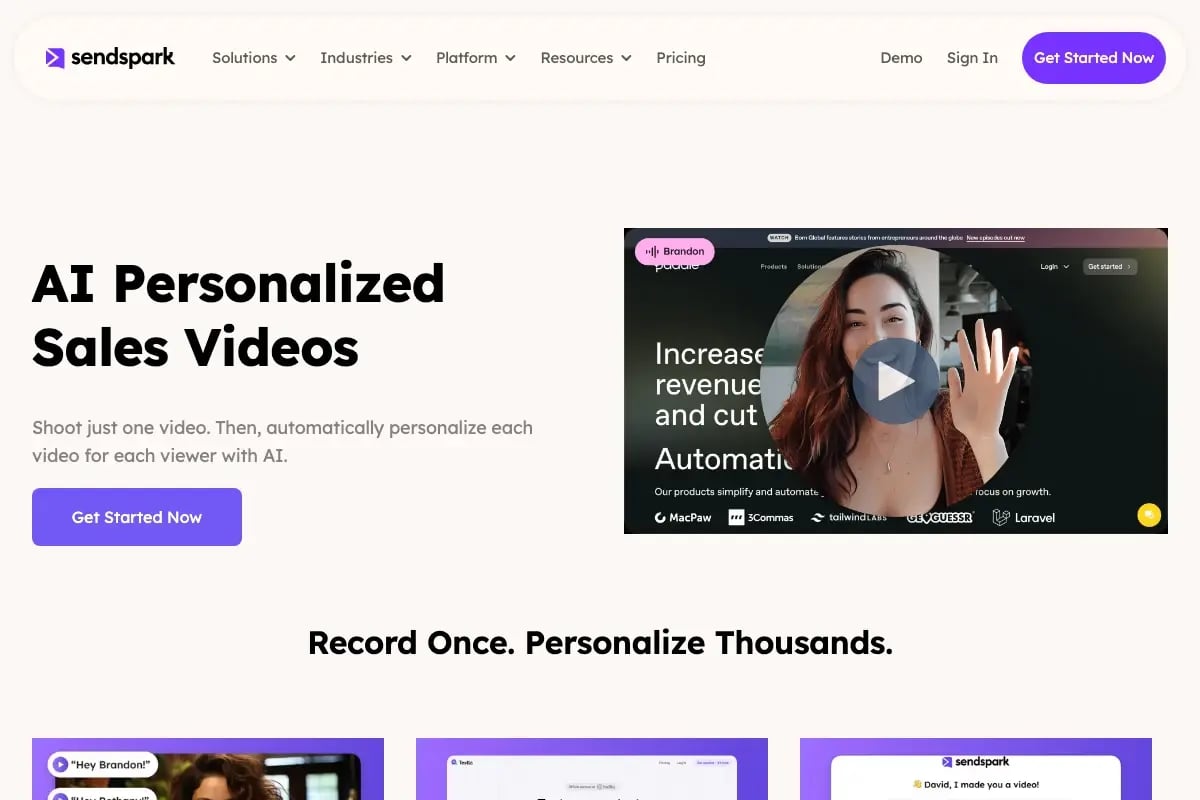
One of the highest-leverage pre-call moves you can make is sending a short personalized video 24-48 hours before the call. Using Sendspark’s AI video personalization platform, you record one short 60-second intro video and AI voice cloning automatically generates a personalized version for each prospect — greeting them by name, in your voice, with their company’s website shown as the dynamic background behind you. When a prospect has already seen your face and heard your voice before the call, the first 60 seconds of awkward small talk evaporate. Show rates increase significantly. And prospects enter the call already predisposed to trust you.
Pro tip
Keep your pre-call video to 60 seconds or less. The goal is "I know who this person is" — not a pitch. Mention one specific thing you noticed about their company to show you did your homework, then confirm the agenda. That's it.
4. Prepare 8-10 Discovery Questions
Write down eight discovery questions before every first sales call — specific, open-ended questions that uncover their current situation, pain, impact, previous solutions tried, decision process, and timeline. Don't improvise this on the call. Having your questions ready means you can focus 100% on listening to the answers instead of thinking about what to ask next. See the complete list of discovery call questions that top B2B reps rely on.
5. Define Your Target Outcome Before You Dial
Know what a "win" looks like before the call starts. For most first sales calls, the target outcome is not a closed deal — it's a confirmed second meeting with the right stakeholder. Write it down: "The call is successful if I leave with a clear pain point, a confirmed next meeting, and one internal champion." This focus prevents you from drifting into a premature pitch when discovery is still incomplete.
Record One Video. AI Personalizes Thousands.
Sendspark is the AI video personalization platform for B2B sales. Record once, and AI voice cloning generates thousands of individually personalized videos with dynamic backgrounds and personalized thumbnails — each prospect hears their name, sees their website, in your voice. Sales teams see 2-3x more replies.
Get Started NowFirst Sales Call Structure: A 5-Phase Framework
The most effective first sales calls follow a five-phase structure that keeps the conversation on track, respects the prospect's time, and ensures you never leave without a clear next step. Total call time: 30-45 minutes. Each phase has a specific goal, and moving smoothly between them is what separates top-performing reps from average ones.
| Phase | Duration | Rep Goal | Key Action |
|---|---|---|---|
| 1. Rapport | 2-3 min | Build trust quickly | Brief personal connection, acknowledge any prior touchpoints (video watched, email replied) |
| 2. Agenda-setting | 1-2 min | Set mutual expectations | Confirm call length, outline the plan, ask permission to take notes, invite them to share their goals |
| 3. Discovery | 15-20 min | Understand pain and fit | Ask open-ended questions, listen 70%, take notes on exact language they use to describe their problem |
| 4. Value intro | 5-8 min | Connect solution to their pain | Only after discovery: briefly explain how you solve the specific pain they just described, using their own language |
| 5. Next steps | 3-5 min | Secure a committed next step | Confirm the next meeting before hanging up — date, time, attendees, and what you'll cover |
The most common mistake is skipping straight from rapport to value intro. Discovery is the engine of the entire sale. Gong's analysis of over 1 million B2B sales calls found that reps who ask 11-14 questions during the first call have a 74% higher close rate than those who ask fewer than 4. Every minute you spend in discovery is compounding interest on the rest of the deal.
Also notice that Phase 4 (value intro) comes after discovery — not before. Too many reps front-load their pitch in the first five minutes, before they know anything about the prospect's actual situation. This is the single most common first-call mistake, and it signals to the prospect that you care more about your quota than their problem.
What to Say on Your First Sales Call: Scripts and Phrases
The best first-call scripts are mostly questions, not monologues. Your goal is to surface enough information that by the end of Phase 3, you understand the prospect's pain better than they do. Here are the core scripts and phrases that structure a first sales call from open to close.
Opening Script (30-45 Seconds)
Start warm, reference something specific, and immediately hand them the floor:
"Hey [Name], great to finally connect — I noticed [specific thing: your team just expanded to the enterprise segment / saw your recent post about SDR ramp times / loved that you replied to my video]. I only have us scheduled for 30 minutes, so I want to make sure we use the time well. My plan was to ask you a few questions about [topic], share what we do briefly if it seems relevant, and then figure out together if a next step makes sense. Does that work for you? And is there anything specific you wanted to cover?"
This opening does three things: builds rapport with a personalized reference, sets a respectful agenda, and immediately invites them to direct the conversation. That last piece — "is there anything specific you wanted to cover?" — is underrated. When a prospect adds their own item to the agenda, they immediately feel ownership over the call.
8 Discovery Questions That Uncover Real Pain
These questions move through the BANT framework (Budget, Authority, Need, Timeline) while staying conversational. Use them in any order that fits the conversation — don't read them off a list:
- "Walk me through how you're currently handling [the problem your product solves]. What does that process look like today?"
- "What's the biggest friction point in that process right now?"
- "How long has this been a problem, and what have you tried so far?"
- "What's the business impact when this isn't working well — in terms of time, revenue, or rep morale?"
- "Who else is involved in decisions like this — is it just you, or are there others I should be talking to?"
- "If you solved this perfectly in the next 90 days, what would success look like?"
- "Is there a specific trigger that made you take a call on this now versus six months ago?"
- "On the investment side, do you have a budget allocated for this, or is that something you'd need to build a case for?"
After each answer, follow up with a simple "Tell me more about that" or "What do you mean by [their exact phrase]?" Repeating their exact language back to them as a question is one of the most powerful listening techniques in sales, and it immediately signals that you're paying attention.
Common mistake
Don't launch into your product pitch the moment you hear a pain point. Acknowledge it, dig deeper, and ask about impact first. Rushing to your solution before you fully understand their problem is the fastest way to lose credibility on a first call.
The Bridge Phrase: Discovery to Value
Once discovery is complete, transition to your value intro with a phrase that explicitly connects what you heard to what you offer. This is called the bridge:
"Based on what you just described — specifically [the specific pain they named in their words] — that's exactly the problem we built Sendspark to solve. Let me show you the three ways we help teams like yours address that…"
Notice you're using their exact language. Mirroring their phrasing makes your solution feel custom-built for them, even if it's the same product you pitch every day. The core of that bridge is really a compressed elevator pitch — see our B2B sales elevator pitch examples for the same hook-solution-proof-CTA structure adapted to seven different channels.
Closing the Call: Locking In the Next Step
Never end a call with "I'll send you some information." That's a dead-end. Every first sales call should end with a confirmed next step:
"Based on everything you've shared, it sounds like [restate their main pain] is the priority. The logical next step for us would be a 30-minute demo where I show you exactly how we'd solve [specific thing]. I have [Tuesday at 2pm] or [Thursday at 10am] available — which works better for you?"
Always offer two specific time slots. "Does next week work?" gives them an easy out. Two concrete options force a binary decision and dramatically increase the booking rate. For more on effective B2B sales techniques that work across the full funnel, see our dedicated guide.
How to Follow Up After Your First Sales Call
The first sales call does not end when you hang up. How you follow up in the next 24 hours directly determines whether the deal moves forward. Research from Salesforce's State of Sales report shows that 80% of deals require at least five follow-up touches after initial contact, yet 44% of sales reps give up after just one. Being the rep who consistently follows up — and does it well — is one of the highest-leverage habits in B2B sales.
What Your Follow-Up Should Include
A strong post-first-call follow-up contains four elements:
- A brief recap of what you covered — 2-3 bullet points restating their key pain points in their own words. This shows you listened and creates a paper trail they can forward internally.
- The specific next step you confirmed — the exact date, time, and what you'll cover in the next meeting. Send the calendar invite within the hour.
- One insight tailored to their situation — a relevant case study, a stat about their industry, or a link to a resource that directly addresses something they mentioned. This is what separates "checking in" from providing real value.
- A clear ask — "Please confirm the invite" or "Let me know if you have any questions before Thursday." Keep it simple.
Why an AI-Personalized Video Follow-Up Wins
The most effective post-first-call follow-up isn't an email — it's a personalized video. When a prospect receives a video recap that shows their company's website as the background and hears you greeting them by name, it creates a standout moment in an inbox full of identical text emails. Sendspark's AI-personalized video platform makes this easy at scale: record one short recap video, and the AI voice cloning technology automatically generates a personalized version for each prospect — using your cloned voice to say their name and showing their company's website behind you. Sales teams using this approach see 2-3x more second-meeting bookings compared to standard follow-up emails.
Here's how to use it: record a 90-second video that covers three things — what you heard, what you think the right next step is, and a genuine thank-you for their time. Then use Sendspark to personalize it at scale if you're running multiple first-call follow-ups in parallel, or send a single custom version for high-priority prospects. Link to the video in your email subject line ("Quick video recap from our call") and track opens with Sendspark's video analytics so you know exactly when they watched it — and when to follow up again.
Post-First-Call Follow-Up Email Template
Subject: Quick recap + [DATE] confirmed
Hi [Name],
Great talking today. Here's a quick recap of what we covered:
- [Their pain point #1, in their words]
- [Their pain point #2]
- Goal: [What success looks like for them in 90 days]
Based on that, I think the next step is [what you agreed on]. I've sent a calendar invite for [DATE/TIME] — please confirm when you get a chance.
In the meantime, I recorded a short 90-second video recap that covers how we've solved [their specific pain] for [similar company type]. [VIDEO LINK]
Talk soon,
[Your Name]
For a deeper playbook on post-meeting follow-up cadences, check our guide on post-demo follow-up sequences — many of the same principles apply directly after a first call. And if you want the full qualification call framework that turns first calls into second meetings, see our qualification call guide.
Follow-Up Method Comparison
| Follow-Up Method | Average Reply Rate | Time to Send | Best For |
|---|---|---|---|
| Plain text recap email | 15-20% | Under 1 hour | Low-priority prospects, high volume |
| AI-personalized video recap (Sendspark) | 45-60% | Under 2 hours | All prospects — especially mid/high priority |
| LinkedIn message + email | 20-30% | 1-4 hours | Decision-makers active on LinkedIn |
| No follow-up | ~2% | — | Never — always follow up |
Use Sendspark's HubSpot integration to log your video send and track engagement directly inside your CRM. When the video analytics show a prospect watched your recap twice, that's your signal to call them same-day. You can also use Sendspark's sales prospecting tools to tie your pre-call video warm-up and post-call follow-up into a single, trackable outreach sequence.
Published July 2026
Frequently Asked Questions
How do you make a first sales call go well?
A first sales call goes well when you prepare thoroughly (research the prospect, set an agenda, send a pre-call video warm-up), follow a structured framework (5 phases: rapport, agenda, discovery, value, next steps), and listen far more than you speak. The most successful first calls end with a confirmed next meeting and a strong sense that you understand the prospect's problem better than anyone else they've talked to.
What is the 3-3-3 rule in sales?
The 3-3-3 rule is a prospecting framework: research 3 things about the company, 3 things about the individual, and review 3 recent news events or social posts before a call. It ensures you have enough personalization material to open with a genuinely relevant observation instead of a generic opener. While it's mostly used for cold calling prep, it applies equally well to any first scheduled conversation.
Should you try to close on the first sales call?
No — for most B2B deals, closing on the first call is counterproductive. The goal of the first call is discovery and qualifying, not closing. Pushing for the close before you understand the prospect's situation fully signals impatience, destroys trust, and usually results in a "let me think about it" that goes nowhere. The only exception: very low-complexity, short-cycle transactional sales where the prospect has done extensive self-research before the call.
How long should a first sales call be?
Thirty to 45 minutes is the ideal length for a first sales call. Long enough to complete all five phases properly (rapport through next steps), short enough to stay focused and respect the prospect's calendar. Always confirm the call duration in your agenda email beforehand. If you find the conversation naturally running long, explicitly check in: "We said 30 minutes — are you okay to go a few more minutes?" Most engaged prospects will say yes.
What should you do if a prospect is unresponsive after the first call?
Follow up at least three times across different channels before marking them as unresponsive. Try: (1) a personalized video recap within 24 hours, (2) a brief LinkedIn message 3 days later referencing something specific from your conversation, and (3) a break-up email at day 7 that gives them an easy way to re-engage or officially pass. In many cases, the third touch is the one that gets a response — most reps give up after the first.
How do you handle objections on a first sales call?
The most common first-call objections are "we're already using something," "not the right time," and "send me more information." For the first: "That's helpful context — what's working well about what you have, and what gaps are you still running into?" For the second: "Totally understand. Out of curiosity, what would need to change to make it the right time?" For the third: "Happy to do that. What specifically would be most useful — a case study, a product overview, or pricing?" Each response turns an objection into a discovery question. See our full guide to common sales objections for scripts covering the other five you'll hit later in the cycle.
Sources & References
- RAIN Group — "What Sales Winners Do Differently: Buyers prefer sellers who lead with genuine curiosity and listening over those who front-load their pitch" (2023 research, 488 B2B buyers surveyed)
- Gong Revenue Intelligence — Analysis of over 1 million B2B sales calls: reps who ask 11-14 questions in the first call have significantly higher close rates; optimal talk-to-listen ratio is 46% rep / 54% prospect (2024)
- Salesforce State of Sales — 80% of deals require 5+ follow-up touches after initial contact; 44% of reps give up after one follow-up attempt (2024)
- Harvard Business Review — "The End of Solution Sales": B2B buyers are 57% through the purchase decision before engaging a sales rep; discovery-led reps consistently outperform pitch-led reps (2012)
- Gartner — B2B buying journey research: the average B2B deal involves 6-10 decision-makers, making first-call qualification of buying committee essential (2023)
Record One Video. AI Personalizes Thousands.
Sendspark is the AI video personalization platform for B2B sales. Record once, and AI voice cloning generates thousands of individually personalized videos with dynamic backgrounds and personalized thumbnails — each prospect hears their name, sees their website, in your voice. Sales teams see 2-3x more replies.
Get Started Now </div>Send Personalized Videos at Scale
Record once and personalize for every prospect with AI. Sales teams see 2-3x more replies.
Try Sendspark Free No credit card required