
B2B sales is won or lost on technique. The reps who consistently hit quota aren’t necessarily the most charming or the hardest working — they use a repeatable set of structured approaches that move complex, multi-stakeholder deals from first contact to signed contract. This guide covers 12 proven B2B sales techniques, how they differ from B2C, and how to build your own technique stack that compounds over time. For a broader set of tactics, explore our proven B2B sales tips to put these techniques into practice — ranked by impact.
Key Takeaways
- B2B sales cycles average 6–9 months and involve 6–10 stakeholders — techniques that build consensus matter more than one-on-one persuasion.
- The Challenger Sale (teaching, tailoring, taking control) outperforms relationship selling — CEB/Gartner research found Challengers make up 40% of high performers despite being just 27% of reps.
- Multi-threading — engaging 3+ stakeholders simultaneously — dramatically cuts deal loss risk when a single champion goes dark or leaves.
- AI-powered video personalization drives 200–300% higher email response rates by combining personal touch with scalable delivery across thousands of prospects.
- The most effective B2B reps layer 3–5 techniques into a repeatable playbook — consultative discovery at the top, champion-building in the middle, value-based closing at the end.
What Are B2B Sales Techniques?
B2B sales techniques are structured approaches that help reps move business buyers from awareness to signed contract. Unlike B2C, B2B deals involve 6–10 decision-makers, cycles of 6–9 months, and high contract values — so techniques that build consensus and quantify ROI outperform pure persuasion tactics.
Selling to businesses is fundamentally different from selling to consumers. B2B buyers operate within complex organizations where purchasing decisions impact entire teams, departments, or the whole company. According to Gartner’s B2B buying journey research, the average B2B buying group involves 6–10 stakeholders, each with different priorities, risk tolerances, and definitions of success.
This complexity means a technique that works in consumer sales — urgency, social proof, one-on-one rapport — often falls flat in B2B. Mastering a handful of structured techniques is what separates reps who consistently hit quota from those who rely on luck and relationships. The 12 techniques below span the full sales cycle, from discovery through close.
12 Proven B2B Sales Techniques That Drive Results
High-performing B2B reps rarely rely on a single technique. They layer 3–5 methods into a repeatable playbook tailored to their deal size, buyer profile, and funnel stage. These 12 techniques span the full cycle — from opening conversations to closing multi-stakeholder deals.
1. Consultative Selling (SPIN)
Consultative selling focuses on diagnosing a prospect’s needs before prescribing a solution. Instead of opening with features, reps ask structured questions to uncover pain, its implications, and the value of solving it. Neil Rackham’s SPIN Selling codifies this as four question types: Situation, Problem, Implication, and Need-payoff.
The contrast with the “show up and throw up” product demo is stark. Rather than overwhelming buyers with information, consultative reps position themselves as trusted advisors. A simple example: instead of explaining your product, ask “What happens to your pipeline if this problem isn’t solved by Q3?” That question forces the buyer to quantify the cost of inaction — and that’s when deals start moving.
2. The Challenger Sale
Based on CEB/Gartner research published in Harvard Business Review, the Challenger Sale identifies the rep profile that consistently outperforms all others. Challengers teach, tailor, and take control rather than simply building relationships. They challenge a prospect’s assumptions, reframe the problem, and lead with insights the buyer hadn’t considered.
The data is clear: Challengers make up only 27% of reps but represent 40% of high performers. Practically, this means leading your discovery call with a compelling industry reframe — something the buyer doesn’t already know about their own business — that creates urgency around your solution.
“The single most valuable attribute in a high-performing sales rep is not relationship building. It is the ability to teach customers something new about their own business that leads them to value your solution.”
— Matthew Dixon and Brent Adamson, The Challenger Sale (CEB Research, via Harvard Business Review)
3. MEDDIC Qualification
MEDDIC is a qualification framework that helps reps determine whether a deal is winnable before investing weeks of effort. It covers: Metrics, Economic Buyer, Decision Criteria, Decision Process, Identify Pain, and Champion. Map each element in your first discovery call and revisit at every stage.
Understanding the Economic Buyer (who controls the budget) and Decision Criteria (what factors drive the final choice) early on prevents wasted time on deals that can’t close. For a deeper look at how this fits into a structured process, see our guide to the lead qualification process. If you’re deciding between MEDDIC, SPIN, Challenger, or Sandler as your team’s primary framework rather than picking pieces of each, see our full sales methodology comparison.
4. Multi-Threading
Multi-threading means engaging 3 or more stakeholders at different levels within a target account simultaneously. This is non-negotiable in enterprise B2B. Gartner’s research notes that 77% of B2B purchases are “complex” — involving buying committees rather than individual decisions. When you single-thread a deal and your one champion leaves or goes dark, the deal dies.
Map your account’s org chart early. Ask your champion directly: “Who else needs to feel confident about this decision for it to move forward?” Use that answer to get introductions. For more on managing multi-stakeholder deals, see our pipeline review framework.
5. Value-Based Selling
Value-based selling shifts the conversation from product features and price to quantified business outcomes. The frame that works: the cost of inaction is higher than the cost of your solution. Build a simple ROI model for your most common buyer profile and use it in every conversation. See our full breakdown of value selling versus consultative and solution selling for when each philosophy wins and how to blend them across a single deal.
For example: “If this gets you 200% more replies on outreach, and each reply is worth $X in pipeline, what’s the annual impact?” Tying your solution directly to the buyer’s P&L makes price conversations secondary. This approach also connects naturally to AI-powered personalization — higher response rates translate directly to more pipeline.
6. Account-Based Selling
Account-based selling (ABS) treats individual high-value accounts as markets of one. Deep research before any outreach — company news, hiring trends, LinkedIn activity, product announcements — allows you to hyper-personalize every touchpoint. The signal this sends: “I did my homework, and I’m talking specifically to you.”
ABS scales best when paired with AI-powered personalized video. Instead of writing 50 custom emails, you record one video and use an AI video personalization platform to generate individually personalized versions — each showing the prospect’s own website in the background and addressing them by name in your voice. That combination of research-depth and delivery-scale is the modern account-based approach.
Record One Video. AI Personalizes Thousands.
Sendspark is the AI video personalization platform for B2B sales. Record once, and AI voice cloning generates thousands of individually personalized videos with dynamic backgrounds and personalized thumbnails — each prospect hears their name, sees their website, in your voice. Sales teams see 2-3x more replies.
Get Started Now7. Social Selling
Social selling uses LinkedIn to build relationships and warm up prospects before any cold outreach. According to HubSpot sales research, social selling leaders are 51% more likely to hit their quota compared to reps who don’t engage on social channels. The mechanism: consistent content, genuine comments on target buyers’ posts, and warm DMs replace cold opens with something far more welcome.
The key mistake to avoid: treating social selling as a direct replacement for outbound. It’s a warming technique. Use it to create name recognition and trust, then convert that goodwill into a meeting with a value-led direct message.
8. AI-Powered Personalized Video Outreach
AI-powered personalized video outreach is one of the highest-impact modern B2B sales techniques for breaking through to busy decision-makers. It solves the traditional personalization bottleneck: recording individual videos for hundreds of prospects is impossible at scale, but generic videos get ignored.
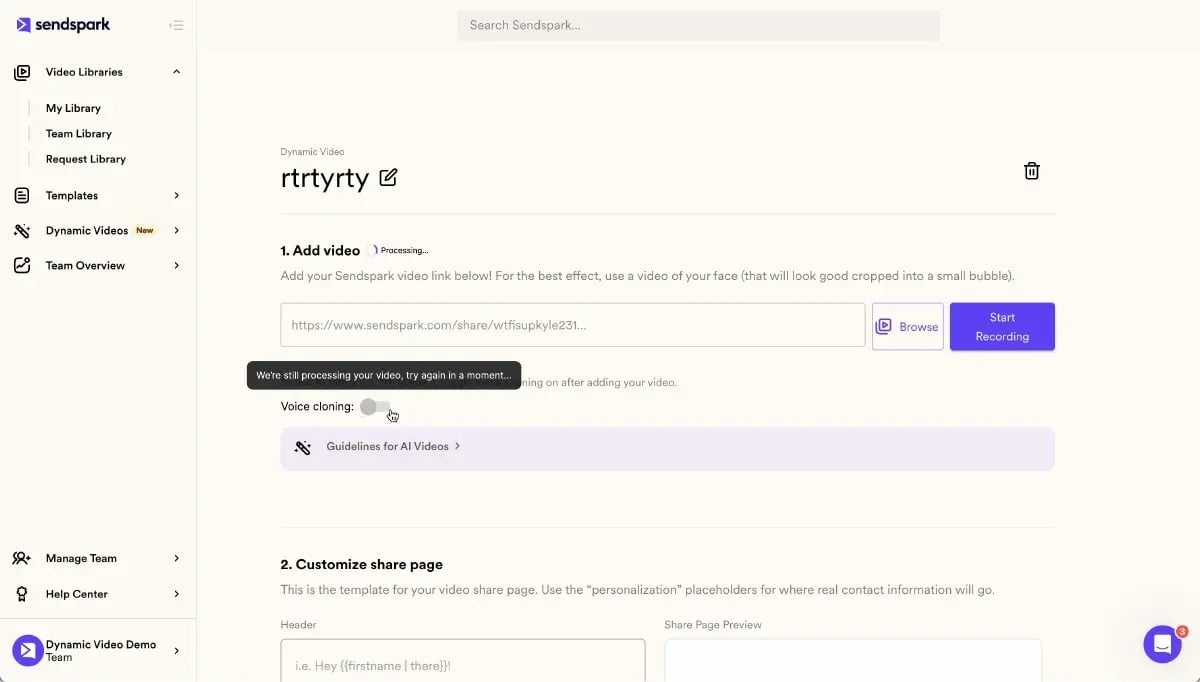
With an AI video personalization platform like Sendspark, you record one video, personalize at scale for every prospect on your list. AI voice cloning generates a personalized intro for each recipient — speaking their name and company — while dynamic backgrounds show their website or LinkedIn profile behind you. Sendspark users consistently report 200–300% higher email response rates, and Update AI saw 2x more LinkedIn replies. Explore how AI-personalized video transforms prospecting and how AI intros work.
Advanced strategy
Use Sendspark’s AI to personalize at Level 4 — showing each prospect’s own website as the video background. This signals genuine research and stops the scroll better than any subject line.
9. Objection Reframing
Objection reframing turns common buyer resistance into an opportunity to reinforce value. The three most common B2B objections — “too expensive,” “we already have something,” and “not the right time” — can each be reframed using the same pattern: acknowledge → reframe → redirect to pain.
For “too expensive”: “I understand budget matters. Let’s look at it differently — what’s the cost to the business if this problem isn’t solved by Q1?” This cost-of-inaction close shifts the frame from “how much does this cost?” to “how much is inaction costing you?” That’s a conversation you can win. For scripts covering the other 7 most common B2B objections, see our full guide to sales objection handling, and for the full set of closing tactics beyond this one, see our complete guide to sales closing techniques.
10. Champion-Building
Your champion is the internal advocate who sells your solution when you’re not in the room. A true champion has power (influence over the decision) and motivation (a personal or professional stake in the outcome). This distinguishes them from a “coach” — someone who shares intel but can’t drive the deal.
Once you identify your champion, equip them to sell internally: a sharp one-pager, a customized ROI calculation, or an AI-personalized video outreach overview tailored to their executive team. The champion’s internal sell is often the deciding factor. This connects directly to strong B2B lead nurturing — ongoing value delivery keeps your champion engaged and well-armed.
11. Follow-Up Cadence Optimization
B2B deals rarely close on the first or second touch. RAIN Group research shows it takes an average of 8 touches to get a first meeting from a cold B2B prospect. A well-structured cadence combines email, LinkedIn, phone, and personalized video — and each touch must add new value, not just “check in.”
Share a new case study, a relevant stat, a short personalized video recap. For more on building a high-conversion cadence, see our guide to follow-up cadence optimization.
Common mistake
Following up with “just checking in” adds zero value and trains your prospect to ignore you. Every touch must give the buyer a new reason to respond.
12. AI-Assisted Deal Insights
AI-assisted deal insights help reps prioritize effort based on real engagement signals rather than gut instinct. By integrating CRM data with content engagement — video opens, email clicks, document views — you can identify which deals are heating up and which are stalling before they slip.
Sendspark’s video analytics show exactly when a prospect watched your video, how far they got, and whether they clicked the CTA. If someone watches 90% of your AI-personalized video and clicks the pricing link, follow up within the hour — that engagement signal beats any lead score. Connect to HubSpot to route those signals directly into your CRM pipeline.
B2B vs. B2C Sales Techniques: Key Differences
B2B sales require different techniques than B2C because deals involve multiple decision-makers, longer timelines, and larger contract values. B2C persuasion works through emotion and impulse; B2B selling works through logic, ROI proof, and stakeholder consensus. For concrete real-world applications of these techniques, see our guide to B2B sales examples with word-for-word scripts.
| Factor | B2B Sales | B2C Sales |
|---|---|---|
| Decision makers | 6–10 stakeholders | 1–2 people |
| Cycle length | 3–12 months | Minutes to days |
| Primary driver | ROI + risk mitigation | Emotion + price |
| Best techniques | MEDDIC, Challenger, multi-threading | AIDA, social proof, urgency |
| Follow-up cadence | 8–15 touches over weeks | 1–3 touches |
| Personalization level | Account- and role-level research | Segment-level messaging |
The biggest structural difference: B2B buying committees mean no single person can say yes alone — but almost anyone can say no. Every stakeholder brings their own risk threshold, success metrics, and political priorities. Techniques like multi-threading, champion-building, and MEDDIC exist specifically to navigate this complexity.
B2C urgency tactics (“only 2 left!”) typically backfire in B2B — they feel manipulative to buyers who know their purchasing process takes months. What works instead is quantifying the cost of the current state and the cost of inaction, both of which are core to value-based selling and the Challenger approach.
How to Build Your B2B Sales Technique Stack
The most effective B2B reps don’t use all 12 techniques in every deal. They build a personal technique stack — 3–5 methods that match their deal type, buyer profile, and funnel stage — and master those completely before adding more.
Start by mapping techniques to where they perform best in the funnel:
- Top of funnel (prospecting): Social selling, AI-powered personalized video outreach, consultative opening questions
- Mid funnel (evaluation): Challenger reframe, multi-threading, champion-building, value-based ROI models
- Late funnel (negotiation/close): Objection reframing, deal insights, cost-of-inaction close
For team leaders, the goal is to build a shared technique stack codified in a playbook: which question to ask at discovery, how to structure the Challenger reframe, what content to send a champion. When the whole team uses the same techniques consistently, you can measure what’s working and optimize systematically. See our resources on sales coaching and the B2B sales cycle for how to structure that training.
Track technique effectiveness in your CRM. For deals that closed, which technique combinations were used? For losses, where did deals stall? Over time, this data tells you which technique stack works for your specific buyer profile — and that’s a competitive advantage most teams never build.
Common B2B Sales Mistakes That Undermine Your Techniques
Even reps who know the right techniques make predictable process mistakes that kill deals. The five below show up in almost every losing pipeline review — and each one has a direct fix tied to the techniques above.
- Pitching before diagnosing. Leading with a product demo before understanding the buyer’s pain. Fix: use SPIN questions in every first meeting before you show anything.
- Single-threading. Relying on one contact. Fix: map the org chart early and ask your champion for introductions to other stakeholders.
- Generic outreach. Same email to every prospect, no personalization. Fix: research each account before outreach — or use AI-personalized video to scale that research signal at volume.
- Empty follow-ups. “Just checking in” messages. Fix: add one new piece of value (stat, case study, personalized video) to every follow-up touch.
- Skipping champion-building. Not identifying an internal advocate. Fix: ask your main contact directly who else will influence the decision and start engaging those people early.
| Mistake | Old approach | Better approach |
|---|---|---|
| Pitching first | Open with product demo | Lead with SPIN diagnostic questions |
| Single-threading | One champion contact | Map the full buying committee |
| Generic outreach | Same email to everyone | AI-personalized video for each prospect |
| Empty follow-ups | “Just checking in” | New data, case study, or insight each touch |
| No deal signals | Guess at buyer interest | Track video opens, clicks, and CRM signals |
For a full review of how these mistakes play out at scale, our pipeline review framework covers how to spot and fix them deal by deal. And if you’re building a team that can avoid these mistakes consistently, the sales coaching playbook walks through technique reinforcement at the rep level. Learn more about what these techniques look like in action with our deal progression solutions.
Published July 2026
Frequently Asked Questions
What are the most effective B2B sales techniques?
The most consistently effective B2B sales techniques are consultative selling (SPIN), the Challenger Sale approach, MEDDIC qualification, multi-threading, and value-based selling. Combined with AI-powered personalized video outreach, these methods form a complete playbook that works across deal sizes and industries. High performers typically master 3–5 of these rather than using all of them superficially.
What is the Challenger Sale method?
The Challenger Sale is a B2B sales approach developed from CEB/Gartner research. It identifies reps who consistently outperform by teaching, tailoring, and taking control of the sales conversation rather than simply building relationships. Challengers lead with an insight that reframes the buyer’s understanding of their own problem — creating urgency around the solution rather than around the deal timeline.
What is MEDDIC in B2B sales?
MEDDIC is a qualification framework used to evaluate whether a deal is winnable before investing significant time. The letters stand for Metrics, Economic Buyer, Decision Criteria, Decision Process, Identify Pain, and Champion. By mapping each element during discovery, reps ensure they understand who controls the budget, what criteria will drive the decision, and who internally advocates for their solution.
What is the rule of 7 in B2B sales?
The rule of 7 (sometimes updated to “rule of 8–12” by RAIN Group) suggests that a prospect needs to see or hear your message multiple times before taking action. In B2B sales, this translates to building multi-touch follow-up cadences that combine email, LinkedIn, phone, and personalized video — each touch adding new value — until the prospect is ready to engage.
How is B2B selling different from B2C?
B2B selling involves longer sales cycles (3–12 months), larger buying committees (6–10 stakeholders), higher contract values, and decision-making driven by ROI and risk mitigation rather than emotion and price. B2B techniques like multi-threading, MEDDIC qualification, and Challenger reframing exist precisely to navigate this complexity, which B2C techniques like urgency and social proof do not address.
How do you personalize B2B outreach at scale?
The most scalable personalization approach is AI-powered video. With Sendspark, you record one video and the platform’s AI voice cloning generates individually personalized intros for each prospect — speaking their name and company — while dynamic backgrounds show their website or LinkedIn profile. This lets you deliver research-level personalization to hundreds of prospects simultaneously, achieving 200–300% higher email response rates without the bottleneck of recording individual videos.
What is multi-threading in sales?
Multi-threading means engaging 3 or more stakeholders at different levels within a target account at the same time. Rather than relying on a single champion, multi-threaded deals involve conversations with economic buyers, end users, and technical evaluators simultaneously. This reduces deal loss risk when a single contact goes dark and accelerates consensus-building across the buying committee.
Sources & References
- Gartner — B2B Buying Journey Research — “The average B2B buying group involves 6–10 stakeholders” (2023)
- Harvard Business Review — The End of Solution Sales — CEB research establishing the Challenger Sale model; Challengers represent 40% of high performers (2012)
- HubSpot — Sales Statistics — Social selling leaders are 51% more likely to hit quota (2024)
- RAIN Group — Sales Research — It takes an average of 8 touches to secure a first meeting from a cold B2B prospect
- Salesforce — State of Sales Report — B2B buyer behavior, digital engagement, and rep performance benchmarks (2024)
Record One Video. AI Personalizes Thousands.
Sendspark is the AI video personalization platform for B2B sales. Record once, and AI voice cloning generates thousands of individually personalized videos with dynamic backgrounds and personalized thumbnails — each prospect hears their name, sees their website, in your voice. Sales teams see 2-3x more replies.
Get Started Now