Most B2B demos are wasted on prospects who were never going to buy. The reason? Reps skip the qualification call — or run it badly — and move unfit leads straight into the pipeline. A sharp qualification call filters out poor-fit prospects early, so your demos, your time, and your quota focus on deals that can actually close.
This guide covers exactly how to run a qualification call that works: the frameworks top reps use, the questions that reveal real buying intent, the mistakes that kill pipeline, and how AI-personalized video outreach can dramatically increase the number of prospects who actually show up.
Published July 2026
Key Takeaways
- A qualification call determines whether a prospect is worth advancing to a demo — protecting your time from poor-fit buyers.
- BANT (Budget, Authority, Need, Timing) and MEDDIC are the two most proven frameworks for structuring qualification questions.
- Best-in-class qualification calls run 20–30 minutes and always end with a specific agreed next step booked on the call.
- Sending an AI-personalized video before the call can increase show rates by 40–50% versus plain text email reminders.
- The #1 mistake reps make is pitching before qualifying — the golden rule is listen 70%, talk 30%.
What Is a Qualification Call?
A qualification call is a short, structured conversation — typically 15 to 20 minutes — where an SDR or AE determines whether a prospect meets the minimum criteria to become a genuine sales opportunity. It filters out poor-fit buyers before investing time in full demos or discovery sessions, protecting your pipeline from clutter and your calendar from wasted hours. See our complete discovery meeting guide for the broader framework.
The call happens early in the B2B sales funnel, usually after an initial cold email, LinkedIn message, or inbound inquiry generates interest. Think of it as a checkpoint. You’re not pitching yet — you’re confirming whether this prospect has a real problem, a budget to solve it, the authority to decide, and enough urgency to act now.
The four criteria most reps use come from the BANT framework:
- Budget — Do they have allocated resources to solve this problem?
- Authority — Can the person on the call approve, or are they just a stakeholder?
- Need — Is there a genuine, quantified pain your solution addresses?
- Timing — Is there urgency, or is this a “someday” conversation?
Skip this call — or run it sloppily — and your pipeline fills up with prospects who will never close. According to Salesforce’s State of Sales research, sellers spend only 28% of their week actually selling. A rigorous qualification process is one of the highest-leverage ways to recover that time.
“The number-one thing that separates elite SDRs from average ones is their willingness to disqualify fast. The best reps treat ‘no fit’ as a win, not a failure — it frees them to find the ‘yes’ faster.”
— RAIN Group, BANT Sales Qualification Guide
The goal of a qualification call is simple: make a confident go/no-go decision. Either advance the prospect to a demo or discovery session — or disqualify them respectfully and move on.
Qualification Call vs. Discovery Call: What Is the Difference?
A qualification call is about filtering — does this prospect meet your ICP and buying criteria? A discovery call is about understanding — what specific business problems do they have, and how does your solution fit their goals? They serve different purposes, happen at different stages, and require different question sets.
Confusing the two is a common reason sales cycles stall. Reps rush into discovery before confirming the prospect is qualified, wasting 45 minutes on someone without budget or authority. Or they run a shallow qualification call and skip the discovery entirely, leaving the AE to pitch blind.
| Feature | Qualification Call | Discovery Call |
|---|---|---|
| Goal | Filter out poor fits; confirm BANT criteria | Understand specific problems, desired outcomes, and context |
| Questions Asked | “Do you have a budget for this?” “Who else is involved?” | “What does success look like for your team?” “Walk me through your current process.” |
| Duration | Short — 15 to 20 minutes | Longer — 30 to 60 minutes |
| Who Leads | Often SDR, sometimes AE | Typically AE or senior rep |
| Outcome | Go/No-Go decision; next step booked | Deep understanding; tailored solution narrative |
| When to Use | Top of funnel — before a full demo | Mid-funnel — after qualification passes |
Many sales teams run a combined “disco-qual” call, collapsing both into one 30-to-45-minute conversation. This works well for simpler sales cycles, lower-ACV products, or when the initial contact is already a confirmed decision-maker. For high-volume outbound motions or complex enterprise deals, keeping them separate is usually better — it lets SDRs efficiently filter before handing to AEs.
If you want to go deeper on the discovery side, see our guide to 30 Discovery Call Questions That Uncover Real Buying Intent. Qualification and discovery are a two-step process: get the filter right first, then invest in the deeper conversation.
Pro tip
If you’re running high-volume outbound (50+ calls/week), keep qualification and discovery separate. It lets your SDRs focus on filtering fast, and your AEs go deep only on properly qualified leads. The 5-minute efficiency gain per call adds up to hours per week.
How to Structure a Qualification Call Step by Step
A great qualification call has five phases: pre-call research, a clear opening, targeted BANT questions, buying committee mapping, and a confirmed next step. Each phase matters — skip the pre-call prep and you’ll ask questions the prospect already answered in their LinkedIn profile; skip the next step and you’ll spend the week chasing a meeting that’s already forgotten.
Phase 1: Pre-Call Research (5 Minutes)
Before you dial, spend five minutes on three things:
- LinkedIn profile — Confirm their role, seniority, and tenure. This tells you how much authority they likely have.
- Company news — Recent funding rounds, product launches, or hiring waves signal urgency. A company that just raised a Series B is actively building infrastructure.
- CRM history — Check if your company has spoken to them or anyone at the organization before. Duplicate outreach is a trust-killer.
This research takes under five minutes but makes your questions sharper and demonstrates genuine preparation. According to Gartner research on B2B buying journeys, buyers are 57% through their decision process before they ever talk to a sales rep — arriving prepared signals that you respect how informed they already are.
Phase 2: Opening and Agenda-Setting (1–2 Minutes)
Start by confirming available time and setting a clear agenda. Something like: “Thanks for joining. Do we still have 15 minutes? Great. My goal today is to learn a bit about [their situation], confirm if there’s a strong fit for what we do, and if so, suggest a clear next step. Does that work?”
This transparency does two things: it signals you respect their time, and it makes the “confirm fit” part of the agenda explicit — so asking qualification questions feels natural, not interrogative.
Phase 3: Qualification Questions (15–20 Minutes)
This is the core of the call. Ask open-ended BANT or MEDDIC questions. Listen more than you talk — the ideal ratio is 70% listening, 30% asking. Do not pitch during this phase. Your job is to understand, not to impress. See Section 4 for the specific questions to ask in each BANT category.
For a complete library with 30 examples across BANT, MEDDIC, and CHAMP, see our guide to qualifying questions for sales.
Phase 4: Buying Committee Mapping
Even when the person you’re speaking with has genuine authority, B2B purchases almost always involve multiple stakeholders. Gartner estimates the average B2B buying group includes 6 to 10 decision-makers. Ask: “Who else would typically be involved in evaluating or approving a solution like this?”
If you skip this question, you’ll hit a wall in week three when your contact says “I need to loop in our head of finance and IT before we can proceed.” Map the committee early so you can plan your multi-threading strategy from the start. For more on building your B2B sales process, see our guide to B2B sales techniques.
Phase 5: Confirm a Next Step on the Call
Never end a qualification call with “I’ll send over some information.” That’s an invitation to disappear. Before you hang up, propose and book a specific next step: “Based on what you’ve shared about [their problem], it sounds like showing you [specific capability] would be worth 30 minutes. Are you free Thursday at 10 AM PST?”
Get the meeting on the calendar before you disconnect. This one habit is the single biggest driver of follow-up show rates. And once you have the meeting booked, send a confirmation with an AI-personalized video — more on that in a moment.
Record One Video. AI Personalizes Thousands.
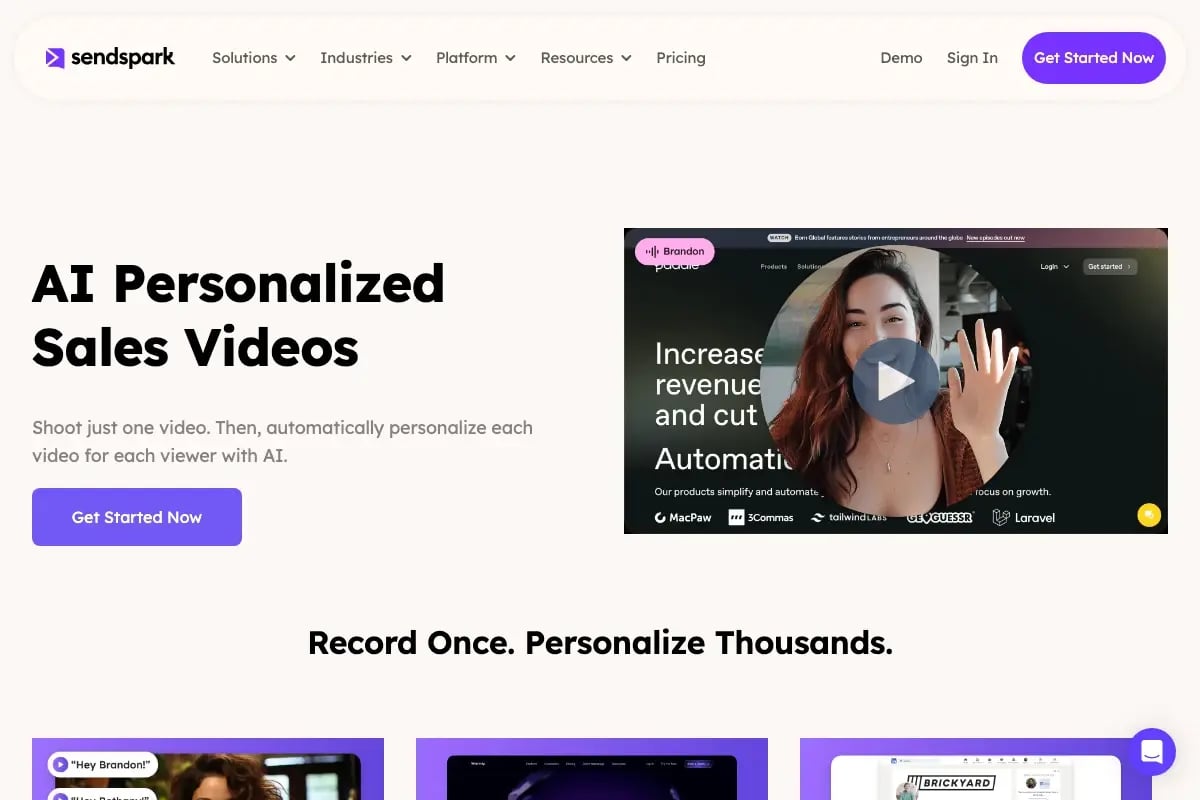
Sendspark is the AI video personalization platform for B2B sales. Record once, and AI voice cloning generates thousands of individually personalized videos with dynamic backgrounds and personalized thumbnails — each prospect hears their name, sees their website, in your voice. Sales teams see 2-3x more replies.
Get Started NowThe Best Qualification Call Questions to Ask
The best qualification questions uncover Budget, Authority, Need, and Timing through open-ended prompts that invite the prospect to share context — not just confirm yes or no. The goal isn’t to run a checklist; it’s to understand the full picture of their situation so you can make a confident qualify or disqualify decision.
Here are 12 proven questions organized by BANT category:
| Category | Questions to Ask |
|---|---|
| Budget | “Do you have a budget allocated for solving [problem] this quarter?” |
| “What have you invested in similar solutions or initiatives before?” | |
| “What impact would solving [problem] have on your team’s revenue or costs?” | |
| Authority | “Who else would be involved in evaluating or approving a solution like this?” |
| “Who typically signs off on decisions for new software or services at your company?” | |
| “What’s the typical decision-making process for investments of this nature?” | |
| Need | “What’s prompting you to look at a solution like ours right now?” |
| “What does solving [problem] actually mean for your team day to day?” | |
| “What happens if you don’t address [problem] in the next six months?” | |
| Timing | “What’s your ideal timeline for having something in place?” |
| “Are there any internal deadlines or events driving this initiative?” | |
| “What would cause this to get deprioritized or stall internally?” |
Three bonus questions that go beyond BANT and surface deeper buying signals:
- Problem Severity: “On a scale of 1 to 10, how critical is solving [problem] right now — and why?” This uncovers urgency and quantifies pain.
- Status Quo Cost: “What is the cost of not fixing this? Think lost revenue, wasted time, missed opportunities.” This helps prospects self-quantify their pain, making budget conversations easier later.
- Yes Criteria: “What would need to be true for you to say yes to a solution like ours?” This surfaces decision criteria you might otherwise discover only in the final negotiation.
Research from Gong’s conversation intelligence data shows that top-performing sales reps establish need first, then move to budget. This order matters: when a prospect understands the value and urgency of solving their problem, budget conversations become less adversarial and more collaborative.
One more tactic worth adding to your pre-call toolkit: send an AI-personalized video as a reminder the day before your qualification call. Sendspark lets you record one video and use AI voice cloning to personalize it with each prospect’s name and dynamic backgrounds showing their company website. Our customers see meetings booked increase by 40–50% when video reminders replace plain-text confirmation emails. A prospect who watched a personalized video about the call they’re about to join shows up engaged, not distracted. You can also review our inbound lead qualification framework for the criteria that should inform your BANT scoring before the call.
Common mistake
Don’t stack all your qualification questions back-to-back like a checklist. Prospects feel interrogated. Ask one question, listen fully, follow up naturally on what they said, then move to the next category. The best qualification calls feel like a conversation, not an intake form.
Qualification Call Mistakes That Kill Your Pipeline
Even experienced reps fall into predictable traps during qualification calls. These mistakes usually come from eagerness — wanting to impress or close fast — but they consistently produce bad outcomes: a fluffy pipeline, low demo show rates, and deals that stall without explanation. Here are the five most common mistakes and exactly how to fix them.
Mistake 1: Pitching Too Early
You launched into features before understanding whether the prospect is even a fit. This shifts the call from their problem to your product — and prospects disengage fast when they feel sold to before being understood.
Fix: Adopt the 70/30 rule. Listen 70% of the time, talk 30%. Your entire job during a qualification call is to ask questions and absorb answers, not to impress anyone with your product knowledge. Save the pitch for after you’ve confirmed they qualify.
Mistake 2: Skipping the Timeline Question
“We might be interested eventually” is not a qualified lead. It’s a polite way of saying the deal has no urgency. Without a clear timeline, every follow-up becomes a shot in the dark, and the deal will sit in your pipeline for months before going dark.
Fix: Always ask “What’s your ideal timeline for having something in place?” and “What would cause this to stall?” If there’s no urgency, either uncover what would create it or move the lead to a long-term nurture sequence and focus on deals that have real momentum. See our guide to follow-up cadence for how to structure those nurture touchpoints.
Mistake 3: Missing the Buying Committee
The person on your qualification call is rarely the only person making the decision. According to Gartner, B2B buying groups average 6 to 10 stakeholders. Failing to map the committee in the first call means you’ll hit a wall later when your contact says “I need to loop in three other people before we proceed.”
Fix: Ask “Who else would be involved in evaluating or approving a solution like this?” on every qualification call. Map the committee, identify champions versus blockers, and build your multi-threading plan from the start. Log it all in your HubSpot CRM while it’s fresh.
Mistake 4: Not Confirming a Next Step on the Call
“I’ll follow up with some information” is the #1 pipeline killer. It transfers all the momentum to you, gives the prospect zero accountability, and dramatically reduces show rates for any meeting you try to book later.
Fix: Before you hang up, propose and book the next meeting on the call. “Based on what you shared about [problem], it makes sense to show you [specific feature]. Are you free Thursday at 10 AM?” Get the meeting on the calendar. Then follow up with a pipeline review-ready summary and an AI-personalized video confirmation.
Mistake 5: Failing to Log Outcomes in CRM
You ran a great qualification call, confirmed BANT, and booked a demo — then jumped straight to the next task without logging anything. Now the AE walks into the demo blind, or you forget a critical detail the prospect shared about their buying process.
Fix: Make CRM logging non-negotiable immediately after every call. Log the BANT signals you confirmed, key pain points, buying committee members identified, and the next step booked. This ensures the entire sales team has the context to progress the deal — and your deal progression stays on track.
| Mistake | Why It Kills Pipeline | Fix |
|---|---|---|
| Pitching too early | Prospect disengages; you miss BANT signals | Listen 70%, talk 30%; establish need before pitching |
| Skipping timeline | Pipeline fills with “someday” deals that never close | Always ask timeline and urgency questions; move no-urgency leads to nurture |
| Missing buying committee | Deal stalls when stakeholders appear out of nowhere late in cycle | Map the committee on every call; plan multi-threading from the start |
| No next step booked | Low show rates, lost momentum, dead pipeline | Book the next meeting before you hang up — always |
| Failing to log CRM | Context lost; AE goes into demo blind; duplicate outreach | Log BANT, stakeholders, and next step immediately post-call |
Sources & References
- Salesforce — State of Sales — “Sellers spend only 28% of their week actually selling” (2024)
- Gartner — The B2B Buying Journey — “Average B2B buying group includes 6 to 10 decision-makers; buyers are 57% through their decision process before talking to sales” (2024)
- RAIN Group — BANT Sales Qualification Guide — Expert guidance on disqualification as a competitive advantage (2024)
- Gong Labs — Qualification Questions Research — Top reps establish need before discussing budget; question order matters (2024)
- HubSpot — Sales Qualification Best Practices — Framework overview and qualification criteria for B2B teams (2024)
Frequently Asked Questions
What is a qualified call in sales?
A qualified call in sales is a conversation where an SDR or AE has confirmed that a prospect meets the minimum criteria to become a genuine sales opportunity — typically by verifying Budget, Authority, Need, and Timing (BANT). The outcome is a clear go/no-go decision: either advance the prospect to a demo or discovery session, or disqualify them and move on.
What are the 3 C’s of cold calling?
The 3 C’s of cold calling are Connect, Convince, and Convert. Connect means reaching the right person and getting past gatekeepers. Convince means establishing enough interest in the first 30 seconds to earn a longer conversation. Convert means turning that conversation into a booked qualification call or next step. The qualification call itself happens after the initial connect.
What are good qualifying questions for a sales call?
Good qualifying questions are open-ended and organized around BANT: budget questions like “Do you have resources allocated for solving this this quarter?”; authority questions like “Who else is involved in this decision?”; need questions like “What’s prompting you to look at this now?”; and timing questions like “What’s your ideal timeline for having something in place?” The best reps also ask about the cost of not solving the problem and what a “yes” decision would require.
How long should a qualification call last?
A qualification call should last 15 to 20 minutes for most B2B sales cycles. Shorter than 15 minutes usually means you didn’t gather enough BANT data. Longer than 20-25 minutes suggests you’re sliding into discovery territory — which is fine if the prospect is qualified and engaged, but consider whether a dedicated discovery session would serve the deal better.
What is the difference between a qualification call and a demo?
A qualification call determines whether a prospect is worth showing a demo to. It confirms BANT criteria and buying signals before you invest AE time in a full product walkthrough. A demo, by contrast, shows the product in action and is designed to align your solution with the prospect’s specific needs. Running a demo before qualifying often wastes both parties’ time — the prospect sees capabilities irrelevant to their situation, and the AE learns the deal was never viable mid-pitch.
What is BANT qualification?
BANT stands for Budget, Authority, Need, and Timing — a four-criteria framework developed at IBM for qualifying B2B prospects. Budget confirms the prospect has financial resources to buy. Authority confirms they can approve or influence the decision. Need confirms they have a genuine problem your product solves. Timing confirms there’s urgency to act now rather than indefinitely defer. A prospect who checks all four criteria is considered BANT-qualified and worth advancing to the next stage.
How do you increase show rates for qualification calls?
The most effective way to increase show rates is to confirm the meeting on the call (not via email afterward), then send a personalized reminder 24 hours before. Using an AI video personalization platform like Sendspark — where you record one video and AI voice cloning personalizes it with each prospect’s name and company — consistently outperforms plain text confirmations. Sendspark customers see meetings booked increase by 40–50% when they use AI-personalized video outreach as part of their pre-call sequence.
Record One Video. AI Personalizes Thousands.
Sendspark is the AI video personalization platform for B2B sales. Record once, and AI voice cloning generates thousands of individually personalized videos with dynamic backgrounds and personalized thumbnails — each prospect hears their name, sees their website, in your voice. Sales teams see 2-3x more replies.
Get Started Now