Most sales reps send a follow-up email after a call and hear nothing back. Not because the call went badly — but because the email did. It restates what was discussed, skips the next steps, and lands in the prospect’s inbox looking exactly like every other follow-up they received that day. The solution isn’t sending more emails. It’s sending a better one. For SDRs looking to scale their outreach, AI video follow-up sequences are a proven next step.
Explore our list of per our conversation alternatives for more options.
This guide gives you proven templates for every major sales call type — discovery, demo, pricing, and no-show — plus the timing rules and subject line formulas that experienced reps actually use to move deals forward. For the full list, see our 30 discovery call questions.
Key Takeaways
- Send your follow-up email within 2 hours of a sales call — Gong research shows response rates drop significantly after 24 hours.
- A strong post-call email recaps agreed next steps, not just what was discussed — prospects act on what they committed to, not what you said.
- Personalizing your subject line with the prospect’s name or company increases open rates by 26%, according to Campaign Monitor research.
- Replacing a text follow-up with a 60-second personalized video recap increases reply rates by 200–300%.
- Different call types — discovery, demo, pricing — require different follow-up structures. Templates for each are included below.
What Makes an Effective Follow-Up Email After a Sales Call?
An effective follow-up email after a sales call does five things: it thanks the prospect for their time, confirms what was discussed, documents agreed-upon next steps, includes a clear single call to action, and stays under 200 words. That last point matters more than most reps realize — long emails get skimmed or deferred indefinitely.
The biggest mistake sales reps make is treating the follow-up as a summary of the call. Your prospect was there. They don’t need a transcript. What they need is a clear answer to: “What happens next and who does what?” For specific call scripts and email templates, see our guide to lead follow-up call templates.
According to Gong’s research on sales follow-up emails, the most effective post-call emails share three characteristics: they’re short (under 150 words in the body), they reference something specific from the conversation, and they contain exactly one call to action — not three.
The 5 Core Elements of a Post-Call Email
Every strong follow-up email after a sales call includes these five components in this order:
- Context opener — One sentence referencing the specific call: “Great speaking with you this afternoon about [Company]’s outbound workflow.”
- Key insight or pain point — Mirror back the main challenge they described. This proves you listened.
- Relevant solution or resource — One specific thing that addresses their pain. Not a product dump — one thing.
- Next steps with ownership — Who does what, by when. “I’ll send the case study by Thursday. You mentioned looping in your VP of Sales — does Friday at 2pm work for a 3-way call?”
- Easy out — A brief line that reduces pressure: “If the timing isn’t right, no problem — happy to reconnect next quarter.”
Pro tip
Write your follow-up email immediately after the call ends — while the conversation is fresh. Reps who wait until end of day send generic emails. Reps who write it within 30 minutes include specific details that make the prospect feel heard.
What to Leave Out
Skip the pleasantries, the company boilerplate, and the feature list. Don’t paste your meeting recap tool’s auto-generated transcript. Don’t attach a 20-slide deck unless the prospect specifically asked for it. If you need to share materials, link to them — don’t attach files that clog inboxes and trigger spam filters. For sales teams running Calendly demos, our guide to Calendly video reminder workflow walks through the full workflow.
For a deeper look at how email structure affects reply rates, see our guide on how to structure sales emails that get replies.
Follow-Up Email Templates for Every Sales Call Type
Not all sales calls are the same, and your follow-up shouldn’t be either. A discovery call, a demo, a pricing discussion, and a no-show each require a different structure and tone. Below are four battle-tested templates — copy them directly or adapt them to your voice.
Template 1: After a Discovery Call
Discovery calls focus on understanding the prospect’s situation. Your follow-up should demonstrate that you understood their challenges and give them one clear reason to move to the next step.
Subject: Following up — [Company] + [Your Company]
Hi [First Name],
Great speaking with you today. Based on what you shared, [specific pain point they mentioned] is the main bottleneck slowing your team’s [goal they mentioned].
Attached is the case study I mentioned — [Customer Name] solved a similar problem and cut [specific metric] by [X]% in [timeframe].
Next step: I’ll send a calendar invite for Thursday at 2pm to walk your VP of Sales through the specifics. Does that timing still work?
Best,
[Your Name]
Template 2: After a Product Demo
Post-demo follow-ups need to address the objections or questions that came up live. If a prospect asked “how does it integrate with Salesforce?” during the demo and you said “I’ll confirm that after the call,” your follow-up is the moment to deliver that answer.
Subject: Your questions from today’s demo — answered
Hi [First Name],
Thanks for the time today. Here are the answers to the questions you raised:
• [Question 1]: [Short, specific answer]
• [Question 2]: [Short, specific answer]Based on what you described, the [specific feature] would solve [their specific pain point] — I’d like to set up a 20-minute technical review with your [IT/ops/RevOps] team so they can pressure-test the integration setup.
Would [Day] at [Time] work?
[Your Name]
Template 3: After a Pricing Conversation
Pricing conversations are high-stakes. The follow-up needs to anchor value before it re-states cost. Never lead with the price in the subject line — that trains prospects to focus on the number instead of the outcome.
Subject: ROI summary for [Company]
Hi [First Name],
Based on what you shared — [X SDRs], sending [Y] outreach sequences per month — here’s a quick look at the potential return:
• Current reply rate at ~[X]% = [Y] replies/month
• With [Your Product], teams like yours typically hit [X+]% = [Y+] replies/month
• Incremental pipeline in 90 days: approximately $[Z] (based on your [ACV])Happy to walk you through the full ROI model — it takes 10 minutes and helps you make the case internally. Want to schedule that before [decision timeline they mentioned]?
[Your Name]
Template 4: No-Show Follow-Up
No-shows happen. The worst thing you can do is ignore it or send a passive-aggressive “I noticed you missed our call” message. The best thing you can do is make it easy for them to reschedule without shame.
Subject: Missed connections — rescheduling our call
Hi [First Name],
Looks like we got crossed up today — no worries at all.
I still think [specific thing they’re trying to achieve] is worth a quick conversation. Here are three times that work this week:
• [Day/Time 1]
• [Day/Time 2]
• [Day/Time 3]Or grab a time directly: [Calendly link]
[Your Name]
For additional template inspiration, see our collection of 15 sales email templates that actually get replies.
Quick Comparison: Post-Call Email Elements by Call Type
| Call Type | Primary Goal | Key Element | CTA | Ideal Length |
|---|---|---|---|---|
| Discovery | Advance to demo | Mirror their pain point back | Schedule next call | 100–150 words |
| Demo | Address objections, advance to proposal | Answer open questions | Technical review or proposal | 100–200 words |
| Pricing | Justify value, move to decision | ROI framing before cost | ROI walkthrough or champion call | 150–250 words |
| No-show | Reschedule | Easy, low-pressure offer | Calendly link or 3 time options | 50–80 words |
Record One Video. AI Personalizes Thousands.
Sendspark is the AI video personalization platform for B2B sales. Record once, and AI voice cloning generates thousands of individually personalized videos with dynamic backgrounds and personalized thumbnails — each prospect hears their name, sees their website, in your voice. Sales teams see 2-3x more replies.
Get Started NowWriting a Subject Line That Gets Opened
Your subject line determines whether the follow-up email gets read or ignored. The best subject lines for post-call follow-ups are specific, personal, and under 50 characters. Generic subjects like “Following up” or “Next steps” get ignored because every rep uses them.
According to HubSpot’s research on follow-up email performance, personalized subject lines that include the prospect’s company name see 26% higher open rates than generic subjects. That’s the single easiest improvement you can make without rewriting your entire email.
Subject Line Formulas That Work
These formulas are based on open-rate data from B2B sales teams. Use them as starting points, not scripts — swap in the actual details from your call.
- Specificity formula: “[Their pain point] + [your solution]” — e.g., “Reply rates + Sendspark demo recap”
- Question formula: “[Company] + [decision or next step]?” — e.g., “Acme Corp + Q2 pilot?”
- Resource formula: “The [case study / ROI model / doc] I mentioned” — sets an expectation and creates curiosity
- Callback formula: “Re: our call today — [one specific thing]” — “Re: our call today — Salesforce integration”
What to Avoid in Subject Lines
Skip vague phrases like “Checking in,” “Just following up,” and “Circling back” — these signal low effort and low priority. Avoid ALL CAPS, excessive punctuation (!!!), and words that trigger spam filters: “guaranteed,” “free,” “urgent,” “act now.” Also avoid misleading subject lines that promise something not in the email — open rates improve but reply rates tank when there’s a mismatch.
Common mistake
Using “Re:” in your subject line when there was no previous email thread. It looks deceptive when prospects notice there’s no earlier message it’s responding to — and they do notice.
When and How Often to Follow Up After a Sales Call
Send your first follow-up within 2 hours of the call ending. This is the most impactful timing decision you’ll make. Gong’s analysis of millions of sales emails shows that follow-up emails sent within 2 hours of a call have significantly higher open and reply rates than those sent the next morning — the call is still fresh in the prospect’s mind and your email feels like a natural extension of the conversation.
If you don’t hear back after the first follow-up, here’s a proven multi-touch sequence:
- Day 0 (same day, within 2 hours): Primary follow-up with recap and next steps
- Day 2: Send the specific resource you promised (case study, ROI model, technical doc)
- Day 5: Brief check-in — “Did the [resource] help? Happy to walk through questions.”
- Day 10: Final bump with a soft close — “Want me to keep this on my radar for next quarter?”
According to RAIN Group research on follow-up frequency, 80% of sales require 5 or more touchpoints to close, yet 44% of reps give up after just one follow-up. The reps who persist — methodically and with value in each touchpoint — win the deals that others abandon.
This multi-touch cadence works best when it’s part of a structured process. For a deeper framework, see our guide to sales cadence best practices.
When to Stop Following Up
Four touchpoints with no response is a signal, not a wall. At this point, send one final “break-up” email that explicitly closes the loop: “I don’t want to keep interrupting your week — I’ll assume the timing isn’t right. Feel free to reach out if things change.” This email counterintuitively often gets the highest reply rate in the sequence because it removes pressure and creates a genuine open door. If you’re not getting responses at all, our no response email reminder templates covers proven scripts and timing frameworks for cold outreach follow-ups.
The difference between persistence and annoyance is value. Each touchpoint must offer something new — a resource, an insight, a different angle on their problem. If you’re sending the same message with different words, stop. Learn more about the full outreach process in our post on the complete guide to cold email follow-up.
How Video Follow-Ups Close More Deals Than Text Emails
A personalized video recap of a sales call outperforms a text email on every measurable metric: open rates, reply rates, and deal velocity. When a prospect sees a short video where you address them by name, reference what they told you, and walk through a specific recommendation, it creates a level of trust that no text email can replicate.
Sales teams using video follow-ups report 200–300% more replies compared to text-only emails — not because video is flashy, but because it’s personal. Seeing and hearing a real person speak directly to your situation is qualitatively different from reading generic paragraphs.
See real-world video sales follow-up templates for inspiration.
What a Good Video Follow-Up Looks Like
The most effective video follow-up after a sales call runs 45–90 seconds and covers three things:
- A personalized opener: Address the prospect by name and reference one specific thing they said: “Sarah, after our call I kept thinking about the outbound workflow challenge you described with your SDR team at Acme.”
- Your recommendation: Show — don’t just tell — your specific suggestion. Screen-share a relevant dashboard, case study slide, or integration setup that applies to their situation.
- A single next step: End the video with one clear ask. Don’t list three options. Pick the most important one.
This kind of video used to require recording a fresh video for every single prospect. That’s what made it impractical at scale. With Sendspark’s AI video personalization, you record the core of your message once, and the AI automatically personalizes the greeting, the prospect’s name, and their company website as the background — for every recipient in your list.
For deal progression workflows specifically, see how Sendspark supports deal progression at each stage of the sales cycle. And for the technical setup, our guide on automating personalized video follow-ups walks through the full workflow.
How to Add Video to Your Text Follow-Up Template
You don’t need to choose between text and video — combine them. Use the text templates above as the email body, and add a video thumbnail link near the top:
“I also put together a 60-second video recap specifically for you — [Video Thumbnail Image linked to your Sendspark video]. Hit play when you have a moment.”
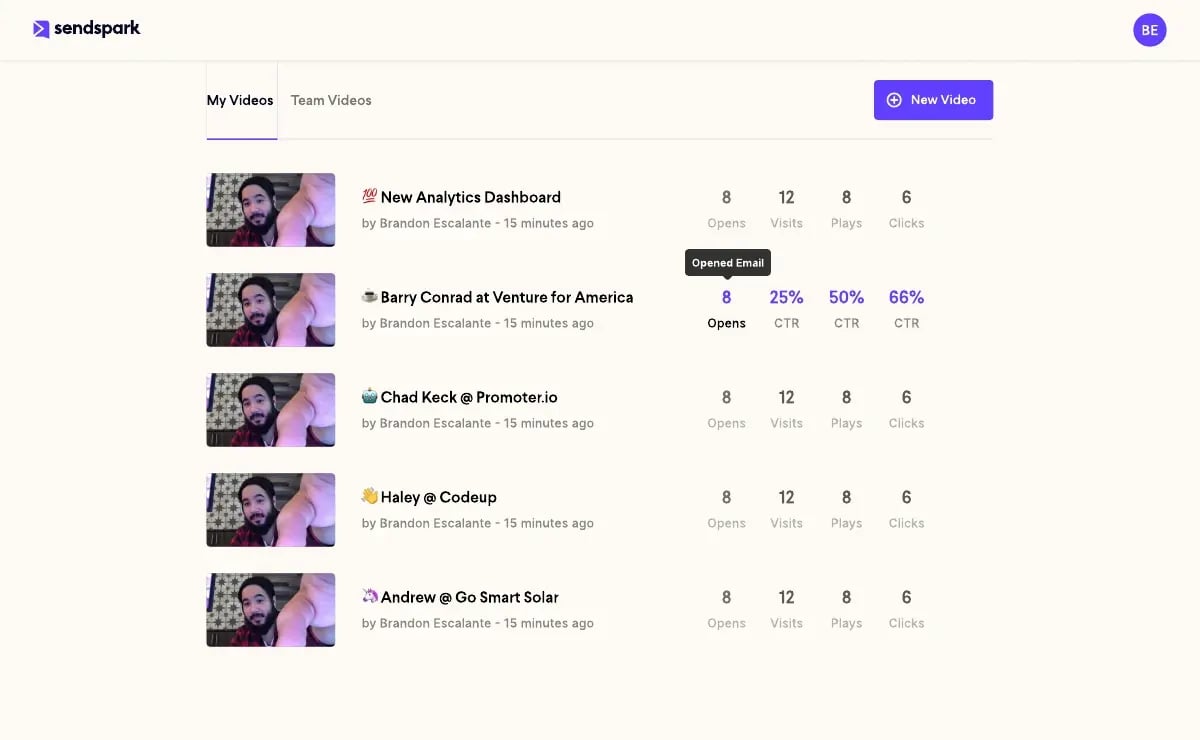
The text ensures the key information is scannable. The video creates the emotional connection that drives replies. Teams using this hybrid approach with Sendspark’s video messaging platform consistently see higher click-through rates and faster deal cycles than text-only sequences.
The HubSpot integration logs every video play, click, and watch-time data point back to your contact record — so you know exactly when a prospect re-watched your follow-up video three times before their internal review meeting.
Follow-Up Email Performance Benchmarks
Based on data from Gong, RAIN Group, and Salesforce State of Sales, here are the benchmarks that high-performing B2B reps consistently hit on post-call follow-up emails:
| Metric | Average Rep | Top Quartile Rep | With Video Follow-Up |
|---|---|---|---|
| Open rate | 38–42% | 55–65% | 70–80% |
| Reply rate | 8–12% | 20–30% | 25–40% |
| Time to send | Next day | Within 2 hours | Within 2 hours |
| Follow-up touches before deal advances | 1–2 | 3–5 | 2–3 |
| Deal cycle impact | Neutral | 5–10% faster | 15–25% faster |
The pattern is clear: speed, specificity, and personalization are the three variables that separate average follow-ups from ones that close deals. Video accelerates all three simultaneously.
Frequently Asked Questions
What should I include in a follow-up email after a sales call?
A strong follow-up email after a sales call should include: a specific reference to what was discussed, the prospect’s main pain point mirrored back to them, one relevant resource or solution, clearly defined next steps with ownership (who does what by when), and a single call to action. Keep it under 200 words — long emails get deferred.
How soon should I send a follow-up email after a sales call?
Send it within 2 hours of the call ending. Gong research shows that follow-up emails sent within 2 hours have significantly higher open and reply rates than those sent the next day. The call is still fresh in the prospect’s mind, and your email feels like a continuation of the conversation rather than cold outreach.
What’s the best subject line for a follow-up email after a sales call?
The best subject lines are specific and personalized — include the prospect’s company name or reference something concrete from the call. Examples: “Acme Corp + Q2 pilot?”, “The ROI model I mentioned”, or “Re: our call today — Salesforce integration.” Avoid generic subjects like “Following up” or “Checking in” — they signal low effort and get ignored.
How many follow-up emails should I send after a sales call?
Send 4 touchpoints over 10 days if you don’t hear back: same-day recap, a resource on day 2, a check-in on day 5, and a final “break-up” message on day 10. RAIN Group research shows 80% of deals require 5+ touchpoints to close, but 44% of reps give up after just one. Persistent, value-driven follow-up is one of the highest-impact habits in B2B sales.
How do I follow up after a sales demo?
After a demo, your follow-up should address the specific questions or objections that came up live. Structure it as: answer the open questions from the call, confirm the pain points your solution addresses, and propose a specific next step — usually a technical review or champion call with additional stakeholders. Don’t resend the demo recording unless the prospect asked for it. If the call surfaced a recurring concern rather than a simple question, our guide to common sales objections and how to handle them has scripts for the ones that come up most.
Should I use video in my follow-up email after a sales call?
Yes — video follow-ups consistently outperform text-only emails with 200–300% more replies. A 60-second personalized video recap where you address the prospect by name and reference their specific situation creates trust that text can’t replicate. Tools like Sendspark let you record the core message once and AI-personalize it for every prospect, making video follow-up practical at scale.
What’s the difference between a post-call follow-up email and a cold email follow-up?
A post-call follow-up email is a warm communication — the prospect already knows you and had a conversation with you. It should reference specifics from that call, be personal in tone, and focus on next steps. A cold email follow-up is sent to someone who hasn’t responded to initial outreach and requires more context-setting and a softer ask. See our complete guide to cold email follow-up for the cold-specific approach.
Sources & References
- Gong — Sales Follow-Up Email Research — “Follow-up emails sent within 2 hours of a call have significantly higher open and reply rates than those sent the next day.” (2024)
- HubSpot — Follow-Up Email Best Practices — “Personalized subject lines with the prospect’s company name see 26% higher open rates than generic subjects.” (2024)
- RAIN Group — How Many Times Should You Follow Up with a Prospect? — “80% of sales require 5 or more touchpoints to close, yet 44% of reps give up after just one follow-up.” (2023)
- Salesforce — Sales Follow-Up Strategies — Data on follow-up timing and deal velocity from the State of Sales report. (2024)
Record One Video. AI Personalizes Thousands.
Sendspark is the AI video personalization platform for B2B sales. Record once, and AI voice cloning generates thousands of individually personalized videos with dynamic backgrounds and personalized thumbnails — each prospect hears their name, sees their website, in your voice. Sales teams see 2-3x more replies.
Get Started Now