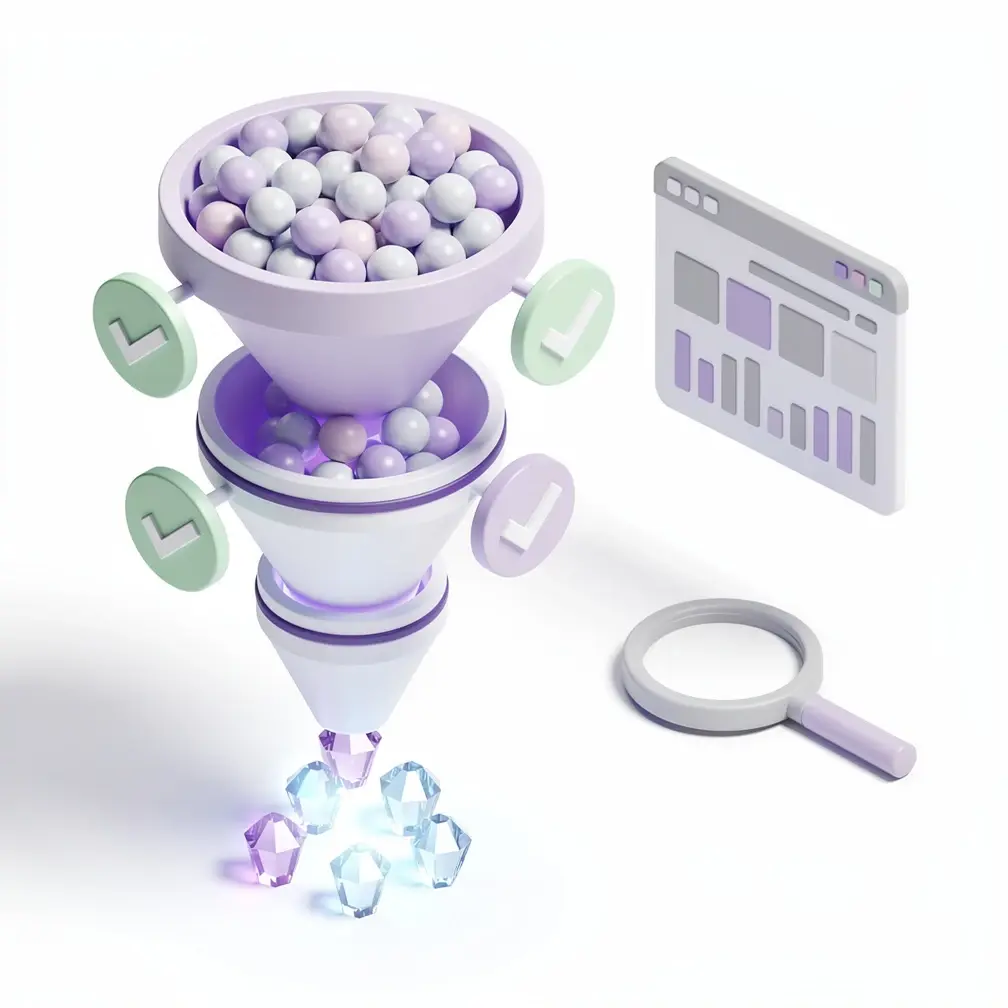
Sales reps waste an average of 50 percent of their time chasing leads who will never buy, according to research from Harvard Business Review. A documented lead qualification process is the single biggest lever for clawing that time back. It is a repeatable, criteria-based workflow that filters every new contact through ICP, capture, enrichment, scoring, routing, and validation steps before a rep ever picks up the phone. Done well, it cuts wasted SDR cycles by 30 to 50 percent and lifts conversion at every funnel stage.
Key Takeaways
- A lead qualification process is a repeatable, criteria-based workflow that filters incoming and outbound leads into sales-ready buyers, reducing wasted SDR cycles by 30 to 50 percent.
- The 7-step framework covers ICP definition, capture, enrichment, scoring, routing, validation, and disqualification, with clear ownership at each stage.
- Pair a scoring model (BANT, MEDDIC, or CHAMP) with explicit thresholds for MQL, SAL, and SQL handoffs to prevent friction between marketing and sales.
- Speed-to-lead under five minutes increases qualification-to-meeting conversion by up to 21x, so qualified leads should trigger outreach within minutes, not days.
- AI-personalized video shortens the qualification cycle by giving every newly scored lead a one-to-one welcome that surfaces intent before discovery calls.
What Is the Lead Qualification Process?
The lead qualification process is the structured set of steps a B2B sales team uses to determine whether a new contact has the budget, authority, need, and timing to become a paying customer. It pairs explicit criteria with scoring rules so every lead is filtered consistently, not by gut feel. The output is a clear yes, no, or nurture decision before any rep books a discovery call.
Qualification is often confused with lead scoring, but the two are different layers of the same system. Scoring is the numeric expression of fit and intent (often 0 to 100). The qualification process is the larger workflow that decides what criteria feed the score, who owns each handoff, and what happens after a lead crosses a threshold. Skip the process and you end up with a sophisticated scoring model that nobody trusts.
An ad-hoc approach (where reps “just know” a good lead when they see one) hides three failure modes: SDRs cherry-pick easy contacts, marketing-qualified leads (MQLs) stall in handoff queues, and disqualifications never get fed back into the source channel. Our deep dive on the B2B lead qualification framework covers the underlying ICP scoring model in more detail, and our 12-criteria qualification checklist is a useful operational companion.
Why a Documented Qualification Process Matters
A documented qualification process pays back in three places: it protects rep time, it shortens the sales cycle, and it gives marketing the feedback loop they need to improve targeting. The biggest cost of skipping it is invisible — SDRs spend hours on leads with no budget or no real pain, while sales-ready buyers wait in the queue. Speed and quality both suffer. For outbound-heavy teams, a clean process is the foundation of any sales prospecting motion.
Gartner found that B2B buyers spend only 17 percent of their purchase journey actually talking to potential suppliers, and when they do, they split that time across three to five vendors. That leaves your reps with a thin window to land a meaningful conversation. Wasting it on poorly qualified leads is the difference between hitting quota and missing it.
“More than two-thirds of customers report they would actually prefer no sales rep interaction at all.”
— Brent Adamson, distinguished vice president, advisory, Gartner (Gartner B2B Buying Journey research)
The flip side is that when reps do get in front of a buyer, qualification quality determines whether the conversation goes anywhere. A documented process also gives revenue operations a clean dataset to analyze: which sources produce SQLs, which scoring criteria correlate with closed-won, and where leads leak between MQL and SAL. Without that, every cycle improvement is guesswork.
Common mistake
Treating every form-fill as a sales-ready lead. Most teams hand 100 percent of inbound contacts to SDRs, then wonder why reps burn out and conversion rates stall. A real process disqualifies aggressively and routes nurture-stage leads back to marketing automation.
The 7-Step Lead Qualification Process
The 7-step lead qualification process moves a contact from raw lead to sales-ready opportunity through ICP matching, capture, enrichment, scoring, routing, validation, and a disqualify-or-advance decision. Each step has a clear owner, an input, and an output. The whole sequence should take minutes for high-fit inbound leads, and hours or days for outbound or nurture-stage contacts. For the broader strategic context, see our full lead qualification framework guide.
Step 1: Define your Ideal Customer Profile (ICP)
Your ICP is the gate everything else runs through. Document the firmographic, technographic, and behavioral attributes of your best customers: industry, company size, revenue range, tech stack, growth signals, and use case fit. Pull the data from closed-won deals in your CRM, not from aspirational marketing personas. If you sell to mid-market B2B SaaS with 50-500 employees and a HubSpot or Salesforce stack, write that down explicitly.
Step 2: Capture leads with intent-aware forms
The capture step is where most teams accidentally pollute their pipeline. Long forms reduce volume but raise quality; short forms do the opposite. The fix is progressive profiling: collect the bare minimum (name, work email, company) on the first interaction, then enrich and re-ask on later visits. Conditional fields based on company size or use case let you ask relevant questions, not a generic list of 12. If most of your pipeline is inbound, our inbound lead qualification playbook walks through capture-form best practices in more depth.
Step 3: Enrich automatically with third-party data
Enrichment turns a name and email into a complete firmographic profile in seconds. Connect Clearbit, ZoomInfo, or Clay to your CRM so every new lead is auto-tagged with company size, industry, tech stack, and revenue range. This is the data your scoring model needs to fire. Skip enrichment and your scoring is guessing.
Step 4: Score against fit and intent signals
Scoring blends two dimensions: fit (does this account match the ICP?) and intent (are they showing buying behavior?). Weight ICP fit attributes (industry match, revenue range, employee count) heavily for outbound, and intent signals (pricing page visits, demo requests, repeat sessions) heavily for inbound. Most teams over-weight intent and end up qualifying low-fit accounts that will never close.
Step 5: Route by score, source, and territory
Routing is operational plumbing, but it’s where speed-to-lead wins or loses. Leads above your SQL threshold should hit a rep’s queue inside one minute. Build routing rules in your CRM that respect territory, account ownership, and round-robin distribution. For HubSpot users, native workflow tools handle this; for complex stacks, Chili Piper or LeanData add multi-rule routing.
Step 6: Validate with a discovery touchpoint
Before a lead becomes a true SQL, a human (or a personalized video) needs to confirm the score reflects reality. This is where an AI-personalized video earns its keep: send every newly qualified lead a 30-second clip addressing them by name, referencing their company website, and asking one validating question. Reply rates on personalized video are 2 to 3x higher than text, which shortens the validation cycle dramatically.
Record One Video. AI Personalizes Thousands.
Sendspark is the AI video personalization platform for B2B sales. Record once, and AI voice cloning generates thousands of individually personalized videos with dynamic backgrounds and personalized thumbnails — each prospect hears their name, sees their website, in your voice. Sales teams see 2-3x more replies.
Get Started NowStep 7: Disqualify, nurture, or advance
Every lead exits the process with one of three outcomes: disqualified (clear no, removed from active pipeline), nurture (right ICP, wrong timing, returned to marketing automation), or advance to SQL (handed to AE for opportunity creation). Treat disqualifications as data: feed them back into source channel reporting so paid-media spend and outbound targeting can correct course. For a deeper look at the validation conversation itself, see our guide on how to qualify sales leads step-by-step.
Qualification Frameworks: BANT vs MEDDIC vs CHAMP
BANT, MEDDIC, and CHAMP are three of the most widely used qualification frameworks in B2B sales, and each fits a different sales motion. BANT works for high-velocity SMB sales, MEDDIC for complex enterprise deals, and CHAMP for product-led growth motions where pain is the primary buying signal. The right framework depends on deal size, sales cycle length, and buying committee complexity.
| Framework | Acronym Stands For | Best For | Avg. Deal Size | Owner |
|---|---|---|---|---|
| BANT | Budget, Authority, Need, Timeline | High-velocity SMB and mid-market | $5K - $50K ARR | Originally IBM (1950s) |
| MEDDIC | Metrics, Economic buyer, Decision criteria, Decision process, Identify pain, Champion | Enterprise and complex deals | $100K+ ARR | PTC (1990s) |
| CHAMP | Challenges, Authority, Money, Prioritization | Pain-led / PLG motions | $10K - $200K ARR | InsightSquared (2010s) |
| GPCTBA/C&I | Goals, Plans, Challenges, Timeline, Budget, Authority, Consequences & Implications | Inbound-led consultative sales | $25K - $250K ARR | HubSpot |
HubSpot’s sales team published a useful breakdown of BANT arguing it is still relevant when adapted for modern buying behavior — specifically by leading with Need and Timeline rather than Budget. Salesforce’s MEDDIC overview is the canonical reference for enterprise-grade qualification, especially the Champion and Economic Buyer roles.
Picking a framework is less important than picking one and applying it consistently. The biggest waste happens when each AE qualifies differently and forecast accuracy collapses. If you’re starting from scratch, BANT is the easiest to operationalize in a CRM; layer MEDDIC criteria on top as deal sizes grow.
Advanced strategy
Hybrid frameworks beat pure ones. Many high-performing teams use MEDDIC for opportunity qualification (after SQL handoff) and a lighter BANT-style filter for lead qualification (before SQL handoff). This keeps the front end fast and the back end rigorous.
How to Operationalize the Process in Your CRM and Tech Stack
Operationalizing the qualification process means turning each of the seven steps into a CRM field, workflow, or automation rule, then layering the right outreach tools on top. Most teams already have the raw ingredients in HubSpot or Salesforce; the missing piece is wiring them together so a new lead moves from capture to validated SQL in under an hour, not a week.
1. Set up CRM scoring properties and lifecycle stages
Create three numeric fields: Fit Score (0 to 50, fed by enrichment data), Intent Score (0 to 50, fed by behavioral events), and Composite Score (their sum). Map score thresholds to lifecycle stages: 0-30 = subscriber, 31-60 = MQL, 61-80 = SAL, 81+ = SQL. Lock down lifecycle transitions with workflow rules so no rep can manually skip stages.
2. Build routing and SLA workflows
SLA breaches are where pipeline leaks. Build a workflow that flags any SQL waiting more than 15 minutes for rep response, escalates to a sales manager at 30 minutes, and reassigns at 60 minutes. Harvard Business Review’s lead response time study found firms that contacted leads within an hour were 7 times more likely to qualify them than firms that waited longer.
3. Use AI-personalized video for sub-five-minute response
The single biggest unlock for qualified leads is responding in minutes, not hours, and doing it personally. Pre-record one master video script, then use AI voice cloning and dynamic backgrounds to send a uniquely personalized version to every newly qualified lead. The prospect hears their name in your voice and sees their own company website behind you. Reply rates jump 2 to 3x versus text-only follow-up.
4. Track the qualification KPIs that matter
Five KPIs reveal whether the process is working: lead-to-MQL rate, MQL-to-SQL rate, SQL-to-opportunity rate, SDR speed-to-lead, and SDR-AE handoff acceptance rate. Set baselines in your first quarter, then target a 10 percent quarter-over-quarter lift on each. If handoff acceptance drops below 60 percent, your qualification criteria are too loose and AEs are rejecting work.
5. Loop disqualifications back to marketing
Every disqualified lead is a data point about where your acquisition spend is misaligned. Tag the disqualification reason (bad fit, no budget, wrong timing, competitor relationship) and feed a weekly report back to marketing. Within two quarters this loop should measurably tighten paid-media targeting and content strategy.
Frequently Asked Questions
What is the lead qualification process in B2B sales?
The lead qualification process in B2B sales is the structured workflow used to evaluate whether a contact has the budget, authority, need, and timing to become a customer. It typically involves ICP matching, data enrichment, fit-and-intent scoring, routing, and a validation touchpoint. Done well, it cuts wasted SDR cycles by 30 to 50 percent and shortens average sales cycle length.
What are the steps of a lead qualification process?
A complete lead qualification process has seven steps: define your Ideal Customer Profile (ICP), capture leads with intent-aware forms, enrich automatically with third-party data, score against fit and intent signals, route by score and territory, validate with a discovery touchpoint, and either disqualify, nurture, or advance to a sales-qualified opportunity. Each step has a single owner and a clear input-output contract.
How is lead qualification different from lead scoring?
Lead scoring is the numeric output (a 0-100 fit and intent score) that helps prioritize follow-up. Lead qualification is the larger workflow that decides which criteria feed the score, who owns each stage, what handoffs look like, and what happens after a lead crosses a threshold. Scoring is a tactic; the qualification process is the system.
Which framework is best: BANT, MEDDIC, or CHAMP?
BANT works best for high-velocity SMB sales under $50K ARR. MEDDIC is the standard for enterprise deals over $100K ARR where buying committees include 5+ stakeholders. CHAMP is preferred for pain-led or product-led growth motions where the prospect already knows they have a problem. Most teams use a hybrid: lightweight BANT-style criteria pre-SQL, full MEDDIC post-SQL.
How fast should reps respond to a qualified lead?
Industry research from Harvard Business Review and InsideSales.com shows that responding to a qualified lead within five minutes makes the contact 21 times more likely to convert than waiting 30 minutes. Inside one hour, conversion is 7 times higher than waiting longer. AI-personalized video, triggered by CRM workflow, lets B2B teams hit sub-five-minute response at scale without sacrificing personalization.
How do you build a lead qualification process in HubSpot?
In HubSpot, create three custom contact properties (Fit Score, Intent Score, Composite Score), build workflows that update them based on form fills and page-view events, map lifecycle stages to score thresholds, and use workflow-based routing to assign SQLs to reps. Connect Clearbit or ZoomInfo for enrichment and Sendspark for AI-personalized video follow-up triggered when a contact crosses the SQL threshold.
What is the average MQL-to-SQL conversion rate in B2B?
Benchmark MQL-to-SQL conversion rates for B2B SaaS sit between 13 and 18 percent, depending on industry and deal size. Companies with a documented qualification process tend to land at the top of that range; those without typically fall below 10 percent. Tracking this rate quarter over quarter is the single best diagnostic for qualification quality.
Sources & References
- Harvard Business Review — “The New Sales Imperative” on the cost of poor qualification and rep time waste (2017)
- Gartner — “The B2B Buying Journey” showing buyers spend only 17 percent of purchase time with potential suppliers (2024)
- Harvard Business Review — “The Short Life of Online Sales Leads” lead response time research (2011)
- HubSpot Sales Blog — “BANT: A Sales Qualification Framework That Has Survived Decades” methodology breakdown (2024)
- Salesforce — “What Is MEDDIC?” canonical MEDDIC qualification framework reference (2024)
Record One Video. AI Personalizes Thousands.
Sendspark is the AI video personalization platform for B2B sales. Record once, and AI voice cloning generates thousands of individually personalized videos with dynamic backgrounds and personalized thumbnails — each prospect hears their name, sees their website, in your voice. Sales teams see 2-3x more replies.
Get Started Now