Sales reps waste nearly a third of their time pursuing leads that were never going to buy. HubSpot’s State of Sales research consistently shows that reps spend more time on administrative tasks and unqualified prospects than on actual selling. The fix is straightforward: a structured lead qualification checklist that gives your team a repeatable, scored process to separate buyers from browsers before a single minute of demo time is spent. For the full breakdown, see our complete the full 7-step lead qualification process.
Key Takeaways
- A structured lead qualification checklist helps reps make fast pass/fail decisions, cutting time wasted on prospects who will never convert.
- BANT covers the basics (Budget, Authority, Need, Timeline), but complex B2B deals require 12+ criteria spanning tech fit, engagement signals, and internal champions.
- Behavioral signals — opening your email multiple times, watching a video, downloading a guide — are often stronger buying signals than stated interest.
- Sending a brief AI-personalized video during early qualification gets 2-3x more replies than text-only email, letting you gauge genuine intent before investing in a full discovery call.
- Scoring each criterion (0-2 points) gives you a numeric threshold — typically 16+ out of 24 — to separate marketing-qualified leads (MQLs) from sales-qualified leads (SQLs).
What Is Lead Qualification and Why It Matters
Lead qualification is the process of evaluating whether a prospect meets your criteria to become a paying customer. A qualified lead has the budget, authority, need, and intent to buy — an unqualified lead has at least one of those missing. The goal of a qualification checklist is to make that judgment in minutes, not weeks.
According to Salesforce’s State of Sales report, over 57% of sales reps expect to miss quota in a given year. Poor qualification is one of the biggest contributors: reps book demos with prospects who aren’t decision-makers, don’t have budget, or aren’t experiencing the pain your product solves. Those demos go nowhere, and the pipeline looks full while the forecast keeps slipping.
There’s also a subtle distinction worth getting right: a marketing-qualified lead (MQL) has shown interest — downloaded a guide, attended a webinar, opened three emails. A sales-qualified lead (SQL) has passed your checklist and is ready for a formal sales conversation. Treating every MQL as an SQL is where most teams hemorrhage time.
A lead qualification checklist gives your reps a consistent way to apply the same standard to every prospect, regardless of which SDR is handling the outreach. The output is a numeric score — and a clear threshold for when to invest in a full discovery call versus when to recycle the lead into a nurture sequence. For more context on prospect evaluation, see our guide on B2B prospect evaluation criteria.
Common mistake
Treating discovery calls as the qualification step is expensive. By the time you’ve run a 45-minute call, you’ve committed 45 minutes of rep time and held calendar space. Run a 5-minute qualification check before booking the call — you’ll reclaim hours every week.
The 12-Point B2B Lead Qualification Checklist
Use this checklist to score every inbound and outbound prospect before booking a discovery call. Score each criterion from 0 to 2: 0 = does not meet criteria, 1 = partially meets, 2 = fully meets. A total score of 16 or higher out of 24 indicates a strong SQL worth pursuing immediately.
1. Budget Availability (0-2 pts)
Does the prospect have allocated budget for a solution like yours? A “2” means confirmed budget in place. A “1” means budget is likely but unconfirmed or requires approval. A “0” means no budget or budget already committed to a competing initiative. You can often surface this early with a question like: “Is solving this problem something you have budget set aside for this quarter?”
2. Decision-Making Authority (0-2 pts)
Is your contact authorized to approve this purchase, or do they need sign-off from someone else? Score “2” for an economic buyer or VP/C-suite who controls the budget. Score “1” for a champion or influencer who can get you in front of the decision-maker. Score “0” for end users with no purchasing influence.
3. Identified Pain or Problem (0-2 pts)
Does the prospect clearly experience the problem your product solves? Score “2” if they’ve articulated the specific pain and its business impact (e.g., “our reply rates have dropped 40% in the last year”). Score “1” if the pain exists but isn’t yet owned or prioritized. Score “0” if your solution doesn’t map to any known problem they have.
4. Timeline and Urgency (0-2 pts)
Is there a defined timeline to solve this problem? Score “2” for a clear deadline (e.g., implementing before Q3 kickoff). Score “1” for a general preference to solve “within the next few months.” Score “0” for “eventually, no rush.” Without urgency, even interested prospects stall indefinitely.
5. Company Size and ICP Fit (0-2 pts)
Does the company fall within your ICP headcount and revenue range? Score “2” for a perfect fit (e.g., 50-500 employees, Series A-D). Score “1” for a company slightly outside your sweet spot that still has potential. Score “0” for companies too small, too large, or in a stage where your solution doesn’t deliver ROI.
6. Industry and Vertical Fit (0-2 pts)
Does this company operate in a sector where you have proven results? Score “2” for a target vertical with case studies and strong win rates. Score “1” for an adjacent vertical you’ve had moderate success with. Score “0” for industries you don’t serve or haven’t won in.
7. Tech Stack Compatibility (0-2 pts)
Does their existing toolset integrate with your product? If your platform connects natively to HubSpot and Outreach, a prospect running both is a “2.” A prospect using Salesforce (with a connector available) is a “1.” A prospect on legacy or bespoke systems requiring heavy custom integration is a “0.”
8. Buying Stage and Journey Position (0-2 pts)
Where is this prospect in their buying journey? Score “2” for prospects actively evaluating solutions — they’ve defined requirements, may have run demos, and are comparing vendors. Score “1” for those in an awareness or consideration stage. Score “0” for prospects who haven’t yet recognized the problem or connected it to a solution category.
9. Engagement Level (0-2 pts)
How engaged is the prospect with your outreach and content? Score “2” for prospects who have opened multiple emails, clicked links, watched videos, or replied with substantive questions. Score “1” for initial engagement (one open, one click). Score “0” for zero engagement after multiple touches. Behavioral signals are often the strongest indicator of real intent — someone who watches your video three times is more likely to buy than someone who said they’re “very interested” in a cold call.
10. Competitive Situation (0-2 pts)
Are they evaluating competitors, and if so, are those competitors you typically beat? Score “2” if they’re evaluating 1-2 vendors you frequently displace. Score “1” if you don’t yet know their shortlist. Score “0” if they’re deep into a process with a competitor you rarely win against, or if they’ve signaled strong incumbent loyalty.
11. Internal Champion or Sponsor (0-2 pts)
Is there someone inside the organization who will advocate for your solution internally? Score “2” for an identified champion who has the trust of the economic buyer and is actively selling your solution upward. Score “1” if you have a strong contact who seems supportive but hasn’t yet committed to championing you. Score “0” if you’re working without a champion at all — deals without internal sponsors are the ones that stall at final approval.
12. Defined Success Criteria (0-2 pts)
Does the prospect know what success looks like, and can your product deliver against those metrics? Score “2” if they have quantified KPIs (e.g., “we need to increase meeting booking rate by 30%”). Score “1” if they have a general sense of what better looks like but haven’t defined it precisely. Score “0” if they can’t articulate success criteria — those deals are difficult to close because there’s no shared standard for “done.”
For a step-by-step methodology on applying these criteria during discovery, see our guide on how to qualify sales leads.
Record One Video. AI Personalizes Thousands.
Sendspark is the AI video personalization platform for B2B sales. Record once, and AI voice cloning generates thousands of individually personalized videos with dynamic backgrounds and personalized thumbnails — each prospect hears their name, sees their website, in your voice. Sales teams see 2-3x more replies.
Get Started NowLead Qualification Frameworks: BANT, MEDDIC, and CHAMP Compared
There are four widely-used lead qualification frameworks in B2B sales. Each covers a different slice of the decision-making picture — none is complete on its own, which is why the 12-point checklist above draws from all of them. Here’s how they compare: For a step-by-step breakdown, see our running an effective qualification call.
| Framework | Stands For | Best For | Depth | Limitation |
|---|---|---|---|---|
| BANT | Budget, Authority, Need, Timeline | Transactional SMB sales | Low — 4 criteria | Misses champion, competition, engagement signals |
| MEDDIC | Metrics, Economic Buyer, Decision Criteria, Decision Process, Identify Pain, Champion | Enterprise and complex deals | High — 6 criteria | Requires more discovery time; can slow early pipeline |
| CHAMP | Challenges, Authority, Money, Prioritization | Consultative or solution selling | Medium — 4 criteria | Doesn’t address tech fit or competitive situation |
| GPCTBA/C&I | Goals, Plans, Challenges, Timeline, Budget, Authority, Consequences & Implications | Inbound / consultative | High — 7 criteria | Complex to train at scale; more suited to AEs than SDRs |
BANT, popularized by IBM in the 1950s and still referenced in Gartner’s B2B buying research, remains the most commonly taught framework because it’s fast and memorable. But it was designed for a simpler era of sales. In modern B2B buying, Gartner research shows the average B2B purchase now involves 6-10 decision-makers and a non-linear buying process — BANT’s four criteria aren’t enough to capture that complexity.
MEDDIC fills the gaps that BANT misses: the champion (who is selling internally?), the economic buyer (who controls the budget?), and the decision process (what steps must happen before a PO is issued?). For deals above $50K ACV, MEDDIC or MEDDPICC (its extended version) is the standard used by enterprise sales teams at companies like PTC and Salesforce.
The 12-point checklist in this article essentially combines the best elements of BANT, MEDDIC, and CHAMP, then adds behavioral engagement data that none of the original frameworks account for.
How to Build a Lead Qualification Process Step by Step
A qualification checklist is only as good as the process around it. Without a defined workflow — who qualifies, when, and what happens with the score — reps default to gut feel and the checklist collects dust. Here’s how to operationalize it in five steps. For the broader strategic context, see our complete lead qualification pillar guide.
Step 1: Define Your ICP With Firmographic Thresholds
Your ICP (Ideal Customer Profile) is the foundation of every qualification decision. Start by pulling your last 50 closed-won deals and identifying what they have in common: industry, headcount range, revenue, geographic region, tech stack. These become your firmographic scoring thresholds for checklist criteria 5, 6, and 7. If 80% of your best customers are SaaS companies with 50-300 employees using HubSpot, those become your “2” criteria. Review and update your ICP every two quarters.
Step 2: Set a Numeric Score Threshold for SQL Handoff
Decide what total score constitutes an SQL worth pursuing. A common starting threshold is 16 out of 24 (67%). Leads scoring 16+ go into active sequence and get booked for a discovery call. Leads scoring 10-15 go into a nurture sequence with educational content. Leads scoring below 10 get recycled into a low-touch automated email sequence. The exact thresholds should be calibrated to your win rate data — track the average checklist score of deals that closed versus deals that didn’t, and adjust accordingly.
Step 3: Integrate the Checklist Into Your CRM
Manual scorecards break down under volume. Build the 12 criteria as custom fields in your CRM so reps can update scores during calls and email exchanges. Use your CRM’s lead scoring rules (available natively in HubSpot and Salesforce) to auto-calculate total scores and trigger handoff workflows. When a lead crosses your SQL threshold, trigger an automatic task for the AE to pick up, eliminating the friction of a manual hand-off.
Step 4: Train Reps on Discovery Questions That Surface Scores
The checklist is only as accurate as the information your reps collect. Map each of the 12 criteria to 1-2 specific discovery questions reps should ask in their first outreach or qualification call. For example:
- Budget: “Is addressing [problem] something you have dedicated budget for in this half?”
- Authority: “Who else would need to be involved in evaluating a solution like this?”
- Timeline: “Do you have a specific date or milestone you’re working toward?”
- Champion: “Is there someone on your team who owns this problem and would champion getting it solved?”
See our guide on sales prospecting techniques for a broader set of discovery frameworks.
Step 5: Review Qualification Accuracy Monthly
Pull your closed-lost deals each month and check their final checklist scores. If you’re consistently closing deals with scores of 12-14, your threshold is too high and you’re leaving revenue on the table. If you’re losing deals that scored 18+, you have gaps in your qualification criteria or your discovery questions aren’t surfacing accurate information. Monthly review keeps the checklist honest.
Advanced strategy
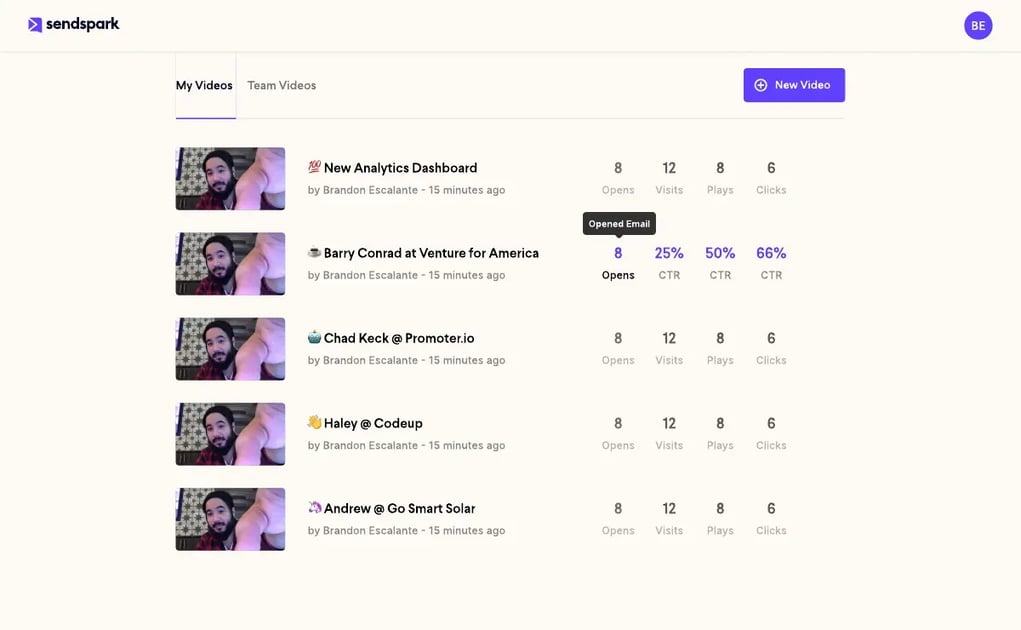
Use engagement signals from your video outreach as automatic CRM score inputs. When a prospect watches a Sendspark personalized video more than once or clicks the embedded CTA, that’s a behavioral signal worth 1-2 qualification points. Wire your video analytics directly into your CRM lead score via webhook or Zapier.
Tools That Speed Up Lead Qualification
A good qualification checklist tells your reps what to look for. Good tools give them the data to fill in the checklist faster — often before the first conversation. Here are the four tool categories that accelerate qualification without adding manual research.
CRM Lead Scoring (Native or Third-Party)
Your CRM should be doing most of the firmographic scoring automatically. HubSpot’s built-in lead scoring tool lets you assign points based on company properties (industry, employee count, revenue) and behavioral signals (email opens, page visits, form fills). Salesforce does the same via Einstein Lead Scoring. The goal is to have 5-7 of your 12 checklist criteria pre-scored before a rep even makes contact, so their discovery call can focus on the criteria that require a conversation.
AI-Personalized Video for Engagement Qualification
One of the fastest ways to test genuine intent is to send a brief, personalized video before committing to a full discovery call. An AI-personalized video — where the prospect hears their name and sees their company’s website as the background — generates 2-3x more replies than a text email. More importantly, whether someone watches your 60-second video (tracked in video analytics) tells you far more about their intent than a form fill. Reps on our team use a single video template, personalized at scale with Sendspark’s AI voice cloning, to qualify engagement on 50+ prospects per day without recording individual videos.
Sales Intelligence Platforms
Tools like ZoomInfo, Clay, and Apollo automate the firmographic data collection for checklist criteria 5, 6, and 7 (company size, industry, tech stack). Clay in particular can pull technographic data — what tools a prospect’s company is using — and feed it directly into your CRM, effectively auto-scoring your tech stack compatibility criterion before any human touchpoint. This is especially valuable for teams running high-volume outbound sequences.
Conversation Intelligence
Platforms like Gong and Chorus record and analyze discovery calls, flagging when reps forget to ask key qualification questions and surfacing the actual answers prospects gave. If your reps are conducting live qualification calls, conversation intelligence tools can automate the “did we actually collect all 12 checklist data points?” review that would otherwise require a manager to listen to every call. This is particularly useful during rep ramp-up periods.
For a broader view of your B2B prospecting tools stack, including qualification-adjacent tools for pipeline management, see our full comparison guide.
Use the reference table below to quickly map all 12 criteria to their source framework and scoring method — a useful one-pager for rep training and CRM field setup.
| # | Criterion | Framework | Max Score | How to Score It |
|---|---|---|---|---|
| 1 | Budget | BANT, CHAMP | 2 | Ask directly; infer from company size |
| 2 | Authority | BANT, MEDDIC | 2 | Title, org chart, direct discovery |
| 3 | Need / Pain | BANT, MEDDIC, CHAMP | 2 | Discovery call, pain articulation |
| 4 | Timeline | BANT, GPCTBA | 2 | Ask about milestones / deadlines |
| 5 | Company Fit | ICP | 2 | CRM auto-score from firmographics |
| 6 | Industry Fit | ICP | 2 | CRM auto-score from vertical data |
| 7 | Tech Stack Fit | ICP | 2 | Technographic tools (Clay, ZoomInfo) |
| 8 | Buying Stage | MEDDIC | 2 | Ask what’s triggered the evaluation |
| 9 | Engagement Level | Behavioral | 2 | Email opens, video views, clicks |
| 10 | Competition | MEDDIC | 2 | Ask who else they’re evaluating |
| 11 | Champion | MEDDIC | 2 | Internal advocate confirmed? |
| 12 | Success Criteria | MEDDIC, GPCTBA | 2 | Ask what a successful outcome looks like |
| Total (SQL threshold: 16+) | 24 | 16+ = SQL, 10-15 = Nurture, <10 = Recycle |
Sources & References
- HubSpot State of Sales — “Sales reps spend significant time on non-selling activities including unqualified prospect research” (2024)
- Salesforce State of Sales Report — “Over 57% of sales reps expect to miss their annual quota” (2023)
- Gartner B2B Buying Research — “The average B2B purchase involves 6-10 decision-makers; buyers spend only 17% of their time meeting with potential suppliers” (2022)
- Harvard Business Review — “Top-performing sales reps systematically qualify prospects before investing time in demos or proposals” (2018)
Frequently Asked Questions
What is a lead qualification checklist?
A lead qualification checklist is a scored list of criteria that sales reps use to evaluate whether a prospect is worth pursuing. Each criterion — such as budget, authority, need, and timeline — is scored on a 0-2 scale, and the total score determines whether a lead should be advanced to a discovery call, placed in a nurture sequence, or recycled. The goal is to make qualification decisions consistent and data-driven rather than relying on gut feel.
What does BANT stand for in sales?
BANT stands for Budget, Authority, Need, and Timeline. It’s the most widely used lead qualification framework, originally developed by IBM in the 1950s. While BANT is a useful starting point, it’s too simple for complex B2B deals — it misses key factors like internal champions, competitive landscape, tech stack fit, and behavioral engagement signals that predict whether a deal will actually close.
How do you score leads on a lead qualification checklist?
Assign each criterion a score of 0 (does not meet), 1 (partially meets), or 2 (fully meets). Sum all 12 criteria for a maximum possible score of 24. Set an SQL threshold — typically 16 or higher out of 24 — at which point a rep advances the lead to a discovery call. Leads scoring 10-15 enter a nurture sequence, and leads below 10 are recycled into a low-touch automated sequence. Calibrate your threshold quarterly against your closed-won deal data.
What is the difference between an MQL and an SQL?
An MQL (marketing-qualified lead) is a prospect who has shown interest through marketing interactions — opening emails, downloading content, attending webinars, or visiting pricing pages. An SQL (sales-qualified lead) is a prospect who has passed your qualification checklist and meets the criteria your sales team considers necessary for a productive discovery conversation. Not every MQL becomes an SQL — typically 15-30% of MQLs qualify as SQLs depending on your ICP definition and lead scoring thresholds.
How many criteria should a B2B lead qualification checklist have?
For most B2B sales teams, 10-12 criteria strike the right balance between thoroughness and practicality. Fewer than 8 criteria (like BANT alone) miss too many important signals, especially for mid-market and enterprise deals. More than 14 criteria makes the process too slow and reduces rep adoption. The 12-point framework in this article covers all major dimensions: firmographic fit, situational factors, stakeholder dynamics, and behavioral engagement signals.
What is the best lead qualification framework for enterprise sales?
MEDDIC (Metrics, Economic Buyer, Decision Criteria, Decision Process, Identify Pain, Champion) is the standard for enterprise B2B deals above $50K ACV. Its focus on the economic buyer, internal champion, and decision process makes it particularly suited to long, multi-stakeholder buying cycles. Many enterprise teams extend it to MEDDPICC, adding Paper Process (legal and procurement steps) and Competition. For teams running a mix of SMB and enterprise deals, combining BANT firmographic scoring with MEDDIC’s stakeholder and process criteria — as in the 12-point checklist above — gives the best coverage across deal sizes.
Record One Video. AI Personalizes Thousands.
Sendspark is the AI video personalization platform for B2B sales. Record once, and AI voice cloning generates thousands of individually personalized videos with dynamic backgrounds and personalized thumbnails — each prospect hears their name, sees their website, in your voice. Sales teams see 2-3x more replies.
Get Started Now