Updated August 2026
Account-based marketing teams now reach high-value accounts through five or more channels before a deal closes, and multi-channel video is the tactic that ties those touchpoints together. Multi-channel video for ABM means using AI-personalized video across email, LinkedIn, paid social, landing pages, and CRM-triggered sequences to engage every stakeholder in a target buying committee. Sendspark’s AI video personalization platform lets you record one video and use AI voice cloning with dynamic backgrounds to generate thousands of individually personalized versions. Teams running structured multi-channel video programs report 2-3x more replies and 40-50% more meetings booked compared with static-email-only outreach.
Key Takeaways
- Multi-channel ABM video needs orchestration, not broadcasting: Gartner reports B2B buying committees now average 11+ stakeholders, so a single video sent once to one contact rarely moves an account.
- Record once, personalize at scale: Sendspark’s AI voice cloning turns one recording into thousands of individually personalized videos with dynamic backgrounds and personalized thumbnails in minutes.
- Intent orchestration is the 2026 shift: AI-routed outreach now triggers video personalization from real-time intent signals rather than static CSV uploads.
- Measure account engagement, not single-metric views: Aggregated buying-committee engagement scores and pipeline velocity outperform open-rate tracking for ABM.
- CRM integration is non-negotiable: HubSpot, Salesforce, and Outreach sync video engagement data so sales follows up while interest is fresh.
What Is Multi-Channel Video for ABM?
Multi-channel video for ABM is the practice of delivering AI-personalized video content to target accounts across email, LinkedIn, paid social, landing pages, and CRM-triggered sequences in a coordinated cadence. Rather than sending one video to one contact, you map the buying committee inside each target account and serve each stakeholder a personalized video that references their role, company, and specific pain point. According to Gartner, B2B buying committees now average 11 or more stakeholders, which means single-contact outreach leaves the majority of decision-makers untouched. For a broader primer, see our guide to using ABM strategy for high-quality leads, or our comprehensive guide to AI video personalization for outbound sales.
The tactic sits at the intersection of account-based marketing and AI video personalization. Traditional ABM relied on static personalization like mail-merge first names in text emails. Multi-channel video replaces that with dynamic, voice-cloned video that shows the prospect their LinkedIn profile or company website as a background, says their name in your cloned voice, and adapts the call-to-action to their funnel stage. HubSpot State of Sales research shows that personalized CTAs convert 202% better than generic ones. For a deeper look at the category, see our complete 2026 guide to personalized video marketing, or our walkthrough of B2B multichannel outreach combining email, SMS, and video.
The shift in 2026 is that multi-channel video is no longer a manual, one-off production. AI video personalization platforms like Sendspark let you record a single template video, upload a contact list, and generate thousands of individually personalized versions in minutes. Each prospect receives a video that feels handmade for them, while your team spends time on messaging rather than recording 500 separate intros.
Selecting Target Accounts for Video Campaigns
Account selection for multi-channel ABM video starts with a data-driven Ideal Customer Profile (ICP) built from firmographics, technographics, behavioral signals, and third-party intent data, then segmented by personalization tier. Companies using well-defined ICPs report a 68% increase in account win rates, according to Forrester B2B revenue research. Tier accounts into 1:1 (top-tier whale hunting), 1:few (clusters of 5-15 similar accounts), and 1:many (AI-driven broader outreach) to match effort to value.
Build your ICP from multiple data layers. Start with firmographics like company size, revenue, industry, and location. Add technographics to align messaging with the account’s technology stack. Layer in behavioral data from LinkedIn activity, webinar attendance, and website visits. Incorporate third-party intent data from providers like Bombora to identify accounts actively researching solutions similar to yours. Review the ICP quarterly because markets shift.
Once the ICP is defined, use the ABM Video Personalization Spectrum to segment accounts. Reserve hyper-personalized 1:1 video for your top 20-50 strategic accounts. Use 1:few modular videos for clusters of 5-15 accounts sharing an industry or pain point. Deploy 1:many AI-driven personalization for broader outbound programs where you personalize name, company, and background automatically.
Your CRM is the backbone of account selection. A well-integrated CRM consolidates account data and lets you score accounts based on video engagement. A 60% video completion rate is a strong indicator of interest and should trigger a follow-up. Enrichment tools like Clay and ZoomInfo add depth by identifying key decision-makers within the buying committee. Intent-based targeting with Bombora pinpoints accounts actively researching your category.
Pro tip
Tier accounts by deal value before you record. Reserve 1:1 voice-cloned video for accounts worth $50K+ in annual contract value, and use 1:many AI personalization for the rest. This protects recording time for the deals that actually move pipeline.
Creating Personalized Videos at Scale
Creating personalized videos at scale means recording one template video and using AI voice cloning plus dynamic backgrounds to generate thousands of individually personalized versions, each addressed to a specific prospect by name and company. This solves the core tension in video prospecting: deeply personal videos take too long to produce, while generic ones fail to engage. Sendspark’s record-once-personalize-at-scale method lets you record a single video using a placeholder like “Watermelon” for the recipient’s name, then the AI clones your voice and swaps in each prospect’s actual name.
The mechanism goes beyond the name swap. Sendspark dynamically integrates each prospect’s LinkedIn profile or website as a video background, giving the impression of a custom screen-share without requiring a new recording for every contact. You upload a CSV with your contact list and the system generates a personalized video for each recipient. Each prospect hears their name in your cloned voice and sees their company website behind you, which signals the video was made specifically for them. For more on the underlying technique, see our complete B2B video prospecting guide.
For deeper account engagement, use Sendspark’s Combine Video feature to merge a short personalized intro with a pre-recorded product demo. Record a 10-20 second personalized intro in camera spotlight mode, then attach a reusable demo recording. This modular approach lets you personalize the high-value opening for key accounts while scaling the demo portion across hundreds of prospects.
Keep videos short and structured. Aim for 30-60 seconds total. Hook viewers in the first 5 seconds with the prospect’s name, company, or a specific challenge. Spend about 10 seconds providing value, 10 seconds sharing social proof, and 10 seconds on a clear call-to-action. Speak clearly and pause naturally around placeholders so name integration sounds seamless. Use personalized thumbnails featuring the recipient’s name or logo to boost play rates by roughly 7%.
Match the call-to-action to the buyer’s funnel stage. Suggest “Schedule a Demo” for early-stage prospects or “Start Free Trial” for those closer to conversion. Sendspark auto-populates landing pages with personalized elements like the prospect’s company logo and custom CTAs.
Record One Video. AI Personalizes Thousands.
Sendspark is the AI video personalization platform for B2B sales. Record once, and AI voice cloning generates thousands of individually personalized videos with dynamic backgrounds and personalized thumbnails — each prospect hears their name, sees their website, in your voice. Sales teams see 2-3x more replies.
Get Started NowDistributing Videos Across Email, LinkedIn, and Paid Channels
Distributing multi-channel ABM video means deploying personalized video across email, LinkedIn outreach, and paid retargeting in a sequenced cadence that reinforces one message to the same buying committee. Email remains the highest-volume channel, LinkedIn captures decision-makers where they research, and paid retargeting re-engages accounts that viewed but did not respond. McKinsey B2B research shows that coordinated multi-channel campaigns generate 30% higher conversion rates than single-channel efforts.
Email is still the best way to share video in ABM campaigns. Including a video in your emails can increase click-through rates by up to 65% and boost open rates by 26%, according to HubSpot research. Pair engaging email content with a customized video and a matching landing page. Use personalized thumbnails featuring the recipient’s name, logo, or website screenshot to improve play rates by 7%. Even something as simple as including the word “Video” in your subject line can enhance open rates. Direct recipients to a landing page that mirrors the email’s personalization and includes a clear call-to-action. For the underlying product capability, see our video email platform overview.
LinkedIn is a goldmine for engaging B2B decision-makers. InMail video messages can generate response rates between 10% and 25%. Target prospects based on specific actions like attending a webinar, commenting on posts, or starting a new job. Use the “spotlight” method by recording your webcam in a bubble over the prospect’s LinkedIn profile, which shows the video was made specifically for them. Keep LinkedIn video under 40 seconds. Integrate Sendspark with tools like Expandi to send personalized videos as part of multi-step nurture campaigns, which can boost reply rates by up to 16x.
Sync video efforts with your CRM and sales platforms to turn manual outreach into a scalable system. Sendspark integrates with HubSpot, Outreach, Salesforce, and SalesLoft so video delivery is automated and engagement is tracked. Feeding video view data into your CRM updates lead scores and triggers timely follow-ups. HubSpot, for example, offers native integrations with a 5/5 marketplace rating. Pair this with Clay to pull dynamic personalization data directly into your videos, and use dynamic CTAs that adapt to the viewer’s funnel stage. For a deeper dive, see our guide to video CRM integration.
Paid ads and retargeting re-engage accounts that did not respond to email or LinkedIn outreach. Personalized video ads on LinkedIn and Google capture prospects who already know your brand. Mirror the personalization used in email and LinkedIn so the buyer experience stays consistent. Launch video content via email first, then follow up with paid social ads. With 82% of people saying video influences their purchasing decisions, a well-timed retargeted video ad can be the final push prospects need to convert, according to HubSpot State of Sales research.
AI Intent Orchestration and Buying Committee Dynamics
AI intent orchestration is the 2026 layer that transforms multi-channel ABM video from batch CSV uploads into behavior-triggered personalization routed to the right stakeholder in real time. As buying committees grow past 11 stakeholders and dark social intent signals multiply across LinkedIn, Slack communities, and review sites, manual account lists can no longer keep pace. AI agent routing reads intent signals, maps the buying group inside each account, and triggers the right personalized video at the moment a prospect shows interest. According to Gartner, 75% of B2B buyers prefer a rep-free sales experience, which means the automated orchestration layer is where the buying journey now happens.
Buying committee dynamics are the core reason single-contact ABM video fails. A typical enterprise deal involves an economic buyer, a technical evaluator, a champion, an executive sponsor, and a security reviewer, each with different questions. AI intent orchestration maps these roles using CRM data, LinkedIn job titles, and engagement signals, then generates role-specific video variants from your single template recording. The economic buyer receives a video focused on ROI, while the technical evaluator receives one focused on integrations. This is the difference between account-based marketing and account-based experience.
The mechanism is an account engagement score that aggregates video views, watch time, CTA clicks, and CRM activity across the entire buying group. When the score crosses an engagement threshold trigger, the AI routes the next video automatically. If the security reviewer watches 80% of a technical video, the system sends a compliance-focused follow-up without waiting for the AE to notice. Salesforce and HubSpot both shipped native AI routing for account engagement in 2025, so the infrastructure is already inside most revenue stacks.
Dark social intent is the signal traditional CRM tracking misses. When a prospect shares your video inside internal Slack, forwards it to a colleague, or researches your category on a review site, that activity does not show up in your dashboard. AI intent orchestration partners like Bombora and LinkedIn Account Intelligence surface these signals so your video cadence responds to buying-group activity, not just individual email opens. Pipeline velocity acceleration comes from following up while buying-committee interest is peaking rather than after a scheduled delay.
The practical shift for revenue teams is that the AI video personalization platform becomes the execution layer while intent data and CRM routing become the decision layer. You still own the messaging and creative — the record-once-personalize-at-scale method still applies — but which prospect gets which video at which moment is now answered by real-time personalization signals rather than a static send calendar. For more on the targeting layer, see our guide to intent-based outreach tactics, or our sales prospecting solutions overview.
Advanced strategy
Map every stakeholder in your top 20 accounts before you record. When AI intent orchestration triggers a video, it routes to the right role-based variant automatically. A buying committee that each sees a video answering their own question closes faster than one that all sees the same generic pitch.
Measuring Engagement and Improving Performance
Measuring multi-channel ABM video performance means tracking account engagement scores, video completion rates, and pipeline velocity rather than single-metric open rates, because ABM success is measured at the account level across the whole buying committee. Companies using personalized video report a 93% boost in meeting-to-qualified pipeline conversions. The right metrics tell you which accounts are warming up, so you can refine campaigns while they are still running.
Focus on view rates and watch time to measure how well subject lines and thumbnails grab attention. A completion rate of 60% is a strong indicator of engagement. Track click-through rate to see how many viewers act on your call-to-action. For ABM, aggregate engagement scores across all stakeholders to gauge organizational interest rather than individual interest. Track pipeline velocity to measure how quickly video-engaged deals progress compared with non-video deals.
Sendspark’s analytics dashboard gives a clear picture of account engagement. Track views, watch time, and CTA clicks, then sync with your CRM for automated lead scoring. Trigger alerts when prospects watch more than 50% of a video so sales follows up while interest is fresh. Use heatmaps to see where viewers lose interest — if drop-offs happen at the 30-second mark, shorten future videos. Run A/B tests on thumbnails and CTAs to identify what drives results.
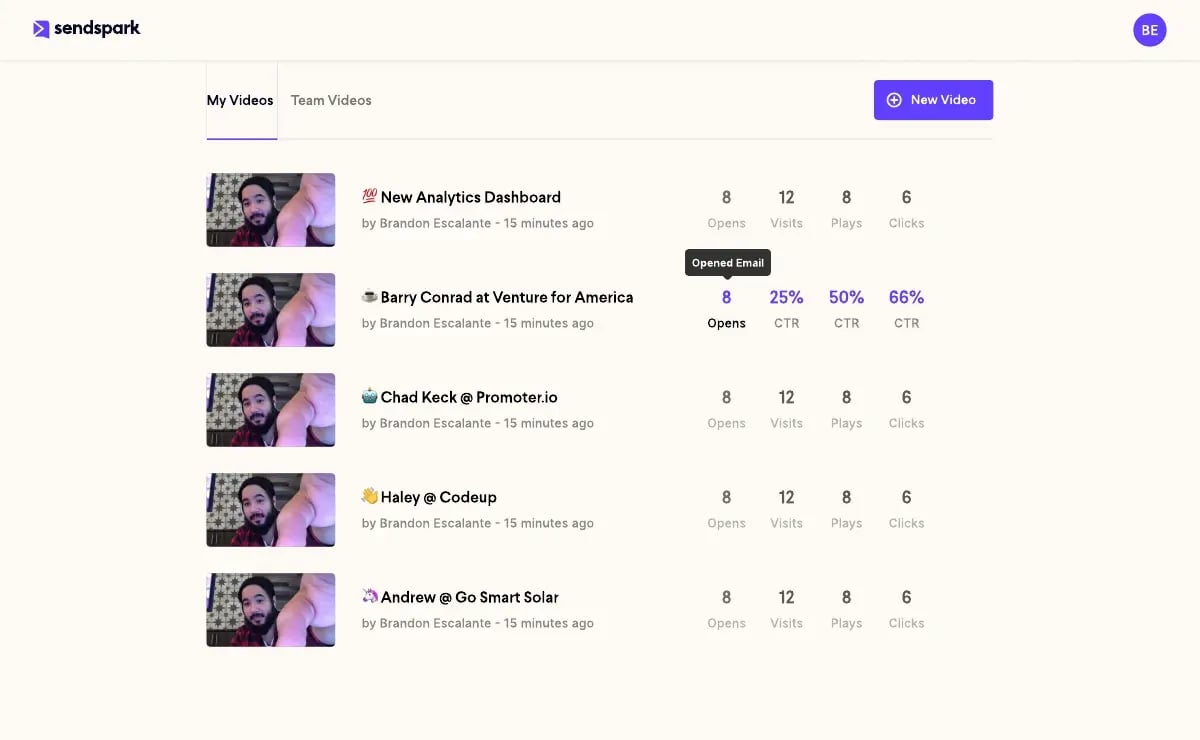
Use engagement thresholds to trigger retargeting. If someone watches 25% of your video but does not engage further, follow up with a LinkedIn ad or email sequence. Personalized CTAs perform three times better than generic ones, so tailor the call-to-action to where the viewer sits in their buyer’s journey. Align metrics with funnel stages: views for awareness, CTR for consideration, and sales opportunities for decision-making.
Campaign Orchestration and Cross-Team Alignment
Campaign orchestration for multi-channel ABM video means tying email, LinkedIn, CRM, and paid touchpoints into one sequenced campaign with shared messaging and cross-team ownership so the buying committee experiences one coherent story. Without this coordination, efforts across channels feel fragmented and prospects disengage. Sendspark’s AI makes personalization effortless by transforming a single recording into thousands of customized versions, but the orchestration layer decides which channel fires when and which team owns the follow-up.
Automate video delivery based on CRM triggers. If a prospect watches more than 60% of a video, your CRM can prompt an immediate follow-up. Syncing Sendspark with HubSpot or Salesforce lets you set these triggers so the right rep reaches out at the right moment. Automation handles delivery while humans focus on the message and positioning that make the campaign work.
For consistent messaging, collaboration across sales, marketing, and customer success is crucial. When these departments operate independently, mixed messages reach the buying committee. Have marketing create Master Video Templates and build a flexible library of intros, outros, and testimonials. This shared resource strengthens multi-channel efforts so every personalized video reinforces the same central message. Superside incorporated video into its ABM strategy in 2023, and 50% of new opportunities for the ABM team originated from personalized video, with click-through rates increasing by 8x.
Your video message should feel seamless whether it is viewed in an email inbox, on LinkedIn, or on a landing page. Define a clear core message and call-to-action, then adapt the format for each channel without altering the substance. For high-value accounts, add a human review step to ensure AI-generated elements like names and logos are accurate.
Common mistake
Letting sales, marketing, and customer success each pick their own video message. When the buying committee sees inconsistent positioning across channels, trust erodes and the account stalls. One Master Video Template library keeps everyone aligned.
Multi-Channel ABM Video Best Practices Summary
The table below summarizes the core practices that separate high-performing multi-channel ABM video programs from static-email-only outreach. Use it as a checklist when you plan your next account-based video campaign.
| Practice | What It Replaces | Why It Works in 2026 |
|---|---|---|
| Record once, personalize at scale with AI voice cloning | Recording 500 individual videos | Each prospect hears their name in your voice without per-video effort |
| Buying committee mapping with role-based video variants | Sending one video to one champion | 11+ stakeholders each get a video answering their own question |
| AI intent orchestration and engagement threshold triggers | Static CSV upload and scheduled cadence | Follow-up fires when buying-committee interest peaks, not on a delay |
| Dynamic backgrounds and personalized thumbnails | Generic stock visuals | Prospect sees their website behind you, boosting play rates by 7% |
| CRM-triggered video delivery and lead scoring | Manual send-and-hope outreach | HubSpot and Salesforce sync engagement so AEs follow up while interest is fresh |
| Account engagement score across the buying group | Single-metric email open rate | 93% boost in meeting-to-qualified pipeline conversions when scored at account level |
Frequently Asked Questions
What is multi-channel video for ABM?
Multi-channel video for ABM is delivering AI-personalized video to target accounts across email, LinkedIn, paid social, and CRM sequences in a coordinated cadence. Each buying-committee stakeholder receives a video referencing their role and company, so the account experiences one consistent message rather than a single generic video sent once.
How does AI video personalization work for account-based marketing?
AI video personalization records one template video with a placeholder for the recipient’s name, then uses AI voice cloning to swap in each prospect’s actual name. Dynamic backgrounds integrate each prospect’s LinkedIn profile or website, so the video feels custom-made. Sendspark generates thousands of personalized versions from a single recording.
Which channels work best for ABM video campaigns?
Email, LinkedIn, and paid retargeting are the highest-performing ABM video channels. Email lifts click-through rates by up to 65% according to HubSpot research. LinkedIn InMail video generates 10-25% response rates among B2B decision-makers. Paid retargeting re-engages accounts that viewed but did not respond.
How do you measure multi-channel ABM video performance?
Measure at the account level using aggregated engagement scores across the buying committee, video completion rates, and pipeline velocity rather than single-metric open rates. Companies using personalized video report a 93% boost in meeting-to-qualified pipeline conversions. Sync engagement data with your CRM so lead scoring reflects real-time buying-committee activity.
What is the record once personalize at scale method?
The record-once-personalize-at-scale method means recording one template video, then using AI voice cloning and dynamic backgrounds to generate thousands of personalized versions. Each prospect hears their name in your cloned voice and sees their company website as the background. Sendspark handles generation from a CSV upload, so your team focuses on messaging.
How does CRM integration improve ABM video campaigns?
CRM integration syncs video engagement data into lead scores and triggers automated follow-ups. When a prospect watches more than 60% of a video, HubSpot or Salesforce prompts an immediate call from the AE. This closes the gap between video view and follow-up, so reps reach out while buying-committee interest is fresh.
How many touchpoints should an ABM video sequence include?
An ABM video sequence should include 5-7 touchpoints across email, LinkedIn, and paid channels over a 2-3 week cadence, each personalized to a different stakeholder. Gartner reports B2B buying committees now average 11+ stakeholders, so a sequence reaching one contact misses the majority of decision-makers. Start with email, follow with LinkedIn, and use paid retargeting for non-responders.
Sources & References
- Gartner Sales Insights — “B2B buying committees average 11+ stakeholders” (2026)
- HubSpot State of Sales — “Personalized CTAs convert 202% better; video in email lifts CTR by up to 65%” (2025)
- McKinsey Growth & Marketing Insights — “Coordinated multi-channel campaigns generate 30% higher conversion rates” (2025)
- Forrester B2B Revenue Research — “Well-defined ICPs deliver 68% higher account win rates” (2025)
- Harvard Business Review — “75% of B2B buyers prefer a rep-free sales experience” (2025)
Record One Video. AI Personalizes Thousands.
Sendspark is the AI video personalization platform for B2B sales. Record once, and AI voice cloning generates thousands of individually personalized videos with dynamic backgrounds and personalized thumbnails — each prospect hears their name, sees their website, in your voice. Sales teams see 2-3x more replies.
Get Started NowTopics: blog