
Reps who skip qualification waste 40-60% of their selling time on prospects who will never buy. The right qualifying questions fix that. They tell you, in the first call, whether you’re talking to a real buyer or chasing a ghost — and they set up every follow-up conversation to close, not just check in.
This guide covers 30 specific qualifying questions across BANT, MEDDIC, and CHAMP frameworks, when to use each, and how to turn the data you gather into personalized follow-up that actually gets replies. New to these frameworks? Our sales glossary defines BANT, MQL, and every other qualification term you will run into.
Key Takeaways
- BANT (Budget, Authority, Need, Timeline) is the most widely used qualification framework, but MEDDIC and CHAMP add depth for complex or enterprise deals.
- Open-ended questions outperform closed yes/no questions because they surface real objections, hidden priorities, and decision dynamics that generic questions miss.
- Sequence questions from pain to impact to urgency to process, not budget-first, which puts prospects on the defensive immediately.
- After qualifying, generic follow-up kills deals, personalized follow-up that references what the prospect said drives 200-300% more replies.
- Sendspark’s AI voice cloning lets you record one follow-up video and personalize it at scale for every qualified prospect, with their name, company, and specific situation.
What Are Sales Qualifying Questions?
Sales qualifying questions are structured questions that determine whether a prospect has the Budget, Authority, Need, and Timeline to become a paying customer. They separate real buyers from tire-kickers, so you spend your time on deals that can actually close — not conversations that go nowhere for weeks.
The difference between qualification and discovery is worth understanding. Qualification answers: should we pursue this deal? Discovery answers: how do we win it? You qualify first. If a prospect doesn’t pass your qualification criteria, there’s no point spending four discovery calls trying to craft a perfect pitch.
Open-ended questions are the engine of good qualification. A closed question like “Do you have budget?” gets a yes or no and tells you almost nothing. An open question like “How does your team typically fund solutions like this?” surfaces the procurement process, the timeline, the stakeholders involved, and whether there’s real urgency. Every piece of that answer is intelligence you can use.
“Top-performing B2B sales reps qualify more rigorously early in the sales cycle, which means they spend less time on low-probability deals and more time closing the ones that matter.”
Good qualification also protects your prospect’s time. If your solution genuinely isn’t a fit, the most professional thing you can do is tell them that early — not three months into a sales process. The right qualifying questions make that call faster, and make your win rate higher when you choose to continue.
BANT Qualifying Questions (10 Examples)
BANT stands for Budget, Authority, Need, and Timeline. IBM developed the framework in the 1950s and it remains the most widely used qualification model in B2B sales today. It gives you a fast, structured way to assess whether a prospect is worth pursuing — and used well, it doesn’t feel like a checklist.
Budget Questions (3)
Budget questions reveal not just whether a prospect has money, but how they spend it and whether your solution fits their procurement cycle.
- “What kind of budget have you set aside for addressing [specific problem]?”
- “How does your team typically fund new technology or process investments?”
- “Is this a planned expenditure for the current fiscal year, or are you still in the early stages of building the business case?”
Authority Questions (2)
You need to know who owns the final decision, and who has informal influence that could kill a deal late in the process.
- “Who else on your team would be involved in evaluating a solution like this?”
- “When you’ve brought in a new tool or vendor before, what did that approval process look like?”
Need Questions (3)
Need questions surface the real urgency behind the prospect’s search. The best need questions connect the problem to a business outcome, not just a feature request.
- “What specific challenge led you to start looking for a solution now?”
- “If you don’t solve this in the next 6 months, what’s the business impact?”
- “What have you already tried, and why didn’t it work?”
Timeline Questions (2)
Timeline questions tell you how serious the prospect is and what’s driving their urgency, whether it’s an external event, an internal initiative, or just general interest.
- “By when are you hoping to have this in place, and what’s driving that deadline?”
- “Are there any internal milestones, budget reviews, or other events that affect your timing?”
| Question | BANT Component | What to Listen For |
|---|---|---|
| “What budget have you set aside for addressing [problem]?” | Budget | A range, a dedicated fund, or signals that they need to build a business case |
| “How does your team typically fund new technology investments?” | Budget | Capital vs. operating expense, project-based vs. departmental budgets |
| “Is this a planned expenditure or early-stage budget planning?” | Budget | Urgency level, proximity to a budget cycle, or need for a champion to secure funds |
| “Who else would be involved in evaluating this?” | Authority | Number of stakeholders, roles, internal politics, procurement involvement |
| “What did the approval process look like for your last major purchase?” | Authority | Number of sign-offs, typical deal length, legal or security reviews required |
| “What specific challenge led you to look for a solution now?” | Need | The triggering event, the level of pain, and whether it’s strategic or operational |
| “If you don’t solve this in 6 months, what’s the impact?” | Need | Quantifiable cost — lost revenue, wasted hours, competitive disadvantage |
| “What have you already tried, and why didn’t it work?” | Need | Past investments, existing bias toward or against certain approaches, maturity level |
| “By when do you need this in place?” | Timeline | A specific date or quarter, and what external event or internal goal is driving it |
| “Are there internal milestones that affect your timing?” | Timeline | Budget reviews, board meetings, product launches, or seasonal pressures |
Common mistake
Asking BANT questions in sequence like a checklist feels like an interrogation. Lead with need, then timeline, then authority, then budget. Save money for last, not first.
MEDDIC and CHAMP Qualifying Questions (10 Examples)
MEDDIC and CHAMP go deeper than BANT, especially for complex enterprise deals with multiple stakeholders. MEDDIC helps you map the entire decision-making landscape. CHAMP leads with the prospect’s challenges rather than your qualification needs, which often produces more honest conversations.
MEDDIC Questions (5 Examples)
MEDDIC stands for Metrics, Economic Buyer, Decision Criteria, Decision Process, Identify Pain, and Champion. Use it when you’re selling a high-value solution to a large organization where one person rarely makes the final call.
- Metrics: “How do you currently measure the impact of [problem], and what specific KPIs are you trying to move?”
- Economic Buyer: “Who is ultimately responsible for the P&L connected to this initiative, and how do they typically evaluate new investments?”
- Decision Criteria: “What are the non-negotiable requirements your team will use to evaluate vendors?”
- Decision Process: “Can you walk me through how your organization typically selects a new solution at this level?”
- Champion: “Who internally is most invested in solving this problem, and what would help them make the case internally?”
CHAMP Questions (5 Examples)
CHAMP stands for Challenges, Authority, Money, Prioritization. It’s particularly effective for mid-market deals where the primary buyer has real pain but limited visibility into budget at the start of the conversation.
- Challenges: “What other challenges is your team dealing with that might be connected to this one?”
- Authority: “Who else would need to weigh in on a solution like this before you could move forward?”
- Money: “What’s the potential ROI or financial impact you’re hoping to achieve by solving this?”
- Prioritization: “Of everything on your plate right now, how high a priority is solving this?”
- Prioritization: “What would change if you put this on hold for another 6 months?”
| Framework | Best For | Complexity | When to Use |
|---|---|---|---|
| BANT | Transactional sales, SMB deals, early-stage qualification | Low | First call, quick qualification, high-volume pipelines |
| MEDDIC | Enterprise sales, multi-stakeholder decisions, large deals | High | When the deal is complex and multiple executives are involved |
| CHAMP | Mid-market, problem-centric sales, urgency-driven deals | Medium | When you want to lead with value before discussing money |
For a deeper breakdown of how these frameworks work across different deal types, see our B2B lead qualification framework guide.
How to Ask Qualifying Questions Without Sounding Scripted
The best qualifying questions fail when delivered wrong. A checklist mentality makes prospects feel processed, not heard. The reps who close the most deals use these questions as a framework to listen, not a script to recite.
Sequence Your Questions for Natural Flow
Start with pain, move to impact, then urgency, then process. Save budget and decision-maker questions for later in the conversation, once you’ve established genuine rapport and context. According to Gong’s analysis of discovery call recordings, top-performing reps spend significantly more time listening than talking, and they probe deeper on fewer topics rather than racing through a full checklist.
The wrong sequence: “Do you have budget? Who’s the decision-maker? What’s your timeline?” The right sequence: “What’s driving this search right now? What happens if you don’t solve it? Who else cares about this outcome?” Budget and process come after you’ve established that the problem is real and urgent.
10 Situational Qualifying Questions for Specific Scenarios
These questions go beyond standard BANT and MEDDIC for specific situations, competitive evaluations, and late-stage qualification:
- “Are you evaluating other solutions at the same time, and what does that comparison process look like?” (competitive displacement)
- “What would need to be true for you to deprioritize this initiative?” (testing urgency)
- “How did you hear about us, and what made you want to take the call?” (intent signal)
- “What would a successful outcome look like 12 months after implementing a solution?” (outcomes-based)
- “Who else on your team would be affected by this decision, positively or negatively?” (buying committee mapping)
- “What’s your biggest concern about making a change right now?” (objection surfacing)
- “Is there a version of this that would solve 80% of the problem at a fraction of the cost?” (budget flexibility)
- “How does your team typically make decisions at this scale?” (process mapping)
- “What would make you say no to moving forward, even if we ticked all the boxes?” (deal-killer identification)
- “If we can solve [specific pain], is there anything stopping you from moving forward this quarter?” (closing readiness)
Pro tip
Script the intent, not the exact words. Know what you’re trying to learn from each qualifying question, then let the conversation shape how you ask it. You’ll sound natural, and the prospect will actually tell you the truth.
Red Flags to Watch For
Vague answers, deflection, and “we’re just researching” are signals to probe deeper, not accept and move on. If a prospect says “we’re thinking about it,” ask: “What part are you still thinking through?” If they say “budget is unclear,” ask: “Have you built the business case internally, or is that still ahead of you?” The follow-up question is often where the real qualification happens.
For more on running the actual call structure, see our guide to running a qualification call.
Record One Video. AI Personalizes Thousands.
Sendspark is the AI video personalization platform for B2B sales. Record once, and AI voice cloning generates thousands of individually personalized videos with dynamic backgrounds and personalized thumbnails — each prospect hears their name, sees their website, in your voice. Sales teams see 2-3x more replies.
Get Started NowTurn Qualification Data Into Personalized Follow-Up
Here’s where most reps leave money on the table. They run a solid qualifying call, gather detailed information about budget, stakeholders, pain, and timeline, then send a generic follow-up email that could have been written before the call. The prospect who just told you their Q3 deadline and the name of the economic buyer receives a “Great connecting today — here’s our deck” email. The deal stalls.
Personalized follow-up is the multiplier on good qualification. When you reference what the prospect said, use their language, and acknowledge their specific situation, reply rates go up 200-300% compared to generic outreach. According to HubSpot’s sales research, personalized follow-up is one of the top differentiators between reps who close consistently and those who don’t.
The challenge is scale. Writing a custom follow-up for every qualified prospect takes time most reps don’t have. That’s where AI video personalization changes the equation. With Sendspark’s AI voice cloning and dynamic backgrounds, you record one follow-up video template and the platform generates individually personalized versions for every prospect — each one starting with their name, showing their company website in the background, and referencing their specific situation, in your voice.
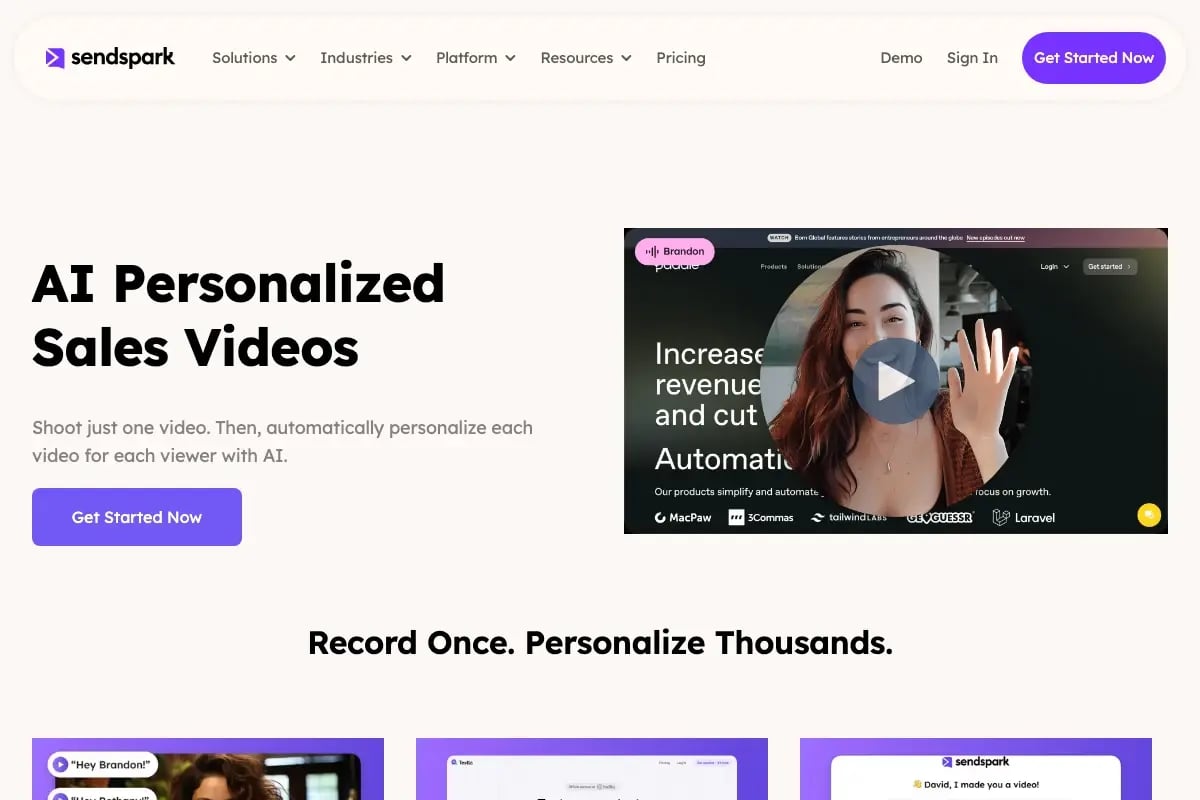
The workflow looks like this: after a qualifying call, log the key details in your CRM (your HubSpot or Salesforce integration handles this). Then trigger a personalized video follow-up from Sendspark using that data. The prospect gets a video that says “Hey [their name], based on what you shared about [their specific challenge] and the Q3 timeline…” — even if you have 50 qualified prospects in your pipeline that week.
This is the payoff from rigorous qualification: you know enough about each prospect to make the follow-up feel like a conversation continuation, not a cold pitch. And because Sendspark lets you record one video and personalize at scale, you’re not choosing between personalization and throughput.
30 Sales Qualifying Questions: Quick Reference
| # | Question | Framework | Stage |
|---|---|---|---|
| 1 | “What budget have you set aside for addressing [problem]?” | BANT | First call |
| 2 | “How does your team typically fund new technology investments?” | BANT | First call |
| 3 | “Is this a planned expenditure or early-stage budget planning?” | BANT | First call |
| 4 | “Who else would be involved in evaluating this?” | BANT | First call |
| 5 | “What did the approval process look like for your last major purchase?” | BANT | First call |
| 6 | “What specific challenge led you to look for a solution now?” | BANT | First call |
| 7 | “If you don’t solve this in 6 months, what’s the business impact?” | BANT | First call |
| 8 | “What have you already tried, and why didn’t it work?” | BANT | First call |
| 9 | “By when do you need this in place, and what’s driving that deadline?” | BANT | First call |
| 10 | “Are there internal milestones that affect your timing?” | BANT | First call |
| 11 | “How do you measure the impact of [problem] today?” | MEDDIC | Discovery |
| 12 | “Who owns the P&L connected to this initiative?” | MEDDIC | Discovery |
| 13 | “What are the non-negotiable criteria your team will use to evaluate vendors?” | MEDDIC | Discovery |
| 14 | “Can you walk me through how your org typically selects a solution at this level?” | MEDDIC | Discovery |
| 15 | “Who internally is most invested in solving this, and how can I help them make the case?” | MEDDIC | Discovery |
| 16 | “What other challenges is your team dealing with that might be connected to this?” | CHAMP | Discovery |
| 17 | “Who else needs to weigh in before you could move forward?” | CHAMP | Discovery |
| 18 | “What ROI or financial impact are you hoping to achieve by solving this?” | CHAMP | Discovery |
| 19 | “Of everything on your plate, how high a priority is solving this right now?” | CHAMP | Discovery |
| 20 | “What changes if you put this on hold for 6 more months?” | CHAMP | Discovery |
| 21 | “Are you evaluating other solutions, and what does that comparison look like?” | Situational | First/second call |
| 22 | “What would need to be true for you to deprioritize this?” | Situational | First call |
| 23 | “How did you hear about us, and what made you take the call?” | Situational | First call |
| 24 | “What would success look like 12 months after implementing a solution?” | Situational | Discovery |
| 25 | “Who else on your team would be affected by this decision?” | Situational | Discovery |
| 26 | “What’s your biggest concern about making a change right now?” | Situational | Discovery |
| 27 | “Is there a version of this that solves 80% of the problem at a fraction of the cost?” | Situational | Discovery |
| 28 | “How does your team typically make decisions at this scale?” | Situational | Discovery |
| 29 | “What would make you say no, even if we ticked all the boxes?” | Situational | Late-stage |
| 30 | “If we solve [specific pain], is anything stopping you from moving forward this quarter?” | Situational | Late-stage |
For more on lead qualification strategy, see our complete guide. And if you’re focused on inbound leads specifically, our guide to inbound lead qualification covers the scoring and routing process.
Frequently Asked Questions
What are qualifying questions in sales?
Sales qualifying questions are structured questions used to determine whether a prospect has the budget, authority, need, and timeline to become a customer. They help reps filter genuine buyers from leads who aren’t a fit, so sales time is spent on deals that can actually close.
What is an example of a good qualifying question?
“What specific challenge led you to start looking for a solution now?” is one of the most effective qualifying questions in B2B sales. It’s open-ended, surfaces the triggering event, and reveals urgency — all without feeling interrogative. The answer tells you the pain level, the timeline, and often the decision-maker’s priorities in a single response.
What is the difference between BANT and MEDDIC qualifying questions?
BANT (Budget, Authority, Need, Timeline) is a simpler framework suited to transactional and SMB sales where one or two people typically make the decision. MEDDIC adds Metrics, Economic Buyer, Decision Criteria, Decision Process, and Champion layers, making it better suited for enterprise deals with multiple stakeholders, longer sales cycles, and higher deal values where understanding the full buying landscape is critical.
How many qualifying questions should you ask on a first call?
Focus on 4-6 targeted qualifying questions rather than a full checklist. The goal is depth, not breadth. Ask one question, listen fully, follow up based on what they said, then move to the next. A first call that surfaces two or three real insights from genuine conversation qualifies better than ten superficial yes/no answers.
What makes a qualifying question effective?
An effective qualifying question is open-ended (can’t be answered with yes or no), tied to a specific outcome you need to understand, and sequenced naturally after building rapport. The best qualifying questions don’t feel like questions — they feel like a conversation where the prospect is telling you their situation, not being interrogated about it.
How do you disqualify a prospect quickly?
Ask your most critical qualifying question first in a natural way, then listen for evasion. If a prospect can’t identify a specific problem, doesn’t know who makes the decision, and has no timeline, those are disqualification signals. The fastest disqualifier is often: “What happens if you don’t solve this in the next 6 months?” — if the answer is “not much,” urgency is absent, and the deal likely isn’t real.
What is the connection between qualifying questions and personalized follow-up?
The data you gather through qualifying questions is the raw material for your follow-up. When you reference a prospect’s specific challenge, their stated timeline, or the economic buyer they named, your follow-up reads like a conversation continuation rather than a cold pitch. This is why reps using structured qualification combined with personalized outreach see significantly higher response rates — the follow-up proves you listened.
Sources & References
- RAIN Group, What Sales Winners Do Differently — “Top-performing B2B sales reps qualify more rigorously early in the sales cycle” (2023)
- Gong, Sales Discovery Questions Analysis — Analysis of discovery call recordings showing how top reps listen more and probe deeper on fewer topics (2023)
- HubSpot, Sales Qualification Questions — “Personalized follow-up is one of the top differentiators between reps who close consistently and those who don’t” (2024)
Record One Video. AI Personalizes Thousands.
Sendspark is the AI video personalization platform for B2B sales. Record once, and AI voice cloning generates thousands of individually personalized videos with dynamic backgrounds and personalized thumbnails — each prospect hears their name, sees their website, in your voice. Sales teams see 2-3x more replies.
Get Started NowPublished July 2026