
Revenue teams that still glue together five different dashboards to answer “what is our pipeline doing this quarter?” lose an average of 9% of forecastable revenue to data drift, according to Salesforce State of Revenue Operations research. Revenue operations software exists to close that gap. The best platforms in 2026 unify sales, marketing, and customer success data, automate forecast rollups, surface deal risk, and give your RevOps team one place to operate the entire revenue engine. This guide compares nine platforms by stack fit, pricing, and the workflows they actually own — so you can pick the right one without sitting through nine demos.
Key Takeaways
- Revenue operations software unifies sales, marketing, and customer success data into one source of truth so revenue teams can forecast, attribute, and act on the same numbers.
- The nine platforms compared here split into four categories: full RevOps suites (HubSpot Operations Hub, Salesforce Revenue Cloud), forecasting tools (Clari, Mosaic), conversation intelligence (Gong), and engagement layers that feed RevOps data (Outreach, ZoomInfo, Sendspark).
- According to Gartner, 75% of the highest-growth companies will deploy a RevOps model by 2025, making tool consolidation a near-term priority.
- Pricing ranges from roughly $25/user/month (Pipedrive Revenue) to $200+/user/month (enterprise Clari and Gong); most B2B teams under 200 reps land at $50-90/user/month.
- AI-personalized video data (opens, watch time, CTA clicks) belongs inside your RevOps stack — it is a leading indicator of deal velocity, not a vanity metric.
What Is Revenue Operations Software?
Revenue operations software is a category of platforms that unifies data and workflows across sales, marketing, and customer success teams into a single operating layer on top of (or as a replacement for) traditional CRMs. It centralizes pipeline data, automates forecast rollups, surfaces deal risk, and gives RevOps leaders one place to govern the metrics every go-to-market function shares.
A traditional CRM tracks records — accounts, contacts, opportunities. RevOps software tracks the system that moves those records: territory rules, lead routing, quota allocation, attribution windows, renewal motions, and the data hygiene rules that keep forecasts accurate. The shift is from “where is the record?” to “is the revenue engine working as designed?”
The category exists because data silos kill forecast accuracy. Marketing owns MQLs in HubSpot. Sales owns opportunities in Salesforce. Customer success owns renewals in Gainsight. Each tool reports a different version of “pipeline” and “ARR” depending on join keys, snapshot timing, and attribution windows. According to Forrester, companies with mature RevOps functions grow revenue 19% faster than peers — and the software layer is what makes that maturity operational at scale.
For a deeper primer on the discipline itself, see our complete guide to RevOps. The strategic question — should you build a RevOps function? — is upstream of this article. Once you have the function, this is the tool comparison.
How We Evaluated These Platforms
We evaluated revenue operations platforms across six criteria: data unification (how well the tool ingests sales, marketing, and CS data), forecasting depth, attribution capabilities, native integrations with HubSpot and Salesforce, pricing transparency, and verified G2 reviews from RevOps practitioners. We excluded pure CRMs (Salesforce Sales Cloud, HubSpot Sales Hub) and single-channel point tools because neither category satisfies the “unify the revenue engine” definition on its own.
We also distinguish between platforms that own the RevOps system of record (HubSpot Operations Hub, Salesforce Revenue Cloud) and platforms that layer on top of an existing CRM to add forecasting, conversation intelligence, or engagement data (Clari, Gong, Outreach, Sendspark). Both are valid — most B2B teams under 500 reps use one suite plus two or three layers.
Finally, we read Harvard Business Review’s research on sales-marketing alignment as the baseline for what RevOps software should actually solve: shared definitions, shared dashboards, shared incentives. Anything that does not move those three things forward is a vendor pitch, not a RevOps platform.
The 9 Best Revenue Operations Software Platforms in 2026
The nine platforms below cover the full RevOps stack: a system-of-record layer, a forecasting layer, an attribution and analytics layer, and an engagement layer that feeds pipeline-stage data back into reporting. Below is the quick comparison, followed by a focused breakdown of where each platform fits, what it costs, and the workflow it actually owns.
| Platform | RevOps Category | Starting Price | Best For | G2 Rating |
|---|---|---|---|---|
| HubSpot Operations Hub | Full suite | $50/mo (Starter) | HubSpot-centric teams under 500 reps | 4.4 / 5 |
| Salesforce Revenue Cloud | Full suite (enterprise) | Custom (typically $150+/user/mo) | Enterprise / complex quoting | 4.2 / 5 |
| Clari | Forecasting | Custom (typically $1,200+/user/yr) | Pipeline forecasting at scale | 4.6 / 5 |
| Gong | Conversation intelligence | Custom (typically $1,600+/user/yr) | Deal coaching + call-driven forecasting | 4.7 / 5 |
| Outreach | Engagement + forecasting | Custom (typically $100/user/mo) | Outbound-heavy teams | 4.3 / 5 |
| ZoomInfo OperationsOS | Data hygiene + enrichment | Custom (typically $15K+/yr) | Data hygiene + ICP enforcement | 4.4 / 5 |
| Mosaic | Financial planning + RevOps | Custom (typically $30K+/yr) | Series B-D with finance-led RevOps | 4.4 / 5 |
| Pipedrive Revenue | Lightweight suite | $25/user/mo | SMB / early-stage teams | 4.3 / 5 |
| Sendspark | Engagement layer (AI video) | $49/mo | Pipeline acceleration via AI-personalized video | 4.8 / 5 |
1. HubSpot Operations Hub
Best for: HubSpot-native teams that want one platform for the entire revenue engine. Operations Hub sits inside the broader HubSpot suite and adds programmable automation, data quality tooling, and shared reporting across Sales, Marketing, and Service Hubs. The Starter tier begins at $50/month for small teams; Professional ($800/mo) and Enterprise ($2,000/mo) unlock the data sync, datasets, and SSO that RevOps actually needs.
Operations Hub is the right choice when your center of gravity is already HubSpot. The native data model means MQLs, opportunities, and renewals share the same contact record without join logic. For teams plugging video engagement signals into the same pipeline view, the Sendspark + HubSpot integration writes watch time and CTA clicks straight into the deal record.
2. Salesforce Revenue Cloud
Best for: enterprise teams with complex quoting, billing, and renewal motions. Revenue Cloud bundles CPQ, Billing, Subscription Management, and Revenue Lifecycle Management on top of Salesforce. Pricing is custom; published list prices typically start around $150/user/month and climb fast with add-ons. The strength is depth — multi-product bundles, usage-based billing, complex commission rules — and the weakness is implementation cost (six-figure SI engagements are common).
If you already run Salesforce as the system of record and your deal motion involves negotiated quotes or usage billing, Revenue Cloud is the most defensible buy. For teams that need video engagement data inside Salesforce, Sendspark writes engagement events to the opportunity object so forecasting models can use watch time as a stage-progression signal.
3. Clari
Best for: forecasting accuracy at scale. Clari is the category leader in pipeline forecasting. It ingests activity data from your CRM, calendar, email, and engagement tools, then runs an AI model that flags deal risk, projects quarter-end, and rolls forecasts up the management hierarchy. Pricing is custom; expect $1,200-$1,800/user/year for mid-market deployments.
Clari is a layer, not a suite. You still need a CRM underneath. The buying signal is when your forecast call takes 90 minutes a week and the number still misses by 15% — Clari typically cuts variance in half within two quarters. For a full comparison of Clari against Gong, Salesforce, and other conversation- and forecast-intelligence tools, see our guide to revenue intelligence platforms.
Record One Video. AI Personalizes Thousands.
Sendspark is the AI video personalization platform for B2B sales. Record once, and AI voice cloning generates thousands of individually personalized videos with dynamic backgrounds and personalized thumbnails — each prospect hears their name, sees their website, in your voice. Sales teams see 2-3x more replies.
Get Started Now4. Gong
Best for: coaching-led deal management and call-driven forecasting. Gong records and analyzes sales conversations, then surfaces the language patterns, objections, and deal risks across your pipeline. The platform doubled-down on revenue intelligence in 2024-2025, adding forecasting and deal-board features that compete with Clari. Pricing is custom; published benchmarks land at $1,600+/user/year.
Gong is strongest for teams that believe call quality is the leading indicator of revenue. If your reps run 8-12 discovery and demo calls per week, the coaching ROI is real. If your motion is heavier on async outreach (video, email, LinkedIn), Gong sees less of the deal, and an engagement-layer tool may give you more signal per dollar.
5. Outreach
Best for: outbound-heavy teams that want sequencing and forecasting in one stack. Outreach started as a sales engagement platform (sequences, dialer, email) and has steadily added forecasting, deal management, and revenue intelligence. Pricing is custom; expect ~$100/user/month for the core sequence product, more for the Kaia conversation intelligence and forecasting modules.
Outreach is the right call when your pipeline depends on outbound sequence performance and you want the engagement tool to feed the forecast directly. Pair Outreach with AI-personalized video at the top of the sequence for a measurable lift in reply rates.
6. ZoomInfo OperationsOS
Best for: data hygiene, ICP enforcement, and account scoring. OperationsOS sits between your data providers and your CRM, enriching contacts and accounts, deduplicating records, and enforcing ICP rules in real time. Pricing is custom; mid-market deployments typically run $15,000-$45,000/year depending on data volume and seats.
The buying signal is when your reps spend more time fixing CRM data than selling. OperationsOS is not a forecasting tool — it is the plumbing that makes every forecasting tool more accurate.
Advanced strategy
Map your stack by the question each tool answers. CRM answers “where is this deal?” Forecasting answers “will we hit?” Engagement answers “what should the rep do next?” If two tools answer the same question, you have overlap. If a question is unanswered, you have a gap.
7. Mosaic
Best for: Series B-D companies where finance owns RevOps. Mosaic is a strategic finance platform with strong RevOps capabilities — pipeline modeling, scenario planning, headcount-to-quota analysis, and board-ready dashboards. Pricing is custom; the typical contract value sits at $30,000-$80,000/year.
Mosaic is the right pick when your VP Finance or CFO is leading the RevOps function (common in Series B-D SaaS). It is less appropriate when RevOps reports into Sales and the day-to-day workload is forecast hygiene and deal inspection.
8. Pipedrive Revenue
Best for: SMB and early-stage teams that want RevOps capabilities without enterprise pricing. Pipedrive added forecasting, revenue insights, and lightweight automation to its core CRM in 2024. The platform starts at $25/user/month and tops out around $100/user/month for Enterprise. It is not as deep as Clari or Salesforce Revenue Cloud, but for teams under 50 reps, the depth is usually sufficient.
Choose Pipedrive Revenue if you already use Pipedrive as a CRM and you do not want to add a separate forecasting layer. The trade-off is that you are buying the system of record and the analytics layer from the same vendor — fewer integration headaches, less best-of-breed depth.
9. Sendspark
Best for: revenue teams that want video engagement signals inside their RevOps stack. Sendspark is the AI video personalization platform for B2B sales. Reps record one video, and AI voice cloning + dynamic backgrounds generate thousands of individually personalized videos. The engagement data — opens, watch time, CTA clicks per recipient — syncs into HubSpot, Salesforce, Outreach, and SalesLoft so your RevOps dashboards see video signal alongside email and call signal. Choosing the right platform is only half the answer — see our breakdown of the team structure that uses these tools to design the org that will actually run the stack.
Sendspark is not a CRM or a forecasting tool. It is the engagement layer that produces the data your forecasting tool needs. Pricing starts at $49/month (Solo) and scales to Business at $699/month for 25 seats and unlimited videos. For sales teams that want to use video at scale without sacrificing personalization, this is the layer that fits.
How to Choose the Right RevOps Platform for Your Team
Choosing the right revenue operations software comes down to three variables: team size, the center of gravity of your existing tech stack, and where your forecast accuracy breaks down today. Start with the variable that hurts most. If forecasting is your problem, buy a forecasting layer. If your CRM has become a graveyard of stale records, buy data hygiene. If reps are drowning in admin, buy automation. Sequence the spend; do not buy a full suite if you only need one layer.
By Team Size
Teams under 25 reps rarely need more than HubSpot Operations Hub Starter or Pipedrive Revenue. The discipline matters more than the tooling at this stage. Teams between 25 and 200 reps benefit from a CRM plus one specialist layer (Clari for forecasting, Gong for coaching, or Outreach for engagement). Above 200 reps, you typically need a suite (HubSpot Enterprise or Salesforce Revenue Cloud) plus two or three layers.
By Stack Center of Gravity
If 70% of your team’s daily work happens in HubSpot, lean toward Operations Hub plus complementary layers. If Salesforce is your hub, Revenue Cloud or a Salesforce-native layer like Clari fits better. Picking the platform that does not sit on your CRM creates integration drag and forces RevOps to maintain two data models. For a deeper comparison of how RevOps differs from the older Sales Ops function, see RevOps vs Sales Ops.
Build vs Buy
Teams with strong data engineering sometimes consider building parts of the stack in dbt, Looker, and reverse-ETL tools (Hightouch, Census). This works for analytics and segmentation. It rarely works for forecasting or deal inspection — those workflows need software that reps and managers actually open every day. Build the analytics layer; buy the workflow layer.
Common mistake
Do not buy three RevOps tools in the same quarter. Each one needs 60-90 days of clean data and rep adoption before it produces useful output. Sequence the rollout: one tool per quarter, prove the ROI, then add the next.
Where AI Video Personalization Fits in Your RevOps Stack
AI-personalized video belongs in the engagement layer of your RevOps stack because video engagement is one of the strongest leading indicators of deal velocity. When a champion watches a personalized demo video to 80% completion and clicks the CTA, that signal predicts close rate better than email opens or generic activity counts. The job of revenue operations software is to capture that signal, route it to the deal record, and surface it on the forecast call. For more on the metrics that matter, see our guide to sales metrics worth tracking.
Sendspark fits this layer specifically. The platform’s video analytics stream watch time, drop-off points, and CTA clicks per recipient into HubSpot and Salesforce, alongside email and call activity. RevOps teams then build forecasts on a richer activity signal — not just “did the rep send an email” but “did the buyer actually engage.”
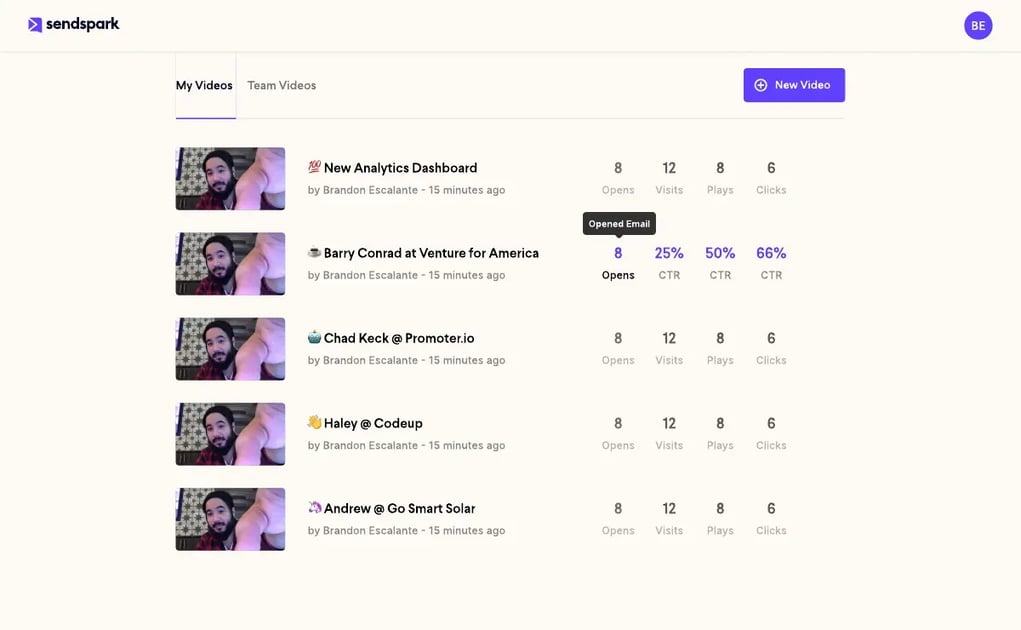
The strategic case is simpler than the tooling. Buyers ignore static text emails. A video that uses AI voice cloning to greet the prospect by name, shows their company’s website as a dynamic background, and runs 60 seconds gets watched. Sales teams using Sendspark report 2-3x more replies than text-only outreach. From a RevOps perspective, that is engagement-data volume increasing, which improves the signal-to-noise ratio of every forecasting model downstream. See our RevOps strategy guide for how to operationalize this end-to-end, and the deal progression solution page for how video accelerates mid-funnel motion.
Pro tip
Before you add a new RevOps platform, audit which existing tools you are paying for but underusing. McKinsey’s growth research consistently finds that the average B2B revenue team uses less than 40% of the features in their existing stack. Consolidation often beats new purchase.
Frequently Asked Questions
What is revenue operations software used for?
Revenue operations software unifies sales, marketing, and customer success data into a single operating layer, automating forecast rollups, surfacing deal risk, and giving RevOps teams one place to manage pipeline, quota, attribution, and revenue process design. It complements (and sometimes replaces) a traditional CRM.
How is revenue operations software different from a CRM?
A CRM tracks records — accounts, contacts, opportunities. Revenue operations software tracks the system that moves those records: routing rules, forecast methodology, attribution windows, data hygiene workflows, and shared KPIs. Most teams run both; the CRM is the database, the RevOps software is the operating model on top of it.
How much does revenue operations software cost?
Pricing ranges from about $25/user/month (Pipedrive Revenue) to $200+/user/month (enterprise Clari, Salesforce Revenue Cloud, Gong). Most B2B teams under 200 reps land at $50-90/user/month for their core platform. Add-on layers like conversation intelligence or attribution typically add another $30-60/user/month.
What is the best revenue operations software for HubSpot users?
HubSpot Operations Hub is the most native option for HubSpot-centric teams because it shares the same data model as Sales, Marketing, and Service Hubs — no join logic, no separate identity layer. For teams that need deeper forecasting, layering Clari on top of HubSpot is a common pattern.
Do I need separate revenue operations software if I already have Salesforce?
Usually yes, but as a thin layer rather than a replacement. Salesforce excels as a system of record and reporting hub, but most teams add a forecasting layer (Clari), a conversation intelligence layer (Gong), and an engagement layer (Outreach or Sendspark) on top because Salesforce alone does not optimize the day-to-day RevOps workflow.
How does AI video personalization fit into a RevOps stack?
AI-personalized video lives in the engagement layer. Tools like Sendspark let sales reps record one video and use AI voice cloning plus dynamic backgrounds to generate thousands of individually personalized versions. The engagement data — watch time, CTA clicks — syncs into the CRM so the RevOps forecasting model gets a leading indicator of deal momentum.
How long does it take to implement revenue operations software?
Lightweight tools like Pipedrive Revenue and HubSpot Operations Hub Starter can be live in days. Mid-market deployments of Clari, Outreach, or Gong typically take 30-60 days for clean integration and rep adoption. Enterprise Salesforce Revenue Cloud or Mosaic implementations can run 90-180 days plus an SI engagement.
Sources & References
- Salesforce State of Revenue Operations — “Revenue teams lose an average of 9% of forecastable revenue to data drift across siloed tools.” (2024)
- Gartner Revenue Operations Research — “75% of the highest-growth companies will deploy a RevOps model by 2025.” (2023)
- Forrester Revenue Operations Research — “Companies with mature RevOps functions grow revenue 19% faster than peers.” (2024)
- Harvard Business Review — “The new power of sales and marketing alignment: shared definitions, shared dashboards, shared incentives.” (2020)
- McKinsey Growth, Marketing & Sales Insights — “The average B2B revenue team uses less than 40% of the features in their existing stack.” (2024)
Record One Video. AI Personalizes Thousands.
Sendspark is the AI video personalization platform for B2B sales. Record once, and AI voice cloning generates thousands of individually personalized videos with dynamic backgrounds and personalized thumbnails — each prospect hears their name, sees their website, in your voice. Sales teams see 2-3x more replies.
Get Started Now