
Most B2B companies build a Sales Operations team first. Then they hit $30M ARR, the marketing and customer success teams start generating their own spreadsheets, and suddenly nobody agrees on what “pipeline” means. That’s usually when someone says the word RevOps. But the difference between RevOps and Sales Ops isn’t just organizational structure — it’s a fundamentally different answer to the question of who owns revenue.
Key Takeaways
- RevOps aligns marketing, sales, and customer success under one operations function — Sales Ops focuses exclusively on the sales team.
- RevOps typically reports to the CRO or CEO; Sales Ops reports to the VP of Sales — the reporting line signals which problems each function owns.
- According to Gartner, companies that unify revenue operations see faster pipeline velocity and improved forecast accuracy compared to siloed ops teams.
- Sales Ops is the right starting point for most B2B companies under $25M ARR; RevOps becomes essential as GTM complexity increases and marketing and CS each build their own data and tooling.
- Both functions improve with AI-powered outreach in the stack — tools like video analytics from Sendspark give RevOps and Sales Ops teams visibility into how prospects engage with personalized outreach.
What Is RevOps?
Revenue Operations (RevOps) is an organizational function that unifies operations across marketing, sales, and customer success under a single umbrella. RevOps teams own the full-funnel tech stack, data architecture, process design, and revenue forecasting — with the goal of eliminating handoff friction between go-to-market teams. In a RevOps model, marketing ops, sales ops, and CS ops all report into one leader (typically a VP of RevOps or Chief Revenue Officer) instead of each reporting into their respective department heads.
RevOps emerged as a distinct discipline around 2018, driven by the recognition that siloed operations created systematic gaps: marketing attributed revenue one way, sales tracked it differently, and CS had no visibility into pre-sale commitments. The Salesforce State of Sales report has consistently found that high-performing sales organizations are significantly more likely to have alignment between sales and marketing operations than lower-performing peers.
Core RevOps Responsibilities
- Tech stack ownership — Managing and integrating CRM, MAP, CS platform, BI tools, and outreach tooling across all revenue teams
- Data governance — Standardizing definitions (what is a “qualified lead”? what counts as “closed won”?) across departments
- Revenue forecasting — Building a single source of truth for pipeline and ARR projections
- Process design — Mapping and optimizing the full customer journey from first touch to renewal
- Compensation and territory planning — Owning quota setting, territory carving, and incentive structures
- Reporting and analytics — Delivering unified dashboards that surface GTM performance to leadership
For a deeper dive into how RevOps functions as a strategic engine, see our complete guide to Revenue Operations for B2B teams.
Pro tip
The fastest way to determine whether your company needs RevOps: count the number of conflicting “pipeline” numbers that appear in your weekly leadership meeting. If marketing, sales, and finance each cite a different figure, you have a RevOps gap.
What Is Sales Ops?
Sales Operations (Sales Ops) is a function dedicated entirely to making the sales team more efficient and effective. A Sales Ops team handles the CRM, sales tooling, deal desk processes, territory planning, and performance reporting specifically for the sales organization. Sales Ops leaders typically report to the VP of Sales or Chief Sales Officer, and their KPIs are directly tied to sales team productivity and revenue output.
Sales Ops has been a recognized function since the 1970s, when Xerox formalized the role to support their field sales organization. Today, sales operations software has expanded the scope dramatically — Sales Ops teams now own CRM administration, sales engagement platforms, conversation intelligence tools, and outreach automation stacks. For a side-by-side breakdown of revenue operations software comparison, see our latest comparison.
Core Sales Ops Responsibilities
- CRM administration — Owning Salesforce or HubSpot configuration, data hygiene, and user workflows
- Sales tool management — Evaluating and administering sales engagement platforms, dialers, and prospecting tools
- Territory and quota design — Building fair territory maps and translating revenue goals into rep-level quotas
- Deal desk — Reviewing non-standard deals, approving discounts, managing CPQ workflows
- Sales reporting — Tracking rep performance, activity metrics, and pipeline health for sales leadership
- Onboarding and enablement support — Collaborating with sales enablement to equip reps with the right tools and data
Sales Ops is laser-focused on one question: how do we help the sales team close more deals, faster? For benchmarks on what good looks like, see our guide to the 20 B2B sales metrics to track.
RevOps vs Sales Ops: Head-to-Head Comparison
The core distinction is scope. Sales Ops optimizes one team — the sales team. RevOps optimizes the full revenue engine — marketing, sales, and customer success working in concert. Here is a direct comparison across the dimensions that matter most for B2B leadership decisions:
| Dimension | RevOps | Sales Ops |
|---|---|---|
| Scope | Marketing + Sales + Customer Success | Sales team only |
| Reports to | CRO or CEO | VP of Sales or CSO |
| Primary KPIs | Full-funnel revenue, NDR, forecast accuracy, time-to-revenue | Win rate, quota attainment, rep ramp time, pipeline coverage |
| Tech stack ownership | CRM + MAP + CS platform + BI + full GTM stack | CRM + sales engagement + dialers + CPQ |
| Data ownership | Cross-functional: unified customer data model | Sales-side: opportunity, activity, and account data |
| Forecasting | Company-wide ARR and NRR forecasting | Sales pipeline and deal-level forecasting |
| Typical company stage | Series B+ or $25M+ ARR | Series A+ or $5M+ ARR |
| Team size (typical) | 3-10+ across all sub-functions | 1-5 analysts and admins |
The Key Data Flow Difference
Sales Ops sees data from the moment a lead enters the CRM as an opportunity through to closed/won or closed/lost. RevOps sees the full picture: how that lead was acquired, what content they engaged with, how the sales cycle progressed, and what happened post-sale — renewal, expansion, or churn.
This difference is critical for measuring outreach effectiveness. When your sales team uses AI-personalized video in prospecting — like Sendspark’s AI voice cloning and dynamic backgrounds — Sales Ops tracks reply rate and meeting booked rate. RevOps connects that same outreach data to downstream metrics: did those meetings convert at a higher rate? Did those accounts expand? A RevOps model gives you the full attribution chain.
Record One Video. AI Personalizes Thousands.
Sendspark is the AI video personalization platform for B2B sales. Record once, and AI voice cloning generates thousands of individually personalized videos with dynamic backgrounds and personalized thumbnails — each prospect hears their name, sees their website, in your voice. Sales teams see 2-3x more replies.
Get Started NowWhen to Build RevOps vs Sales Ops
The right choice depends almost entirely on your company stage and GTM complexity. Sales Ops should come first — you need operational support for the sales team before you have the scale to justify unifying all revenue functions. RevOps is the evolution you build when marketing and customer success have grown large enough to warrant their own operational capacity, and you realize those three functions need to share a data model and tech stack to operate efficiently.
Build Sales Ops When:
- You have 5+ quota-carrying sales reps and nobody owns the CRM
- Your sales team is spending time on manual data entry, territory disputes, or tool confusion
- You’re at Series A or $5M-$25M ARR and need to scale the sales process
- Forecast accuracy is below 70% and you don’t have a clear pipeline methodology
- Onboarding new reps takes 90+ days with no structured ramp plan
Build RevOps When:
- Marketing, sales, and CS each have separate systems that don’t talk to each other
- You’re above $25M ARR and have 3+ distinct revenue-generating teams
- Your board asks for full-funnel metrics and you can’t produce them without a weekend of spreadsheets
- Customer success is generating expansion revenue but it’s not showing up in the pipeline model
- You’re hiring a VP of Revenue or CRO and they’re asking about your revenue architecture
“The problem isn’t that Sales Ops is bad — it’s that Sales Ops was never designed to answer the question ‘why is our NRR declining?’ That’s a RevOps question, because it requires data from post-sale that Sales Ops doesn’t own.”
Per Gartner’s research on revenue operations, organizations that consolidate go-to-market operations into a RevOps model experience significantly better forecast accuracy and faster deal velocity than those running siloed ops teams. The consolidation pays off most clearly when multiple revenue teams have accumulated conflicting data models.
For a step-by-step guide on building the RevOps function once you’ve decided you need it, see our RevOps strategy guide.
How RevOps and Sales Ops Work Together
In mature organizations, Sales Ops doesn’t disappear when RevOps is introduced — it becomes a sub-function within the RevOps umbrella. The Sales Ops team continues owning the CRM, sales tools, and rep-level reporting, but now coordinates with Marketing Ops and CS Ops through a unified RevOps leader who owns the cross-functional data model and forecasting layer.
The Typical Structure
A common org design at a $50M-$100M B2B SaaS company looks like this: If you’ve decided RevOps is the right path, our guide to the right RevOps team structure walks through the seven core roles and when to add each one.
- VP of Revenue Operations (reports to CRO)
- Sales Ops Manager + Analysts (own CRM, sales tools, territory/quota)
- Marketing Ops Manager (owns MAP, attribution, campaign ops)
- CS Ops Manager (owns CS platform, health scoring, renewal tracking)
- Data/BI Analyst (owns unified dashboards and revenue reporting)
The B2B marketing KPIs that Marketing Ops tracks — MQL volume, conversion rates, campaign attribution — feed directly into the RevOps forecasting model alongside the pipeline metrics that Sales Ops manages. That connection is what makes RevOps valuable: a single dashboard for the CRO that shows the full revenue picture.
Shared Tools in the RevOps + Sales Ops Stack
The tools that RevOps and Sales Ops share most frequently:
- CRM — HubSpot or Salesforce (the single source of truth for both functions)
- Sales engagement — Outreach, SalesLoft, or Apollo for sequence management
- BI and reporting — Tableau, Looker, or CRM-native dashboards
- Conversation intelligence — Gong or Chorus for call analysis and coaching insights
- AI video personalization — Sendspark for AI-personalized video outreach at scale, with engagement data flowing back to the CRM
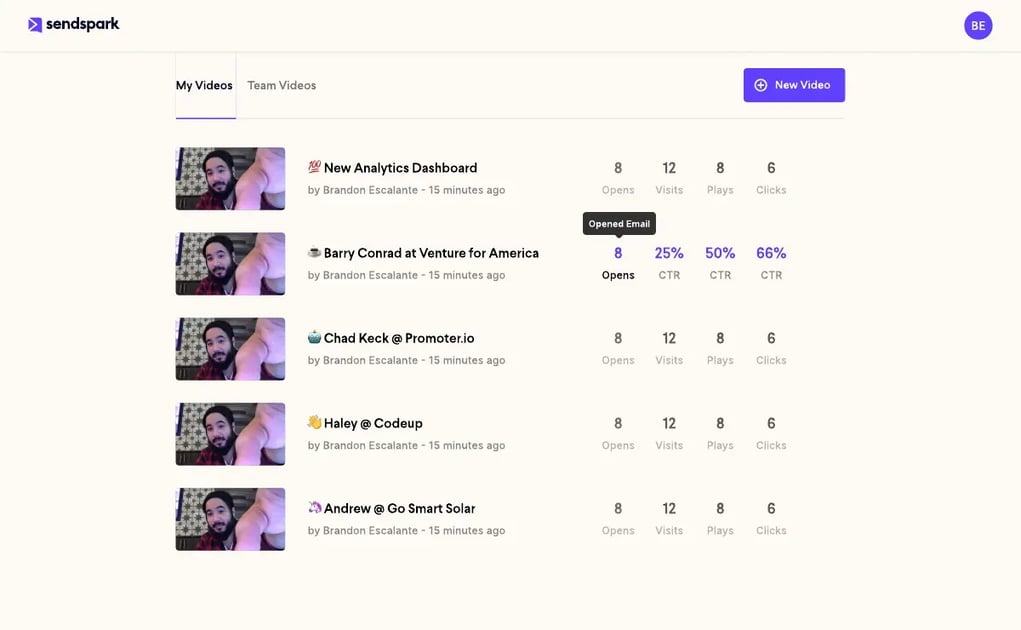
On the AI video personalization front, Sendspark’s video analytics give both Sales Ops and RevOps teams visibility into how prospects engage with personalized video emails: who opened, who watched to completion, who clicked the CTA. That data surfaces in the CRM alongside call and email activity, giving ops teams a richer signal on prospect intent.
Common mistake
Companies often build RevOps before building Sales Ops, hoping to solve all ops problems at once. This usually fails. Sales Ops needs to be functional before you can layer in cross-functional coordination — you need a working CRM and sales process before you can unify it with marketing ops data.
Summary: RevOps vs Sales Ops Quick Reference
| If You Need To… | Use Sales Ops | Use RevOps |
|---|---|---|
| Fix CRM hygiene | Yes | Yes (but broader) |
| Improve rep quota attainment | Yes | Indirectly |
| Unify marketing and sales data | No | Yes |
| Build a full-funnel revenue forecast | No | Yes |
| Manage expansion and renewal ops | No | Yes |
| Reduce sales team admin time | Yes | Yes |
| Align GTM teams on shared KPIs | No | Yes |
The LinkedIn State of Sales report finds that sales professionals who describe their team as highly aligned with marketing are more likely to hit quota — a finding that reinforces the case for RevOps as the mechanism to create and sustain that alignment at scale.
For a complementary perspective, HubSpot’s marketing research consistently shows that companies with tightly aligned revenue teams achieve better customer acquisition costs and faster sales cycles — the downstream payoff of the RevOps investment.
Frequently Asked Questions
What is the difference between RevOps and Sales Ops?
RevOps (Revenue Operations) covers marketing, sales, and customer success operations under one function, while Sales Ops focuses exclusively on the sales team. RevOps reports to the CRO and owns full-funnel revenue data; Sales Ops reports to the VP of Sales and owns deal-level and rep performance data. RevOps is the broader, more strategic function that emerges as companies scale beyond a single revenue-generating team.
Does RevOps replace Sales Ops?
No. In most mature B2B organizations, Sales Ops becomes a sub-function within RevOps rather than being eliminated. The Sales Ops team continues to own CRM administration, rep-level reporting, and sales tooling, but now coordinates with Marketing Ops and CS Ops under a unified RevOps leader. RevOps adds cross-functional visibility; it doesn’t remove the specialized work Sales Ops does for the sales team.
When should a B2B company hire its first Sales Ops person?
Most B2B companies should hire their first Sales Ops hire when they reach 5-8 quota-carrying reps and the VP of Sales is spending meaningful time on CRM administration, territory disputes, or tool management instead of coaching. A good rule of thumb: if the VP of Sales is doing ops work for more than 5 hours per week, a dedicated Sales Ops hire will pay for itself quickly in leadership focus alone.
When does a B2B company need RevOps instead of just Sales Ops?
The transition to RevOps typically makes sense when a company reaches $25M-$30M ARR and has distinct, growing marketing and customer success teams each building their own data and tooling. The trigger is usually when leadership realizes they’re getting conflicting pipeline or revenue numbers from different teams — that’s the signal that Sales Ops can no longer solve the problem alone because the problem is cross-functional.
What KPIs does RevOps own vs Sales Ops?
RevOps owns full-funnel metrics: net dollar retention (NDR), net revenue retention (NRR), time-to-revenue, forecast accuracy, and customer acquisition cost (CAC). Sales Ops owns sales-team metrics: quota attainment, win rate, pipeline coverage ratio, average deal size, and rep ramp time. Where they overlap is in pipeline velocity — both functions care about how quickly deals move from stage to stage, but RevOps also tracks what happens to those customers post-close.
Is Revenue Operations the same as Revenue Operations and Intelligence (ROI)?
Revenue Operations and Intelligence (ROI) is a term some vendors use to describe RevOps platforms that include AI-powered analytics and predictive scoring on top of the core operations infrastructure. Standard RevOps is the organizational function; ROI is a product category that supports that function with advanced intelligence tooling. For most B2B teams, the distinction matters less than having clean data and aligned processes in place first.
How does AI video personalization fit into a RevOps tech stack?
AI video personalization tools like Sendspark integrate into the RevOps stack through CRM connections. Reps record one video; Sendspark’s AI voice cloning personalizes it at scale with each prospect’s name and dynamic background. Video engagement data — opens, watch time, CTA clicks — flows back to the CRM, giving both Sales Ops and RevOps teams attribution data on outreach activity. This makes personalized video a measurable line item in the revenue ops model rather than a black box.
Sources & References
- Salesforce State of Sales — “High-performing sales organizations are significantly more likely to have strong alignment between sales and marketing operations” (2024)
- Gartner Revenue Operations Research — Organizations with consolidated revenue operations experience faster pipeline velocity and improved forecast accuracy compared to siloed ops models (2024)
- LinkedIn State of Sales Report — Sales professionals who describe their team as highly aligned with marketing are more likely to exceed quota (2024)
- HubSpot Marketing Statistics — Companies with tightly aligned revenue teams achieve better CAC and faster sales cycles (2024)
Record One Video. AI Personalizes Thousands.
Sendspark is the AI video personalization platform for B2B sales. Record once, and AI voice cloning generates thousands of individually personalized videos with dynamic backgrounds and personalized thumbnails — each prospect hears their name, sees their website, in your voice. Sales teams see 2-3x more replies.
Get Started Now