
Most B2B companies have a revenue problem that org charts can’t solve. Sales blames marketing for low-quality leads. Marketing blames sales for not following up. Customer success isn’t looped in until churn happens. The answer isn’t hiring more people — it’s building a RevOps strategy that aligns all three teams around a single revenue engine.
According to Forrester Research, companies with aligned revenue operations grow revenue 19% faster and are 15% more profitable than those running siloed go-to-market teams. But alignment doesn’t happen by accident. It requires a deliberate strategy.
This guide walks you through exactly how to build one — from the five foundational pillars to a 90-day rollout plan and the metrics that tell you whether it’s working.
Key Takeaways
- RevOps strategy unifies sales, marketing, and customer success around shared data and revenue goals — companies with RevOps alignment grow revenue 3x faster than those without
- The 5 pillars of a strong RevOps strategy are: data alignment, process standardization, tech stack consolidation, cross-functional KPIs, and continuous improvement loops
- Start with a single CRM of truth — without shared data, every other RevOps initiative will break down at the team handoff
- AI-personalized video outreach integrates naturally into RevOps, giving every team a measurable touchpoint at each funnel stage
- Most B2B teams see measurable pipeline improvement within 90 days of standing up a structured RevOps strategy
What Is a RevOps Strategy?
A RevOps strategy is a deliberate operating plan that aligns your sales, marketing, and customer success teams around shared data, shared processes, and shared revenue targets. It is not the same as hiring a RevOps person or standing up a RevOps team. Those are structural decisions. A strategy defines how those teams operate together to generate, convert, and retain revenue.
If you want a grounding on the concept itself, our guide on what RevOps is and how it works covers the framework in full. This article assumes you understand the basics and are ready to translate them into an executable plan.
The Problem a RevOps Strategy Actually Solves
The core problem is handoff failure. Marketing generates a lead and throws it over the wall to sales. Sales converts a deal and throws it over the wall to customer success. Each handoff loses context, loses data, and creates friction for the buyer. The result: your pipeline leaks, your conversion rates plateau, and churn shows up as a lagging indicator six months too late.
A RevOps strategy eliminates those walls by creating a continuous, measurable revenue cycle — from first touch to renewal — with clear ownership at each stage and data that flows between teams instead of getting stuck in silos.
RevOps Strategy vs. RevOps Framework
A framework describes the structure (three functions, one team, shared goals). A strategy describes the execution: which processes you’ll change, in what order, using what tools, measured by what KPIs, and delivered in what timeframe. Without a strategy, a RevOps framework is just an org chart. For a side-by-side breakdown of best revenue operations software platforms, see our latest comparison.
“Revenue Operations is not a department — it’s an operating philosophy. The strategy is the document that turns philosophy into pipeline.”
The 5 Pillars of RevOps Strategy
A RevOps strategy rests on five pillars. Every pillar is interconnected — weakness in one creates drag across the others. According to Gartner, by 2025, 75% of the highest-growth companies planned to deploy a RevOps model, with data alignment identified as the single most critical implementation factor.
Pillar 1: Data Alignment (Single Source of Truth)
Every RevOps strategy starts with one question: where does your revenue data live? If sales tracks pipeline in Salesforce, marketing tracks leads in HubSpot, and CS tracks health scores in a spreadsheet, you don’t have a revenue engine — you have three separate machines that can’t talk to each other.
Data alignment means choosing one CRM as the system of record and building every team’s workflow into it. Deals, contacts, email sequences, video engagement, call outcomes, onboarding milestones — all in one place. Your HubSpot integration or Salesforce integration becomes the nerve center, not just a sales tool.
Pillar 2: Process Standardization
Shared data is worthless without shared processes. If every rep runs their own sequence and every marketer uses a different lead scoring model, the data looks clean but the patterns are meaningless. Standardization means defining the exact stages of your funnel — with entry criteria, exit criteria, and required actions at each stage — and enforcing them across all three teams.
This includes your sales process automation logic: which sequences trigger at which stage, which handoff criteria move a deal from MQL to SQL, and which events trigger a CS touch. When these are codified through RevOps automation, theied and consistent, your pipeline data becomes a real forecasting input instead of a guess.
Pillar 3: Tech Stack Consolidation
Most B2B teams have 15-30 tools in their revenue stack, and many overlap. RevOps strategy requires an honest audit of what each tool does, whether it integrates with the CRM, and whether it generates data that the other teams can actually use. Consolidation doesn’t mean cutting tools — it means eliminating redundancy and ensuring data flows both directions.
Pillar 4: Cross-Functional KPIs
Siloed teams optimize for siloed metrics. Marketing optimizes for MQLs. Sales optimizes for close rate. CS optimizes for NPS. None of these is a revenue metric. RevOps strategy replaces siloed KPIs with a shared set of metrics that span the full cycle: pipeline velocity, revenue attribution, win rate by source, customer acquisition cost, and net revenue retention.
Our breakdown of B2B marketing KPIs that actually move revenue goes deep on which metrics to choose and why MQL volume is often a misleading north star.
Pillar 5: Continuous Improvement Loops
A RevOps strategy is not a one-time project. It requires a recurring cadence: weekly pipeline reviews, monthly funnel analysis, and quarterly strategy adjustments. The best RevOps teams run what’s called a “revenue rhythm” — a structured meeting schedule that ensures every team is looking at the same data and making decisions from the same set of facts.
Pro tip
Set up a weekly RevOps standup with one representative from sales, marketing, and CS. Keep it to 20 minutes. Review the same three metrics every week: pipeline added, pipeline moved, and pipeline lost. Consistency matters more than complexity.
Record One Video. AI Personalizes Thousands.
Sendspark is the AI video personalization platform for B2B sales. Record once, and AI voice cloning generates thousands of individually personalized videos with dynamic backgrounds and personalized thumbnails — each prospect hears their name, sees their website, in your voice. Sales teams see 2-3x more replies.
Get Started NowHow to Build Your RevOps Strategy: Step by Step
Building a RevOps strategy takes roughly 90 days from audit to first results. The five steps below are sequential — skip one and you’ll find yourself rebuilding later. Most teams that “tried RevOps and it didn’t work” skipped Step 1.
Step 1: Audit Your Current State
Before you can fix anything, you need to see what’s broken. Run a current-state audit across four dimensions: data quality (how complete and consistent is your CRM?), process coverage (which funnel stages have defined criteria, which are ad hoc?), tech stack (what tools do each team use, which integrate with the CRM, which don’t?), and metrics (what does each team currently measure and optimize for?).
The output of this audit is a gap map — the specific places where data leaks, process breaks, or teams optimize against each other. This is your prioritization input.
Step 2: Define Your Shared Revenue Goal
Agree on a single revenue number that all three teams are working toward. Not MQLs. Not close rate. Not NPS. Revenue. Specifically: what ARR number do you need to reach in the next 12 months, and what does each team need to contribute to get there?
This creates accountability without micromanagement. Marketing knows they need to generate $X in pipeline. Sales knows they need to convert $Y of it. CS knows they need to retain $Z of existing ARR. Every team can then work backwards from their number to the activities that drive it.
Step 3: Map the Customer Journey
Draw a single, agreed-upon customer journey map from first touch to renewal. For each stage, define: what does the buyer experience, what data does the team capture, what action does the team take, and what criteria move the buyer to the next stage?
This sounds simple but is often the hardest step. Sales and marketing frequently disagree on what an MQL is, what a demo-ready lead looks like, and when CS should be introduced to a deal. Getting alignment here, in writing, is the foundation of everything else.
Step 4: Assign Ownership at Each Stage
Every stage of the journey needs a single owner — not a committee, not a shared responsibility. Ownership means: this person ensures the action happens, the data gets entered, and the handoff criteria are met before moving to the next stage. Build this into your CRM as required fields and stage gates, not as a policy document that lives in a wiki no one reads.
Common mistake
Assigning ownership to a team instead of a person. “Marketing owns MQL qualification” is a recipe for no one owning it. Assign a named individual responsible for each stage gate and build the accountability into your weekly revenue rhythm.
Step 5: Roll Out in 90-Day Sprints
Don’t try to implement everything at once. Start with the highest-impact gap from your audit — usually data alignment or a broken MQL-to-SQL handoff — and build one working process before adding complexity. A 90-day sprint gives you enough time to see results without losing momentum or buying a tool you won’t use.
Your outbound sales strategy is often the best place to start because it sits at the top of the funnel where every team has an opinion. Getting marketing and sales to agree on what counts as a qualified outbound lead is high value, low risk, and immediately measurable.
RevOps Tech Stack: Choosing Tools for Each Pillar
The right RevOps tech stack isn’t the most comprehensive one — it’s the most integrated one. Every tool you add should either live inside your CRM or write data back to it automatically. If a tool can’t do either, its data is invisible to the rest of the revenue team and adds no value to the RevOps strategy.
According to the Salesforce State of Sales report, high-performing sales teams are 4.9x more likely to use AI tools across the full revenue cycle compared to underperformers. The difference is not which tools they use, but how those tools connect. A strategy charter only works if the team is built to deliver on it — see our guide to what roles your RevOps team needs for the hiring sequence and org chart that match each stage of growth.
| RevOps Pillar | Tool Category | What to Look For | CRM Integration Required? |
|---|---|---|---|
| Data Alignment | CRM | Bidirectional sync, custom objects, pipeline reporting | This IS the CRM |
| Process Standardization | Sales Engagement | Sequence automation, task triggers, stage gates | Yes — writes deal stage and activity data back to CRM |
| Process Standardization | AI Video Personalization | AI voice cloning, dynamic backgrounds, per-recipient analytics | Yes — video engagement data flows to contact record |
| Tech Consolidation | Revenue Intelligence | Call recording, deal health scoring, pipeline forecasting | Yes — syncs call outcomes and deal signals |
| Cross-Functional KPIs | Analytics & Reporting | Multi-touch attribution, funnel reporting, cohort analysis | Yes — reads from CRM as primary data source |
| Continuous Improvement | Revenue Rhythm Tool | Meeting agendas, OKR tracking, shared dashboards | Optional — pulls from CRM for live data |
Where AI-Personalized Video Fits in Your RevOps Stack
One tool category that B2B RevOps teams consistently underuse is AI video personalization. Most teams think of video as a top-of-funnel SDR tactic — cold outreach. In a RevOps context, it applies at every stage.
With Sendspark’s AI-personalized video platform, your SDR records one video and AI voice cloning generates individually personalized versions for every prospect — each one addressing the prospect by name, showing their company website as the background, in the rep’s cloned voice. The same AI personalization applies to deal progression sequences, onboarding videos from CS, and re-engagement campaigns from marketing. Every team uses the same tool, the same brand voice, and the same CRM integration.
The video analytics dashboard shows you exactly which prospects opened, watched, and clicked — data that flows directly to the HubSpot or Salesforce contact record. Your RevOps reporting captures video engagement the same way it captures email opens or call outcomes, giving your revenue team a complete picture of buyer activity at every stage.
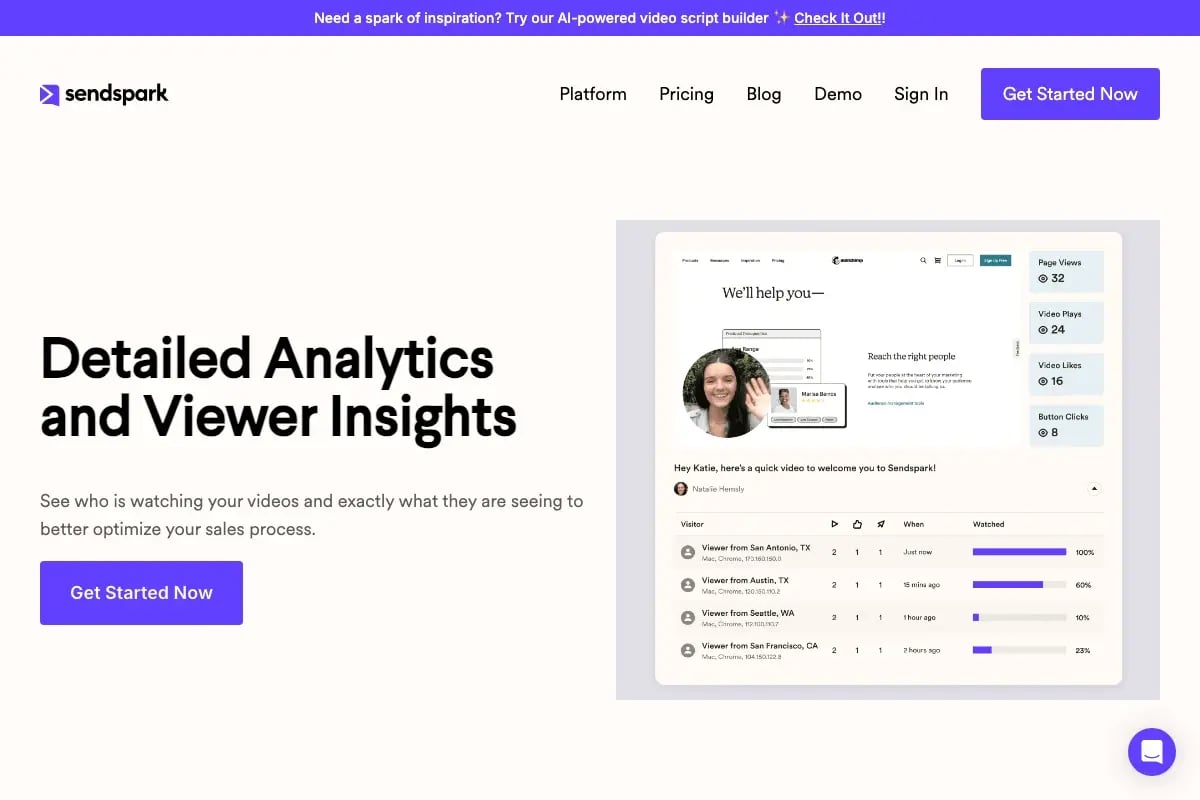
For deal progression, a personalized video from the AE after a demo is one of the highest-converting touchpoints B2B teams use. It takes 30 seconds to send and generates reply rates 2-3x higher than a text follow-up email.
Measuring RevOps Strategy Success
A RevOps strategy is working when the metrics that used to contradict each other start moving in the same direction. Here are the five metrics that give you the clearest signal on whether your strategy is functioning as a unified revenue engine.
According to HubSpot Research, only 26% of marketers describe their sales and marketing teams as tightly aligned. The teams that achieve alignment track these metrics jointly — not on separate dashboards.
| Metric | What It Measures | Who Owns It | Healthy Benchmark |
|---|---|---|---|
| Pipeline Velocity | How fast deals move through each stage (days) | Sales + RevOps | Varies by deal size; track direction not absolute value |
| Win Rate by Source | Which lead sources convert at the highest rate | Marketing + Sales | 20-30% for outbound; 30-50% for inbound SQLs |
| Revenue Attribution | Which channels and campaigns generated closed revenue | Marketing + RevOps | Multi-touch model covering all influenced touches |
| Customer Acquisition Cost (CAC) | Total cost to acquire one new customer | Finance + RevOps | CAC payback under 18 months for SaaS |
| Net Revenue Retention (NRR) | Revenue retained + expanded from existing customers | CS + RevOps | 110%+ signals healthy expansion; under 90% signals churn risk |
Leading vs. Lagging Indicators
The metrics above are mostly lagging — they tell you what happened. A complete RevOps strategy also tracks leading indicators: number of qualified conversations booked, video engagement rates per outreach sequence, demo-to-proposal conversion, and time-to-close by segment. Leading indicators give you 30-60 days of advance warning before the lagging metrics move.
The sales enablement KPIs that most directly predict revenue are the ones that measure buyer engagement — not rep activity. Track how many prospects clicked a link, watched a video, or replied to a follow-up, not how many emails a rep sent.
Your First 90-Day RevOps Scorecard
In the first 90 days, you shouldn’t try to track all five metrics. Pick two: pipeline velocity (to see if deals are moving faster) and win rate by source (to see if marketing and sales are aligned on lead quality). If both improve over 90 days, your RevOps strategy is working at the foundation. Add metrics as the foundation stabilizes.
Frequently Asked Questions
What is a RevOps strategy?
A RevOps strategy is an executable plan that aligns sales, marketing, and customer success around shared data, standardized processes, and a single revenue target. Unlike a RevOps framework (which describes the structure), a strategy defines the specific actions, ownership, tools, and metrics that turn cross-functional alignment into measurable revenue growth.
How long does it take to build a RevOps strategy?
Most B2B teams complete an initial RevOps strategy in 4-6 weeks — covering the audit, journey mapping, KPI alignment, and tool review. The first 90 days are the rollout sprint, where you implement and measure the highest-priority change. Expect to see measurable pipeline impact within 90 days of executing the strategy, not from building it.
What is the first step in a revops strategy?
The first step is a current-state audit: assess your CRM data quality, identify where the MQL-to-SQL handoff breaks down, map which tools each team uses, and document what metrics each team currently optimizes for. The audit produces a gap map that tells you where to start — usually data alignment or a broken handoff between marketing and sales.
What tools do you need for a RevOps strategy?
The minimum RevOps tech stack is a CRM (HubSpot or Salesforce), a sales engagement platform for sequencing and automation, and an analytics layer for attribution reporting. High-performing teams add AI video personalization for outreach, revenue intelligence for deal health, and a shared dashboard for the weekly revenue rhythm. Every tool must integrate with the CRM — if data doesn’t flow back, the tool is invisible to RevOps reporting.
How does RevOps differ from sales ops?
Sales ops focuses on optimizing the sales team specifically — territory planning, quota setting, CRM hygiene, and sales process improvement. RevOps extends that scope to cover marketing operations and customer success operations as well, creating a unified function that owns the full revenue cycle from first touch to renewal. Sales ops is a subset of RevOps.
What metrics should a RevOps strategy track?
A RevOps strategy tracks metrics that span all three teams: pipeline velocity (how fast deals move), win rate by source (which channels convert), revenue attribution (which campaigns generate closed revenue), customer acquisition cost, and net revenue retention. Avoid siloed metrics like MQL volume or close rate alone — they optimize for one team at the expense of the full cycle.
Can small B2B teams implement RevOps strategy?
Yes. RevOps strategy scales down to teams of 3-5 people. The core principles — shared CRM data, defined handoffs, and shared revenue targets — apply regardless of team size. Small teams often implement RevOps faster because there’s less organizational inertia. Start with a shared CRM and one defined handoff process; you can layer in the rest as the team grows.
Sources & References
- Forrester Research — “Companies with aligned revenue operations grow revenue 19% faster and are 15% more profitable than those with siloed go-to-market teams” (2024)
- Gartner on Revenue Operations — “By 2025, 75% of the highest-growth companies planned to deploy a Revenue Operations model, with data alignment cited as the most critical success factor” (2023)
- Salesforce State of Sales — “High-performing sales teams are 4.9x more likely to use AI tools across the full revenue cycle compared to underperformers” (2024)
- HubSpot Research — “Only 26% of marketers describe their sales and marketing teams as tightly aligned, despite alignment being a top predictor of revenue growth” (2024)
Record One Video. AI Personalizes Thousands.
Sendspark is the AI video personalization platform for B2B sales. Record once, and AI voice cloning generates thousands of individually personalized videos with dynamic backgrounds and personalized thumbnails — each prospect hears their name, sees their website, in your voice. Sales teams see 2-3x more replies.
Get Started Now