
Most B2B companies run three separate operations teams — sales ops, marketing ops, and customer success ops — each with their own data, their own tools, and their own definition of what “qualified” means. Revenue operations, or RevOps, replaces that fragmented model with a single unified function that aligns all three teams around one goal: predictable, repeatable revenue growth. For tools that support RevOps teams, see our guide to the top sales enablement platforms. For a side-by-side breakdown of revenue operations software platforms, see our latest comparison.
If you’re a sales leader, RevOps practitioner, or founder trying to build a more efficient go-to-market machine, this guide covers everything you need: what RevOps is, how the framework works, best practices for implementation, the metrics that matter, and the tech stack that powers it.
Key Takeaways
- RevOps (Revenue Operations) unifies sales, marketing, and customer success under one operational framework to drive predictable, repeatable revenue growth.
- Companies with aligned revenue teams generate 19% more revenue and grow 15% faster, according to Forrester research on B2B go-to-market alignment.
- A RevOps tech stack needs a CRM as its foundation, plus a sales engagement platform, data enrichment, and AI-powered outreach tools for personalized prospecting at scale.
- The five core RevOps metrics: pipeline velocity, win rate by stage, customer acquisition cost, average deal size, and net revenue retention.
- RevOps success starts with one CRM, shared MQL/SQL definitions, and closed-loop reporting between marketing, sales, and customer success.
What Is RevOps?
Revenue Operations (RevOps) is a go-to-market function that consolidates the operations responsibilities of sales, marketing, and customer success into a single team. The RevOps team owns the data, processes, and technology that all three functions share — so instead of three siloed ops teams pulling in different directions, you get one aligned system pointing toward revenue. For context on the broader framework, see our guide on how to build a RevOps strategy.
The term was popularized around 2018 as B2B companies realized their go-to-market teams were creating friction rather than flow. Marketing would generate leads with their own attribution model, sales would qualify them by different criteria, and customer success would inherit accounts with incomplete data. Every handoff meant lost context, duplicated effort, and holes in the pipeline.
According to Salesforce, RevOps is designed to “break down silos between departments that touch revenue by giving them shared visibility into data, more coordinated processes, and a common technology stack.” It’s less a job title and more an operating model for the entire go-to-market organization.
How RevOps Differs from Sales Ops and Marketing Ops
Sales Operations focuses on the sales team specifically — quota setting, territory planning, sales tool administration, and forecasting. Marketing Operations manages the marketing tech stack, campaign tracking, and lead routing. Both are valuable, but they each optimize for their own function, not for the whole revenue system. For a side-by-side breakdown, see our guide on RevOps vs Sales Ops: Key Differences and When to Choose Each.
RevOps isn’t a replacement for Sales Ops or Marketing Ops — it’s the connective layer above them. A RevOps team coordinates shared data standards, cross-functional reporting, and integrated workflows so that Sales Ops, Marketing Ops, and CS Ops aren’t building competing systems. In smaller companies, RevOps consolidates all three into a single team. In larger organizations, RevOps often becomes a central function that owns strategy while individual ops teams handle execution.
Why B2B Companies Adopt RevOps
The commercial case for RevOps is straightforward. According to Gartner, companies that align revenue functions under a RevOps model see up to 27% faster three-year profit growth compared to competitors operating in silos. The core driver: fewer handoff failures, faster pipeline velocity, and better forecasting accuracy when all revenue data lives in one place.
“The companies winning in B2B right now aren’t the ones with the best individual salespeople. They’re the ones with the best revenue systems — where marketing, sales, and customer success operate from the same data and reinforce each other at every stage of the buyer journey.”
The RevOps Framework: Aligning Sales, Marketing, and Customer Success
A RevOps framework organizes three previously siloed functions — sales, marketing, and customer success — into a single, connected revenue system built on shared data, shared processes, and a shared technology stack. The framework doesn’t flatten organizational structures; it creates the operating model that lets each function work faster by removing friction at the handoffs between them.
According to McKinsey, B2B companies that unify their go-to-market operations report 20% higher marketing ROI and 30% faster sales cycles compared to those running fragmented ops teams. The mechanism is straightforward: shared data eliminates redundant work, shared definitions eliminate miscommunication, and shared tools eliminate the manual hand-stitching between systems.
The Three Pillars of RevOps
Every RevOps implementation rests on three pillars:
- People: A centralized RevOps team (or a RevOps lead with cross-functional remit) that sets the operating standards for all revenue-generating functions. This team owns data governance, tool administration, and process documentation.
- Process: Shared definitions (what is an MQL? what is a SQL?), documented handoff criteria (when does a lead move from marketing to sales? when does a deal move from sales to CS?), and agreed SLAs for each stage of the revenue cycle.
- Technology: A unified tech stack with the CRM at the center. Every tool that touches the customer record — marketing automation, sales engagement, customer success platform — integrates into the CRM so that data flows automatically and no context is lost at handoffs.
The Revenue Flywheel
The revenue flywheel model replaces the traditional linear funnel with a circular motion: marketing attracts prospects, sales converts them, and customer success retains and expands them — generating referrals and case studies that feed marketing again. RevOps is the operational backbone that makes this flywheel spin smoothly. When data flows automatically from marketing to sales to CS and back, the flywheel accelerates. When each team builds separate systems, friction kills the momentum.
Pro tip
Map your current revenue handoffs on a whiteboard before implementing RevOps. Identify every point where data is manually re-entered, re-qualified, or re-interpreted. Each one of those friction points is a RevOps fix waiting to happen.
How Handoffs Work in a RevOps Model
The biggest source of revenue leakage in B2B companies is the handoff — marketing to sales, sales to CS, and CS back to expansion sales. RevOps solves this by making handoff criteria explicit and system-enforced, not judgment-based and manual.
In practice: a lead becomes a SQL when it hits a defined score in the CRM. A deal is handed to CS when specific fields are completed in the opportunity record. An expansion opportunity triggers an SDR touch when CS marks a customer at a defined health score. No email threads, no Slack messages asking “is this ready?” — the system moves it automatically based on agreed rules. Check out our guide to aligning inbound and outbound sales under RevOps for a deeper look at how this applies to pipeline generation.
Record One Video. AI Personalizes Thousands.
Sendspark is the AI video personalization platform for B2B sales. Record once, and AI voice cloning generates thousands of individually personalized videos with dynamic backgrounds and personalized thumbnails — each prospect hears their name, sees their website, in your voice. Sales teams see 2-3x more replies.
Get Started NowRevOps Best Practices for B2B Teams
RevOps best practices fall into five categories: data governance, shared definitions, closed-loop reporting, quarterly planning cadence, and outreach scalability. Teams that nail all five consistently outperform those that optimize one or two in isolation — because RevOps is a system, and systems require all the components to work together.
1. Build a Single Source of Truth
The foundation of every successful RevOps implementation is one CRM that every revenue-generating function updates and trusts. This sounds obvious, but most B2B companies have contact records duplicated across three tools, campaign attribution split across two platforms, and deal data that lives partly in the CRM and partly in spreadsheets. RevOps starts by collapsing all of this into one authoritative record.
Choose your CRM first — typically Salesforce for mid-market and enterprise, HubSpot for scaling B2B teams — and make it the system of record for all contact, account, deal, and customer data. Every other tool either pushes data into the CRM or reads data from it. No tool is the source of truth except the CRM.
For a complete breakdown of what tools to include across each layer of the stack, see our guide to the best sales operations software for B2B revenue teams.
2. Align on Shared Definitions
Most B2B go-to-market problems trace back to vocabulary. Marketing thinks an MQL is anyone who downloads a whitepaper. Sales thinks an MQL should be someone actively evaluating solutions with a budget. RevOps resolves this by creating written, system-enforced definitions for every stage:
- Marketing Qualified Lead (MQL): A contact that meets a defined lead score threshold (e.g., 40+ points based on firmographic fit + engagement actions)
- Sales Qualified Lead (SQL): A lead that an SDR has contacted and confirmed meets BANT or MEDDIC criteria
- Sales Accepted Opportunity (SAO): An opportunity that an AE has accepted and booked a discovery call for
- Closed Lost: Must include a documented reason in the CRM — not just a stage change
3. Implement Closed-Loop Reporting
Closed-loop reporting means marketing can see which of their leads actually closed — and sales can see which marketing campaigns produced the deals that closed. Without this, marketing optimizes for leads and sales blames marketing for lead quality. With it, both teams optimize for the same thing: revenue.
Set up a shared dashboard that shows pipeline by source, win rate by source, and revenue by source — updated weekly. This is the single report that every RevOps meeting should start with. See our breakdown of RevOps metrics for B2B sales teams for a full list of the metrics that belong in this dashboard.
4. Run Quarterly Revenue Planning
RevOps teams own the quarterly planning process — not sales leadership alone. This means reviewing the previous quarter’s pipeline data (what came in, what converted, what was lost and why), updating capacity models for the next quarter, and setting quota and pipeline coverage targets based on actual historical data rather than top-down mandates.
The output of quarterly planning should be: (1) a signed-off pipeline target by segment, (2) a marketing investment plan tied to pipeline gaps, (3) agreed headcount needs for the next two quarters, and (4) a list of process or tool changes needed to hit the targets.
5. Scale Outbound Personalization with AI
One of the clearest RevOps wins in 2026 is applying AI to outbound prospecting. When your RevOps team has enriched contact data in the CRM and a standardized outreach process in your sales engagement platform, you can use tools like AI-powered video personalization to scale what previously required 1:1 effort.
Sendspark’s approach: an SDR records one video, and AI voice cloning and dynamic backgrounds generate thousands of individually personalized versions — each showing the prospect’s name, their company website, and spoken in the rep’s own voice. Teams using AI-personalized video outreach see 2-3x more replies compared to text-only email sequences. The RevOps system makes this scalable: CRM data feeds the personalization engine, and engagement data flows back into the CRM for pipeline attribution.
Common mistake
Don’t implement RevOps by adding a new tool. RevOps is a process change first, a technology change second. Teams that buy a RevOps platform before aligning on definitions and data standards just move their silos into a new system.
RevOps Metrics and KPIs to Track
RevOps metrics measure the health of the entire revenue system, not just individual team performance. The five metrics every RevOps team must track are pipeline velocity, win rate by stage, customer acquisition cost, average deal size, and net revenue retention — because together, these five numbers give you a complete picture of how fast money is moving through your go-to-market engine and where the leaks are. Once you understand the discipline, the next step is figuring out how to structure a RevOps team — the roles, org models, and hiring sequence that turn RevOps from theory into execution.
| Metric | What It Measures | RevOps Action If Low |
|---|---|---|
| Pipeline Velocity | How fast deals move through the pipeline (deals × win rate × avg deal size ÷ cycle length) | Identify which stage has the longest average age; investigate and remove the bottleneck |
| Win Rate by Stage | % of opportunities that convert at each stage | Low early-stage win rate = qualification issue; low late-stage = proposal/competitive issue |
| Customer Acquisition Cost (CAC) | Total sales + marketing spend divided by new customers acquired | High CAC signals inefficient pipeline generation or long cycles; fix lead quality or process |
| Average Deal Size | Mean contract value of closed-won deals | Declining ADS signals poor ICP targeting or discounting pressure; tighten qualification |
| Net Revenue Retention (NRR) | Revenue retained + expanded from existing customers (gross retention + expansion - churn) | NRR below 100% means you’re losing revenue even as you add new customers — fix CS processes first |
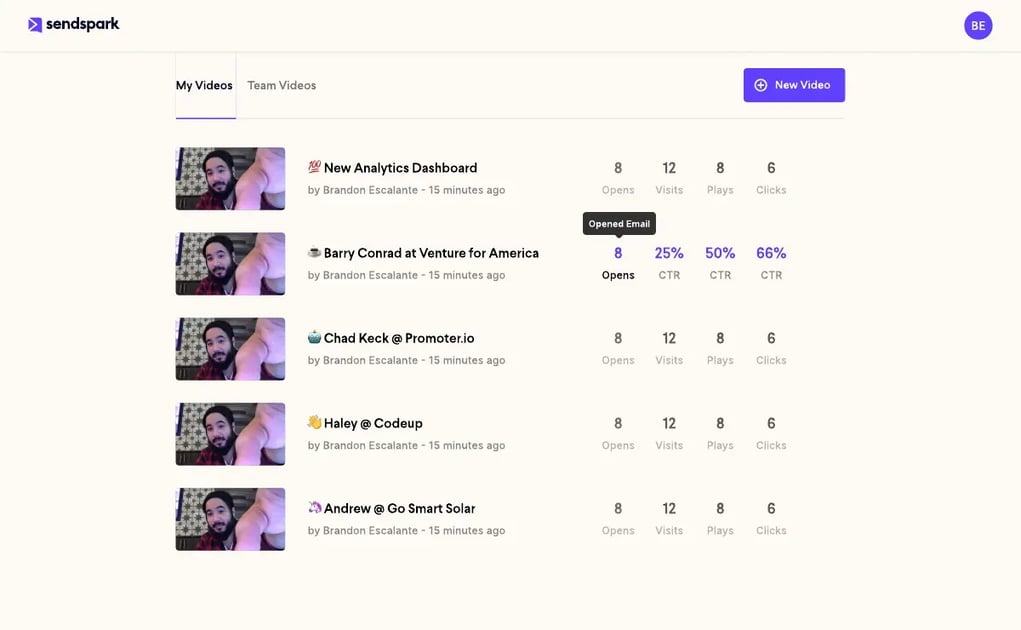
| Video Engagement Rate | % of prospects who open and watch AI-personalized video outreach | Low engagement signals wrong ICP or weak subject lines; test different personalization hooks |
Beyond these five, leading RevOps teams track pipeline coverage (pipeline value as a multiple of quota — healthy B2B teams target 3-4x), MQL-to-SQL conversion rate (signals marketing lead quality), and time-to-first-contact (how quickly sales touches a new MQL — every hour of delay reduces conversion probability). Our detailed breakdown of 20 sales metrics to track covers additional KPIs for sales operations teams.
One metric increasingly tracked in RevOps dashboards: video engagement data. When your video analytics platform pushes watch-time, reply rates, and CTA clicks back into the CRM, RevOps teams can correlate video engagement with deal velocity. Prospects who watch more than 70% of a personalized video convert at nearly 3x the rate of those who receive only text-based outreach — which means video engagement becomes a leading indicator for pipeline health, not just a vanity metric.
Building Your RevOps Tech Stack
A RevOps tech stack is a set of integrated tools that cover five layers: CRM (the system of record), sales engagement (outreach at scale), data enrichment (contact and account intelligence), AI-powered personalization (one-to-one outreach without one-to-one effort), and analytics/BI (reporting across all layers). Every tool should integrate into the CRM — no standalone systems that create their own data islands.
Layer 1: CRM (System of Record)
Every RevOps stack starts here. The CRM holds your authoritative contact, account, opportunity, and customer data. The two dominant choices for B2B SaaS teams:
- Salesforce: Deep customization, extensive integration ecosystem, strong for mid-market and enterprise. Higher admin overhead but unmatched flexibility for complex revenue models.
- HubSpot: Tighter marketing-sales integration, easier to administer, better UX for smaller RevOps teams. Native marketing automation removes one tool from the stack.
Layer 2: Sales Engagement Platform
The sales engagement platform manages outbound sequences, call scheduling, task queues, and activity logging. It connects to your CRM and ensures every rep interaction is captured. Leading options include Outreach.io, SalesLoft, and Apollo.io. The key RevOps requirement: bidirectional CRM sync so that every email sent, call logged, and reply received is automatically attributed to the right contact and opportunity record.
Layer 3: Data Enrichment
You can’t personalize at scale without clean, enriched data. Data enrichment tools (Clay, ZoomInfo, Apollo) append missing firmographic data — company size, industry, tech stack, funding stage — to every contact record in your CRM. This is the fuel that makes both human and AI-powered personalization work. A RevOps team that invests in data quality at this layer sees outsized returns across every other layer of the stack.
Layer 4: AI-Powered Outreach Personalization
This is the layer where RevOps teams have seen the biggest efficiency gains in 2026. With enriched CRM data and a standardized sales engagement process, AI tools can take personalization from a manual bottleneck to an automated advantage. The most impactful category: AI video personalization.
With Sendspark’s AI video personalization platform, your SDRs record one video and the platform automatically generates thousands of individually personalized versions — each with AI voice cloning that uses the rep’s cloned voice to address each prospect by name, combined with dynamic backgrounds that show the prospect’s own website behind the speaker. The result: each recipient gets a video that feels like a personal recording, without the rep spending hours recording individually.
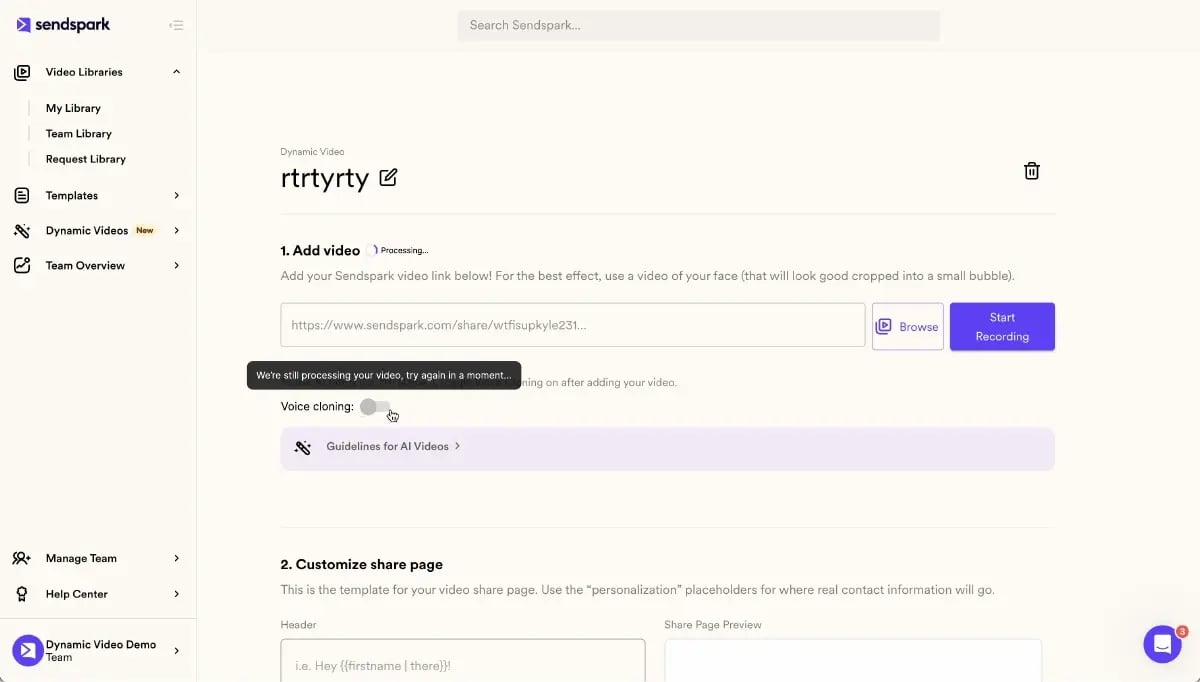
Sendspark integrates directly with HubSpot, Salesforce, and Outreach — meaning video engagement data (opens, plays, watch percentage, CTA clicks) flows back into your CRM automatically. For a RevOps automation team, this turns video outreach from a standalone activity into a measurable pipeline signal. Learn more about how revenue operations automation fits into modern sales stacks.
Layer 5: Analytics and BI
The analytics layer sits across all other tools and pulls data into a single reporting view. This is where RevOps builds the shared dashboards for weekly pipeline reviews, quarterly business reviews, and board-level revenue reporting. Tools like Tableau, Looker, or Salesforce’s native reporting cover most needs. The RevOps team owns these dashboards — not the individual ops teams — ensuring everyone in the organization sees the same numbers.
| Stack Layer | Purpose | Common Tools |
|---|---|---|
| CRM | Single source of truth for all revenue data | HubSpot, Salesforce |
| Sales Engagement | Outbound sequences, call scheduling, activity logging | Outreach, SalesLoft, Apollo |
| Data Enrichment | Firmographic data, contact intelligence, ICP scoring | Clay, ZoomInfo, Apollo |
| AI Personalization | AI-powered 1:1 outreach at scale (video + voice cloning) | Sendspark |
| Analytics / BI | Cross-functional reporting, forecasting, pipeline dashboards | Tableau, Looker, Salesforce Reports |
Frequently Asked Questions
What does RevOps stand for?
RevOps stands for Revenue Operations. It refers to the business function that aligns sales, marketing, and customer success operations under one team or framework — with shared data, shared tools, and shared processes — to drive more predictable and efficient revenue growth across the entire customer lifecycle.
What is the difference between RevOps and Sales Ops?
Sales Operations focuses specifically on the sales team — territory planning, quota setting, CRM admin, and sales forecasting. Revenue Operations (RevOps) has a broader scope: it aligns sales ops, marketing ops, and customer success ops under one umbrella so all three functions work from shared data and integrated systems. RevOps doesn’t replace Sales Ops; it coordinates above it.
How do you build a RevOps team?
Start with a single RevOps lead or manager who owns the CRM, data governance, and cross-functional reporting. In early-stage companies, one person can cover all three functions. As the company scales, add specialists for marketing ops, sales ops, and CS ops — but keep the RevOps function as the coordinating layer. Most B2B companies hire their first dedicated RevOps role when they hit $5-10M ARR or 15+ quota-carrying reps.
What are the most important RevOps metrics to track?
The five metrics that give the most complete view of revenue system health are: pipeline velocity (how fast deals move), win rate by stage (where deals are lost), customer acquisition cost (efficiency of pipeline generation), average deal size (ICP quality), and net revenue retention (customer expansion minus churn). Together, these five metrics tell you whether your revenue flywheel is accelerating or stalling.
How does RevOps use AI and automation?
RevOps teams use AI and automation at multiple layers: lead scoring (AI-prioritized queues for SDRs), data enrichment (auto-appending firmographic data to CRM records), outreach personalization (AI voice cloning and dynamic video backgrounds for 1:1 outreach at scale), and forecasting (AI-assisted pipeline probability scoring). The biggest efficiency gains come from AI-powered outreach tools that let sales teams personalize at scale without the time cost of manual 1:1 recording or writing.
What is the RevOps framework?
The RevOps framework organizes go-to-market operations around three pillars: people (a centralized RevOps team with cross-functional authority), process (shared MQL/SQL definitions, documented handoff criteria, and agreed SLAs), and technology (a unified tech stack with the CRM as the system of record). The framework converts the linear funnel model into a revenue flywheel where marketing, sales, and customer success continuously feed each other with data and context.
Is RevOps only for large companies?
No — RevOps principles apply at any stage, but the implementation scales with company size. A 20-person B2B startup might have one person doing all three ops functions. A 200-person company might have a four-person RevOps team with specialists for each function. The principles (single source of truth, shared definitions, closed-loop reporting) matter just as much for a team of 5 SDRs as for a team of 50 — because silo problems start small and compound fast as the company grows.
Sources & References
- Salesforce — “RevOps is designed to break down silos between departments that touch revenue by giving them shared visibility into data, coordinated processes, and a common technology stack.” (2024)
- Gartner — Companies that align revenue functions under a RevOps model see up to 27% faster three-year profit growth compared to siloed competitors. (2024)
- McKinsey & Company — B2B companies that unify go-to-market operations report 20% higher marketing ROI and 30% faster sales cycles. (2024)
- Salesforce State of Sales — Benchmark data on sales team performance, CRM adoption, and pipeline health across B2B organizations. (2024)
Record One Video. AI Personalizes Thousands.
Sendspark is the AI video personalization platform for B2B sales. Record once, and AI voice cloning generates thousands of individually personalized videos with dynamic backgrounds and personalized thumbnails — each prospect hears their name, sees their website, in your voice. Sales teams see 2-3x more replies.
Get Started Now