Published November 2026
Pick the wrong sales commission structure and you will not just underpay your best reps, you will actively train your whole team to avoid the deals that actually grow the business. A flat-rate commission rewards the fastest close over the biggest account. A plan with no renewal payout gives your account managers zero reason to fight for retention. Before you touch a spreadsheet, you need to know which of the nine common structures fits your motion, and just as importantly, how to roll out a change without losing the trust of the reps who have to live under it.
Key Takeaways
- Most B2B SaaS commission plans run a 50/50 to 70/30 base-to-variable pay mix, with new-logo commissions typically at 10% to 14% of annual contract value and renewals paid at a lower 3% to 5% rate
- There are at least nine distinct commission structures, including base plus commission, tiered, accelerator, draw against commission, gross margin, residual, territory, multiplier, and straight commission, and each rewards a different rep behavior
- 76% of sales reps say they wish their commission was calculated more transparently, and tech and software reps leave their jobs at a 67% higher rate than reps in other industries, making plan clarity a retention problem, not just a math problem
- The wrong structure discourages the behavior you want: a straight commission plan on a long, multi-stakeholder SaaS deal rewards urgency over diligence, and a flat renewal rate gives account managers no reason to fight for retention
- How you roll out a new or changed plan matters as much as the plan itself. Confirming every rep actually reviewed the new terms before they take effect prevents the disputes that come from confusion, not disagreement
What Is a Sales Commission Structure?
A sales commission structure is the formula that converts a rep’s closed revenue into variable pay, layered on top of (or instead of) a base salary. It defines the rate, the trigger (bookings, collected revenue, or gross margin), and any thresholds, accelerators, or caps that change the payout once a rep crosses a line. The structure is the single biggest lever a sales leader has over which deals a rep chases and how hard they work to keep a customer after the ink dries. If a term below is unfamiliar, our sales glossary covers the broader quota, pipeline, and OTE vocabulary this topic assumes.
In B2B SaaS specifically, new-logo commissions typically run 10% to 14% of annual contract value (ACV), while renewals pay a lower 3% to 5%, with many companies moving renewal commission to account managers or customer success instead of the original closing rep. That gap exists on purpose: SaaS revenue is recurring, so the economics of winning a deal and the economics of keeping it are not the same problem, and your plan needs to pay for both separately.
There exists a stark difference between building sales commission structures for one-off purchases and SaaS companies that run on recurring revenue models.
Before comparing all nine structures in depth, here is how the five most common ones stack up on pay mix and risk:
| Structure | Typical Pay Mix | Rep Risk | Best Fit |
|---|---|---|---|
| Base plus commission | 50/50 to 70/30 base/variable | Low to moderate | Most B2B SaaS AE and SDR roles |
| Tiered commission | Varies, rate increases by revenue band | Moderate | Teams that want urgency late in the quarter |
| Draw against commission | Advance recovered from future commission | Low (short term) | New reps still ramping to quota |
| Gross margin commission | Rate applied to margin, not revenue | Moderate | Deals with variable discounting or cost to serve |
| Straight commission | Fully variable, no base salary | High | Short-cycle, transactional, high-volume sales |
9 Sales Commission Structures Compared
The nine most common B2B sales commission structures are base plus commission, tiered commission, accelerator or multiplier plans, draw against commission, gross margin commission, residual commission, territory or volume commission, straight commission with no base salary, and management-by-objective (MBO) bonuses layered on a smaller base. Each one calculates pay differently and pushes reps toward a different kind of deal.
| # | Structure | Formula | Best For |
|---|---|---|---|
| 1 | Base plus commission | Fixed salary + (revenue × rate) | Standard AE and SDR comp in recurring-revenue B2B sales |
| 2 | Tiered commission | Rate increases at set revenue thresholds (e.g. 8% to $100K, 12% above) | Motivating reps to push past an early plateau |
| 3 | Accelerator or multiplier | Base rate × a multiplier that rises with quota attainment | Rewarding reps who exceed quota, not just hit it |
| 4 | Draw against commission | Advance paid upfront, recovered from future commission earned | New hires and reps ramping during their first 60 to 90 days |
| 5 | Gross margin commission | Rate applied to margin after cost of goods, not the full sale price | Products with variable discounting, services, or hardware costs |
| 6 | Residual commission | Smaller, recurring rate paid for as long as a subscription stays active | SaaS account managers responsible for renewals and expansion |
| 7 | Territory or volume commission | Shared pool split by territory output or team quota attainment | Field sales teams or pods that split ownership of an account base |
| 8 | Straight commission (no base salary) | Revenue × rate, no base salary at all | Short, transactional, high-volume sales cycles |
| 9 | MBO bonus on a smaller base | Fixed payout for hitting defined non-revenue objectives | Sales engineers, overlay reps, and other roles without a direct quota |
Pro tip
Pair a tiered or accelerator structure with a quarterly, not annual, reset. An annual accelerator only pays off for reps who had a hot start, which demotivates everyone who had a slow first quarter for reasons outside their control.
The math behind these structures matters as much as the labels. Spotio’s breakdown of commission formulas walks through this same kind of step-by-step calculation: on a tiered plan paying 8% up to $100,000 in quarterly revenue and 12% above that, a rep who closes $150,000 earns $8,000 on the first $100,000 and $6,000 on the remaining $50,000, for $14,000 total. On a gross margin plan, a $10,000 deal with $4,000 in delivery cost pays commission on the $6,000 margin, not the full $10,000, which is why reps on margin-based plans push back harder on discounting than reps paid on raw revenue.
Common mistake
Putting new reps on straight commission with no draw. A rep with zero pipeline in month one has zero income, and most will quit before their first real paycheck arrives. Pair straight commission with a draw for at least the first 60 days.
How to Choose the Right Commission Structure for Your Team
The right commission structure depends on three factors: the rep’s role in the sales cycle, how long and how large your typical deal is, and how mature your company’s revenue motion is. A structure built for a transactional, high-volume SDR team will actively hurt retention if you apply it to an enterprise AE closing six-figure, multi-stakeholder deals.
By Rep Role
SDRs and BDRs typically carry a higher base and a smaller variable component, often 70/30 or 80/20 base to variable, tied to meetings booked or qualified pipeline rather than closed revenue, since they do not control the close. This is also why most video prospecting programs put the SDR’s incentive on activity and meeting quality, not on a deal they never get credit for closing. AEs shift toward 50/50 or 60/40, paid on closed-won new-logo revenue. Account managers and customer success reps responsible for renewals usually sit on a residual or lower flat-rate structure, since their job is protecting revenue already won, not creating net-new pipeline.
By Deal Cycle and ACV
Short, transactional deal cycles (days to a few weeks) support straight commission because volume evens out income over a month. Longer, multi-stakeholder enterprise cycles (three months or more) need a base-heavy plan with a draw or a split-pay structure, since a single rep cannot survive a three-month gap in income waiting for one deal to close. The longer the cycle, the more your plan needs to reward pipeline-building activity along the way, not just the final signature. On deals with heavy discounting, commission design cannot be separated from who signs off on the discount in the first place; see how a deal desk approval process interacts with margin-based commission plans.
By Company Stage
Early-stage companies still finding product-market fit tend to favor flatter, simpler commission math (a single base-plus-commission rate with no tiers) because the sales motion itself is still changing month to month, and complex plans built for a process that will not exist in six months waste everyone’s time. As a company scales and the ideal customer profile stabilizes, tiered and accelerator structures start paying off because there is enough deal volume for the thresholds to mean something.
How to Roll Out a New Commission Plan Without Losing Trust
Most commission disputes come from confusion about how a plan works, not disagreement with the plan itself, so the rollout matters as much as the design. Salesforce’s own 2026 sales research found that 76% of reps wish there were more transparency in how their sales compensation is calculated, and 32% of sales leaders admit their own tech stack lacks compensation management capabilities to even show reps that math clearly.
A written policy document or a one-time all-hands slide rarely closes that gap, because reps forget the details within days and the document sits unread in a shared drive. A short explainer video, recorded once by sales leadership or RevOps and walking through the new math with a real example deal, holds attention longer than a spreadsheet and can be referenced back whenever a rep has a question about a specific payout. Sendspark’s AI-personalized video lets a manager record that explanation once and send it with each rep’s name attached, instead of a generic memo that reads like it was written for no one in particular.
Advanced strategy
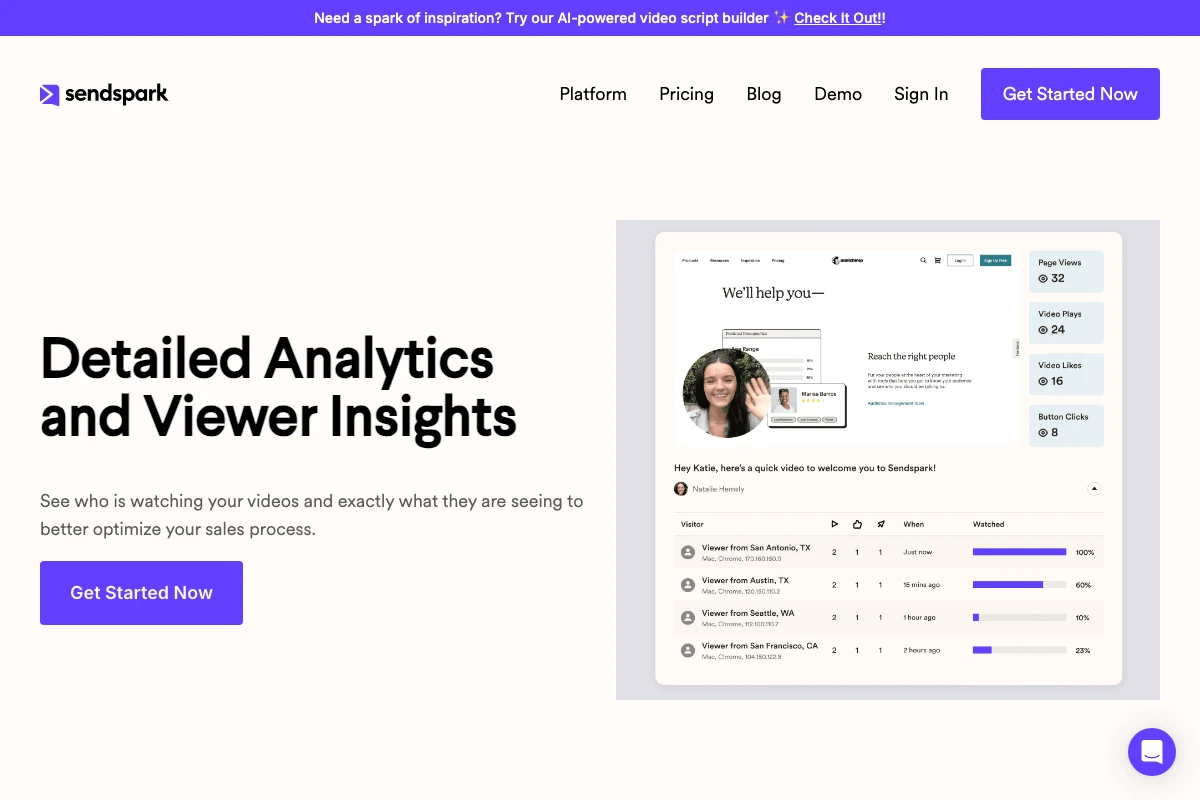
Use Sendspark’s video analytics to confirm who actually watched the plan explainer before the new terms take effect, not just who received the email. A watched-to-completion report gives RevOps a documented record that every rep reviewed the change, which is the fastest way to shut down an “I was never told that” dispute during the first payout cycle under a new plan.
This does not replace a written plan document, which should still exist for legal and audit purposes. It replaces the assumption that sending a document is the same as a rep understanding it. Teams building a structured ramp-up plan for new hires already use this pattern for product training. Applying it to compensation, the one topic every rep actually cares about, closes a transparency gap that a static PDF never will.
Common Commission Structure Mistakes to Avoid
The most common commission structure mistakes are changing the plan too often, leaving out a clawback policy, raising quotas immediately after a good quarter, and paying the same rate on a renewal as on a new-logo deal. Each one is fixable once you can name it, which is why most RevOps teams catch these only after reps have already started complaining or quietly leaving.
| Mistake | Why It Backfires | Fix |
|---|---|---|
| Changing the plan mid-year without warning | Reps stop trusting forecasts they build around their own pay, and start hedging deals instead of pushing them | Lock plan changes to the start of a fiscal year or quarter, announced at least 30 days ahead |
| No clawback policy | Reps have no incentive to care whether a deal survives past the first invoice | Pay commission in installments tied to the customer staying active through the first 60 to 90 days |
| Raising quota right after a strong quarter | Punishes the exact performance you wanted, and reps learn to sandbag future results | Set quotas on a rolling average, not a single standout quarter |
| Same rate on renewals as new logos | Account managers have no reason to fight churn if a renewal pays the same regardless of effort | Pay a lower base rate on renewals with an accelerator for net expansion within the account |
| No documented, repeatable math reps can check themselves | Builds the exact shadow-accounting problem that drives the trust gap, where reps track commission by hand because they do not trust the system | Give reps a simple, reusable formula and a recorded walkthrough they can replay, not just a number on a paycheck |
Tech and software companies carry extra exposure here. Xactly’s research on sales turnover found that technology and software companies see 67% more reps leave their jobs than companies in other industries, and a commission plan that reps do not understand or trust is one of the few retention levers a sales leader fully controls. Teams thinking about who should own that design work can start with how RevOps teams typically split responsibility for compensation versus territory and forecasting, and how comp KPIs fold into a broader sales leadership coaching program.
Frequently Asked Questions
What are the main types of sales commission structures?
The main types are base plus commission, tiered commission, accelerator or multiplier plans, draw against commission, gross margin commission, residual commission, territory or volume commission, straight commission with no base salary, and MBO bonuses on a smaller base. Most B2B SaaS teams use a base-plus-commission structure for new AEs and shift to residual or accelerator structures for account management and renewal roles.
What is a typical commission rate for B2B sales?
Commission rates typically range from 5% to 20% depending on industry and deal size. In B2B SaaS specifically, new-logo commissions usually run 10% to 14% of annual contract value, while renewal commissions are lower, typically 3% to 5%, since renewal revenue is less effortful to close than a brand-new deal.
What is a 70/30 split in sales commission?
A 70/30 split describes the pay mix between base salary and variable commission, where 70% of on-target earnings comes from a fixed base and 30% comes from commission. This mix is common for SDRs and sales engineers, who influence revenue but do not directly close it, and is more base-heavy than the 50/50 split typical of closing AEs.
Should commission be paid on gross revenue or gross margin?
Gross margin commission makes more sense when deal profitability varies significantly due to discounting, delivery cost, or hardware, since it stops reps from closing low-margin deals just to hit a revenue number. Gross revenue commission is simpler to explain and is fine when your product has a consistent cost structure and discount policy across most deals.
How often should you change a sales commission structure?
Change the structure at most once per fiscal year, and announce the change at least 30 days before it takes effect. Mid-year changes without warning erode trust even when the new plan is objectively better, since reps build their own pipeline and personal budget decisions around the plan they were hired under.
What is a clawback in a commission plan?
A clawback is a policy that recovers paid commission if a deal does not hold, most often because the customer cancels or does not pay within a defined window after close. Most B2B teams structure clawbacks as a percentage of the original commission rather than full recovery, since a full dollar-for-dollar clawback makes reps avoid any deal that carries renewal risk.
Can you use video to explain a new commission plan to a distributed sales team?
Yes. Recording a single explainer video that walks through the new formula with a real example deal, then sending it to each rep and confirming who watched it, closes the gap left by a written policy document that most reps skim once and forget. This matters most when a sales team is remote or split across regions and cannot all attend the same live rollout meeting.
Record One Video. AI Personalizes Thousands.
Sendspark records your video once, then clones your voice to greet each prospect by name in front of their own website.
Get Started NowSources & References
- Salesforce, State of Sales statistics: “76% of reps wish there were more transparency in how their sales compensation is calculated” and “32% of sales leaders say their tech stacks lack compensation management capabilities” (2026)
- Everstage, 2026’s Definitive Guide to Software Sales Commissions: “there exists a stark difference between building sales commission structures for one-off purchases and SaaS companies that run on recurring revenue models” (2026)
- Visdum, Sales Commission Rates by Industry: “B2B SaaS new-logo commissions typically run 10% to 14% of annual contract value” and renewals “typically pay 3% to 5% of ACV” (2026)
- Xactly, Sales Turnover Statistics: “technology and software companies had 67% more reps leave than others” (2026)
- Spotio, 12 Sales Commission Structures: reference for the stated-versus-effective commission rate distinction and common structure definitions (2026)