Most sales managers spend less than 30 minutes per week coaching each rep. Yet RAIN Group research shows consistent coaching leads to 19% higher win rates. That gap — between how little coaching actually happens and how much it moves the needle — is the core problem sales leadership coaching solves.
Sales leadership coaching isn’t about telling your team what to do. It’s about developing their skills, helping them solve problems, and building genuine self-sufficiency. Done well, it’s the single highest-ROI activity a sales manager can invest time in.
This guide covers the frameworks, program structure, and tools that make coaching stick — including how AI video personalization lets you scale coaching across your entire team without adding hours to your week.
Key Takeaways
- Sales leaders who coach consistently see 19% higher win rates — yet most managers spend less than 30 minutes per week coaching each rep (RAIN Group)
- The GROW model (Goals, Reality, Options, Will) is the most effective framework because it develops rep self-sufficiency instead of creating dependency on manager answers
- Effective coaching programs use a three-tier cadence: weekly 30-min 1:1s, monthly group sessions, and quarterly skill deep-dives
- AI video personalization tools let sales managers deliver coaching asynchronously — record one coaching walkthrough and personalize it for each rep, saving 10+ hours per month
- The biggest coaching mistake: reviewing pipeline status instead of developing skills — every session should focus on observable behaviors, not deal updates
What Is Sales Leadership Coaching?
Sales leadership coaching is the ongoing process where a sales manager guides, develops, and builds the skills of their sales representatives — not by handing them answers, but by asking questions that help reps find solutions themselves. The goal is long-term performance improvement, not just closing today’s deal.
This is different from sales management. Sales management is directive: assign tasks, track KPIs, approve discounts, run forecast calls. Coaching is developmental: observe behavior, ask probing questions, give specific feedback, and follow up on growth goals. Both matter, but most managers over-index on management and under-invest in coaching.
The manager-as-coach model shifts your default response from “here’s what you should do” to “what do you think went wrong there?” That question — uncomfortable at first — builds a rep who can self-diagnose, adjust, and improve without you on every call. At scale, that’s the difference between a team that depends on you to close every deal and one that runs itself.
Why do so many managers skip coaching? Two reasons: urgency and misclassification. Pipeline pressure makes deal reviews feel more valuable than skill sessions. And most managers confuse reviewing deals (“why did that one go sideways?”) with coaching behaviors (“you interrupted the prospect three times — let’s work on active listening”). The complete guide to sales coaching covers this distinction in depth.
According to Salesforce’s State of Sales research, high-performing sales teams are 2.8x more likely to have managers who spend 20% or more of their time coaching. The data is consistent: coaching frequency directly correlates with quota attainment.
Sales Coaching Frameworks Every Sales Leader Should Know
A coaching framework gives your conversations structure. Without one, sessions drift into status updates and deal reviews. With one, every coaching conversation develops a specific skill and ends with a clear commitment. Here are the four frameworks every sales leader should have in their toolkit.
GROW Model
The GROW model (Goal, Reality, Options, Will/Way Forward) is the most widely used sales coaching framework because it’s structured yet flexible. It shifts the power dynamic: you’re not the expert dispensing advice, you’re a facilitator helping the rep discover their own path forward.
Goal: “What do you want to achieve on your next discovery call?” Reality: “What’s actually happening now? What’s getting in the way?” Options: “What are three different ways you could approach this?” Will: “Which option will you commit to? What does that look like by Friday?”
GROW works best for 1:1 coaching sessions focused on skill development, goal-setting, or working through specific performance challenges. It builds self-sufficient reps because they arrive at the solution themselves — and are far more likely to follow through on a plan they created.
SBI Model (Situation, Behavior, Impact)
SBI is your go-to framework for delivering behavioral feedback. It makes feedback specific, objective, and non-personal — which is why it lands better than generic praise or criticism.
Situation: “During last Tuesday’s discovery call with Acme.” Behavior: “You interrupted the prospect twice while they were explaining their current workflow.” Impact: “They visibly disengaged — you can see it in the call recording around the 12-minute mark — and the call ended 15 minutes early.”
The power of SBI is specificity. Telling a rep to “listen better” is useless. Showing them exactly when, where, and what happened makes the behavior observable and changeable. Use it for sales call coaching after reviewing recorded calls or shadowing live.
Challenger Coaching
Based on the CEB/Gartner Challenger Sale research, Challenger coaching teaches reps to deliver insight-led selling. Instead of responding to stated needs, they learn to reframe the prospect’s understanding of their own problem.
Coach reps to do three things: teach the prospect something new and counterintuitive about their business, tailor the insight to their industry and role, and take control of the conversation by leading with commercial teaching rather than qualification. This is high-complexity coaching best suited to experienced reps who need to move from reactive to proactive selling.
SPIN Coaching (Rackham)
Neil Rackham’s SPIN framework trains reps to ask better discovery questions: Situation (context-setting), Problem (identifying pain), Implication (amplifying consequences), Need-payoff (connecting the solution to their specific outcome).
SPIN coaching is ideal for reps who jump to demo too quickly or struggle to uncover deep buyer needs. Coach them through call reviews: “Where did you ask an implication question? What could you have asked here?” For more approaches, see one-on-one sales coaching frameworks.
Framework Comparison
| Framework | Best Use Case | Coaching Style | Complexity | Session Format |
|---|---|---|---|---|
| GROW | Developing self-sufficiency, goal-setting | Facilitative, question-based | Low | Structured weekly 1:1 |
| SBI | Behavioral feedback on specific calls | Direct, observational | Low | Brief debrief, ad-hoc |
| Challenger | Insight-led selling for experienced reps | Strategic, role-play focused | High | Longer 1:1, group workshops |
| SPIN | Discovery skills, needs identification | Structured, question-focused | Medium | Call reviews, role-play |
Pro tip
Don’t pick just one framework. Use GROW for structured 1:1s, SBI for call debrief feedback, and SPIN when you’re coaching reps through call reviews. Each covers a different coaching context — together they cover most situations you’ll face.
How to Build a Sales Leadership Coaching Program
For leaders developing senior sellers and VPs, our executive sales coaching guide covers the strategic skills that top-tier revenue leaders need. A coaching program turns ad-hoc conversations into a system. Without structure, coaching happens when convenient — which means it doesn’t happen. Here’s a five-step process to build a program that produces measurable results.
Step 1: Assess Current Rep Skill Gaps
You can’t coach effectively without a baseline. Start with a structured skill assessment: review 3-5 call recordings per rep, conduct deal post-mortems on won and lost deals from the last quarter, and ask reps to self-rate their confidence on core skills (discovery, objection handling, negotiation, closing). Look for patterns — if seven of your ten reps struggle with discovery, that’s a program-level coaching priority, not just an individual one.
Step 2: Define Coaching Goals and KPIs
Coaching without a measurable goal is just talking. Tie every coaching initiative to a business outcome. Common coaching KPIs include: win rate (target: +5% within 90 days), average ramp time for new hires (target: first deal within 60 days), average deal size (target: +10% through improved value-selling), and pipeline stage conversion rates (target: improve discovery-to-demo conversion by 15%).
Write these down. Share them with each rep. When reps know the specific metric their coaching is designed to move, they take the sessions more seriously. See sales performance coaching for a deeper framework on goal-setting.
Step 3: Set the Coaching Cadence
Consistency beats intensity. A 30-minute weekly 1:1 produces better results than a quarterly all-day workshop. Build a three-tier cadence, and see our comparison of live roleplay, AI simulators, and video practice for how to structure the practice piece specifically:
- Weekly 30-min 1:1s — GROW-structured skill development, using the rep’s current deals as context (not as pipeline reviews)
- Monthly group coaching (60-90 min) — Address patterns across the team; replay anonymized call recordings; run role-play exercises
- Quarterly skill deep-dives (half-day) — Pick one skill (e.g., discovery or negotiation) and go deep with structured training, coaching, and practice
Block these in calendars at the start of each quarter. When they’re pre-scheduled, they don’t get canceled for deal reviews.
Step 4: Create Coaching Scorecards
A coaching scorecard standardizes how you evaluate rep performance, making feedback objective rather than impressionistic. For a discovery call scorecard, you might rate each rep on: asked three or more open-ended questions (yes/no), identified prospect’s primary pain point (yes/no), quantified the business impact of the problem (yes/no), summarized understanding before moving forward (yes/no).
Score calls consistently. Share scores with reps before coaching sessions so they know exactly what you observed. Over time, scorecards show progress — which motivates reps and gives you data on whether the coaching is working.
Step 5: Scale Coaching With AI Video
The bottleneck in most coaching programs is time. With eight to twelve reps, a weekly coaching cadence takes 8-12 hours — before you’ve done any actual sales leadership work. AI video personalization changes the economics.
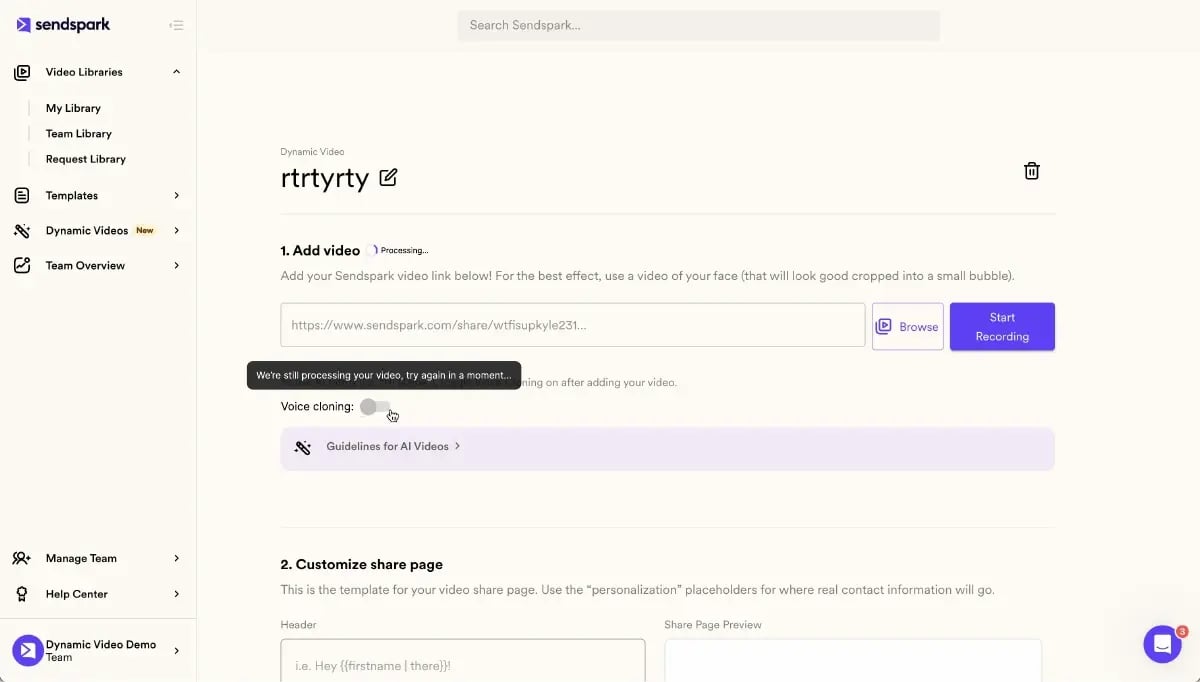
With a tool like Sendspark’s AI video personalization platform, you record one coaching video — say, a demonstration of how to handle the “we’re already working with a competitor” objection — and AI voice cloning generates a personalized version for each rep, addressing them by name and referencing their specific deals. Each rep gets a coaching video that feels 1:1, without you recording ten separate sessions.
This works especially well for asynchronous coaching: new hires who need to learn a specific skill before their next call, reps in different time zones, or reinforcing a framework between coaching sessions. Sales teams using async video coaching tools report saving 10+ hours per month while maintaining coaching quality.
Record One Video. AI Personalizes Thousands.
Sendspark is the AI video personalization platform for B2B sales. Record once, and AI voice cloning generates thousands of individually personalized videos with dynamic backgrounds and personalized thumbnails — each prospect hears their name, sees their website, in your voice. Sales teams see 2-3x more replies.
Get Started NowSales Coaching Technology: Tools That Scale Your Impact
Technology doesn’t replace sales leadership coaching — it makes your existing coaching more effective, more consistent, and more scalable. The right tech stack lets you spend less time on logistics (reviewing calls, scheduling, tracking) and more time on actual development conversations.
CRM-Based Coaching Workflows
Your CRM is already where your reps live. Tools like HubSpot and Salesforce let you build coaching workflows directly into deal stages. Flag deals for coaching review at specific pipeline stages. Log coaching notes and action items alongside deal activity. Track whether coaching commitments (e.g., “ask a budget question in the next discovery call”) are being executed.
The best coaching programs integrate directly with the CRM so coaching isn’t a separate administrative layer — it’s baked into how reps work every day.
Call Recording and AI Analysis
Conversation intelligence tools automatically record and transcribe calls, flag keywords (“pricing,” “competition,” “not interested”), and score calls against predefined criteria. Instead of listening to every call yourself, you get an automated first pass that surfaces the calls most worth reviewing.
This is particularly valuable for identifying coaching patterns at scale: which reps consistently get hit with the same objection, who uses filler words that undermine credibility, who talks more than they listen. For a full review of what’s available, see the best sales coaching tools for B2B teams.
AI Video for Async Coaching Delivery
Asynchronous coaching — delivering coaching content outside of a live session — is one of the highest-ROI activities a sales leader can add to their toolkit. Instead of explaining the same concept to each rep individually, you record it once and distribute it at scale.
“The things we’re learning about excellence suggest that it cannot be replicated by following a single prescribed process or by adopting a single prescribed mindset. Instead, excellence occurs when each person identifies their unique pattern of strengths and then figures out how to build on those strengths.”
— Marcus Buckingham & Ashley Goodall, Harvard Business Review, “The Feedback Fallacy”
This is where an AI video personalization platform becomes genuinely powerful for coaching. Sendspark’s video analytics show you exactly which reps watched your coaching video, how long they watched, and whether they clicked through to supporting resources — so you know who engaged and who needs a follow-up.
Coaching Technology Stack
| Tool Category | What It Does | When to Use It |
|---|---|---|
| CRM workflows | Logs coaching notes, flags deals for review, tracks action items | Ongoing — integrated with daily rep workflow |
| Call recording / AI analysis | Transcribes calls, scores performance, surfaces coaching moments | Weekly — review flagged calls before 1:1s |
| AI video personalization | Delivers personalized coaching video to each rep asynchronously | Between sessions — reinforce frameworks, cover new skills |
| Coaching scorecards | Standardizes skill evaluation, tracks progress over time | Weekly — use scores as the basis for 1:1 coaching conversations |
Common mistake
Don’t buy coaching tech before establishing a coaching cadence. Tools amplify what’s already working — if you don’t have weekly 1:1s happening consistently, no software will create that habit for you. Build the process first, then add tools to scale it.
Common Sales Leadership Coaching Mistakes to Avoid
Most sales leaders genuinely want to coach their teams. The mistakes aren’t about intent — they’re about execution habits that undermine even well-meaning coaching programs. Here are the five most common, and how to avoid them.
Mistake 1: Coaching Deals Instead of Skills
The most common coaching mistake: you sit down for a “coaching session,” spend 25 minutes reviewing pipeline status, and then the call ends. Deal reviews have their place — but they’re management, not coaching. Ask yourself after every session: “Did I develop a skill, or did I review a deal?” If it’s the latter every week, you’re managing, not coaching.
Mistake 2: Only Coaching Top Performers
High performers are easy to coach — they’re motivated, receptive, and show progress quickly. But the biggest win-rate gains come from moving middle-of-the-pack reps (50th-75th percentile) up one tier, not from marginal improvements to your top performers. Gartner research confirms that coaching focus on the middle tier produces the highest ROI per hour invested.
Mistake 3: Canceling 1:1s Under Pressure
When a big deal is at risk or a quarter-end crunch hits, coaching 1:1s are the first thing that gets canceled. The problem: the reps who most need coaching are often the ones tied to the struggling deals — so you’re canceling coaching precisely when it’s most needed. Pre-blocking and treating coaching sessions as non-negotiable is the only solution.
Mistake 4: Vague Feedback
“Be more confident.” “You need to push harder on the close.” These are not coaching — they’re impressions. Useful coaching feedback is specific and behavioral: “In the Acme call at 14:32, you said ‘Does that make sense?’ three times in 60 seconds. That’s a confidence signal that causes prospects to question your credibility. Let’s practice replacing that phrase.”
Mistake 5: No Follow-Up Loop
A coaching commitment with no follow-up is just a conversation. At the end of every coaching session, agree on one specific, measurable action the rep will take before your next session. Open every subsequent session by reviewing that commitment. Without this loop, the same issues resurface week after week because nothing changed between sessions.
Mistakes Summary
| Mistake | What Happens | What to Do Instead |
|---|---|---|
| Coaching deals, not skills | Sessions become status updates; skills don’t improve | Pick one skill per session; use deals only as coaching context |
| Only coaching top performers | Middle-tier reps plateau; ROI is low | Prioritize 50th-75th percentile reps — biggest win-rate gains |
| Canceling 1:1s | Coaching habits break; struggling reps fall further behind | Pre-block sessions; treat them as non-negotiable |
| Vague feedback | Reps don’t know what to change; same behaviors repeat | Use SBI: Situation + Behavior + Impact with specific timestamps |
| No follow-up loop | Commitments evaporate; same issues resurface weekly | Agree on one action per session; open the next session reviewing it |
Published July 2026
Frequently Asked Questions
What is sales leadership coaching?
Sales leadership coaching is the ongoing process where a sales manager develops their reps’ skills through structured conversations, behavioral feedback, and goal-setting — rather than simply telling them what to do. Unlike deal reviews or pipeline management, coaching focuses on improving the underlying skills (discovery, objection handling, closing) that drive long-term performance.
What is the GROW model in sales coaching?
GROW stands for Goal, Reality, Options, and Will/Way Forward. It’s a coaching framework where the manager asks questions at each stage to help the rep define what they want to achieve, understand their current situation, explore possible approaches, and commit to a specific action. GROW works best in weekly 1:1 sessions because it builds rep self-sufficiency rather than dependency on the manager’s answers.
How often should sales managers coach their reps?
Research consistently points to weekly coaching as the most effective frequency — specifically 30-minute structured 1:1s per rep. This should be supplemented with monthly group coaching sessions (60-90 minutes) and quarterly skill deep-dives. Teams that coach weekly see significantly higher win rates than those that coach monthly or quarterly.
What is the difference between sales coaching and sales training?
Training is an event — a one-time workshop, onboarding program, or skill course delivered to a group. Coaching is an ongoing relationship — regular 1:1 conversations focused on developing each individual’s specific skill gaps. Training transfers knowledge; coaching changes behavior. Both are necessary, but most B2B sales teams over-invest in training and under-invest in the coaching that reinforces it — the annual sales kickoff is the clearest example, and our guide to sales kickoff reinforcement covers how to fix it.
How do you measure the effectiveness of sales leadership coaching?
Track leading indicators (behavior change) and lagging indicators (business outcomes) separately. Leading indicators: coaching scorecard scores over time, call quality ratings, rep self-assessment scores. Lagging indicators: win rate by rep, ramp time for new hires, average deal size, pipeline stage conversion. Improvements in leading indicators should predict improvements in lagging indicators 60-90 days later.
What makes a good sales leadership coach?
Effective sales leadership coaches ask more questions than they answer, give specific behavioral feedback rather than vague impressions, maintain a consistent coaching cadence even under pipeline pressure, and follow up on coaching commitments session-to-session. The best coaches are genuinely curious about why reps think and act the way they do — not just focused on fixing the immediate deal.
How can sales managers coach remotely or asynchronously?
Remote coaching uses video calls for live 1:1s and AI video personalization tools for asynchronous delivery. With a platform like Sendspark, a sales leader can record one coaching walkthrough — demonstrating how to handle a specific objection — and AI voice cloning creates a personalized version for each rep. Reps watch it on their own time, and video analytics show the manager exactly who engaged with the content. This scales async coaching without losing the personalized feel of 1:1 development.
Sources & References
- RAIN Group — Sales Coaching Research — “Consistent coaching leads to 19% higher win rates” (ongoing research series)
- Harvard Business Review — “The Feedback Fallacy” — Buckingham & Goodall on excellence, coaching, and the limits of deficit-based feedback (2019)
- Salesforce — State of Sales Research — High-performing teams are 2.8x more likely to have managers spending 20%+ of time coaching
- Gartner — Sales Coaching Insights — Coaching the middle tier of reps produces the highest ROI per coaching hour invested
Record One Video. AI Personalizes Thousands.
Sendspark is the AI video personalization platform for B2B sales. Record once, and AI voice cloning generates thousands of individually personalized videos with dynamic backgrounds and personalized thumbnails — each prospect hears their name, sees their website, in your voice. Sales teams see 2-3x more replies.
Get Started Now