By 2026, every serious video tool has bolted on AI avatars, AI scripts, and AI voiceovers — making generic AI video a commodity overnight. The real dividing line in the synthesia vs vidyard debate is no longer who has avatars or who has analytics. It is which platform can generate thousands of individually personalized videos, each one speaking to a specific prospect by name, showing their company website, with a unique thumbnail — all from a single recording.
Key Takeaways
- Synthesia is built for AI avatar training and marketing videos — it does not offer per-prospect dynamic personalization or voice cloning of your own voice.
- Vidyard excels at one-to-one screen recordings and CRM analytics, but still requires one recording per send for truly personalized outreach.
- Sendspark is the only platform in this comparison that combines AI voice cloning, dynamic backgrounds, and personalized thumbnails to generate thousands of personalized videos from a single recording — resulting in 200–300% more email replies.
- Wistia is a marketing video hosting platform, not designed for outbound sales workflows or prospect-level personalization.
- For B2B sales teams running Clay enrichment workflows, Smartlead sequences, or intent-based outreach, Sendspark is the only option in this comparison with native integrations and dynamic variable video support.
How Sales Video Tools Changed in 2026
The clearest way to understand 2026’s AI video landscape is this: AI avatars and AI script generation are now table stakes, not differentiators. Every platform from Synthesia to Vidyard to a dozen challengers now offers some form of AI-generated talking head or auto-written email script. What actually separates winners from laggards is dynamic variable video — the ability to swap in prospect-specific data, visuals, and voice at the moment of send, across thousands of recipients simultaneously.
Two years ago, “personalized video” meant a rep recording a quick webcam clip with the prospect’s name on a whiteboard. That was one-to-one, manual, and unscalable past a handful of sends per day. Then AI avatars arrived and promised scale — but the personalization was still generic. An avatar says “Hi, I recorded this for you” to everyone. That is not personalization. That is the illusion of personalization, and buyers in 2026 can spot it in seconds.
The shift that actually matters is prospect-level personalization powered by agentic AI workflows. Sales teams are now connecting their video platforms directly to intent data, enrichment tools like Clay enrichment pipelines, and sequencing tools via Smartlead integration — so that when a prospect visits a pricing page, triggers a buying signal, or enters a sequence, a personalized video is generated and delivered automatically. These intent-based video triggers turn video from a manual effort into a scalable outbound motion. The concept of a generative video sequence — where each step of a cadence produces a unique, variable-driven video — is now a reality for teams using the right platform.
Voice is where the gap becomes most visible. Voice cloning at scale means a rep records their voice once, and the platform uses that clone to say each prospect’s first name, company name, or any other variable — in the rep’s actual voice — across every single video. Not a robot voice. Not a pre-built avatar voice. Your voice, saying their name. Combined with dynamic backgrounds that pull each prospect’s live website or LinkedIn profile into the video frame, the result is a video that feels hand-crafted even though it was generated in milliseconds.
Video deliverability has also emerged as a discipline in 2026, much like email deliverability was in 2022. Personalized thumbnails showing the prospect’s name or face drive dramatically higher click-through rates because they stand out in crowded inboxes. Generic video thumbnails — even with a smiling rep — have lost their novelty. The platforms that understand this build personalized thumbnails generation directly into their workflow. When you combine dynamic variable video, voice cloning at scale, personalized thumbnails, and agentic AI workflows that fire on intent signals, you have a fundamentally different category of tool than the screen recorder or avatar generator your team may be using today.
Quick Comparison: Synthesia vs Vidyard vs Sendspark vs Wistia
If you want a fast side-by-side, here is how the four platforms compare across the dimensions that matter most for B2B sales teams in 2026. Synthesia wins on avatar variety, Vidyard wins on basic recording workflows, Wistia wins on marketing hosting, and Sendspark is the only platform that delivers true prospect-level personalization at scale.
| Feature | Synthesia | Vidyard | Sendspark | Wistia |
|---|---|---|---|---|
| Best For | Training & marketing explainers | One-to-one sales recording | AI-personalized outbound at scale | Marketing video hosting |
| AI Personalization | Generic avatars only | AI script assist; no per-prospect variables | Dynamic variable video per prospect | None for sales outreach |
| Voice Cloning | No (pre-built avatar voices) | No | Yes — your voice, says each name | No |
| Dynamic Backgrounds | No | No | Yes — shows prospect’s website live | No |
| Personalized Thumbnails | No | Limited | Yes — auto-generated per recipient | No |
| CRM Integrations | Limited | HubSpot, Salesforce (strong) | HubSpot (5/5), Salesforce, Outreach, Salesloft, Apollo, Clay, Smartlead | HubSpot, Marketo (marketing focus) |
| Analytics | Basic view tracking | Engagement analytics, CRM sync | View, CTR, reply tracking per prospect | Deep marketing analytics |
| Starting Price | ~$30/mo | Free / Plus ~$19/mo | Solo $49/mo | Free tier available |
| G2 Rating | 4.7/5 | 4.5/5 | 4.8/5 (350+ reviews) | 4.6/5 |
Synthesia: AI Avatar Video Generator
Synthesia is the leading AI avatar video platform — it lets you create professional-looking videos with 230+ digital avatars across 140+ languages without ever turning on a camera. For internal training, product explainers, and localized marketing content, it is genuinely excellent, and it sits in the same AI-avatar category as HeyGen (see our HeyGen alternatives comparison for how the two stack up). But for B2B sales outreach that requires per-prospect personalization, Synthesia hits a hard ceiling.
Synthesia’s core strength is avatar variety and multilingual production. You type a script, choose an avatar, and render a polished video in minutes. This workflow is powerful for L&D teams creating onboarding modules or marketing teams producing localized content at scale. Plans start around $30 per month, which is competitive for what it does in the content creation space.
Where Synthesia falls short for sales teams is fundamental to its architecture. The platform does not clone your voice — it uses pre-built avatar voices. That means every prospect hears the same generic AI voice, not you. There is no mechanism to inject prospect-specific variables like a first name, company name, or domain into the video itself. There are no dynamic backgrounds that pull a prospect’s website. There are no personalized thumbnails per recipient. And critically, there are no native integrations with sales execution tools like Outreach, Salesloft, Apollo, or Smartlead.
If you are evaluating Synthesia as a video platform for b2b sales outreach specifically, you are looking at the wrong category of tool. Synthesia is an AI content production platform, not an AI video personalization platform. That distinction matters more in 2026 than it ever has.
Common mistake
Sales teams frequently purchase Synthesia thinking they can use AI avatars to “personalize at scale.” But because Synthesia uses pre-built avatar voices rather than your voice, and lacks per-prospect variable injection, the videos feel generic to recipients. Buyers in 2026 immediately recognize a Synthesia-style avatar as a mass broadcast, not a personal message — which can actually hurt reply rates compared to plain text.
Synthesia also lacks the sales workflow integrations that modern outbound teams depend on. You cannot trigger a Synthesia video send based on a prospect opening an email, visiting your pricing page, or hitting a Clay enrichment trigger. For sales teams building agentic AI workflows, this is a dealbreaker.
Synthesia is best for: L&D teams, HR departments, marketing teams creating training content, and companies that need multilingual video production without on-camera talent. It is a strong tool in its category — just not the right category for outbound sales personalization.
Vidyard: Sales Video With Static Recording
Vidyard is the most established name in sales video, built on a foundation of easy screen and webcam recording with strong CRM integrations. In 2025 and into 2026, Vidyard added AI script writing, AI avatars, and better analytics. For individual reps who record and send one video at a time, it works well. The limitation is that it still requires one recording per truly personalized send — making true scale impossible.
Vidyard’s recording workflow is genuinely smooth. Install the Chrome extension, hit record, share a link — your HubSpot or Salesforce rep has engagement data within minutes. The free tier is accessible, and plans scale from Plus at around $19 per month up to Pro at roughly $59 per month, with Business tiers above that. The AI script assist feature helps reps write better outreach scripts, which is useful. And the CRM integrations, particularly HubSpot and Salesforce, are deep and reliable.
The challenge surfaces when a sales team tries to operationalize video at scale. If a rep has 200 prospects in a sequence, they need to record 200 individual videos to deliver a genuinely personalized message to each person. AI script suggestions do not solve this — they speed up script writing, but the rep still has to record. Vidyard’s AI avatar feature helps produce templated video content, but it does not dynamically inject each prospect’s name in the rep’s voice, show their company website in the background, or generate a unique thumbnail for each recipient.
For more depth on how these two platforms compare in head-to-head workflows, see our detailed Sendspark vs Vidyard comparison for automated personalized video outreach. You can also explore our roundup of the best personalized video software for B2B sales to see how the category looks in 2026.
Vidyard is also not built for the agentic AI workflows that high-performing outbound teams are running in 2026. There is no native Clay enrichment integration, no Smartlead integration, and no intent-based video trigger system. The platform is designed around the rep-initiates-recording model, which is a fundamentally different paradigm than automated prospect-level personalization.
If your team values ease of one-to-one recording, solid CRM analytics, and a familiar workflow for individual reps, Vidyard is a reasonable choice. But if you are trying to run video personalization at the volume modern outbound motions demand, you will hit the ceiling quickly.
Vidyard is best for: Individual sales reps doing high-touch, low-volume outreach. SDR teams sending fewer than 20 personalized videos per day. Teams that prioritize basic recording simplicity over dynamic variable personalization. You can also compare Vidyard against other recording-first tools in our Loom vs Vidyard feature comparison.
Record One Video. AI Personalizes Thousands.
Sendspark is the AI video personalization platform for B2B sales. Record once, and AI voice cloning generates thousands of individually personalized videos with dynamic backgrounds and personalized thumbnails — each prospect hears their name, sees their website, in your voice. Sales teams see 2-3x more replies.
Get Started NowSendspark: AI Voice Cloning + Dynamic Backgrounds at Scale
Sendspark is the AI video personalization platform built specifically for B2B sales teams that need to send personalized video at scale without recording thousands of individual clips. You record one video, Sendspark’s AI clones your voice to say each prospect’s name and company, places their website in the background, and generates a unique thumbnail for each recipient — all automatically.
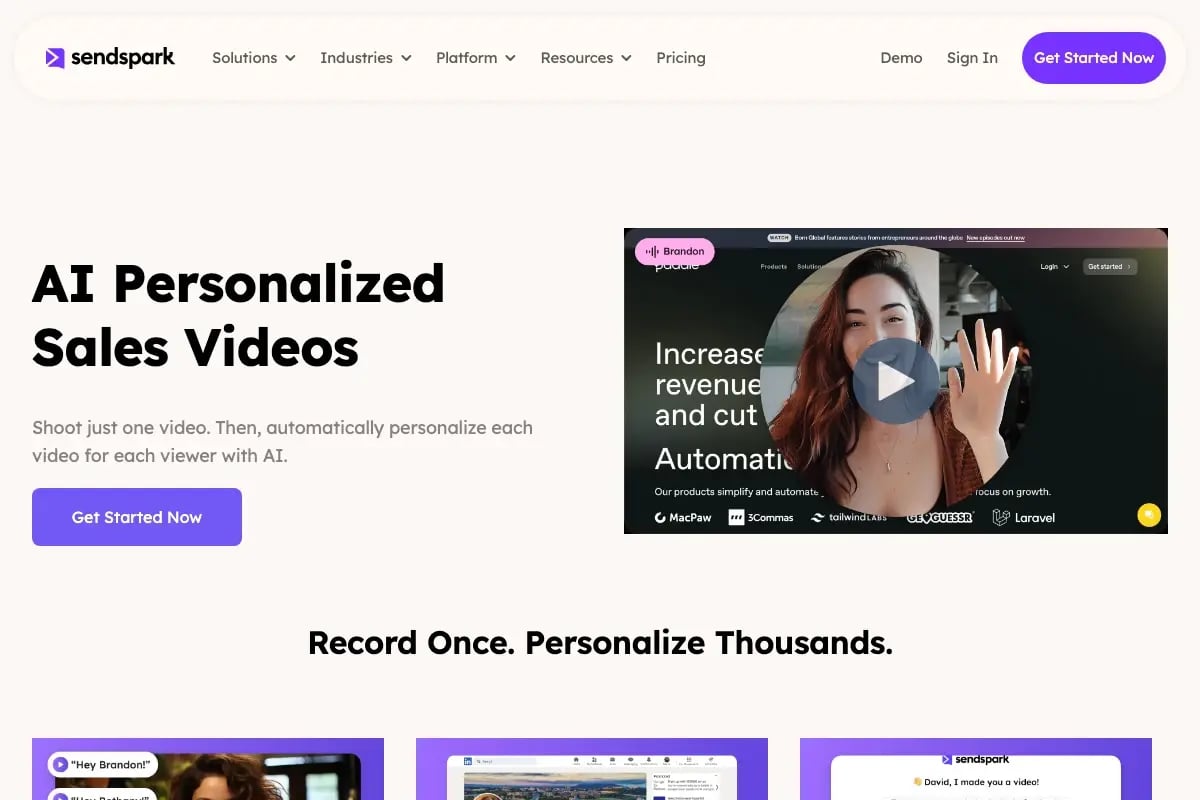
The core mechanism is what separates Sendspark from every other tool in this comparison. You record once. From that single recording, Sendspark generates thousands of unique videos. Each prospect hears their name spoken in your actual cloned voice. Each video shows that prospect’s company website as the background behind you. Each email lands with a personalized thumbnail that includes the prospect’s name or company branding — dramatically improving open-to-click rates in crowded inboxes. This is video personalization at a level no other platform in this comparison delivers.
The results are quantified and consistent across 50,000+ Sendspark campaigns. Teams report 200–300% increases in email response rates, a 50% lift in CTR, and 40–50% more meetings booked. The meeting-to-reply ratio runs at roughly 2:1 compared to plain text email, meaning nearly every reply converts to a meeting. These are outcomes that reflect a fundamental change in how prospects experience outreach — not an incremental improvement.
The AI Intros feature is the engine behind this. AI Intros uses your voice clone to generate a personalized introduction for each prospect, spliced seamlessly into your main recording. The transition is natural — not robotic or obviously automated. For prospects, the experience is receiving a video that sounds and looks like you recorded it just for them.
Sendspark’s integration stack is purpose-built for modern outbound workflows. The HubSpot integration is rated 5/5 and syncs video engagement data directly to contact records. The Outreach integration lets reps embed personalized video directly into sequences. Native connections to Clay enrichment pipelines, Smartlead, Apollo, Salesloft, and Salesforce mean your video personalization can fire as part of fully automated agentic AI workflows — triggered by intent signals, enrichment data, or sequence steps without manual rep intervention.
Pro tip
Connect Sendspark to your Clay enrichment workflow to trigger dynamic variable video personalization the moment a prospect hits a buying intent signal — a pricing page visit, a job change, or a funding round. This turns video from a manual rep activity into a fully automated, prospect-level signal-response system. Teams using this approach report the highest meeting-booking rates of any video outreach motion.
Pricing is structured for teams at every stage. The Solo plan starts at $49 per month. Growth is $99 per month. Team runs $299 per month, and Business is $699 per month. For a full breakdown, see the Sendspark pricing page. Compared to the cost of a rep recording individual videos for hours each day, the ROI on the Growth or Team plan is typically recovered within a single week of improved reply rates.
For teams specifically focused on prospecting motions, the sales prospecting solution page shows exactly how Sendspark fits into a cold outbound stack. You can also explore our guide to video prospecting tools for a broader view of how the category is evolving. For a deep dive into strategy, our comprehensive guide to AI video personalization for outbound sales covers the full playbook.
Sendspark is best for: B2B sales teams running outbound sequences at scale, SDR managers looking to multiply team output without adding headcount, and any revenue team already using Clay, Apollo, Outreach, or Smartlead who wants to add a proven video personalization layer to their existing stack.
Wistia: Marketing Video Hosting
Wistia is a polished marketing video hosting platform designed for brand-controlled content libraries, gated video channels, webinars, and audience analytics. It is an excellent tool for marketing teams. It is not built for outbound sales workflows, and it offers no per-prospect personalization capabilities at any tier.
Wistia’s strengths are real within its category. The player is clean, customizable, and brand-forward. The analytics suite gives marketing teams detailed view-through data, heatmaps, and lead capture forms embedded directly in video. The channel feature lets companies build Netflix-style content libraries for buyers in late-stage deals. For a marketing team hosting case studies, product demos, or webinar recordings, Wistia is a strong choice.
But if you search the Wistia feature set for anything resembling dynamic variable video, voice cloning, personalized thumbnails, intent-based triggers, or sales sequence integrations with tools like Outreach or Smartlead, you will come up empty. Wistia competes more directly with platforms like Vimeo Pro or Brightcove than it does with Sendspark or even Vidyard for outbound use cases. The vidyard vs wistia question comes up often, and the answer is straightforward: Wistia is for marketing content hosting, Vidyard is for sales recording workflows.
Wistia offers a free tier, with paid plans scaling through Plus, Pro, Advanced, and Premium tiers depending on video count and feature access. For marketing teams that need a reliable, brand-forward video host, it earns its price. For sales teams doing outbound, it is simply the wrong category of tool.
Wistia is best for: Marketing teams hosting content libraries, gated video assets, webinar recordings, and brand-controlled video channels. Not recommended for outbound sales or ai video personalization use cases.
Which AI Video Tool Wins for B2B Sales Outreach
For pure B2B sales outreach in 2026, the answer is Sendspark — and it is not close. The defining capability is prospect-level personalization at scale using dynamic variable video, AI voice cloning, and personalized thumbnails. No other platform in this comparison delivers all three. That said, each tool has a legitimate home, and the right choice depends on your specific use case.
| Use Case | Best Fit | Why |
|---|---|---|
| Outbound prospecting at scale (100+ videos/day) | Sendspark | Dynamic variable video + voice cloning — only option that scales without recording each video individually |
| High-touch one-to-one sales recording | Vidyard or Sendspark | Vidyard for pure recording simplicity; Sendspark for recording + AI personalization layer |
| Clay + Smartlead agentic AI workflow | Sendspark | Native integrations with both; only platform supporting intent-based video triggers |
| Training videos and L&D content | Synthesia | 230+ avatars, 140+ languages, no on-camera production required |
| Marketing video hosting and content library | Wistia | Best-in-class player, analytics, and channel features for marketing teams |
| Multilingual AI avatar marketing content | Synthesia | 140+ language support with consistent avatar quality across all |
| HubSpot-native video engagement tracking | Sendspark | 5/5-rated HubSpot integration with full per-prospect video engagement sync |
| Budget-constrained individual rep | Vidyard (free tier) | Free plan covers basic recording and sharing needs for low-volume outreach |
The bottom line: if you are a B2B sales team in 2026 and your outreach motion depends on video, the only platform in this comparison that delivers best ai video software capabilities for prospect-level personalization at scale is Sendspark. The other platforms are excellent in their own categories — they are simply not built for this specific job.
Frequently Asked Questions
What’s the difference between Synthesia, Vidyard, and Sendspark for B2B sales?
Synthesia is an AI avatar generator built for training and marketing content — it does not offer per-prospect personalization or voice cloning of your own voice. Vidyard is a screen and webcam recording platform with CRM analytics, best suited for one-to-one sales recording. Sendspark is the AI video personalization platform that lets you record one video and generate thousands of individually personalized versions using AI voice cloning, dynamic backgrounds, and personalized thumbnails — making it the only option in this group purpose-built for outbound sales at scale.
Which video platform offers AI voice cloning at scale?
Sendspark is the only platform in this comparison that offers true AI voice cloning at scale for sales outreach. You record your voice once, and Sendspark’s AI clones it to say each prospect’s name and company in your actual voice across every personalized video. Synthesia uses pre-built avatar voices and does not clone your voice. Vidyard does not offer voice cloning for per-prospect personalization.
Does Vidyard or Synthesia personalize videos for each prospect automatically?
Neither Vidyard nor Synthesia offers automatic per-prospect dynamic variable video personalization. Vidyard requires a separate recording for each truly personalized video. Synthesia generates AI avatar content but does not inject prospect-specific variables like names, company websites, or dynamic backgrounds at the individual recipient level. Sendspark is specifically built to automate prospect-level personalization from a single recording.
What is the best AI video tool for outbound sales in 2026?
For outbound sales in 2026, Sendspark is the best AI video tool by a significant margin. It is the only platform that combines AI voice cloning, dynamic variable video, dynamic backgrounds showing each prospect’s website, and personalized thumbnails — all generated automatically from one recording. Sales teams using Sendspark report 200–300% more email replies and 40–50% more meetings booked compared to text-only outreach.
How much do Synthesia, Vidyard, and Sendspark cost?
Synthesia plans start at approximately $30 per month. Vidyard offers a free tier, with paid plans from roughly $19 per month (Plus) to $59 per month (Pro) and higher Business tiers. Sendspark is priced at $49 per month (Solo), $99 per month (Growth), $299 per month (Team), and $699 per month (Business). Wistia has a free tier with paid plans scaling based on video count and features.
Can Synthesia or Vidyard show a prospect’s website in the video background?
No. Neither Synthesia nor Vidyard offers dynamic backgrounds that automatically display each prospect’s company website or LinkedIn profile behind the presenter. This capability is unique to Sendspark’s dynamic backgrounds feature, which pulls each prospect’s live website into the video frame as part of the AI-generated personalized video — creating a visually striking, highly relevant experience for each recipient.
Which AI video platform integrates best with HubSpot and Outreach?
Sendspark leads on both integrations. Its HubSpot integration is rated 5/5 and syncs per-prospect video engagement data directly to contact and deal records. Its native Outreach integration lets reps embed personalized videos directly into sequences. Vidyard also has strong HubSpot and Salesforce integrations for analytics. Synthesia has limited CRM integration built for sales execution workflows, and Wistia’s integrations are primarily oriented toward marketing automation platforms.
Sources & References
- Salesforce State of Sales Report — “Sales reps spend the majority of time on non-selling activities; personalized outreach at scale is the top productivity priority” (2026)
- HubSpot State of Marketing — “Video remains the highest-ROI content format for both marketing and sales teams; personalization drives the largest engagement lifts” (2026)
- Gartner Sales Insights — “AI-driven personalization in outbound sales is identified as the top technology investment priority for B2B revenue teams” (2026)
- G2 Video Platform Category Reviews — Independent user ratings and reviews for Sendspark (4.8/5, 350+ reviews), Synthesia (4.7/5), Vidyard (4.5/5), and Wistia (4.6/5) (2026)
- Gong Revenue Intelligence Blog — “Deals that include personalized video touchpoints in outbound sequences show consistently higher connect and conversion rates than text-only sequences” (2025)
Record One Video. AI Personalizes Thousands.
Sendspark is the AI video personalization platform for B2B sales. Record once, and AI voice cloning generates thousands of individually personalized videos with dynamic backgrounds and personalized thumbnails — each prospect hears their name, sees their website, in your voice. Sales teams see 2-3x more replies.
Get Started NowTopics: blog