The average B2B team takes 42 hours to respond to a new lead. The lead converts best in the first five minutes. That gap, not a lack of good leads, is where most pipeline quietly leaks out before a rep ever picks up the phone.
Speed to lead is the metric that measures this gap: the total time between a prospect raising their hand and a sales rep making first contact. Fix it, and you win deals your competitors never had a real shot at. Ignore it, and no amount of better copy, better targeting, or better discovery questions will make up the difference.
Key Takeaways
- The average B2B team takes 42 hours to respond to a new lead, and only about 7% respond inside the five-minute window that converts best (LeanData, Aloware).
- Harvard Business Review found that contacting a lead within an hour makes you roughly 7x more likely to qualify it than waiting even one more hour, and more than 60x more likely than waiting a day.
- Speed to lead is a system problem, not a motivation problem — the fix is routing, alerting, and automated first-touch, not asking reps to work faster.
- AI-personalized video can close the response gap without losing personalization: an agentic workflow can trigger a voice-cloned video the moment a lead comes in, before any rep is even free to pick up the phone.
- Response times have gotten worse since the original research on this, not better — one 2024 test of 1,000 B2B SaaS companies found 63.5% never responded to a test lead at all, up from 23% in 2011.
What Is Speed to Lead?
Speed to lead is the elapsed time between a prospect expressing interest, such as filling out a form, requesting a demo, or replying to an email, and a sales rep making first contact. The formula is simple: Lead Response Time = Lead Processing Time + Rep Response Time. Processing time is everything that happens before a lead reaches a human (routing, enrichment, scoring); rep response time is how long that human takes to act once it lands in front of them.
Most teams treat speed to lead as a vague aspiration (“respond quickly”). Treated as a metric with a formula, it becomes something you can instrument, assign an SLA to, and improve on purpose instead of hoping reps get to it between calls.
The two halves of the formula fail in different ways, which is why they need different fixes. Processing time breaks down when a lead sits in a shared inbox or a CRM view nobody checks, waiting for someone to notice it and claim it. Rep response time breaks down when the lead does get assigned, but the rep is on another call, in a meeting, or simply hasn’t refreshed their notifications. A system that only fixes one half still leaves the other half of the clock running.
| Response Time | Impact on Conversion | Source |
|---|---|---|
| Under 1 minute | 391% higher conversion rate vs. slower response | Velocify, via LeanData |
| Under 5 minutes | 100x more likely to connect than waiting 30 minutes | Forbes, via LeanData |
| Within 1 hour | ~7x more likely to qualify the lead than waiting one more hour | Harvard Business Review |
| After 24 hours | 60x less likely to qualify the lead at all | Harvard Business Review |
We built this comparison from published response-time research rather than a single vendor’s benchmark, because the pattern holds across every study we checked: conversion doesn’t decay gradually as response time slips. It falls off a cliff in the first hour, and keeps falling from there.
Why Speed to Lead Matters More in 2026, Not Less
Speed to lead matters more now because buyer expectations have kept rising while most teams’ actual response times have gotten worse, not better. The original 2011 Harvard Business Review study found that 23% of companies never responded to an inbound lead at all. A 2024 independent test of 1,000 B2B SaaS companies found that number had climbed to 63.5%.
That’s the opposite of what you’d expect. Every team now has a CRM, a marketing automation platform, and usually some kind of lead-routing tool. The infrastructure to respond fast has never been more available or more affordable. Yet according to LeanData’s 2026 speed-to-lead research, which cites a Blazeo benchmark study of 573 businesses, 74% of companies still miss the five-minute response window entirely, and of the companies that say a five-minute response is essential, only 62% actually deliver it.
Common mistake
Treating a slow average response time as a rep discipline problem. If your median is measured in hours, the fix almost never lives in a performance review — it lives in your routing, alerting, and first-touch automation.
The industry breakdown makes the gap even clearer. Aloware’s 2026 lead response time benchmarks found that only about 7% of B2B teams respond within five minutes, ranging from roughly 5% in fintech to 15% among RevOps tool vendors, and that fast responders convert roughly 9x better than the rest of the field. As Ruby Kootval, Head of Product Marketing at Aloware, puts it:
“A 42-hour median isn’t a motivation gap, it’s a coverage gap. You close it with automation in front of the rep, not pressure on the rep.”
— Ruby Kootval, Head of Product Marketing, Aloware
That’s the frame worth borrowing even if you never touch Aloware’s product: the gap closes with a system, not a pep talk. The lead qualification process you already run downstream only works on leads that are still warm when they reach it.
Record One Video. AI Personalizes Thousands.
Sendspark is the AI video personalization platform for B2B sales. Record once, and AI voice cloning generates thousands of individually personalized videos with dynamic backgrounds and personalized thumbnails — each prospect hears their name, sees their website, in your voice. Sales teams see 2-3x more replies.
Get Started NowThe 4 Levers That Actually Cut Response Time
Four things actually move speed to lead: routing rules that skip the queue, real-time alerts that reach a rep wherever they are, an automated first-touch that engages the lead before a human is free, and a clear SLA that makes the whole system accountable. Most teams have one or two of these. Few have all four working together.
| Lever | What It Fixes | Trade-off |
|---|---|---|
| Lead routing / SLAs | Removes the “whose lead is this” delay by assigning ownership instantly | Only as fast as the rep it routes to |
| Real-time alerting | Gets the notification to a rep the moment a lead lands, not at their next inbox check | Still depends on a human being available |
| AI chatbot / voice qualification | Engages instantly and qualifies before a rep even joins | Text-based interaction can feel generic and impersonal |
| AI-personalized video reply | Delivers a human-sounding, personalized first touch in minutes, at any volume | Needs a pre-recorded template and a connected trigger |
The first two levers are table stakes. Most modern CRMs and marketing automation platforms can route a lead and fire a Slack alert in seconds. What actually separates the fastest responders is the third and fourth lever: some form of automated first-touch that doesn’t wait on a human to be at their desk.
Advanced strategy
Chatbots solve speed but often sacrifice warmth. Sendspark’s Agentic Workflows can trigger the moment a form is submitted, automatically generating a Sendspark video that uses AI voice cloning to say the prospect’s name and shows their company’s own website as a dynamic background — a first touch that’s both instant and personalized, not one or the other.
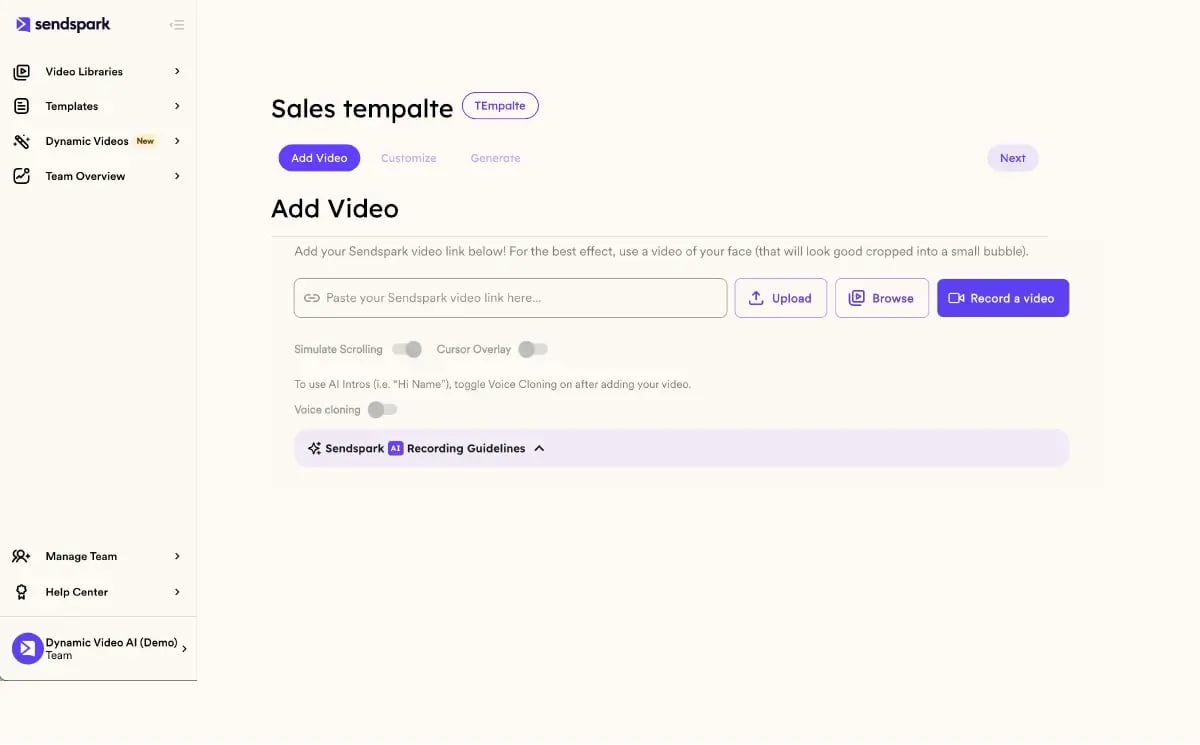
This is the piece most speed-to-lead playbooks miss: they treat “fast” and “personalized” as a trade-off you have to accept one way or the other. A form-triggered or CRM-triggered agentic workflow removes that trade-off for the first touch specifically, because the rep records the template once and the system does the personalizing and sending automatically, the moment a new lead comes in, whether that’s 9am or 9pm. Compare that to the AI SDR category, which mostly automates the outbound side of the funnel rather than the inbound response side speed to lead is concerned with.
Agentic Workflows are available starting on Sendspark’s Growth plan, which is the same tier that unlocks API access for teams who want to wire the trigger directly into a form handler or CRM webhook instead of a native integration. Check the full breakdown on the pricing page before committing a workflow to a specific plan tier, since the exact automation limits can change as your lead volume scales.
How to Build a Speed-to-Lead System in 5 Steps
Building a speed-to-lead system takes five steps: define your SLA target, instrument routing so ownership is instant, add real-time alerting for the rep on point, automate a first-touch response that doesn’t wait on human availability, and measure the full funnel so you know the system is actually holding under real volume. This applies just as much to a dedicated outbound prospecting motion as it does to inbound demo requests — the moment any prospect signals real interest, the same five-step logic applies.
- Define your SLA target first. Pick a number your team can actually hit consistently — five minutes for hot inbound demo requests, maybe 30 minutes for a lower-intent form fill — and write it down. An SLA nobody agreed to isn’t a system, it’s a hope.
- Instrument routing so ownership is instant. Round-robin, territory-based, or account-based routing all work; the point is that no lead sits in a shared queue waiting for someone to notice it.
- Add real-time alerting that reaches reps wherever they are. Email notifications get buried. Route hot-lead alerts to Slack, SMS, or a mobile push so a rep sees it inside the SLA window, not at their next inbox check.
- Automate the first touch so the SLA holds even when no rep is free. This is the step most teams skip, and it’s the one that actually protects your SLA on nights, weekends, and back-to-back-call afternoons. A chatbot, an instant call-back, or a personalized AI video reply can all fill this gap.
- Measure the whole funnel, not just response time. Track response time alongside qualification rate and close rate by response-time bracket. A system that responds fast but qualifies poorly isn’t actually working — it’s just fast.
Most CRMs, including HubSpot, support the routing and alerting steps natively. The gap is almost always step 4, and it’s the one worth solving with automation rather than another reminder to reps to “check the queue more often.”
Rolling this out in stages beats trying to fix all five at once. Start with the SLA and routing, since those changes are mostly configuration inside tools you already own. Layer in alerting once ownership is instant, so reps actually see the alert before the SLA clock runs out. Save the automated first-touch for last, once you know exactly which gap it needs to fill: after-hours coverage, weekend coverage, or overflow during a busy launch week are three different problems with three different fixes.
Speed-to-Lead Mistakes to Avoid
The most common speed-to-lead mistakes are optimizing for average response time instead of the worst case, automating the first touch with something generic enough that it reads as spam, and measuring speed without also measuring what happens to lead quality once you speed things up.
Pro tip
Track your 90th-percentile response time, not just your average. A team can have a great median response time and still lose deals because the leads that land at 6pm on a Friday wait until Monday morning.
| Mistake | Fix |
|---|---|
| Only tracking average response time | Track 90th-percentile response time so the worst cases are visible, not hidden behind a good average |
| Automating with a generic, unpersonalized first touch | Use a personalized channel (video, a named rep’s alert) instead of a template that reads as a bot |
| No coverage for after-hours or weekend leads | Automate the first touch for off-hours specifically, since that’s when human coverage naturally breaks down |
| Speeding up response without measuring lead quality | Pair response-time tracking with qualification and close-rate data by response bracket |
| Treating a slow SLA as a rep performance issue | Fix the routing and alerting system first; only address individual rep behavior once the system itself is fast |
Speed to lead is one piece of a larger video prospecting strategy, not a standalone tactic. If you’re building out the rest of your outbound motion alongside it, our comprehensive guide to video prospecting covers the parts of the funnel this article doesn’t: script structure, send cadence, and how video fits around the fast first response covered here.
Frequently Asked Questions
What is speed to lead in sales?
Speed to lead is the total elapsed time between a prospect expressing interest, such as submitting a form or requesting a demo, and a sales rep making first contact. It’s calculated as lead processing time plus rep response time, and it’s one of the strongest predictors of whether a lead converts at all.
What is a good speed-to-lead response time?
Under five minutes is the benchmark most research points to, since conversion and qualification rates drop sharply after that window. In practice, only about 7% of B2B teams actually hit five minutes, so even getting inside 30 minutes puts a team ahead of most competitors.
Why is lead response time getting worse instead of better?
More channels, more form fills, and more automated marketing have increased lead volume faster than most sales teams have scaled their response capacity. A 2024 test of 1,000 B2B SaaS companies found 63.5% never responded to a test lead at all, up from 23% in the original 2011 research.
Does speed to lead matter for outbound as well as inbound?
Speed to lead specifically measures the response to inbound interest, but the same logic applies to fast follow-up on any signal, including a reply to a cold email or a form fill from an outbound sequence. The faster a real signal gets a real response, the more likely it converts.
Can AI actually replace a human first response?
AI can’t replace a rep for the full sales conversation, but it can fill the gap before a rep is available. An AI-personalized video, an instant call-back, or a qualification chatbot can all engage a lead within the SLA window and hand off to a human once the lead is warmed and qualified.
How do you measure speed to lead?
Track the timestamp between lead creation and first rep contact for every lead, then report both the average and the 90th-percentile response time. Segment by lead source and time of day, since off-hours and weekend leads usually reveal the biggest gaps in an otherwise decent average.
What’s the difference between speed to lead and lead qualification?
Speed to lead measures how fast you respond; lead qualification measures whether that lead is worth pursuing once you’ve responded. A fast response to a poorly qualified lead wastes a rep’s time just as efficiently as a slow response to a great one — the two systems need to work together, not compete for priority.
Sources & References
- Harvard Business Review — “Firms that tried to contact potential customers within an hour of receiving a query were nearly seven times as likely to qualify the lead… and more than 60 times as likely as companies that waited 24 hours” (2011)
- LeanData — “A 2026 benchmark study by Blazeo across 573 businesses found that 74% miss the five-minute response window entirely” (2026)
- Digital Applied — “An independent test of 1,000 B2B SaaS companies found [the never-responded rate] had climbed to 63.5%,” up from 23% in the original 2011 research (2026)
- Aloware — “Only about 7% of B2B teams respond within five minutes… fast responders convert ~9x better” (2026)
Published September 2026
Record One Video. AI Personalizes Thousands.
Sendspark is the AI video personalization platform for B2B sales. Record once, and AI voice cloning generates thousands of individually personalized videos with dynamic backgrounds and personalized thumbnails — each prospect hears their name, sees their website, in your voice. Sales teams see 2-3x more replies.
Get Started Now