An AI SDR can research a thousand accounts, draft a thousand emails, and hit send before your coffee gets cold. What it can’t do is show up in a prospect’s inbox with a real voice saying their name. That gap between automated volume and human trust is the exact question a lot of B2B teams are quietly stuck on in 2026, as AI agents rewrite outbound prospecting: do you need an AI SDR platform, an AI video personalization tool, or both?
Published September 2026
Key Takeaways
- AI SDR platforms like 11x and Artisan automate researching, drafting, and sending outbound — but they run on text and LinkedIn messages, not a recorded human voice.
- In head-to-head tests, human reps still out-convert AI SDRs on meeting quality — 71% show rates vs. 52% for AI, according to Salesmotion.io.
- Sendspark’s Agentic Workflows plug into the same triggers AI SDR platforms use — a new lead, a CRM stage change, a website visit — to add a personalized video touch without replacing your existing stack.
- The strongest 2026 outbound motions pair an AI SDR (or an enrichment layer like Clay) for volume with AI video personalization for the moments that need a real voice to earn trust.
- Gartner projects 40% of enterprise apps will carry task-specific AI agents by the end of 2026 — the real question isn’t whether to add AI, it’s which part of your outbound motion it should touch first.
What Is an AI SDR, and How Is It Different From AI Video Personalization?
An AI SDR is a software agent that takes over the research-write-send loop of an outbound rep, deciding who to contact, drafting the message, and hitting send with no human touching the copy. AI video personalization is a different category entirely — it’s the asset a rep, or an AI SDR, sends once that gets sent. One replaces a job function. The other replaces a recording session.
Tools like 11x (Alice) and Artisan (Ava) are the clearest examples of the “digital worker” category — sold as fully autonomous agents that sit inside your CRM, pull account and contact data, write the outreach copy, and send it across email and LinkedIn without a rep approving each message. They’re built to replicate the cognitive work of a sales development rep, not to make a single message look better.
AI video personalization works the opposite way. A rep records one video one time. Sendspark’s AI video personalization then uses AI voice cloning to speak each prospect’s name in that rep’s own cloned voice, dynamic backgrounds to show the prospect’s actual company website or LinkedIn profile behind the speaker, and personalized thumbnails to boost open rates in the inbox. It doesn’t decide who to contact. It doesn’t write anything. It personalizes the one asset a rep or an AI SDR was already going to send.
That distinction matters more than it sounds. If you’re evaluating Sendspark as a replacement for an AI SDR, you’re comparing the wrong two things — Sendspark isn’t trying to do a rep’s research or writing. It’s trying to make the message that rep (human or AI) sends feel like it came from an actual person, which is exactly the job description of our own sales prospecting solution.
Record One Video. AI Personalizes Thousands.
Sendspark is the AI video personalization platform for B2B sales. Record once, and AI voice cloning generates thousands of individually personalized videos with dynamic backgrounds and personalized thumbnails — each prospect hears their name, sees their website, in your voice. Sales teams see 2-3x more replies.
Get Started NowAI SDR vs. AI Video Personalization: Quick Comparison
The clearest way to tell these tools apart is by what they automate and what channel they live in — AI SDR platforms automate the entire outbound motion over email and LinkedIn text, while AI video personalization automates one recorded asset across every channel you already use. We evaluated the tools below on what each one automates, its primary channel, whether it uses a real human voice, its published pricing, and its best-fit use case.
| Tool | What It Automates | Primary Channel | Real Human Voice? | Published Pricing |
|---|---|---|---|---|
| 11x (Alice) | Full SDR workflow — research, drafting, sending | Email, LinkedIn | No (optional voice add-on) | ~$5,000/mo (quote-only, reported) |
| Artisan (Ava) | Full SDR workflow — research, drafting, sending | Email, LinkedIn | No | $280-$600/mo self-serve; $2K-$5K+ enterprise |
| AiSDR | Email sequencing with AI-drafted personalization | No | $900-$2,500/mo | |
| Clay | Data enrichment and orchestration only — sends no email | None (infrastructure layer) | N/A | $167-$446/mo; full stack $1,700-$5,000/mo |
| Sendspark | Video personalization at scale from one recording | Video link/embed in any channel | Yes — AI voice cloning of the rep | $49-$699/mo by seat/video tier |
Clay is worth calling out separately because it gets lumped in with AI SDR platforms constantly and it isn’t one. Clay enriches contact and account data and orchestrates it into other tools — it has no send capability of its own. Teams typically pair a Clay integration with a separate sequencer like Instantly or Smartlead to actually deliver the message, which is exactly the same slot Sendspark plugs into.
Pro tip
Don’t compare a $280/month self-serve AI SDR agent against a $5,000/month enterprise “digital worker” and a data-enrichment layer that sends no email at all — they’re three different budget lines solving three different problems, even though they all get pitched as “AI for outbound.”
Where AI SDR Platforms Hit Their Limit
AI SDR platforms win on speed and cost, but they lose on conversion quality once a prospect actually replies. In head-to-head testing published by Salesmotion, human SDRs generated 2.6x more revenue than AI SDRs ($147K vs. $56K) and closed 71% of booked meetings into a show, compared to 52% for AI-run sequences. The AI gets more activity out the door. It doesn’t get more people in the room.
Trinity Nguyen, CMO of UserGems, points to a few specific failure modes: AI SDRs personalize shallowly — they can insert a first name or a company name, but they can’t reference something a rep actually noticed and reason about it the way a person would. That shows up as brand erosion, because prospects increasingly recognize fully AI-generated outreach and penalize it. It also shows up as a deliverability problem — AI SDRs send at a volume no human rep could sustain, and high-volume, low-engagement sending damages domain reputation over time.
“The Business Development team gets 80 to 90 percent of what they need in 15 minutes. That is a complete shift in how our reps work.”
— Andrew Giordano, VP of Global Commercial Operations, Analytic Partners (via Salesmotion)
That quote is the honest version of the AI SDR pitch: it gets the busywork out of a rep’s day, fast. It’s not a claim that the AI closes deals better than a person does — none of the data supports that.
Common mistake
Running every account through a fully autonomous, all-text AI SDR sequence with no human signal anywhere in it. Enterprise prospects are getting better at spotting AI-generated outreach every quarter, and they penalize it — a single touch that clearly comes from a real person can do more for reply rates than another thousand emails.
How to Combine AI SDR and AI Video Personalization in One Workflow
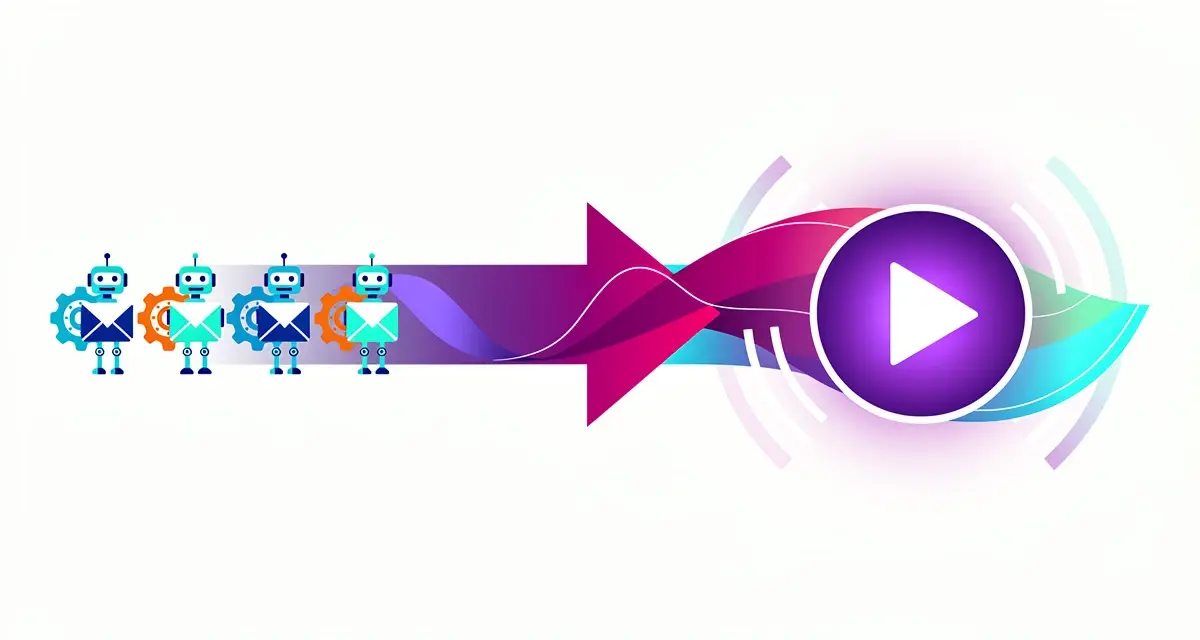
You don’t have to choose between an AI SDR platform and AI video personalization — the two connect through the same trigger-and-action pattern most B2B automation already runs on. A signal fires (a new lead, a CRM stage change, a website visit), and instead of only drafting a text email, that same signal can also generate a personalized video that gets dropped into the sequence your AI SDR or sequencer is already running.
Sendspark’s Agentic Workflows use exactly this pattern: every automation pairs one trigger with at least one action, and there’s no limit on how many actions you chain together. Triggers can be a form filled, a demo booked, a webpage visited, a lead status met, or a Sendspark event itself — New Video Generated, New Video CTA Clicked, or New Video Watched. Right now, the one Sendspark action is generating a dynamic video, which you then route into an email, a Gmail/Outlook send, or a campaign in Instantly or Smartlead.
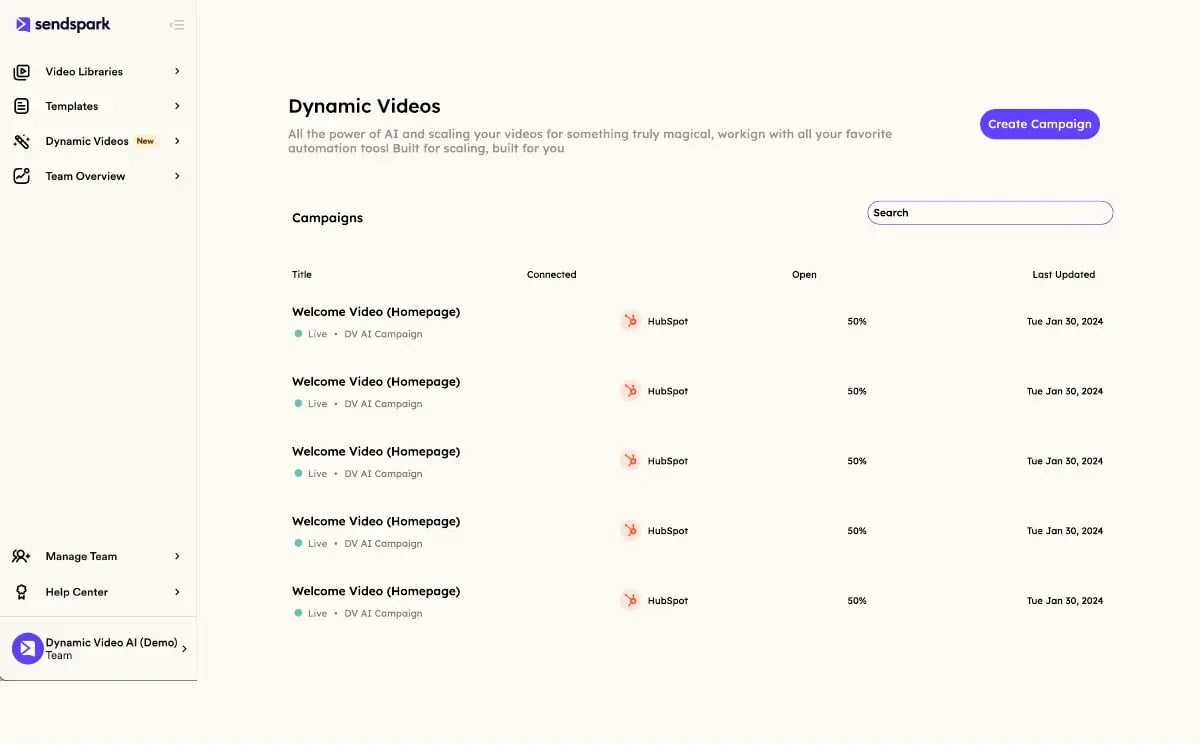
In practice, that gives you two integration patterns worth setting up:
- Pattern A — enrichment triggers the video. A Clay enrichment signal, or an anonymous-visitor identification tool like RB2B or Warmly, fires a Sendspark Agentic Workflow that generates a personalized video for that specific account. The video link then gets dropped into whatever your AI SDR or Apollo sequence sends next, instead of a plain text-only touch.
- Pattern B — video engagement triggers the follow-up. You flip the direction and use Sendspark’s own events as the trigger. When a prospect clicks the CTA in a video or watches it to the end, that fires a notification to the rep or a stage change in the CRM — a signal an AI SDR’s own logic can’t see, because it only reads email opens and replies, not video watch behavior.
Advanced strategy
Layer the stack instead of replacing a piece of it. Let an AI SDR or Clay handle the volume — the research, the list-building, the first few touches. Reserve the AI video personalization touch for the moment in the sequence where trust actually decides the outcome: the first email to a target account, or the reply to a prospect who’s gone quiet.
This is the same pattern already documented for CRM-triggered sends more broadly — see how it works end to end with a native CRM in our GoHighLevel Agentic Workflow walkthrough, which is one of the clearest worked examples of a trigger firing a personalized video automatically. It’s also the fastest way to reclaim rep hours instead of just tracking rep productivity metrics after the fact — for a deeper build-out of the full workflow, our video prospecting guide walks through setup end to end.
Do You Need an AI SDR, AI Video Personalization, or Both?
The right answer depends on your deal size and sales cycle, not on which tool has the flashier demo. High-volume, transactional SMB outbound with a standardized pitch is where an AI SDR earns its cost — it scales faster and cheaper than a person ever will. Complex, multi-stakeholder, higher-ACV B2B deals are where AI video personalization earns its cost — trust and differentiation decide those deals, and a recorded voice does more for that than another paragraph of text.
The economics back this up. UserGems puts a fully loaded human SDR at $75,000-$110,000 a year against an AI SDR platform at $15,000-$35,000, with payback in 3.2 months for the AI versus 8.7 months for the human hire — and separately notes that responding to a lead within one minute boosts conversion rates by 391%. Speed has real economic value. It just isn’t the same thing as trust, and it doesn’t show up in the same part of the funnel.
If you’re mapping out where to start, most teams considering this in 2026 land in one of three places:
| If your bottleneck is… | Start with… | Why |
|---|---|---|
| Not enough volume/activity | AI SDR platform (11x, Artisan, AiSDR) | Automates research, drafting, and sending at a scale no rep can match |
| Low reply/trust on the accounts that matter | AI video personalization (Sendspark) | A real cloned voice and the prospect’s own website behind you signals genuine effort |
| Both, at different stages of the funnel | Layered stack via Agentic Workflows | AI SDR/Clay handles volume; Sendspark handles the trust moment for target accounts |
Gartner projects that 40% of enterprise applications will carry task-specific AI agents by the end of 2026, up from less than 5% in 2025. The takeaway isn’t that you need to adopt every AI tool pitched to you this year — it’s that most B2B outbound stacks will soon run on some combination of an agent that handles volume and an asset that handles trust. Deciding which one to add first just depends on which side of that equation is actually holding your pipeline back.
Common mistake
Buying an AI SDR platform to fix a trust problem, or buying AI video personalization to fix a volume problem. Match the tool to the actual bottleneck — an AI SDR won’t make a cold, generic outreach motion feel more human, and AI video personalization won’t get you more activity against a target list that’s too small.
Frequently Asked Questions
What is an AI SDR?
An AI SDR is a software agent that automates the sales development rep’s core workflow: researching accounts, drafting outreach copy, and sending it across email and LinkedIn without a person approving each message. Platforms like 11x and Artisan sell this as a fully autonomous “digital worker” that replaces the repetitive parts of outbound prospecting.
Can an AI SDR record or personalize a video?
No major AI SDR platform records or personalizes video today — they’re built around text-based email and LinkedIn messaging. Some sequences embed a static video link inside the outreach, but generating a uniquely personalized video for each recipient is a separate category of tool, which is what AI video personalization platforms like Sendspark do instead.
Is Sendspark an AI SDR?
No. Sendspark is an AI video personalization platform, not an AI SDR. It doesn’t research accounts, decide who to contact, or write email copy — it takes one recorded video and uses AI voice cloning and dynamic backgrounds to personalize it for each recipient, whether that recipient came from a human rep’s list or an AI SDR’s.
Do AI SDR platforms and AI video personalization tools work together?
Yes. An enrichment or AI SDR signal can trigger a Sendspark Agentic Workflow to generate a personalized video, which then gets dropped into the same sequence the AI SDR or sequencer is already sending through tools like Instantly, Smartlead, or Apollo — adding a human-voice touch to an otherwise fully automated motion.
What’s the difference between an AI SDR and an AI BDR?
In practice, the terms are used almost interchangeably — both describe an AI agent that automates outbound prospecting tasks like research, message drafting, and sending. Some vendors use “BDR” to signal a broader focus that includes inbound qualification alongside outbound, but the underlying automation is the same.
How much do AI SDR platforms cost compared to AI video personalization?
AI SDR platforms range widely — Artisan runs $280-$600 a month self-serve up to $2,000-$5,000+ for enterprise, AiSDR runs $900-$2,500 a month, and 11x is reported around $5,000 a month on a quote-only basis. Sendspark’s AI video personalization plans start at $49 a month, since it’s personalizing one asset rather than running an entire autonomous outreach motion.
Will AI SDRs replace human sales reps in 2026?
Unlikely in complex B2B sales. Gartner projects 40% of enterprise apps will carry task-specific AI agents by the end of 2026, but head-to-head data still shows human reps converting booked meetings into pipeline at a higher rate than AI-run sequences. The realistic pattern is AI agents absorbing repetitive volume work while reps and AI-personalized touches handle the moments that need trust.
Sources & References
- Gartner Newsroom — “40% of enterprise applications will feature task-specific AI agents by the end of 2026, up from less than 5% in 2025” (2025)
- UserGems, “Are AI SDRs Worth It?” — “Human SDR costs $75,000-$110,000/year vs. AI SDR $15,000-$35,000/year; payback in 3.2 months for AI vs. 8.7 months for human hires; responding within one minute boosts conversion 391%” (2026)
- Salesmotion, “AI SDRs vs. Human SDRs” — “Human SDRs generated 2.6x more revenue ($147K vs. $56K) and achieved 71% meeting show rates vs. 52% for AI” (2026)
- DigitalApplied, “AI SDR Agents in 2026: The Realistic Buyer’s Guide” — named AI SDR platform landscape and pricing for 11x, Artisan, AiSDR, and Clay (2026)
Record One Video. AI Personalizes Thousands.
Sendspark is the AI video personalization platform for B2B sales. Record once, and AI voice cloning generates thousands of individually personalized videos with dynamic backgrounds and personalized thumbnails — each prospect hears their name, sees their website, in your voice. Sales teams see 2-3x more replies.
Get Started Now