
Send a video at exactly 10 a.m. on a Tuesday and it can still flop if the prospect isn’t in a buying moment. Send it thirty seconds after they revisit your pricing page and it can outperform every clock-based rule you’ve ever tested. That’s the real story behind timing for video outreach in 2026: the clock still matters, but the signal matters more.
This guide covers what the data actually says about weekday and time-of-day engagement windows, then goes further into how AI agents and real-time intent signals are replacing fixed send-time windows, and how to build a cadence that blends both. You’ll also see how Sendspark’s AI video personalization uses real-time engagement notifications to time follow-ups the moment a prospect is watching, not three days later on a schedule.
Updated August 2026
Key Takeaways
- Weekday engagement for video outreach still peaks in three windows – 9am-12pm, 12pm-2pm, and 3pm-6pm – with Tuesday through Thursday consistently outperforming Monday and Friday.
- Agentic AI systems can respond to a fresh signal in under 15 minutes, versus an industry-average manual response time of roughly 42 hours, and leads contacted within 5 minutes are about 21x more likely to qualify.
- Signal-triggered outreach, not calendar scheduling, is becoming the default: Salesforce’s 2026 State of Sales Report ties this shift to AI agents unifying real-time CRM and behavioral data.
- Localizing send times by recipient time zone can lift open rates by up to 50% on global video outreach campaigns.
- Sendspark’s video analytics notify reps the moment a prospect watches, turning every view into a real-time follow-up trigger instead of a scheduled check-in – a tactic that helped one customer post a 62% jump in open rates in two weeks.
What Is the Best Time to Send Video Outreach?
The best time to send video outreach is not a single hour on the clock. It is the moment a prospect shows intent. Fixed windows like Tuesday at 10 AM are a starting point, but the real answer is behavior-triggered timing. When someone visits your pricing page, opens a previous email, or gets a new job title, that is the best time to send. The clock matters less than the signal.
That said, weekday engagement windows still provide a useful baseline. Response rates for video outreach tend to peak during three daily windows: 9 AM to 12 PM, 12 PM to 2 PM, and 3 PM to 6 PM. Tuesday through Thursday are the strongest days overall. If you are building a scheduled cadence without real-time triggers, these windows are your safest bet. But they are a floor, not a ceiling, for modern outreach.
The key shift in 2026 is this: you no longer have to guess the right hour. AI tools can now detect when a prospect is most receptive and send your video the moment that window opens. The universal “best time” is being replaced by a personalized, signal-driven approach – also worth reading alongside our breakdown of the best time to send emails, which covers the general email-timing research this article builds on for video specifically.
How Human Behavior Shapes Video Engagement Throughout the Day
Human behavior drives when people actually watch and reply to video messages. Mid-morning, roughly 9 AM to 11 AM, is a strong window because people have cleared their inbox from the night before and are scanning for priority items. Early evening, around 4 PM to 6 PM, is another peak as professionals wrap up work and check less urgent messages.
Lunch breaks, particularly 12 PM to 2 PM, see a surprising amount of engagement. People scroll on their phones while eating, and video content is easy to consume in that context. This is especially true for shorter clips under 90 seconds. If your video is concise, the lunch hour can be a goldmine for views.
Pro tip
If you’re targeting the lunch window, keep the video under 90 seconds. Most people are scrolling on their phones between bites, and a long video is the first thing they’ll skip.
Day-of-week patterns also matter. Tuesday through Thursday remain the strongest days for response rates. Monday is typically a catch-up day where prospects are buried in weekend overflow. Friday sees a noticeable drop-off as people mentally check out for the weekend. However, Gen Z buyers are changing this pattern. They are more likely to engage outside traditional 9-to-5 hours, including evenings and weekends, because they are always on their devices. If your audience skews younger, rigid weekday windows may miss them entirely.
These behavioral patterns are real, but they are averages, not rules. The best approach is to use them as a default while letting real-time signals override the schedule. That is where AI becomes essential, and it’s the same logic behind our email cadence for B2B sales and sales cadence best practices guides.
Record One Video. AI Personalizes Thousands.
Sendspark is the AI video personalization platform for B2B sales. Record once, and AI voice cloning generates thousands of individually personalized videos with dynamic backgrounds and personalized thumbnails -- each prospect hears their name, sees their website, in your voice. Sales teams see 2-3x more replies.
Get Started NowWhy AI Agents and Real-Time Intent Signals Are Replacing Fixed Send-Time Windows
Fixed send-time windows are giving way to agentic AI and real-time intent-signal triggers. Instead of scheduling a video for Tuesday at 10 AM and hoping for the best, AI sales agents now watch for specific prospect behaviors and send outreach the moment intent is detected. This shift from calendar-based timing to signal-triggered outreach is one of the biggest changes in B2B sales cadence timing since the invention of the email sequence.
The speed-to-lead advantage is dramatic. Agentic AI systems can respond to inbound leads in under 15 minutes for the vast majority of cases. Compare that to the average B2B lead response time industry-wide, which sits at roughly 42 hours. A lead contacted within 5 minutes is approximately 21 times more likely to qualify than one contacted after 30 minutes, according to the MIT/InsideSales Lead Response Management study. When an AI agent watches for intent signals and triggers a personalized video within minutes, you are not just beating the clock; you are beating nearly every competitor still working off a calendar.
Salesforce’s 2026 State of Sales Report confirms this shift. AI agents are increasingly unifying CRM data, marketing automation, service history, and real-time behavioral data so sellers can act the moment a signal fires. These AI sales agents use intent data from sources like website visits, content downloads, and firmographic changes to calculate a propensity score for each prospect. When that score crosses a threshold, the system triggers a next-best-action recommendation, often a personalized video message sent immediately. This is real-time engagement at scale, and it is replacing the old “pick the right hour” mindset entirely.
The concept of buying-committee timing also plays a role. In complex B2B deals, multiple stakeholders need to be reached at different moments. An AI agent can monitor when each member of the buying committee shows intent and send individually timed videos that align with their specific behavior. The response-time SLA for each prospect becomes dynamic, tied to their actions rather than a static calendar slot.
This proactive approach matters even before a specific signal fires. RAIN Group’s sales prospecting research found that 82% of buyers accept meetings with sellers who reach out to them proactively – which means the real risk in 2026 isn’t reaching out at all, it’s reaching out at a moment that feels random instead of relevant.
This does not mean scheduled cadences are dead. It means they are the default, not the optimization. The real power comes from combining a well-structured cadence with real-time override triggers. When a prospect visits your pricing page, the AI should pause the scheduled sequence and send a behavior-triggered video immediately. That is signal-triggered outreach in practice, and it is the new standard for video prospecting timing.
Here’s what automating that hand-off between a sales engagement platform and AI video generation looks like in practice:
How Sendspark Uses AI to Time Personalized Video Outreach
Sendspark uses AI to remove the friction from timing personalized video outreach at scale. With AI voice cloning and personalization, a rep can record a single video and have the AI generate thousands of unique variants, each tailored to a specific prospect’s name, company, and industry. This means the timing decision is no longer bottlenecked by manual recording. The video is ready to send the moment a signal fires.
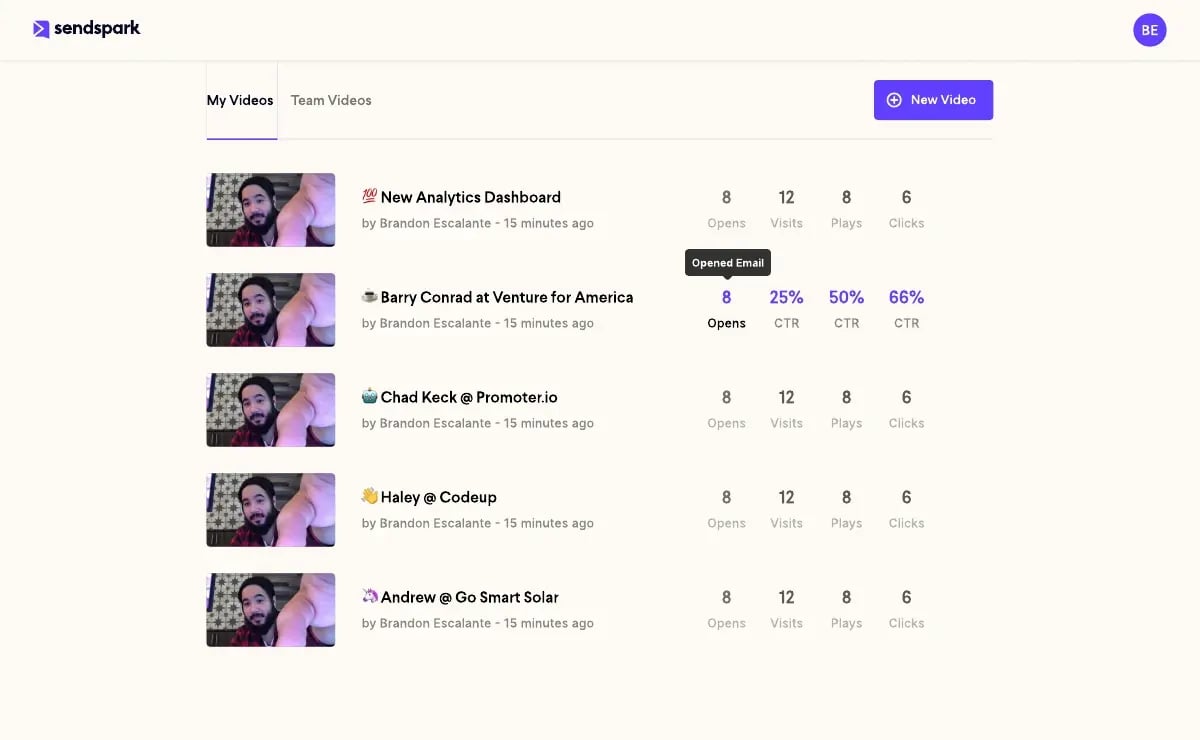
Sendspark’s video analytics also play a critical role in timing follow-ups. When a prospect opens or watches a video, the system notifies the rep in real time. This notification is itself a behavior-triggered signal. The rep can then send a follow-up video or email while the prospect is still engaged, rather than waiting for a scheduled check-in. This turns every view into a timing opportunity.
“The metric tracking capabilities help us understand not just what’s working, but why it’s working. We can now engage with more prospects at scale while actually increasing personalization.” — Victoria Loewenstern, Director of Sales Development, LivePerson, on implementing AI-powered outreach timing in November 2025
The results of well-timed, AI-personalized outreach show up in real customer data. In May 2025, ecommerce platform Brikl tested Sendspark’s AI-driven timing and personalization in its outbound campaigns. Led by Head of Operations Dan Vermont, the team combined personalized outreach with well-timed, CRM-triggered delivery. Within two weeks, Brikl’s sales team saw a 62% jump in email open rates and a 4x increase in reply rate – and their reps created personalized videos 40% faster by recording once and letting Sendspark’s AI handle the rest.
Sendspark also integrates with CRM and sales engagement platforms like Outreach, allowing AI agents to trigger video sends based on intent data. If a lead reaches a certain propensity score or visits a key page, the system can automatically generate and send a personalized video within minutes – the same real-time engagement pattern covered in our guide to AI video follow-ups for SDRs. This combines the scalability of AI with the precision of real-time timing, making it possible to hit the optimal send window for every prospect without manual effort.
Best Practices for Timing Your Video Outreach in 2026
The best practices below combine human behavior patterns with AI-driven, signal-based timing so your video outreach lands when a prospect is actually ready to engage, not just when your calendar says to send. Most of this applies whether you’re running video email straight in the inbox or a broader sales prospecting sequence across channels.
- Trigger on behavior, not the calendar. The single most effective timing strategy is to send a video immediately after a prospect takes a meaningful action: visiting your pricing page, downloading a case study, or getting a new job title. Use intent data and propensity scoring to automate these triggers – see our step-by-step video outreach scheduling process for the mechanics.
- Localize by recipient time zone. A video sent at your 10 AM might hit a West Coast prospect at 7 AM or a European buyer at 4 PM. Use send-time optimization tools to ensure each prospect receives your message during their own peak engagement window. Global optimization can boost open rates by up to 50%.
- Favor Tuesday through Thursday for scheduled sends. If you are running a standard cadence without real-time triggers, these three days consistently outperform Monday and Friday. Monday is for catch-up, Friday is for wind-down. Save your best video outreach for midweek.
- Watch for the 8th business day. Reply rates often spike around the 8th business day of a sequence, when persistence meets timing. Build your cadence to include a video touchpoint around that mark, and pair it with interest-based CTAs – a Gong Labs analysis of over 300,000 sales emails found interest-based CTAs get better reply rates than direct meeting-request CTAs.
- Combine scheduled cadence with real-time override triggers. Do not choose one approach over the other. Set a default cadence based on best windows, but program your AI to pause, skip, or reschedule sends when a prospect shows intent. The override should always win.
- Keep videos short for lunch-hour and mobile viewing. Since many prospects watch videos on their phones during breaks, keep your clips under 90 seconds. The shorter the video, the more likely it is to be watched in its entirety during a quick scan.
Common mistake
Treating the 9am-12pm / 12pm-2pm / 3pm-6pm windows as a strict rule instead of a fallback. If a prospect visits your pricing page at 4:45pm on a Friday, the AI-driven, signal-triggered send should win over the “best practice” schedule every time.
These practices reflect a simple truth: the best time to send is when the prospect is ready, not when your calendar says so. AI makes that possible at scale – and it pairs well with a video cadence that books meetings across calls, email, and video together.
Fixed Send-Time vs. Signal-Triggered AI Approach
| Dimension | Fixed Send-Time Approach | Signal-Triggered AI Approach |
|---|---|---|
| Trigger basis | Calendar slot (e.g., Tue 10 AM) | Real-time prospect behavior (pricing page visit, email open, role change) |
| Typical response lag | Hours to days (average 42 hours industry-wide) | Under 15 minutes for AI-driven sends |
| Personalization depth | Manual, one-to-one or basic merge fields | AI-generated, scalable, personalized to prospect name, company, and intent signal |
| Scalability | Limited by rep bandwidth and time zones | Unlimited; AI clones and personalizes one video into thousands of variants |
| Engagement optimization | Based on aggregate best windows (9-12, 12-2, 3-6, Tue-Thu) | Based on individual prospect’s real-time intent and behavioral data |
| Follow-up timing | Scheduled check-ins or manual review | Automatic notification and immediate follow-up when prospect watches video |
| Buying committee alignment | Same message, same time for all stakeholders | Individualized timing and message for each committee member based on their signals |
Frequently Asked Questions
What is the best time to send video outreach in 2026?
There’s no single universal hour anymore. The best time to send video outreach is the moment a prospect shows real intent – visiting your pricing page, opening a previous email, or changing roles – with the traditional 9am-12pm, 12pm-2pm, and 3pm-6pm windows serving only as a fallback baseline for scheduled cadences.
How does AI decide the best time to send a personalized video?
AI agents track behavioral and firmographic signals, including website visits, content downloads, email opens, and job changes, and calculate a propensity score for each prospect. When that score crosses a threshold, the system triggers a next-best-action recommendation, often a personalized video sent within minutes of the signal firing.
What is speed-to-lead and why does it matter for video outreach?
Speed-to-lead measures how quickly you respond after a prospect shows interest, and it’s one of the strongest predictors of whether that lead converts. Leads contacted within 5 minutes are roughly 21 times more likely to qualify than those contacted after 30 minutes, and agentic AI systems now respond in under 15 minutes compared to a 42-hour industry average for manual outreach.
Do intent signals change the best time to send a video?
Yes. A generic Tuesday-morning send might reach an inbox before the prospect is ready to engage, while a video triggered by an actual buying signal, such as a pricing-page visit or a new hire in a relevant role, arrives exactly when the prospect is already thinking about the problem you solve.
How should global, multi-time-zone campaigns handle video send timing?
Segment your list by recipient time zone rather than sending everyone at your own local best-time window. AI-driven send-time optimization that accounts for time zone differences has been shown to lift open rates by up to 50% on global outreach campaigns.
Does the day of the week affect video outreach response rates?
Yes. Tuesday through Thursday consistently outperform Monday and Friday for video outreach response rates. Monday is typically spent catching up from the weekend, and Friday sees a natural drop-off, so save higher-effort personalized sends for the midweek window when you’re running a scheduled cadence.
Can AI agents send video outreach automatically at the right moment?
Yes. Platforms like Sendspark combine AI voice cloning with real-time engagement data so a single recorded video can be personalized and sent automatically the instant a prospect’s behavior crosses a trigger threshold, without a rep manually deciding when to hit send.
Sources & References
- InsideSales / MIT Lead Response Management study — leads contacted within 5 minutes are ~21x more likely to qualify than those contacted after 30 minutes
- Salesforce’s State of Sales Report — AI agents unifying real-time CRM and behavioral signals (2026)
- RAIN Group Center for Sales Research — 82% of buyers accept meetings with sellers who proactively reach out (488 buyers, 489 sellers)
- LivePerson — Victoria Loewenstern on AI-powered outreach timing and metric tracking (November 2025)
- Gong Labs — analysis of 300,000+ sales emails on CTA framing and reply rates (2026)
Record One Video. AI Personalizes Thousands.
Sendspark is the AI video personalization platform for B2B sales. Record once, and AI voice cloning generates thousands of individually personalized videos with dynamic backgrounds and personalized thumbnails -- each prospect hears their name, sees their website, in your voice. Sales teams see 2-3x more replies.
Get Started NowTopics: blog